Want more images or videos?
Request additional images or videos from the seller
1 of 11
Japanese Skeleton Boxwood Netsuke Late Edo Period
$3,925.95List Price
About the Item
- Dimensions:Height: 2.56 in (6.5 cm)Width: 1.07 in (2.7 cm)Depth: 1.19 in (3 cm)
- Style:Edo (Of the Period)
- Materials and Techniques:
- Place of Origin:
- Period:
- Date of Manufacture:circa 1840
- Condition:Wear consistent with age and use.
- Seller Location:Newark, GB
- Reference Number:Seller: SSTDD1stDibs: LU6971231585092
About the Seller
5.0
Vetted Professional Seller
Every seller passes strict standards for authenticity and reliability
Established in 2019
1stDibs seller since 2022
40 sales on 1stDibs
Typical response time: 3 hours
Authenticity Guarantee
In the unlikely event there’s an issue with an item’s authenticity, contact us within 1 year for a full refund. DetailsMoney-Back Guarantee
If your item is not as described, is damaged in transit, or does not arrive, contact us within 7 days for a full refund. Details24-Hour Cancellation
You have a 24-hour grace period in which to reconsider your purchase, with no questions asked.Vetted Professional Sellers
Our world-class sellers must adhere to strict standards for service and quality, maintaining the integrity of our listings.Price-Match Guarantee
If you find that a seller listed the same item for a lower price elsewhere, we’ll match it.Trusted Global Delivery
Our best-in-class carrier network provides specialized shipping options worldwide, including custom delivery.You May Also Like
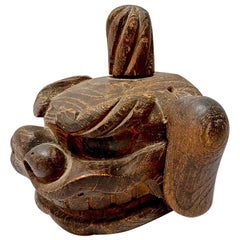
Noh Edo Period Lion Mask
Located in Pasadena, CA
This a well-preserved lion mask that dates to the 18th century (possibly earlier). Lion masks were used in the traditional Gion Matsuri festival lion dances...
Category
Antique Early 18th Century Japanese Edo Sculptures and Carvings
Materials
Wood
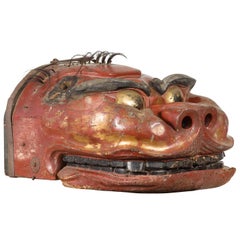
Japanese Edo Period Noh Theater Mask with Red, Black and Golden Patina
Located in Yonkers, NY
A Japanese Edo period "Noh" theater mask from the 17th to 19th century. Created in Japan during the Edo period (1603-1868), this mask captures our attention with its striking expression and contrasting colors. Noh, a form of theater involving music, dance and drama and originating in the 14th century, uses...
Category
Antique 19th Century Japanese Edo Sculptures and Carvings
Materials
Wood
$4,500
H 20.5 in W 17 in D 11.5 in
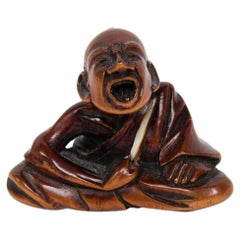
Japanese Professional sneezer Boxwood Netsuke
Located in PARIS, FR
Boxwood netsuke of a seated professional sneezer depicted as an old man with his right hand raised, holding an stick to tickle himself. His head is slightly raised, his eyes practica...
Category
Antique Late 18th Century Japanese Edo Sculptures and Carvings
Materials
Boxwood
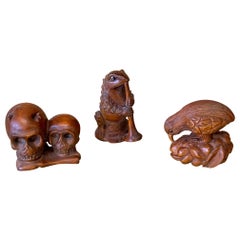
Set of Three Japanese Wood Netsukes
Located in Atlanta, GA
Set of three Japanese netsukes carved out of wood with a reddish stained finish, appear to be circa mid-20th century. One depicts a frog holding a trumpet; one a rooster eating grain...
Category
Mid-20th Century Japanese Japonisme Sculptures and Carvings
Materials
Wood
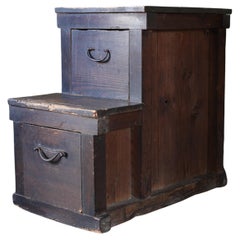
Japanese Antique "Staircase Chest"
Late Edo Period-Meiji Period
/Cabinet
Located in Sammu-shi, Chiba
We have an aesthetic sense peculiar to Japanese people.
And we introduce the unique items that only we can do, the route of purchasing in Japan, the experience value so far, and the way that no one can imitate.
Japanese antique black chest "staircase chest...
Category
Antique 19th Century Japanese Edo Furniture
Materials
Cedar
$800
H 22.64 in W 13.78 in D 23.63 in
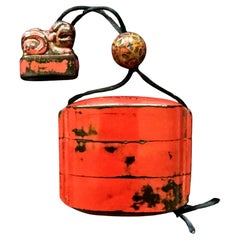
Rare Japanese Inro Netsuke and Omije with Negoro Red Lacquer Edo Period
Located in Atlanta, GA
A Japanese three-case inro with stringed carved netsuke and bead ojime from early Edo period circa 17th century. The trio accoutrement is covered in red Negoro lacquer and displays w...
Category
Antique 17th Century Japanese Edo Lacquer
Materials
Wood, Lacquer
$4,800
H 2.5 in W 2.8 in D 0.8 in
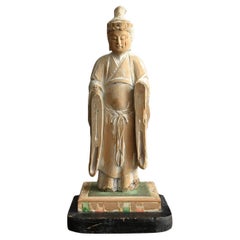
Wooden Buddha statues from the Edo period in Japan/1800-1868/Late Edo period
Located in Sammu-shi, Chiba
This wooden Buddhist statue was made in the late to late Edo period.
It is thought to be a statue of Kannon Bodhisattva.
It was originally placed in a shrine and was painted, but the...
Category
Antique 19th Century Japanese Edo Sculptures and Carvings
Materials
Cypress
$900
H 11.03 in W 5.12 in D 4.02 in
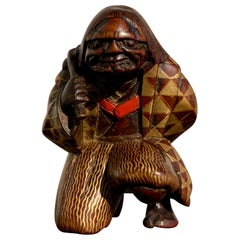
Carved Boxwood and Lacquer Netsuke of a Noh Dancer, Meiji Period, Japan
Located in Austin, TX
A fine lacquer decorated carved boxwood netsuke of a Noh dancer in a Hannya role, unsigned, Meiji period, late 19th century, Japan.
The boxwood netsuke finely carved as a kneeling Noh dancer dressed in striking geometric patterned robes. The actor holds an opened war fan behind their back in one hand, a Shinto wand slung over the shoulder in the other.
The war fan, tessen, decorated in red lacquer with a golden rising sun at the center. Tessen were sturdy fans used by samurai as protective devices, and sometimes as weapons.
The wand, called an onusa, is a traditional Shinto ritual implement comprised of folded paper streamers, shide, attached to a wooden wand, often used in purification rituals. Here, the shide are crafted from silver maki-e, with the handle of the natural boxwood.
The actor wears a fierce and unearthly hannya mask...
Category
Antique 1890s Japanese Meiji Sculptures and Carvings
Materials
Boxwood, Lacquer
$1,850
H 1.88 in W 1 in D 1.13 in
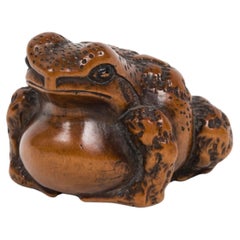
Japanese Netsuke of a croaking Toad in boxwood
Located in PARIS, FR
Netsuke of a wooden toad with its throat swollen. Made entirely in boxwood, the skin is treated with detail, the naturalistic pause suggests that the toad is croaking, the smooth tex...
Category
Antique Late 18th Century Japanese Sculptures and Carvings
Materials
Boxwood
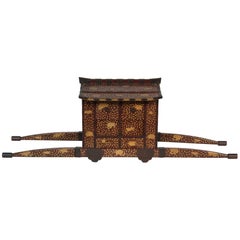
Japanese Edo-Meiji Period Lacquered Palanquin
Located in Stamford, CT
A Japanese Edo-Meiji period Palanquin chair for the childrens festival. The form with sliding and hinged doors, decorated in gold hiramaki-e with peonies ...
Category
Antique 1890s Japanese Edo More Asian Art, Objects and Furniture
Materials
Lacquer
More From This Seller
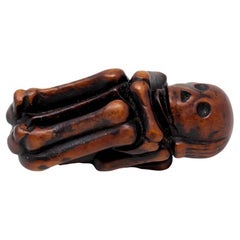
View AllJapanese Edo Period (1603-1868) Skeleton Foetus Netsuke
Located in Newark, England
Laying Foetus
From our Japanese collection, we are pleased to offer this Japanese Edo Period Skeleton Netsuke. The Skeleton Netsuke is carved from Boxwood depicting a skeleton in t...
Category
Antique Mid-19th Century Japanese Edo Sculptures and Carvings
Materials
Wood, Boxwood
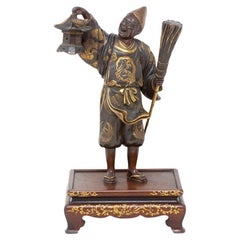
Japanese Bronze Figure by Miyao Eisuke, Meiji Period
By Eisuke Miyao 1
Located in Newark, England
FREE WORLDWIDE SHIPPING
A FINELY DETAILED JAPANESE BRONZE FIGURE BY MIYAO EISUKE, MEIJI PERIOD, CIRCA 1890.
From our Japanese collection, we a...
Category
Antique Late 19th Century Japanese Meiji Sculptures and Carvings
Materials
Bronze
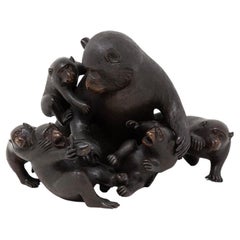
Japanese Meiji Period Bronze Monkey Group Sculpture Okimono Shosai
Located in Newark, England
Featuring Seven Japanese Macaques
Form our Japanese collection, we are delighted to offer this Japanese Bronze Monkey Group by Shosai. The Japanese Bronze Group displaying a male father monkey and his infants playing around and being mischievous with Persimmon fruit. The monkeys modelled as Japanese macaque monkeys (snow monkey). The bronze okimono is beautifully patinated with a highly lifelike and naturalistic casting signed to the underside Shosai 正齊鋳. The Bronze group dates to the Meiji Period (1868-1912) circa 1885.
Japanese macaque (snow monkey) is a terrestrial Old World monkey species that is native to Japan. They are known as snow monkeys because some live in areas where snow covers the ground for long periods each year hence their nickname. No other non-human primate lives further north or in a colder climate than the snow monkey. Individuals have brownish grey fur, pinkish-red faces, and short tails. Two subspecies are known and their conservation Status is of least concern. In Japan, the species is known as Nihonzaru ニホンザル, 日本 (Japan/Nihon) and saru 猿 (monkey) to distinguish it from other primates, but the Japanese macaque is the only species of monkey in Japan.
The Japanese macaque features heavily in the religion, folklore, and art of Japan, as well as in proverbs and idiomatic expressions in the Japanese language. They are often seen in paintings, block prints and represented in all manner of carvings from Okimono to netsuke. Many of these art forms reside in the world’s most famous museums and collections, some of the most prominent pieces by artists such as Mori Sosen and Kawanabe Kyosai. In Shinto belief (Japan’s indigenous religion/nature religion) legendary mythical beasts known as raiju sometimes appeared as monkeys and kept Raijin (the god of lightning/storms) company. In another well known tale the three wise monkeys who warn people to “see no evil, hear no evil and speak no evil” can be seen depicted in relief over the door of the famous Tosho-gu shrine in Nikko.
Meiji Period was an era of Japanese history that spanned from 1868 to 1912. It was the first half of the Empire of Japan, when the Japanese people began to build a paradigm of a modern, industrialised nation state and emergent great power, influenced by Western countries and aesthetics. As a result of radically different ideas, the changes to Japan were profound and it affected the social structure, politics, economy, military, and foreign relations across the board. The period corresponded to the reign of Emperor Meiji and was preceded by the Keio era and was succeeded by the Taisho era.
Cultural Art during the Meiji Period was of particular interest to the government and they overhauled the art export market which in turn promoted Japanese arts via various world’s fairs, beginning in Vienna at the world fair in 1873. The government heavily funded the fairs and took an active role organising how Japan’s culture was presented to the world including creating a semi-public company named Kiritsu Kosho Kaisha (First Industrial Manufacturing Company). The Kiritsu Kosho Kaisha was used to promote and commercialise exports of Japanese art and established the Hakurankai Jimukyoku (Exhibition Bureau) to maintain quality standards. For the 1876 Centennial International Exhibition in Philadelphia, the Japanese government created a Centennial Office and sent a special envoy to secure space for the 30,000 items that would be displayed. The Imperial Household also took an active interest in arts and crafts, commissioning works by select artists to be given as gifts for foreign dignitaries further emphasising the high quality and importance of Japanese art. Just before the end of the 19th century in 1890, the Teishitsu Gigeiin (Artist to the Imperial Household) system was created to recognise distinguished artists. These artists were selected for their exceptionally high quality wares and talent in their own industry. Over a period of 54 years Seventy artists were appointed, amongst these were ceramicist Makuzu Kozan and cloisonné enamel artist...
Category
Antique Late 19th Century Japanese Meiji Sculptures and Carvings
Materials
Bronze
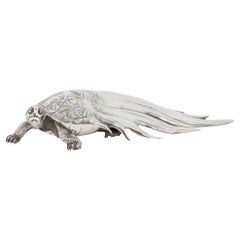
Japanese Antique Silvered Bronze Minogame by Ryūbundō Meiji Period
Located in Newark, England
FREE WORLDWIDE SHIPPING
LEGENDARY JAPANESE MINOGAME
From our Japanese collection, we’re pleased to offer this Meiji period silvered bronze minogame Okimono by Ryūbundō.
Cast in si...
Category
Antique Early 1900s Japanese Meiji Sculptures and Carvings
Materials
Silver, Bronze
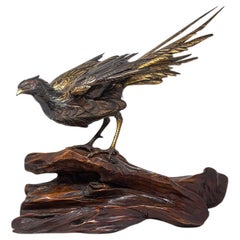
Japanese Bronze Pheasant Okimono Genryusai Seiya
Located in Newark, England
Unusual Casting of a Pheasant in Flight
From our Japanese collection, we are delighted to offer this Japanese bronze okimono of a Pheasant upon a naturalistic root wood base. The Ph...
Category
Antique Late 19th Century Japanese Meiji Sculptures and Carvings
Materials
Bronze
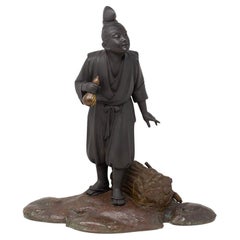
Japanese Bronze Okimono Sculpture by Yamamoto Kozan
Located in Newark, England
YOUNG MAN WOOD CUTTING
From our Japanese collection, we are pleased to offer this Japanese Bronze Okimono by Yamamoto Kozan. The Japanese Bronze Sculpture cast in Bronze with a natu...
Category
Early 20th Century Japanese Meiji Sculptures and Carvings
Materials
Bronze
Still Thinking About These?
All Recently ViewedMore Ways To Browse
Antique Bronze Ganesh
Chinese Dragon Statue
Vintage Japanese Hakata Dolls
Xian Warrior
Barong Mask
Bowenite Sculpture
Chinese Carved Ivory Emperor
Chinese Puzzle Ball
Crab Pot
Dragonfly Lantern
Jade Dragon Boat
Octopus Pottery
Ox Bone Sculptures
Phra Malai
Polychromed Wood Foo Dogs
Red Stone Carving China
Vintage Japanese Calendar
Wood Carving Salmon