Want more images or videos?
Request additional images or videos from the seller
1 of 9
Late 19th Century Small Bronze Vishnu Statue
Price:$175
About the Item
- Dimensions:Height: 4.25 in (10.8 cm)Width: 2.5 in (6.35 cm)Depth: 1.38 in (3.51 cm)
- Materials and Techniques:
- Place of Origin:
- Period:
- Date of Manufacture:Late 19th Century
- Condition:Wear consistent with age and use.
- Seller Location:Chapel Hill, NC
- Reference Number:Seller: WBR-247z1stDibs: LU6458228569812
About the Seller
4.9
Platinum Seller
Premium sellers with a 4.7+ rating and 24-hour response times
Established in 1930
1stDibs seller since 2022
383 sales on 1stDibs
Typical response time: 1 hour
Authenticity Guarantee
In the unlikely event there’s an issue with an item’s authenticity, contact us within 1 year for a full refund. DetailsMoney-Back Guarantee
If your item is not as described, is damaged in transit, or does not arrive, contact us within 7 days for a full refund. Details24-Hour Cancellation
You have a 24-hour grace period in which to reconsider your purchase, with no questions asked.Vetted Professional Sellers
Our world-class sellers must adhere to strict standards for service and quality, maintaining the integrity of our listings.Price-Match Guarantee
If you find that a seller listed the same item for a lower price elsewhere, we’ll match it.Trusted Global Delivery
Our best-in-class carrier network provides specialized shipping options worldwide, including custom delivery.You May Also Like
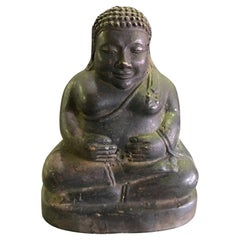
Seated Laughing Jolly Bronze Buddha Sculpture, 18th-19th Century
Located in Studio City, CA
A wonderful, gem of a piece. The piece has a beautiful feel and heft to it. The laughing or jolly Buddha is known in China as Budai or Putai, Bodai in Vie...
Category
Antique 19th Century Asian Sculptures and Carvings
Materials
Bronze
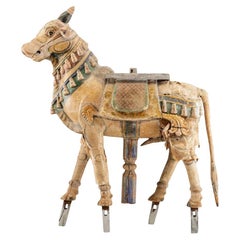
19th Century Hindu Nandi Temple Guardian, Architectural Ornament
Located in Forney, TX
A monumental Hindu Nandi temple gate-guardian architectural ornament, born in India, dating to the 19th century, hand carved and painted, richly detailed, polychrome decorated, the wooden sculpture depicting Nandi, a sacred bull, gatekeeper, and vahana religious deity figure.
Provenance:
Acquired from The Neiman Marcus Corporate Art Collection. Details below.
Dimensions: (approx)
49.5" x 43" x 12"
An important religious folk art work, the Nandi is of carved wood and gessoed cloth, then hand-painted. In Hindu religion, Nandi is the mythical mount of Shiva. The four legs represent truth, righteousness, peace and love.
More than a means of conveyance, Nandi is considered Shiva's constant companion on all his travels, so much so that in any temple dedicated to Shiva, there is a sculpture of Nandi. This symbol is a deity in its own right, and in India there are temples dedicated exclusively to Nandi.
In Hindu symbolism, the bull represents both strength and ignorance. The white or light color of the bull symbolizes purity and justice. Symbolically, the seated Nandi towards sanctum in Shiva temples, represents an individual jiva (soul) and the message that the jiva should always be focused on the Parameshwara. From the yogic perspective, Nandi is the mind dedicated to Shiva, the absolute. In other words, to understand and absorb light, the experience, and the wisdom is Nandi, which is the guru within. The fact that Shiva uses it as a mount symbolizes how this divine figure removes ignorance while instilling strength and wisdom.
A superb example, the life size work is in great overall shape, and presents wonderfully, having beautifully aged patina over the whole, highly desirable original, worn, rustic, naturally distressed, chippy paint, craquelure finish, that's delicate, and enhances the artistic antique character and rich historic depth.
Detailed Condition Report:
Fragile / delicate by design. Loss to one ear, age related checking and separation to carvings, fabric to hind quarters is released and tattered with minor loss, rubbing to paint throughout with wear indicative of age and use; later grey painted mounting blocks are attached to back and hooves.
White glove in-home shipping/delivery available.
Pickup available near Dallas, Texas
Additional Provenance:
Property from the Neiman Marcus Collection. Acquired from Heritage Auction, Design District Gallery, Dallas, Texas.
From The Dallas Morning Newspaper; April 12th, 2021
Neiman Marcus is selling some of its history and valuables that have been displayed and stored for decades as part of the luxury retailer’s corporate art collection.
The Neiman Marcus corporate art collection dates back to 1951, when Stanley Marcus (1905-2002), a life long avid art collector, purchased Mariposa, a large mobile by Alexander Calder and started a long tradition of buying original artwork for new stores as they opened. The Mariposa sold at a Sotheby’s auction last month fetching $18.2 million. The items are being offered through Sotheby's auction house, NYC, New York and Heritage Auction, Dallas, Texas.
Many of the pieces were personally collected by Stanley Marcus from the 1960s through the 1980s.
Some of the pieces are from corporate spaces, stores and the company’s archives, among the items are important antique textiles, tribal robes...
Category
Antique 19th Century Indian Folk Art Sculptures and Carvings
Materials
Gesso, Wood, Paint
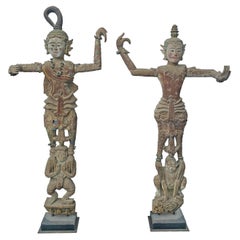
Burmese Wooden Teak Nat Statue Spirit Guardians Pair, Early 20th Century
Located in Jimbaran, Bali
These statues are adorned wood-carved Burmese Mandalay 'Nat' Spirits from the early 20th century. Nats were worshipped by the Burmese people, depicted as supernatural guardians they ...
Category
Early 20th Century Burmese Other Sculptures and Carvings
Materials
Wood, Teak
$8,060 / set
H 66.93 in W 31.5 in D 5.91 in
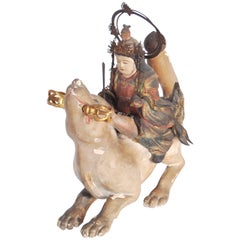
Antique Japanese Statue of Dakini Ten
Located in Prahran, Victoria
Rare and highly unusual antique Japanese statue of the esoteric deity 'Dakini Ten,' a Buddhist goddess who was associated with the agricultural...
Category
Antique 1770s Japanese Sculptures and Carvings
Materials
Gesso, Wood
$7,040 Sale Price
20% Off
Free Shipping
H 11.82 in W 9.45 in D 5.52 in
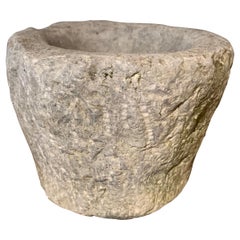
Small Primtive Mortar
Located in Vosselaar, BE
A small primitive mortar in hardstone. Probably Asian, 19h century.
Category
Antique Early 19th Century Asian Sculptures and Carvings
Materials
Stone
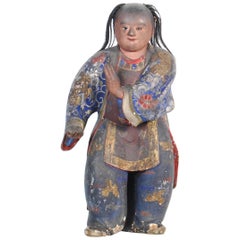
Rare Antique Statue of a Chinese Child Performing Tai Chi
Located in Prahran, Victoria
Rare Japanese antique statue of a Chinese child performing Tai chi capturing the pose in motion. Middle Edo period, circa 1750. Made from polychrome on carved ...
Category
Antique Mid-18th Century Japanese Edo Sculptures and Carvings
Materials
Cypress
$2,880 Sale Price
20% Off
H 23.63 in W 11.82 in D 7.88 in
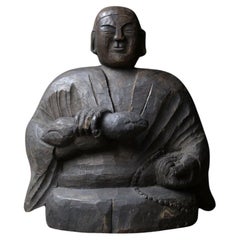
Antique Wooden Sculpture "Kobo Daishi" / Buddha Statues / Edo-Meiji Period
Located in Sammu-shi, Chiba
This is an old Japanese "Kobo Daishi" wooden figure.
"Kobo Daishi" means "Kukai".
"Kukai" was a monk from the early Heian period. His posthumous name was "Kobo Daishi". He is the fou...
Category
Antique 19th Century Japanese Edo Sculptures and Carvings
Materials
Cypress
$1,200
H 14.18 in W 10.63 in D 7.09 in
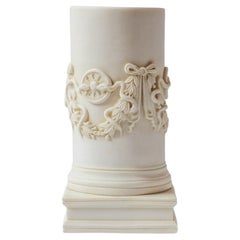
The Snaked Altar Column Statue Compressed Marble Powder Sculpture Bergama Museum
By LAGU
Located in İSTANBUL, TR
Weight: 8 kg
The Snaked Altar, situated atop a marble column at the entrance square of the Ancient City of Asclepion, holds the distinction of being recognized as the earliest symbol of medicine and pharmacy.
The altar's prominent position within the Asclepion complex highlights its importance in the context of ancient medical practices. It served as a visual representation of the profound connection between spirituality and healing, as Asclepius, the Greek god of medicine, was often depicted alongside snakes, which were regarded as symbols of rebirth and rejuvenation.
Today, the original Snaked Altar finds its rightful place of honor in the prestigious Bergama Museum. Visitors to the museum can marvel at its intricate details and appreciate the craftsmanship of the ancient artisans who sculpted it. The altar's preservation allows us to delve into the depths of history and gain insights into the ancient world's understanding and reverence for medicine.
*Crafted from compressed marble powder.
*Manufactured using molds...
Category
21st Century and Contemporary Turkish Classical Greek Sculptures and Car...
Materials
Statuary Marble
$388
H 11.23 in W 5.71 in D 5.71 in
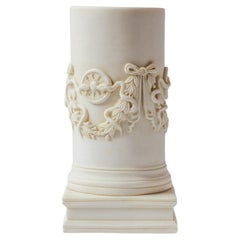
The Snaked Altar Column Statue Compressed Marble Powder Sculpture Bergama Museum
By LAGU
Located in İSTANBUL, TR
Weight: 8 kg
The Snaked Altar, situated atop a marble column at the entrance square of the Ancient City of Asclepion, holds the distinction of being recognized as the earliest symbol of medicine and pharmacy.
The altar's prominent position within the Asclepion complex highlights its importance in the context of ancient medical practices. It served as a visual representation of the profound connection between spirituality and healing, as Asclepius, the Greek god of medicine, was often depicted alongside snakes, which were regarded as symbols of rebirth and rejuvenation.
Today, the original Snaked Altar finds its rightful place of honor in the prestigious Bergama Museum. Visitors to the museum can marvel at its intricate details and appreciate the craftsmanship of the ancient artisans who sculpted it. The altar's preservation allows us to delve into the depths of history and gain insights into the ancient world's understanding and reverence for medicine.
*Crafted from compressed marble powder.
*Manufactured using molds...
Category
21st Century and Contemporary Turkish Classical Greek Sculptures and Car...
Materials
Statuary Marble
$388 / item
H 11.23 in W 5.71 in D 5.71 in
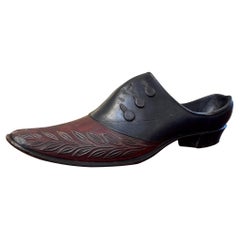
Late 19th Century Carved Shoe
Located in Charlottesville, VA
This is a great piece of carved folk art. Lots of character.
Category
Antique Late 19th Century Sculptures and Carvings
Materials
Wood, Paint
More From This Seller
View AllLate 19th Century Chinese Qingtian Stone (Soapstone) Carved Scholar
s Brush Rest
Located in Chapel Hill, NC
Late 19th century Qingtian stone (soapstone) carved scholar's brush rest, Chinese. A landscape carving depicting tea houses among pine trees by a lake with mountains behind. Contrast...
Category
Antique Late 19th Century Chinese Qing Sculptures and Carvings
Materials
Soapstone

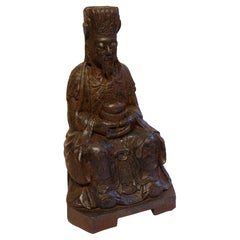
Mid-19th Century Chinese Cast Iron Seated Figure
Located in Chapel Hill, NC
Mid-19th century Chinese cast iron seated figure. Chinese seated figure in official robes
head-dress, an immortal in Taoism
mythology...
Category
Antique Mid-19th Century Chinese Qing Sculptures and Carvings
Materials
Iron
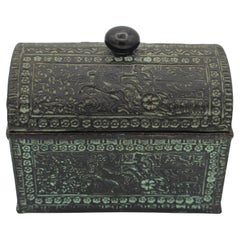
Late 19th Century Bronze Jewel Casket Box
Located in Chapel Hill, NC
Late 19th century bronze jewel casket box, Egyptian. A Grand Tour souvenir. A Pharoh drives his chariot across the larger panels. End panels are opposing sphinxes. Unmarked. 3.25" x ...
Category
Antique Late 19th Century Egyptian Egyptian Jewelry Boxes
Materials
Bronze
$220 Sale Price
20% Off
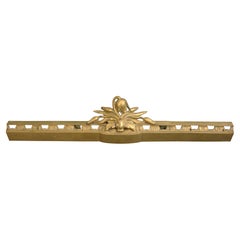
Mid-Late 19th Century French Bronze Chenet Rail
Located in Chapel Hill, NC
Mid-late 19th century bronze chenet rail, French. Rococo revival floral & leaf motifs. Ideal to decorate a bookshelf, hearth, etc.
30 7/8" w., 5 5/8" h., 2 3/8" d.
Category
Antique Late 19th Century French Rococo Revival Fireplaces and Mantels
Materials
Bronze
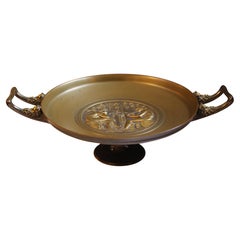
Late 19th Century Bronze Tazza Likely by Barbedienne
By F. Barbedienne Foundry, Ferdinand Levillain
Located in Chapel Hill, NC
Later 19th century large French bronze tazza with central medallion
handles. The central medallion sculpted by Ferdinand Levillain (1837-1905) of Menalcas
Mopsus from Vir...
Category
Antique Late 19th Century French Neoclassical Revival Decorative Bowls
Materials
Bronze
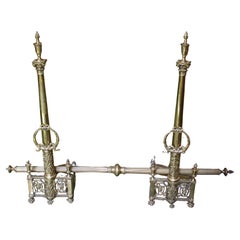
Late 19th Century Brass Andirons
Located in Chapel Hill, NC
A smartly styled pair of andirons, brass, late 19th century, Louis XVI style, torchieres with flame finials. 20" h., 8 1/2" d.
Whitehall Antiques is a family business that has been ...
Category
Antique Late 19th Century English Louis XVI Fireplace Tools and Chimney ...
Materials
Brass
$435 Sale Price / set
42% Off
Still Thinking About These?
All Recently ViewedMore Ways To Browse
Small Bronze Statues
Vishnu India
Vishnu Statue
Vishnu Bronze
Chinese Jade Sculpture
Unknown Buddha
Buddha Siam
Japanese Temple
Thai Buddhas
Carved Wood Buddha
Chinese Statue Statue
Large Asian Carved Wood Sculptures
18th Century Buddha
Asian Wood Carvings Red Wood
Tibet Art
Vintage Dragon Art
Japanes Lanterns
Asian Heads