Want more images or videos?
Request additional images or videos from the seller
1 of 21
Ming Dynasty Polychromed Clay
Stucco Head of Bodhisattva Guanyin
Price:$3,000
$5,950List Price
About the Item
- Dimensions:Height: 15.75 in (40.01 cm)Width: 8 in (20.32 cm)Depth: 9 in (22.86 cm)
- Style:Ming (Of the Period)
- Materials and Techniques:
- Place of Origin:
- Period:
- Date of Manufacture:18th Century or Older
- Condition:Wear consistent with age and use. Minor losses. Minor structural damages. Minor fading.
- Seller Location:West Palm Beach, FL
- Reference Number:Seller: 84421stDibs: LU2592326646292
About the Seller
5.0
Platinum Seller
Premium sellers with a 4.7+ rating and 24-hour response times
Established in 1996
1stDibs seller since 2017
1,480 sales on 1stDibs
Authenticity Guarantee
In the unlikely event there’s an issue with an item’s authenticity, contact us within 1 year for a full refund. DetailsMoney-Back Guarantee
If your item is not as described, is damaged in transit, or does not arrive, contact us within 7 days for a full refund. Details24-Hour Cancellation
You have a 24-hour grace period in which to reconsider your purchase, with no questions asked.Vetted Professional Sellers
Our world-class sellers must adhere to strict standards for service and quality, maintaining the integrity of our listings.Price-Match Guarantee
If you find that a seller listed the same item for a lower price elsewhere, we’ll match it.Trusted Global Delivery
Our best-in-class carrier network provides specialized shipping options worldwide, including custom delivery.You May Also Like
Chinese Carved Wood Bodhisattva Guanyin, Late Ming Dynasty, 17th Century
Located in Austin, TX
An attractive carved wood figure of the Bodhisattva Avalokiteshvara, known as Guanyin in China, late Ming Dynasty, early 17th century, China.
Guanyi...
Category
Antique Early 17th Century Chinese Ming Sculptures and Carvings
Materials
Gesso, Wood
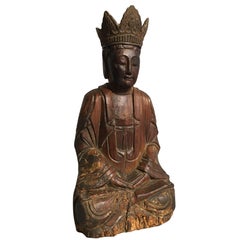
$4,200
H 14 in W 6.75 in D 5 in
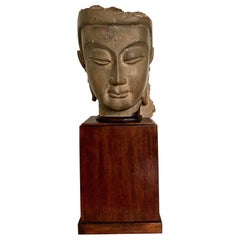
Fine Chinese Stucco Head of Bodhisattva Southern Dynasties
Located in Atlanta, GA
On offer is a fine Bodhisattva head made of stucco around a wood core circa 6th century AD. The fragment was part of high-relief wall sculpture based ...
Category
Antique 15th Century and Earlier Chinese Archaistic Sculptures and Carvings
Materials
Earthenware, Stucco, Petrified Wood
A large wood Buddha/Guanyin with traces of pigments Ming Dynasty (1368-1644)
By Master
Located in Vienna, AT
A LARGE WOOD FIGURE OF GUANYIN WITH TRACES OF PIGMENTS
MING DYNASTY (1368-1644)
The bodhisattva is shown seated in padmasana, wearing long flowing ro...
Category
Antique Mid-17th Century Chinese Ming Sculptures and Carvings
Materials
Hardwood
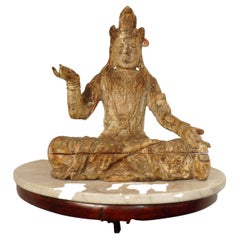
$9,539
H 23.63 in W 17.72 in D 9.85 in
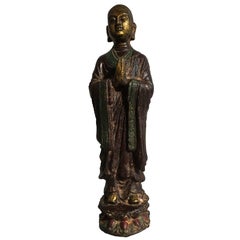
Ming Dynasty Polychrome Lacquer and Gilt Iron Figure of Ananda
Located in Austin, TX
Ananda is portrayed in a typical fashion, as a youthful monk with a shaved head and dressed in simple robes. He stands upon a double lotus pedestal with hands clasped in front of him...
Category
Antique 16th Century Chinese Ming Sculptures and Carvings
Materials
Iron
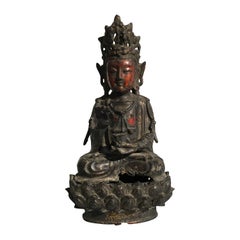
Chinese Ming Dynasty Lacquered and Gilt Bronze Bodhisattva, 17th Century
Located in Austin, TX
Chinese late Ming dynasty bronze figure of the Bodhisattva Avalokiteshvara, also known as Guanyin (Quan Yin, Kwan Yin, Kuan Yin), 17th century, China
The figure well cast in two ...
Category
Antique Mid-17th Century Chinese Ming Sculptures and Carvings
Materials
Bronze
$6,500
H 11.5 in W 6.25 in D 4.25 in
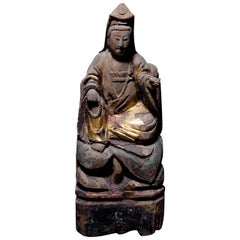
Lady Guanyin Bodhisattva Gilded Wood Carving - Ming Dynasty, China 1368-1644 AD
Located in San Pedro Garza Garcia, Nuevo Leon
Magnificent Lady Guanyin Bodhisattva seated in Royal Relaxation pose hand-carved in Gilded Wood with traces of paint still visible.
This expressi...
Category
Antique 15th Century and Earlier Chinese Ming Antiquities
Materials
Wood
$5,625
H 13 in W 5 in D 4.25 in
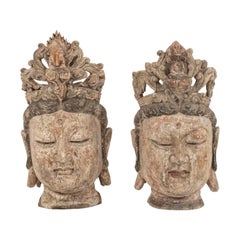
Pair Guanyin Bodhisattva Heads
Located in Houston, TX
Pair of 20th Century or earlier polychrome hand carved Guanyin Bodhisattva heads with glass eyes.
Category
20th Century Chinese Sculptures and Carvings
Materials
Wood
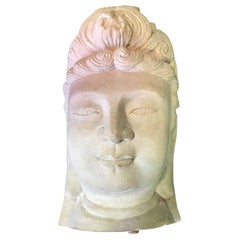
Large Carved Chinese Marble Bust Head of Guanyin Buddhist Bodhisattva Sculpture
Located in Studio City, CA
Beautiful marble Quan Yin. Very large and incredibly heavy (needs additional padding on the underside or a stand to help balance the bust so that it ca...
Category
20th Century Chinese Sculptures and Carvings
Materials
Marble
$995
H 17 in W 10.5 in D 8 in
Ming Period Stucco Head of a Court Lady with Original Paint Mounted on Stand
Located in Yonkers, NY
A Chinese Ming Dynasty period stucco head of a court lady from the 15th or 16th century, mounted on a wooden stand. Crafted in China during the Ming Dynasty, this stucco head is moun...
Category
Antique 16th Century Chinese Ming Sculptures and Carvings
Materials
Wood, Stucco
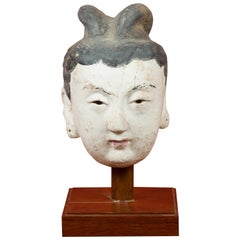
$4,500
H 12 in W 6 in D 6 in
Chinese Ming Dynasty Bronze Nanhai Guanyin, 16th/17th Century, China
Located in Austin, TX
A decidingly charming Chinese polychromed and gilt cast bronze figure of Nanhai Guanyin, Guanyin of the South Sea, Ming Dynasty, 16th/17th century, China.
Guanyin, the bodhisattva of compassion, is portrayed here as a beatific figure seated upon a raised lotus pedestal over waves. Guanyin is dressed in heavy robes, and wears an elaborate headdress. The small figure of Amitabha Buddha in the headdress positively identifies this figure as Guanyin.
Guanyin rests one hand in his lap, holding a cup of pure water said to be able to alleviate all suffering. His other hand is raised, holding a willow branch which is used to sprinkle the healing waters.
The two lotus blossoms to either side of Guanyin would originally have supported figures of the acolytes...
Category
Antique Early 1600s Chinese Ming Sculptures and Carvings
Materials
Bronze
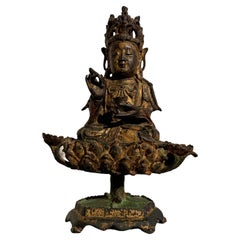
$9,800
H 13.25 in W 8.25 in D 5 in
More From This Seller
View AllPair of Chinese Export Hardstone Horses and Stands
Located in West Palm Beach, FL
Pair of Chinese export hardstone horses and stands, each one finely carved of a standing horse with one leg up, facing left and right. Removable from the associated lacquered stands....
Category
20th Century Chinese Chinese Export Sculptures and Carvings
Materials
Precious Stone, Lacquer
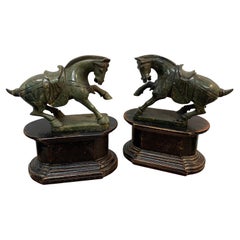
$1,516 Sale Price / set
20% Off
19th Chinese Carved Hardwood Figure of an Immortal Holding a Bat
Located in West Palm Beach, FL
This exquisite late 19th-century Chinese carved hardwood figure depicts an immortal holding a bat, symbolizing happiness and good fortune in Chinese culture. The workmanship is exemp...
Category
Antique Late 19th Century Chinese Chinese Export Sculptures and Carvings
Materials
Bone, Hardwood
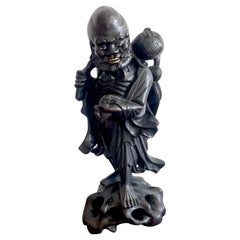
$1,036 Sale Price
20% Off
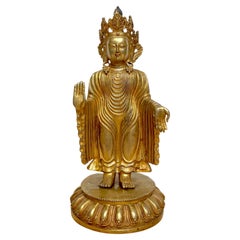
Tibetan Bronze Standing Gilt Bronze Buddha Offering Protection
Located in West Palm Beach, FL
Tibetan bronze standing gilt bronze buddha offering protection
China, 20th century
A fine example, the Buddha standing on lotus base with the "no fear" abhaya mudra, the figure is ...
Category
20th Century Chinese Chinese Export Sculptures and Carvings
Materials
Bronze
$1,000 Sale Price
20% Off
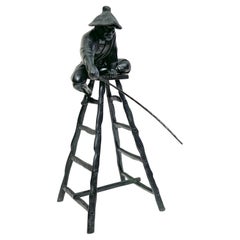
Meiji Bronze Fisherman Okimono, Sealed Masatsune Saku
Located in West Palm Beach, FL
Meiji Bronze Fisherman Okimono, Sealed Masatsune saku
Japan, Meiji period (1868–1912)
A fine and rare Meiji period bronze Okimono of a fisherman by Masatsune Saku, originating from Japan and crafted during the Meiji period (1868–1922). This exquisite piece is a notable example of the Tokyo School's artistry, dating to the late 19th century.
The Okimono depicts a fisherman seated on a four-rung ladder, holding a bamboo fishing rod...
Category
Antique Late 19th Century Japanese Meiji Sculptures and Carvings
Materials
Bronze
$2,360 Sale Price
27% Off
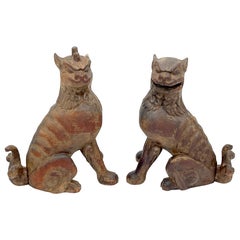
Pair of 19th C. Tibetan Carved Wood
Polychromed Foo/ Guardian /Temple Dogs
Located in West Palm Beach, FL
A unique and enchanting pair of 19th Century Tibetan carved wood & polychromed foo/guardian/temple dogs. These mythical Buddhist temple dogs, also known as "foo dogs" or "lion dogs,"...
Category
Antique 19th Century Tibetan Tibetan Sculptures and Carvings
Materials
Wood
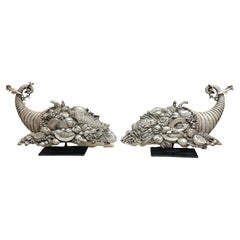
Pair of Continental Carved and Polychromed Wooden Cornucopias, 19th Century
Located in West Palm Beach, FL
Pair of Continental Carved and Polychromed Wooden Cornucopias, 19th Century
These finely carved and polychromed wooden cornucopias exemplify the enduring symbolic power of the horn of plenty in European decorative arts. Each composition is rendered in high relief, the ribbed horn issuing an abundant cascade of fruit and vegetables—pomegranates, grapes, melons, pumpkins, gourds, citrus, corn, and floral sprays—arranged with exuberant Baroque fullness. Now mounted on forged iron bases for display, the pair measures 20" high × 28" wide × 3.5" deep, including stands 12.5" x 6" (carvings alone 28" wide × 17" high × 3.5" deep).
The Cornucopia in History
Originating in antiquity, the cornucopia (Latin cornu copiae) was first associated with Amalthea, the goat who suckled the infant Zeus, whose horn became a miraculous source of nourishment. In Roman culture it was carried by deities of abundance—Fortuna, Abundantia, and Ceres—as an emblem of civic prosperity and the cycles of nature. Revived in the Renaissance and Baroque periods, the cornucopia became a favored motif in architecture, painting, and decorative arts, symbolizing divine blessing, seasonal plenty, and the wealth of the natural world.
Iconography of the Fruits and Vegetables
The profusion of produce is not merely decorative but encodes symbolic meanings rooted in both classical and Christian traditions:
Pomegranates—fertility, eternal life, and resurrection.
Grapes—festivity, vintage, and the Eucharistic blood of Christ.
Melons and Watermelon Slices—sensual abundance, refreshment, and ephemeral pleasure.
Pumpkins and Gourds—autumn harvest, transformation, and the cycles of plenty.
Corn (Maize)—sustenance and prosperity, reflecting New World influence on European symbolism.
Citrus Fruits—health, luxury, and Mediterranean prosperity.
Floral Sprays—seasonal beauty and the transience of life, underscoring vanitas themes common in still-life art.
This allegorical language aligns the carvings with the broader European tradition of abundance imagery found in still-life painting, silverwork, and architectural ornament.
Continental Style and Possible Origin
The sculptural density, dramatic overlapping of forms, and naturalistic rendering suggest a Continental origin, likely Austrian, German, or Italian, c. late 19th century. While Swedish decorative carving of the same era tends toward flatter surfaces and folk stylization, these examples embody a more theatrical Baroque and Rococo inheritance, later enhanced with a polychrome or silver-toned surface to heighten their decorative impact. Originally conceived as architectural appliqués...
Category
Antique 19th Century European Neoclassical Figurative Sculptures
Materials
Hardwood
Still Thinking About These?
All Recently ViewedMore Ways To Browse
Clay Sculpture Head
Crown Buddha
Crowned Buddha
Bodhisattva Chinese
Chinese Carving Polychrome
Chinese Polychrome Carved Wood
Chinese Wood Sculpture Ming
Wood Guanyin
Amitabha Buddha
Bodhisattva Wood
Chinese Wood Guanyin
Guanyin Carved Wood
Wood Sculpture Ming Dynasty
Ming Guanyin
Guanyin Head
Ming Dynasty 18th Century
Bronze Sculpture From Asia
Figural Carving Furniture