Want more images or videos?
Request additional images or videos from the seller
1 of 9
Pair of Large Chinese Guanyin Statues in the Manner of of James Mont
$4,250List Price
About the Item
- Similar to:James Mont (Designer)
- Dimensions:Height: 75 in (190.5 cm)Width: 20 in (50.8 cm)Depth: 18 in (45.72 cm)
- Sold As:Set of 2
- Materials and Techniques:
- Place of Origin:
- Period:
- Date of Manufacture:circa 1970
- Condition:Wear consistent with age and use. Age Cracks, Expected wear to Painted finish.
- Seller Location:Lambertville, NJ
- Reference Number:Seller: 10251stDibs: LU130826231233
About the Seller
4.9
Gold Seller
Premium sellers maintaining a 4.3+ rating and 24-hour response times
Established in 1985
1stDibs seller since 2015
1,062 sales on 1stDibs
Typical response time: 1 hour
Authenticity Guarantee
In the unlikely event there’s an issue with an item’s authenticity, contact us within 1 year for a full refund. DetailsMoney-Back Guarantee
If your item is not as described, is damaged in transit, or does not arrive, contact us within 7 days for a full refund. Details24-Hour Cancellation
You have a 24-hour grace period in which to reconsider your purchase, with no questions asked.Vetted Professional Sellers
Our world-class sellers must adhere to strict standards for service and quality, maintaining the integrity of our listings.Price-Match Guarantee
If you find that a seller listed the same item for a lower price elsewhere, we’ll match it.Trusted Global Delivery
Our best-in-class carrier network provides specialized shipping options worldwide, including custom delivery.You May Also Like
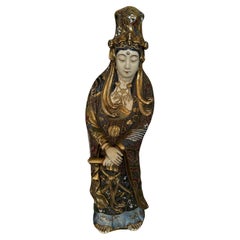
Large Japanese Satsuma Guanyin statue
Located in Chonburi, TH
Large 20th Century satsuma Guayin statue, in very good condition.
Category
20th Century Japanese Sculptures and Carvings
Materials
Porcelain
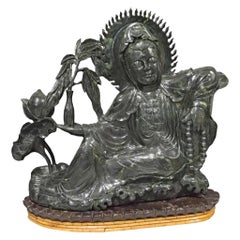
Massive Chinese Guanyin Statue in Jade-Like Green Hardstone
Located in Ottawa, Ontario
Massive 37 1/2"- inch high Chinese Guanyin statue in Green Jade-like hardstone
Late 20th century,
The reclining deity adorned with a crown emulating ...
Category
20th Century Chinese Chinese Export Figurative Sculptures
Materials
Other
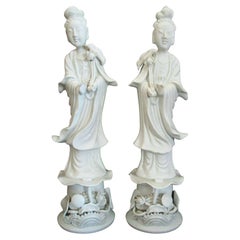
Vintage Pair of
Blanc De Chine
Porcelain Guanyin Statues, China, circa 1950
Located in Chatham, ON
Fine vintage pair of 'Blanc de Chine' porcelain Guanyin statues - each figure holding an applied flower and standing on a lotus leaf and decorative stan...
Category
Mid-20th Century Chinese Chinese Export Ceramics
Materials
Porcelain
$3,500 / set
H 13 in W 3.75 in D 3.5 in
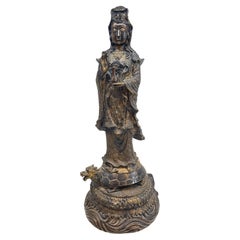
Large Chinese Original Bronze Figure of Guanyin
Located in Southall, GB
This large original bronze figure of Guanyin, depicting the bodhisattva with a sea dragon, is an exquisite example from the Qing dynasty, likely refl...
Category
Antique 19th Century Chinese Sculptures and Carvings
Materials
Bronze
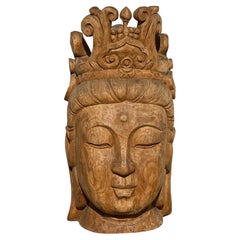
Large Zen Garden Shrine Head of Guanyin Buddha Statue
Located in San Juan Capistrano, CA
Large 20th century Chinese head of Guanyin. This piece is quite large and has been hand crafted by a skilled artisan from a single log. It measures 27 1/2” ...
Category
20th Century Chinese Qing Sculptures and Carvings
Materials
Wood
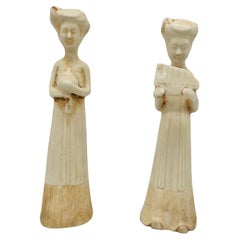
Pair of Chinese Terracotta Statues in the Tang Dynasty Style
Located in Atlanta, GA
This striking pair of Chinese terracotta mortuary statues, created in the Tang Dynasty style, reflects the ancient tradition of placing figurines in tombs to accompany the deceased i...
Category
20th Century Chinese Tang Sculptures and Carvings
Materials
Terracotta
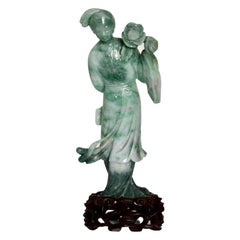
Jadeite Figure of Guanyin, Chinese
Located in West Palm Beach, FL
A Jadeite Figure of Guanyin, Chinese
Carved wearing long flowing robes, holding a flower, the lustrously polished stone with a long fissure ingeniously...
Category
20th Century Sculptures and Carvings
Materials
Jade
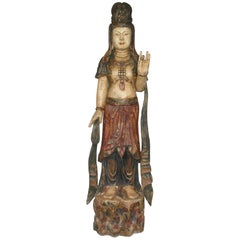
Chinese Carved Wood Standing Figure of Guanyin in the Ming Dynasty Style
Located in Ottawa, Ontario
A Chinese carved wood standing figure of Guanyin in the Ming dynasty style, with polychrome application, the hair tied back into an elaborate high chignon, with her left hand raised,...
Category
Early 20th Century Chinese Chinoiserie Sculptures and Carvings
Materials
Wood
$1,600
H 45 in W 13 in D 9.5 in
A Large Chinese Carved Wood Figure of Guanyin, Late Qing Dynasty
Located in ARMADALE, VIC
An impressive depiction of Guanyin, the Bodhisattva of compassion, whose name bears the meaning ‘One who hears the cries of the world.’ The rather androgynous figure is adorned with beaded jewellery and the princely regalia of a dhoti, draped across her body and spilling out over to partially obscure what she is resting upon. The goddess’ profile exhibits idealised features of Asian artistic convention; her face is soft and rounded, with full lips and relaxed eyes that provide a serene quality of youthfulness to the figure. Adhering to Chinese iconography of Guanyin, the figure is marked by an urna on her forehead, denoting her own enlightenment, as well as a diadem displaying Buddha Amitabha, the spiritual teacher of Guanyin. Seated in the Lalit asana pose, translated as ‘royal ease’, the figure exudes a fine example of the relaxed majesty typical in the characterisation of Guanyin. Whilst the figure’s left hand is placed restfully upon the left leg pendant, the right is raised in the gesture shuni mudra, the second finger held gently against the thumb. Otherwise known as the seal of patience, this gesture indicates the figure as one intended to bestow this virtue, along with compassion and understanding, upon the beholder.
Notes on the item:
Guanyin is the Chinese interpretation of Avalokiteshvara, the Indian Bodhisattva of compassion. The term “Bodhisattva” is derived from the Sanskrit “Bodhi”, meaning ‘awakening’ or ‘enlightenment’, combined with “Sattva”, meaning ‘spirit’ or ‘being’, referring to one on the path to achieving enlightenment. Bodhisattvas in Mayahana Buddhism are recognised as figures who have effectively achieved enlightenment yet relinquish their accension to nirvana in order to remain amongst mankind in the ultimate act of compassion to aid as spiritual guides. As such, the Bodhisattva inhabit a liminal space between samsara and nirvana; enlightened beings that maintain a relationship with humanity that buddhas cannot, as attaining Buddhahood necessitates the abandonment of all worldly attachments, including mankind. Guanyin’s very name, ‘One who hears the cries of the world’ highlights this role as a compassionate figure who acknowledges the suffering and strife of man. Along with Mahāsthāmaprāpta, a fellow bodhisattva, Guanyin serves as an attendant to Buddha Amitabha, with these three deities recognised as the Three Sages of Western Pure Land Buddhism, a sect of Mayahana Buddhism popular in East Asia.
Avalokiteshvara is commonly posited to have been adopted from Indian Buddhism into China as Guanyin around 200-400 CE, however it was the Tang dynasty (618-907) which saw the popularisation of the deity. By the Ming (1358–1644) and Qing (1644–1911) dynasties, Guanyin held the position as the most popular female deity in China. The unique state of religion in China held no monolithic canon regarding Buddhism and saw the assimilation of several belief systems, primarily Daoism, Buddhism and Confucianism. Consequently, Guanyin became a deity to be revered beyond Buddhism alone, appointed as both an official imperial deity and Daoist deity in the 12th century. Guanyin may also be seen to fulfil the role of idealised femininity as prescribed by Confucianism, with the scarcity of female Chinese deities perhaps accounting for the gradual gender shift Guanyin underwent.
The Indian Avalokiteshvara is unequivocally recognised as male, whilst the supposed gender of Guanyin remains contentious. Although there is a clear shift from the masculine Avalokiteshvara towards a more feminine representation, it is unclear if Guanyin is understood to be entirely feminine, to inhabit qualities of both genders or to be elevated beyond gender entirely, embodying neither. Depictions of Guanyin are highly androgynous, which some believe lends credence towards Guanyin symbolising the unity of dualistic forces as recognised in Daoism, displaying the anthropomorphism of yin and yang.
Comparative Analysis:
Market comparisons of similar Qing Dynasty polychrome figures of Guanyin include lot 767 (no.2) From Christies ‘Important Chinese Ceramics and Works of Art,’ New York, 25 March 2022, with the price realised USD 52,920 (Estimate USD 20,000 – USD 30,000). Christies also auctioned a comparable polychrome Guanyin...
Category
Antique Late 19th Century Chinese Qing Sculptures and Carvings
Materials
Hardwood
$28,500
H 57.09 in W 35.44 in D 25.6 in
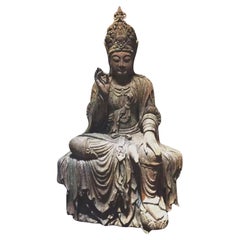
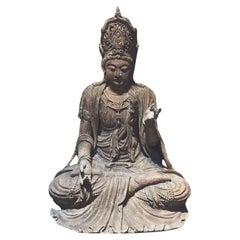
A Large Chinese Carved Wood Figure of Guanyin, Late Qing Dynasty
Located in ARMADALE, VIC
Description:
A singular example of Guanyin. Deviating from the Bodhisattva’s conventional pose of ‘royal ease’, the figure is instead seated in the meditative padmasana, or ‘lotus position’, rendering this Guanyin something of a rarity. An Apana more typically associated with depictions of Buddhas, Guanyin assuming this pose immediately signifies this figure as one of particular spiritual reverence. Both feet are revealed crossed upon one another from beneath fabric which spills before her, her left palm turned upward with her hand resting upon her left knee and her right raised in a relaxed gesture. Adorned with a diadem housing a depiction of Amitabha Buddha, her own spiritual guide, she exudes an air of tranquil regality, further characterised by her numerous strings of beads and elaborately fastened dhoti, attire traditionally reserved for Indian princes. Though the figure’s dress is Indian her face is undoubtedly exemplifying artistic Chinese beauty standards. Her face is soft and rounded, full in both the lips and cheeks, with eyes that restfully peer down, as though she is watching over the worries of mankind with compassion.
Notes on the item:
Guanyin is the Chinese interpretation of Avalokiteshvara, the Indian Bodhisattva of compassion. The term “Bodhisattva” is derived from the Sanskrit “Bodhi”, meaning ‘awakening’ or ‘enlightenment’, combined with “Sattva”, meaning ‘spirit’ or ‘being’, referring to one on the path to achieving enlightenment. Bodhisattvas in Mayahana Buddhism are recognised as figures who have effectively achieved enlightenment yet relinquish their accension to nirvana in order to remain amongst mankind in the ultimate act of compassion to aid as spiritual guides. As such, the Bodhisattva inhabit a liminal space between samsara and nirvana; enlightened beings that maintain a relationship with humanity that buddhas cannot, as attaining Buddhahood necessitates the abandonment of all worldly attachments, including mankind. Guanyin’s very name, ‘One who hears the cries of the world’ highlights this role as a compassionate figure who acknowledges the suffering and strife of man. Along with Mahāsthāmaprāpta, a fellow bodhisattva, Guanyin serves as an attendant to Buddha Amitabha, with these three deities recognised as the Three Sages of Western Pure Land Buddhism, a sect of Mayahana Buddhism popular in East Asia.
Avalokiteshvara is commonly posited to have been adopted from Indian Buddhism into China as Guanyin around 200-400 CE, however it was the Tang dynasty (618-907) which saw the popularisation of the deity. By the Ming (1358–1644) and Qing (1644–1911) dynasties, Guanyin held the position as the most popular female deity in China. The unique state of religion in China held no monolithic canon regarding Buddhism and saw the assimilation of several belief systems, primarily Daoism, Buddhism and Confucianism. Consequently, Guanyin became a deity to be revered beyond Buddhism alone, appointed as both an official imperial deity and Daoist deity in the 12th century. Guanyin may also be seen to fulfil the role of idealised femininity as prescribed by Confucianism, with the scarcity of female Chinese deities perhaps accounting for the gradual gender shift Guanyin underwent.
The Indian Avalokiteshvara is unequivocally recognised as male, whilst the supposed gender of Guanyin remains contentious. Although there is a clear shift from the masculine Avalokiteshvara towards a more feminine representation, it is unclear if Guanyin is understood to be entirely feminine, to inhabit qualities of both genders or to be elevated beyond gender entirely, embodying neither. Depictions of Guanyin are highly androgynous, which some believe lends credence towards Guanyin symbolising the unity of dualistic forces as recognised in Daoism, displaying the anthropomorphism of yin and yang.
Comparative Analysis:
Market comparisons of similar Qing Dynasty polychrome figures of Guanyin include lot 767 (no.2) From Christies ‘Important Chinese Ceramics and Works of Art,’ New York, 25 March 2022, with the price realised USD 52,920 (Estimate USD 20,000 – USD 30,000). Christies also auctioned a comparable polychrome Guanyin...
Category
Antique Late 19th Century Chinese Qing Sculptures and Carvings
Materials
Hardwood
$28,500
H 51.19 in W 35.44 in D 34.65 in
More From This Seller
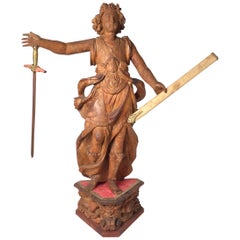
View AllExceptional 17th Century Carved Wooden Statue of Saint Micheal
Located in Lambertville, NJ
Exceptional 17th century carved wooden statue of Saint Micheal, European probably from a church or rectory. Naturally patinated and ori...
Category
Antique 17th Century European Baroque Sculptures and Carvings
Materials
Hardwood
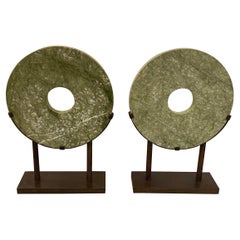
Impressive Pair of Round Hardstone Archaistic Sculptures
Located in Lambertville, NJ
A pair of large round hardstone or marble Chinese sculptures with custom aged steel bases. the stone circles are 24 dimeter and 1.05 inches deep, total measurement is 34.5 high, 24 w...
Category
Vintage 1970s Chinese Sculptures and Carvings
Materials
Marble, Steel
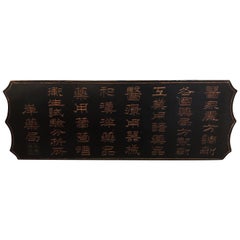
Antique Chinese Carved Wood Trade Sign
Located in Lambertville, NJ
Unique hand carved wood trade sign from China, 1890s. The sign with hand carved Chinese lettering with gilt highlights. The black background with a gilt border.
Category
Antique 1890s Chinese Chinese Export Sculptures and Carvings
Materials
Hardwood
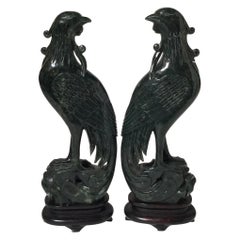
Pair of Hand Carved Spinach Jade Phoenix Bird Figures with Wood Stands
Located in Lambertville, NJ
A pair of lovely late 19th / early 20th century hand carved had phoenix bird sculptures with original custom wood bases. The spinach jade is a deep rich jade green without stands mea...
Category
Antique Early 1900s Chinese Sculptures and Carvings
Materials
Jade
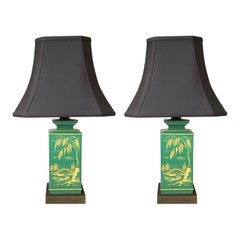
Mid-Century Pair Of James Mont Style Asian Motif Table Lamps
Located in Lambertville, NJ
A Pair of vibrantly colored yellow and green Asian motif table lamps. In the manner of James Mont, the bright green background with yellow chinoiserie decoration and pin stripping. ...
Category
Mid-20th Century American Hollywood Regency Table Lamps
Materials
Ceramic
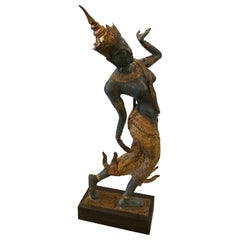
Antique Thai Bronze Sculpture of a Dancer
Located in Lambertville, NJ
An antique bronze figure of a Thai dancer. The patinated and gilt bronze surface, all original. In very good condition with original aged finish. The female dancer with traditional c...
Category
Early 20th Century Thai Sculptures and Carvings
Materials
Bronze
Still Thinking About These?
All Recently ViewedMore Ways To Browse
Rare Duck Decoys
Salvatore Riolo
Samurai Arrows
Samurai Horse Bell
Shinto Bell
Buddha Mask
Fluorite Carving
Vintage Bride Doll
Female Jade Sculpture
Bowenite Sculpture
Phra Malai
Vintage Japanese Calendar
Abhaya Mudra Sculpture
Japanese Antique Octopus Pot
Dancing Shiva Statue
Jade Temple
Antique Stone Hitching Post
Barong Mask