Items Similar to QING DYNASTY 20th Century Carved Tiger
s Eye Foo-Dog Censer With Cover Lid
Want more images or videos?
Request additional images or videos from the seller
1 of 9
QING DYNASTY 20th Century Carved Tiger
s Eye Foo-Dog Censer With Cover Lid
$1,048.60per set
$1,498per set30% Off
£792.62per set
£1,132.31per set30% Off
€909.17per set
€1,298.81per set30% Off
CA$1,461.79per set
CA$2,088.27per set30% Off
A$1,591.28per set
A$2,273.26per set30% Off
CHF 844.65per set
CHF 1,206.65per set30% Off
MX$19,146.52per set
MX$27,352.16per set30% Off
NOK 10,702.89per set
NOK 15,289.84per set30% Off
SEK 9,806.87per set
SEK 14,009.81per set30% Off
DKK 6,789.61per set
DKK 9,699.45per set30% Off
About the Item
An early 20th century censer from the Qing Dynasty.
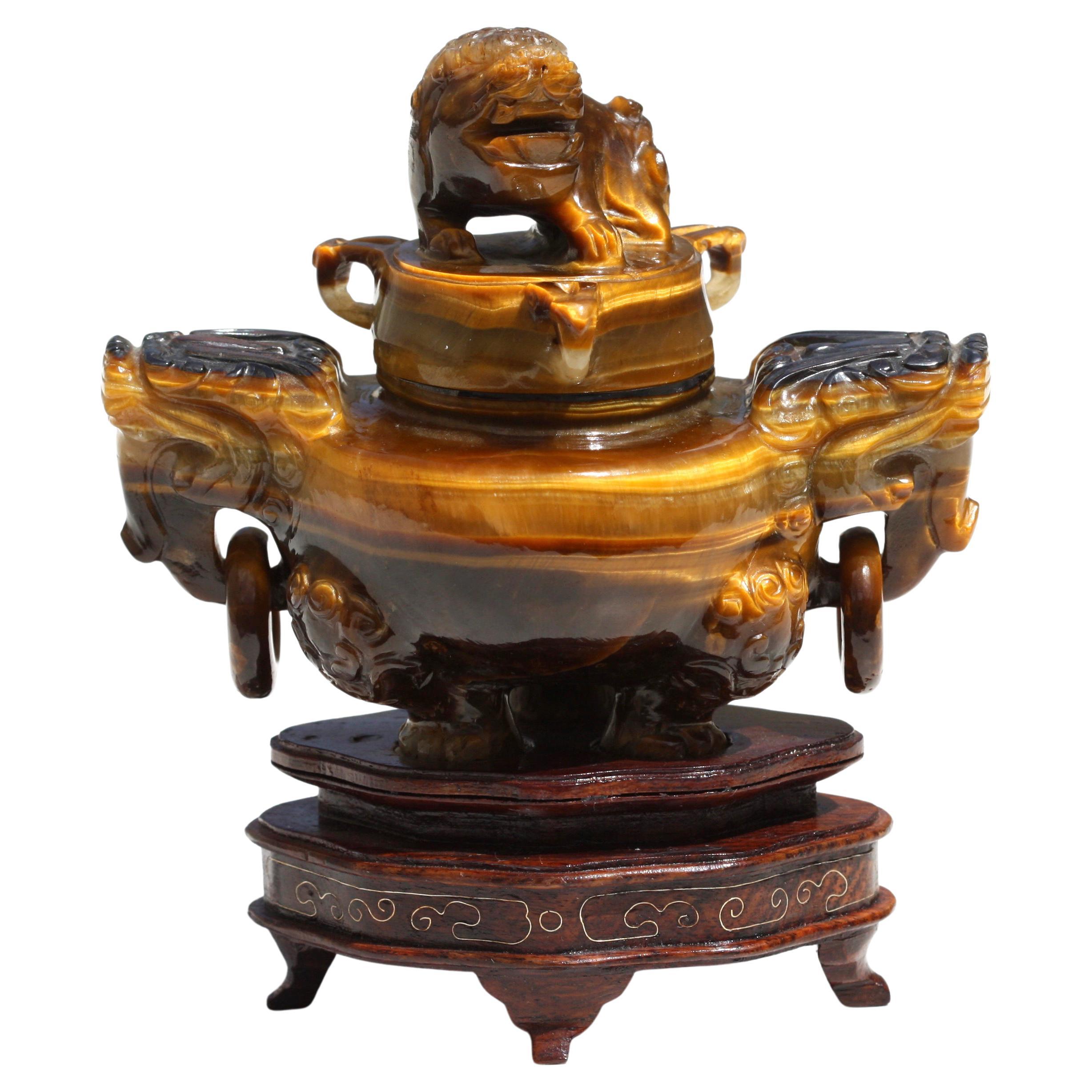
This is a beautiful highly detailed small censer, created in the early 20th century during the Qing Dynasty, circa 1910. The censer has been designed in a round ovoid body, which is standing on three legs. It was masterfully carved from natural tiger's eye gemstone, depicting on top the seated figure of a foo-dog looking forward. At the sides with two mythical lion's heads with carved rings freely hanging from their mouths.
Foo-Dogs
They are actually lions. They originated in China, Shi meaning lion or Sishi or stone lion. Foo Dogs are symbolic, protective statues, one is female and one is male. The female represents the Yin and symbolically protect the people dwelling in the home, while the male represents the Yang, he protects the structure itself.
The Qing Dynasty
Officially the Great Qing, was the Manchu-led last dynasty in the imperial history of China. It was proclaimed in 1636 in Manchuria (modern-day Northeast China), in 1644 entered Beijing, extended its rule to cover all of China proper, and then extended the empire into Central Asia. The dynasty lasted until 1912. In orthodox Chinese historiography, the Qing dynasty was preceded by the Ming dynasty and succeeded by the Republic of China. The multiethnic Qing empire lasted for almost three centuries and assembled the territorial base for modern China. It was the largest Chinese dynasty and in 1790 the fourth largest empire in world history in terms of territorial size. With a population of 432 million in 1912, it was the world's most populous country at the time.
Country: China, Qing Dynasty (1644-1912).
Date: Circa 1910.
Materials: Carved natural tiger's eye gemstone.
Weight: About 750 Grams (0.75 Kg.).
Measurements: Censer alone is 96.5 mm by 120.7 mm by 77.5 mm (3.80 x 4.75 x 3.05 Inches).
Collateral: This censer is accompanied by a customized base in carved wood.
Condition: The overall condition of Qing Dynasty Censer is excellent. Beside the little normal wear, there is no damage and all parts are secured in their settings. This antique censer has been carefully inspected to guarantee the condition and authenticity.
INVENTORY REF: D032925SNNJ/.9082
- Dimensions:Height: 3.8 in (9.66 cm)Width: 4.75 in (12.07 cm)Depth: 3.05 in (7.75 cm)
- Sold As:Set of 3
- Style:Qing (Of the Period)
- Materials and Techniques:
- Place of Origin:
- Period:
- Date of Manufacture:1910
- Condition:Wear consistent with age and use. The overall condition of Qing Dynasty Censer is excellent. Beside the little normal wear, there is no damage and all parts are secured in their settings. This antique censer has been carefully inspected to guarantee the condition and authenticity.
- Seller Location:Miami, FL
- Reference Number:Seller: D032925SNNJ/.90821stDibs: LU8303244629742
About the Seller
5.0
Gold Seller
Premium sellers maintaining a 4.3+ rating and 24-hour response times
1stDibs seller since 2023
248 sales on 1stDibs
Typical response time: <1 hour
- ShippingRetrieving quote...Shipping from: Miami, FL
- Return Policy
More From This Seller
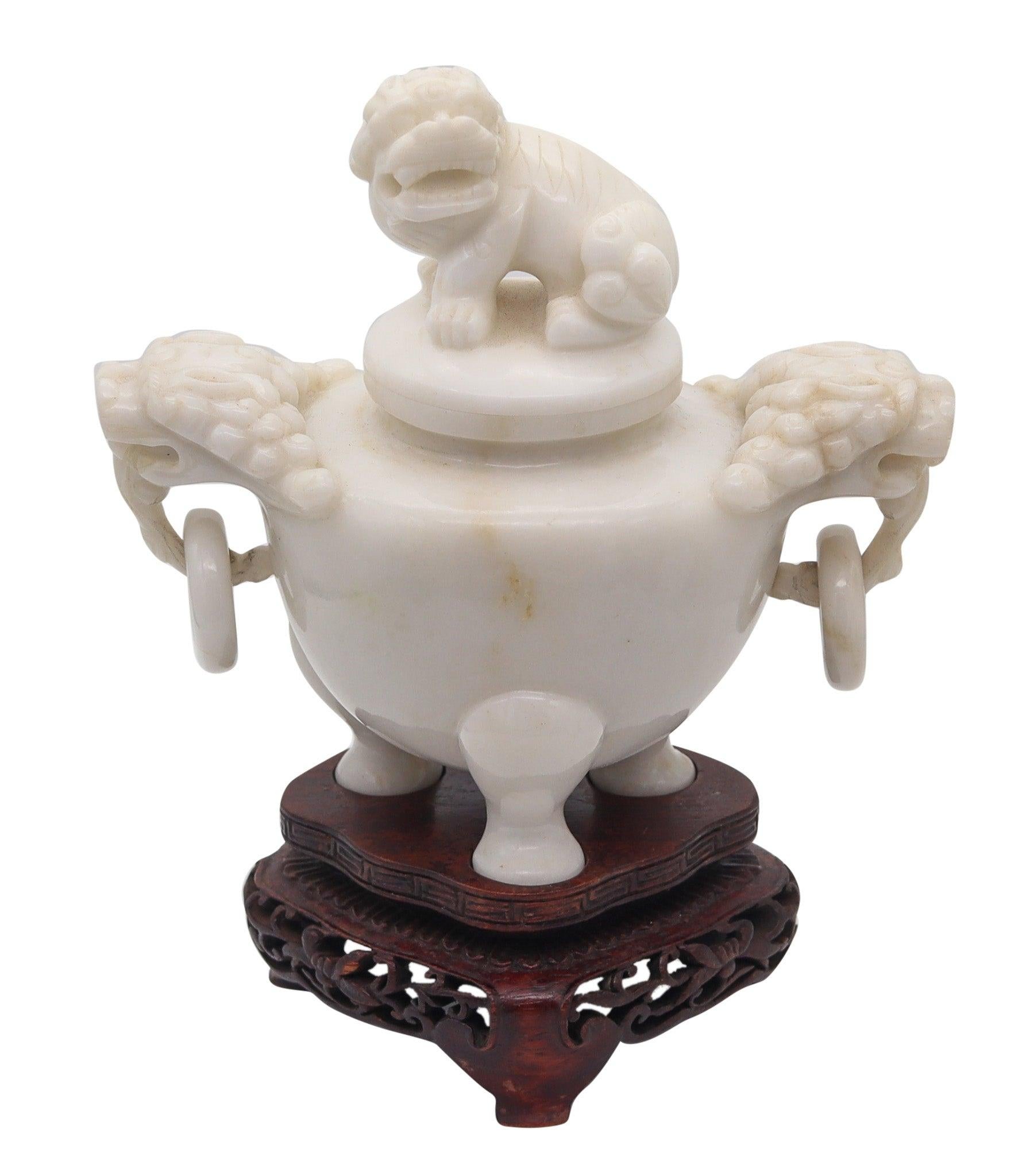
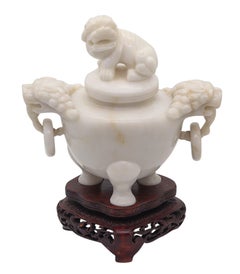
View AllQING DYNASTY 19th Century Carved Foo-Dog Censer With Cover Lid In White Marble
Located in Miami, FL
A late 19th century censer from the Qing Dynasty.
This is a beautiful censer created in the late 19th century during the Qing Dynasty, circa 1890-1910. The censer has been designed ...
Category
Antique 1890s Chinese Qing Sculptures and Carvings
Materials
Marble
$978 Sale Price / set
30% Off
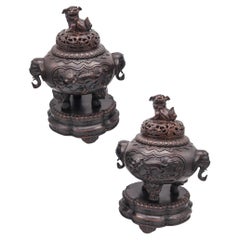
QING DYNASTY 1800 Early 19th Century Pair of Bronze Censers With Lids
Bases
Located in Miami, FL
An early 19th century dragons censer from the Qing Dynasty.
This is a beautiful antique pair of censers, heavily cast in high relief in the early of the 19th century during the Qing...
Category
Antique Early 1800s Chinese Qing Metalwork
Materials
Bronze
$3,325 Sale Price / set
30% Off
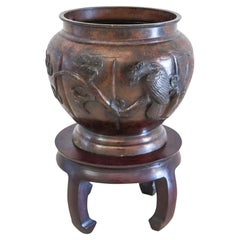
JAPAN 1900 Meiji Period Bronze Planter Vase With Carved Wood Base
Located in Miami, FL
Large Planter Vase from imperial Japan.
This a beautiful piece of Japanese decorative arts, created in Japan during the Meiji imperial period, circa 1900. The oversized vase can be ...
Category
Antique Early 1900s Japanese Meiji Metalwork
Materials
Bronze
$2,789 Sale Price / set
30% Off
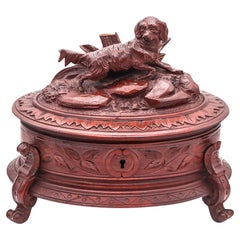
VICTORIAN 1880 Carved Wood Desk Oval Box With Hunting Dog Sculpture
Located in Miami, FL
Late Victorian carved wood oval box.
Stupendous antique oval desk box, created in England during the late Victorian period, circa 1880. The beautifu...
Category
Antique 1880s English Late Victorian Decorative Boxes
Materials
Wood
$1,188 Sale Price
30% Off
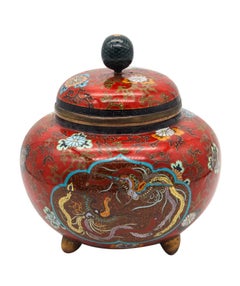
JAPAN IMPERIAL 1900 Meiji Period Tripode Koro Censer In Cloisonné Enamel With
Located in Miami, FL
Japanese tripod Koro from the Meiji Period (1868-1912).
This is a rare and beautiful antique koro censer, created in the imperial Japan during the Meiji period (1868-1912), circa 1900. It was carefully crafted in solid bronze and copper with silver wires and embellished with applications of polychromatic Cloisonné enamels and aventurine. The designs depict organics and natural motifs such mythological animals and flowers.
The Chrysanthemum Symbol
In Imperial Japan, the chrysanthemum (Kiku) was a potent symbol of the imperial family and the emperor himself, representing longevity, royalty, and divine power. The 16-petaled chrysanthemum is the Imperial Seal and crest, found on passports, coins, and the Chrysanthemum Throne. This association dates back to the Kamakura period (1185–1333), particularly with Emperor Go-Toba's fondness for the flower, establishing its link to imperial authority and lineage. The connection between the chrysanthemum and the imperial family began when Emperor Go-Toba adopted it as a personal emblem, aligning it with the strength and refinement of the emperor's rule. During the Meiji Period, the 16-petaled chrysanthemum crest, solidifying the association with the imperial family, was established during this time.
The Meiji Imperial Period
This is an era of Japanese history that extended from October 23, 1868 to July 30, 1912.The Meiji era was the first half of the Empire of Japan, when the Japanese people moved from being an isolated feudal society at risk of colonization by Western powers to the new paradigm of a modern, industrialized nation state and emergent great power, influenced by Western scientific, technological, philosophical, political, legal, and aesthetic ideas. As a result of such wholesale adoption of radically different ideas, the changes to Japan were profound, and affected its social structure, internal politics, economy, military, and foreign relations. The period corresponded to the reign of Emperor Meiji. It was preceded by the Keiō era and was succeeded by the Taishō era, upon the accession of Emperor Taishō.
Country: Imperial Japan.
Period: Meiji, 1890-1910.
Technique: Silver Wire Cloisonné over copper and bronze.
Weight: 416.80 Grams, (0.417 Kg).
Measurements:118 mm by 115 mm (4.65 x 4.52 Inches).
Koro
This term refers to a Japanese censer, incense burner, perfume burner or pastille burner is a vessel made for burning incense or perfume in some solid form. They vary greatly in size, form, and material of construction, and have been in use since ancient times throughout the world. They may consist of simple earthenware bowls or fire pots to intricately carved silver or gold vessels, small tabletop objects a few centimeters tall to as many as several meters high. Many designs use openwork to allow a flow of air. In many cultures, burning incense has spiritual and religious connotations, and this influences the design and decoration of the censer.
Cloisonné
This is an enameling technique in which the pattern is formed by wires soldered to the surface of the object to be decorated, which is usually made from copper, forming cells or cloisons, each of which holds a single colour of enamel paste which is then fired, and ground and polished. The champleve technique also uses an enameling technique, but the cells are formed by carving into the surface of the object, or in the casting. The cloisonne technique has been in use since the 12th century BC in the west, but the technique did not reach China until the 13th or 14th century. It became popular in China in the 18th century. Initially bronze or brass bodies were used, and in the 19th century copper, at which time the quality of the items produced began to decline. Chinese cloisonné is the best-known enamel cloisonné, though the Japanese produced large quantities from the mid-19th century, of very high technical quality. In the west the cloisonne technique was revived in the mid-19th century following imports from China, and its use continued in the Art Nouveau and Art Deco periods.
Condition: Basically, is in great antique condition, near mint, with insignificant and minimal usage, in great condition. All parts are secured in the settings. This Japanese Meiji Koro...
Category
Antique Early 1900s Japanese Meiji Metalwork
Materials
Silver, Bronze, Copper, Enamel
$1,398 Sale Price
30% Off
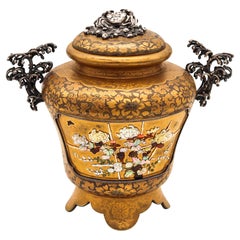
Japan 1890 Meiji Shibayama Round Urn in Gilded Wood and Sterling Silver
Located in Miami, FL
Shibayama urm from the Japan meiji (1858-1912) period.
Gorgeous piece of art, created in the imperial Japan during the Meiji period, circa 1890. This is a little urn with a lid crafted in gilded wood, shibayama panels and sterling silver. Composed by a four footed round vase with two sterling silver handles in the shape of trees and the lid on top accented with the figure of a crab in sterling silver. The gilded wood is decorated with flowers, sea patterns and the imperial flower...
Category
Antique 1890s Japanese Meiji Antiquities
Materials
Multi-gemstone, Gold, Silver, Sterling Silver, Gold Leaf
$4,889 Sale Price / set
30% Off
You May Also Like
Tiger
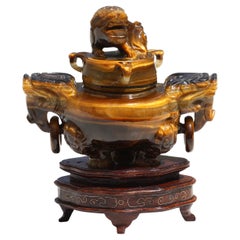
s Eye Tripod Incense Burner and Cover
Located in West Palm Beach, FL
A Tiger's eye tripod incense burner and cover
Chinese, 20th century
of compressed globular form raised on three cabriole legs issuing from lion masks, flanked by two horned mythica...
Category
20th Century Scholar s Objects
Materials
Bronze
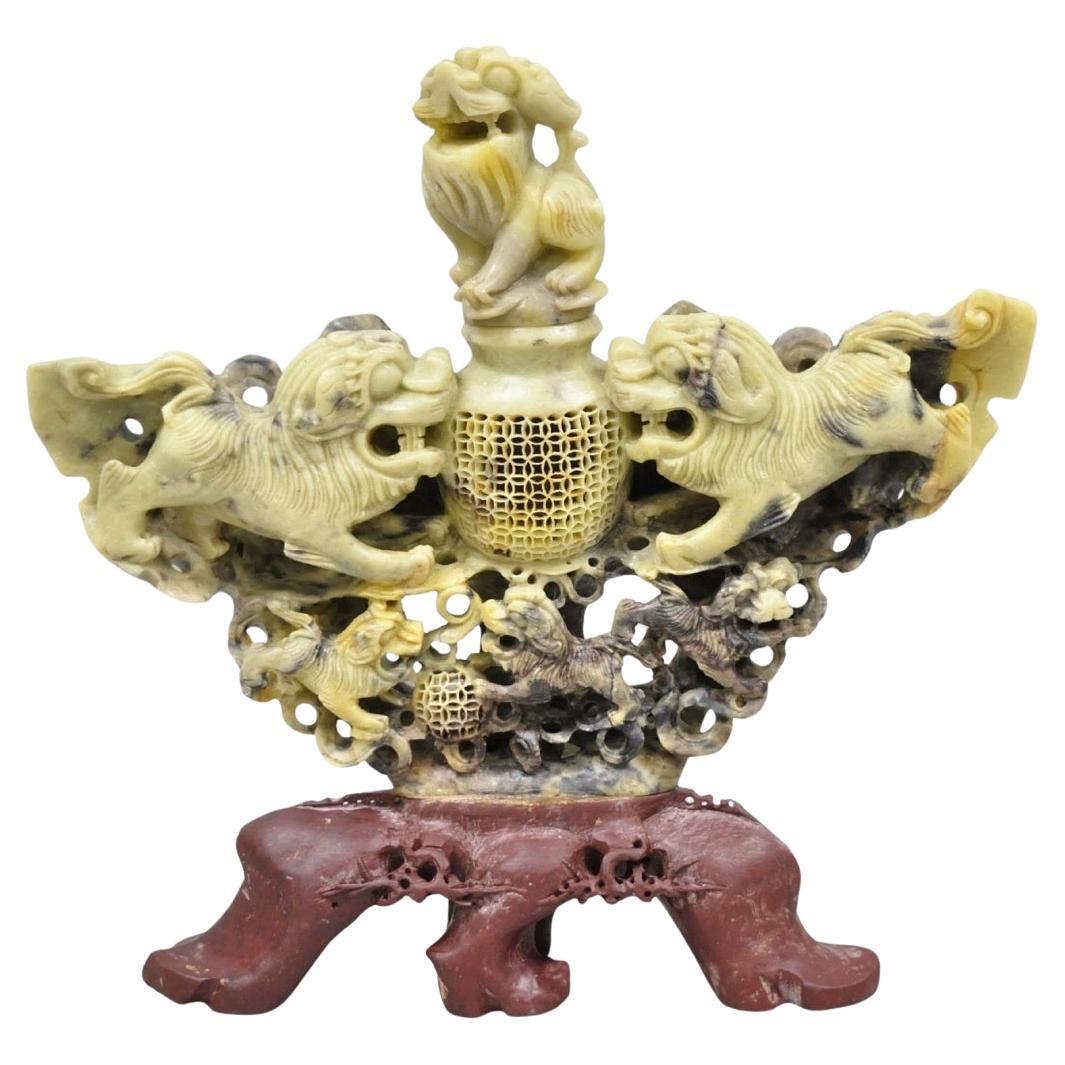
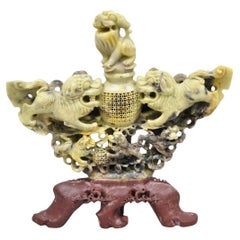
Vintage Chinese Carved Soapstone Foo Dog Figural Incense Burner Sculpture
Located in Philadelphia, PA
Vintage Chinese Carved Soapstone Foo Dog Figural Incense Burner Sculpture. Circa Mid 20th Century. Measurements: 12" H x 12" W x 2" D.
Category
Mid-20th Century Chinoiserie Abstract Sculptures
Materials
Soapstone
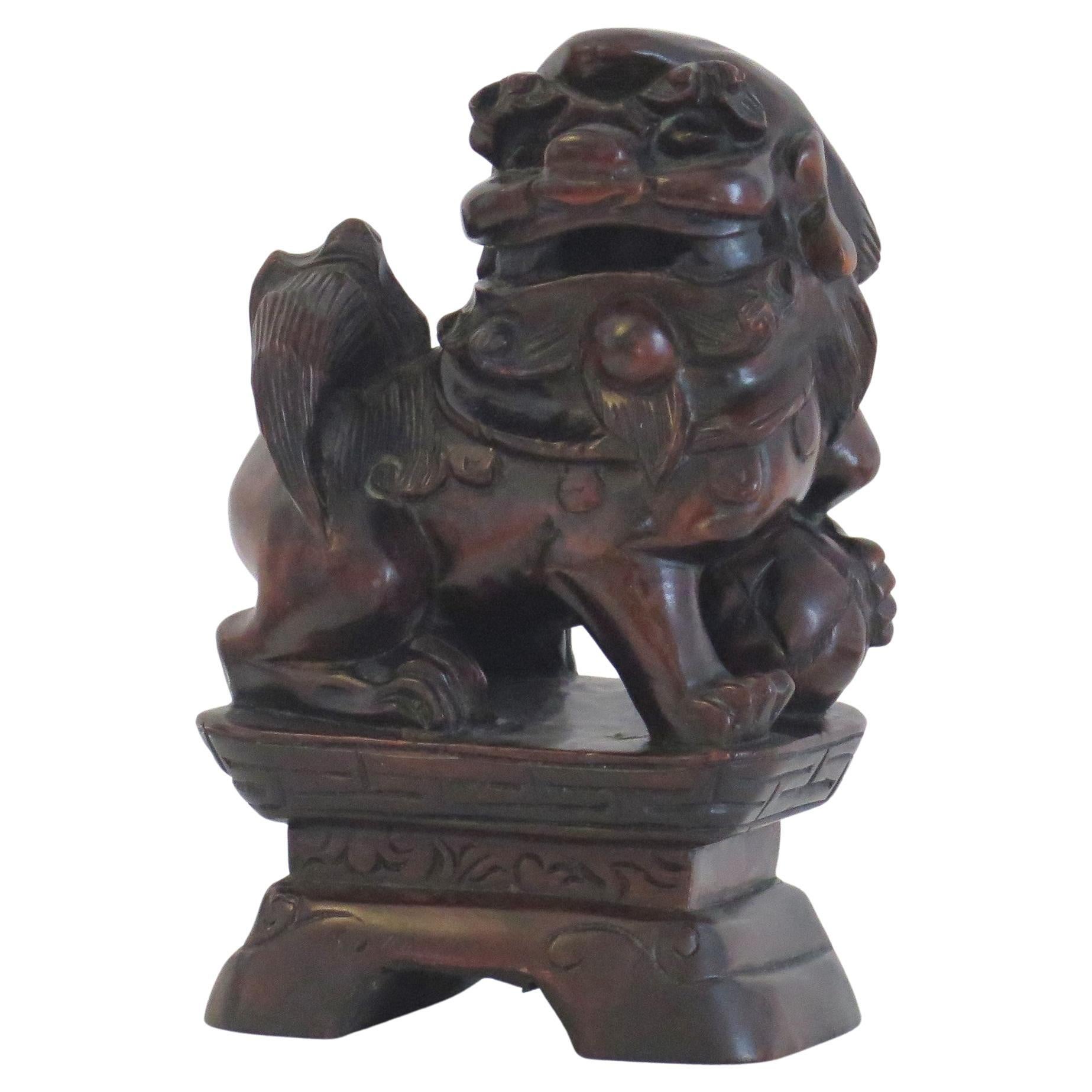
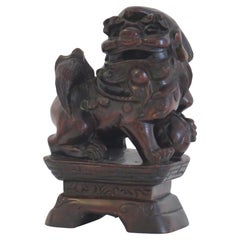
Antique Chinese Foo Dog Hardwood Hand Carved and Signed, Qing circa 1900
Located in Lincoln, Lincolnshire
This is a good Chinese hardwood foo dog, sometimes called a temple lion that we date to the late Qing period, circa 1900.
The piece is hand carved as a fierce dog or lion sat on a...
Category
Early 20th Century Chinese Qing Ceramics
Materials
Hardwood
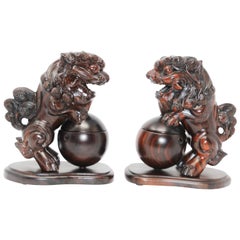
Two Chinese Wood Lion Foo Dogs Incense Holder
Located in Moreno Valley, CA
Two Chinese wood Foo Dogs Incense holder burners.
Featuring a pair of highly detailed lion foo dogs, one male and one female which were thought to protect the home from harmful spiritual influences and harmful people that might be a threat.
The Foo Dogs...
Category
Late 20th Century Chinese Chinese Export Sculptures and Carvings
Materials
Wood
Foo-Dog
Shi-Shi
Incense Burner
Koro
with Removable Lid
Located in Hudson, NY
This unique piece of ceramic has beautiful color. It also has a collector's box.
Category
Antique 19th Century Japanese Ceramics
Materials
Ceramic
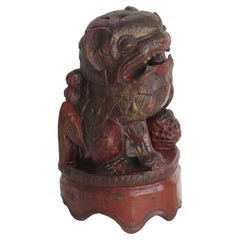
Antique Chinese Foo Dog Hand Carved Bamboo Gilded, 19th Century Qing
Located in Lincoln, Lincolnshire
This is a good Chinese hand carved bamboo Foo or Lion Dog, sometimes called a temple lion that we date to the 19th Century Qing period.
T...
Category
Antique 19th Century Chinese Qing Ceramics
Materials
Bamboo
More Ways To Browse
Stone Head Sculpture Hand Carved
Antique Lion Ring
Carved Tiger
Antique Foo Dogs
Antique Orthodox
Antique Carved Dog Furniture
Tiger China
Antique Stone Lions
Dog Carved Sculpture
Tiger Eye Furniture
Hand Carved Tiger
Antique Tiger Wood
Carved Tiger Eye
Early 20th Century Foo Dogs
Two Headed Lions
Antique Tiger Eye
Wood Dog Sculpture
Antique Tiger Wood Furniture