Pre-Columbian Asian Art and Furniture
to
1
1
441
392
232
186
155
74
55
46
42
33
25
20
15
14
13
13
12
4
1
1
1
1
1
1
1
Style: Pre-Columbian
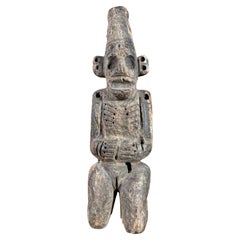
Fine America’s Chieftain Ceremonial Figure
Located in South Burlington, VT
Pre-Columbian style , Hispaniola, Arawak Peoples, Taino Native Indians
This is a finely carved Taino Cacique Chief's hand carved hard wood figure- a superb ancestor style ceremonial...
Category
20th Century American Pre-Columbian Asian Art and Furniture
Materials
Wood
Related Items
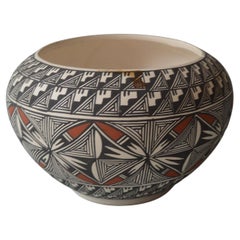
Fine Vintage Laguna Pot Native American Pueblo
Located in London, GB
Fine Vintage Laguna Pot Native American Pueblo
Finely painted in linear geometric designs
Period 1970s signed on base R Reano
Condition Good
Category
20th Century American Pre-Columbian Asian Art and Furniture
Materials
Pottery

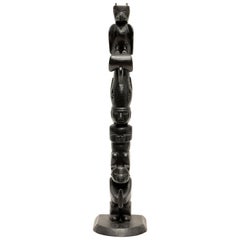
Northwest Four Figure Cedar Totem
Located in Coeur d
Alene, ID
Northwest four figure totem from British Columbia. Old black paint and integral base. Great condition and just the right size. Northwest Coast art, consisting of totem poles, posts or pillars, carved with symbols or figures. They are usually made from large trees, mostly western red cedar...
Category
Early 20th Century Pre-Columbian Asian Art and Furniture
Materials
Cedar
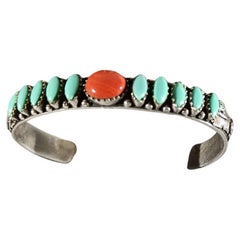
Fine Vintage Native American Navajo Cuff bracelet Silver Turquoise
Located in London, GB
A Fine Vintage Native American Navajo bracelet Silver Turquoise jewellery
A fine quality elegant slender bracelet with turquoise and coral with floral silver embellishments at the ...
Category
20th Century American Pre-Columbian Asian Art and Furniture
Materials
Silver
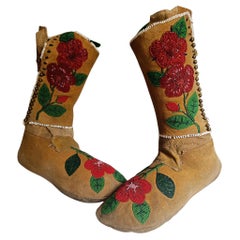
Native American Fine Plains beaded boot moccasins
Located in London, GB
Fine Pair of Plains Woman's Boot Moccasins
North America 19th to early 20th century
A beautifully crafted and well-preserved pair of Plains Native American woman's high-top moccas...
Category
Early 20th Century American Pre-Columbian Asian Art and Furniture
Materials
Hide, Beads
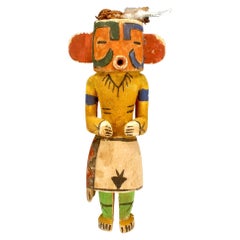
Painted Wood Hopi Katsina Kachina Figure
#1
Located in Bradenton, FL
Hopi katsina figures (Hopi language: tithu or katsintithu), also known as kachina dolls, are figures carved, typically from cottonwood root, by Hopi people to instruct young girls an...
Category
Mid-20th Century American Pre-Columbian Asian Art and Furniture
Materials
Wood
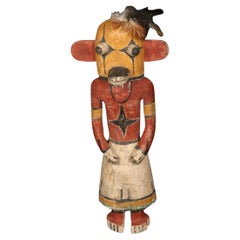
Painted Wood Hopi Kachina Figure
Located in Bradenton, FL
Hopi Katsina figures (Hopi language: tithu or katsintithu), also known as Kachina dolls, are figures carved, typically from cottonwood root, by Hopi people to instruct young girls an...
Category
Early 20th Century American Pre-Columbian Asian Art and Furniture
Materials
Wood
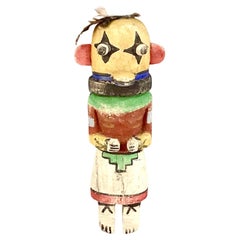
Painted Wood Hopi Katsina Kachina Figure (#2)
Located in Bradenton, FL
Hopi katsina figures (Hopi language: tithu or katsintithu), also known as kachina dolls, are figures carved, typically from cottonwood root, by Hopi people to instruct young girls an...
Category
Mid-20th Century American Pre-Columbian Asian Art and Furniture
Materials
Wood
Large Fine Apache Basket
Located in Coeur d
Alene, ID
Apache large finely coiled basket having a continuous diamond/floral design.
Period: Last quarter of the 19th century
Origin: Apache
Size: 15" D x 3" H....
Category
Late 19th Century American Antique Pre-Columbian Asian Art and Furniture
Materials
Other
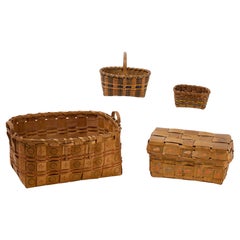
Four Native American Painted Baskets
Located in Branford, CT
Four Northeastern Native American splint baskets. 19th century. Original paint and decoration.
Smallest: H 2-1/4" W 4-7/8" D 3-7/8".
Bale Handle: H 5-3/8" W 6-3/4" D 5-3/8".
Cove...
Category
1890s Antique Pre-Columbian Asian Art and Furniture
Materials
Wood
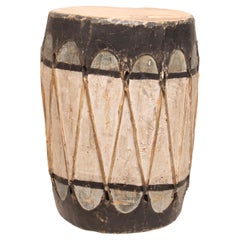
Native American Cochiti Painted Drum
Located in Coeur d
Alene, ID
Native American Cochiti drum with sides painted in black, white and turquoise. Made of a cottonwood log and hide.
Period: Early 20th century
Origin: So...
Category
Early 20th Century American Pre-Columbian Asian Art and Furniture
Materials
Wood
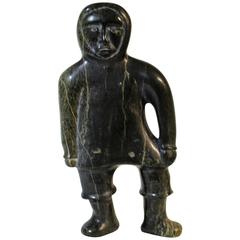
Inuit Soapstone Figural Sculpture
Located in Hamilton, Ontario
Eskimo figural soapstone carving.
Category
Mid-20th Century Canadian Pre-Columbian Asian Art and Furniture
Materials
Soapstone
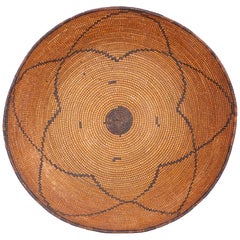
Native American Mono Basket
Located in Coeur d
Alene, ID
Native American Mono basket bowl. 15" x 6". Dark geometric band below rim. Very tight, no issues. Golden patina. From a liftetime Oregon collection. Museu...
Category
20th Century American Pre-Columbian Asian Art and Furniture
Materials
Reed
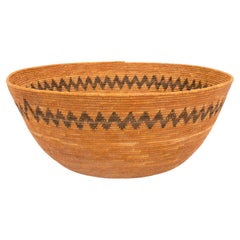
Previously Available Items
America’s Taino People Jade Pendant God
Located in South Burlington, VT
Hispaniola, Arawak peoples, Taino native Indians
This is a fine hand carved jade ancestor sculpture fashioned as a pendant from the Arawak Peoples of the Greater Antilles Islands, Dominican Republic. It is a good example and is accompanied by a certificate of authenticity as photographed.
Taino jades are extremely uncommon due to lack of local island jade cobble resources. Jade was likely traded into this country hundreds of years ago and this work of art is just one of a small collection found in a cave in La Altagracia Province, Dominican Republic in 1958.
Taino Jade Anthropic Pendant of a female figure, 20th century or earlier
Dimensions: 3.1 inches high, 8 cm
Sometimes described as a jade -cemi- this work of art belongs to a broader category of Taino art also called -zemis-. This term refers to the physical incarnation of a Taino god, spirit or ancestor. This figure may represent a Taino in trance and a similar might have adorned Cohoba ceremonies where hallucinogenic substances like cohoba were consumed to induce trances to communicate with the gods.
While the precise function of such objects remain somewhat a mystery- they continue to impress us with their bold abstract form and magical associations.
This remarkable sculpture figure is carved in a medium green jade with brown inclusions. This example has a large triangular carved head, slanted eyes, hands to its sides prominent nasal, open mouth, and pointed base.
As chieftains and important shamans were deified after death this sculpture may represent a cacique chief or high status member of Taino Community.
The arrangement of the figure’s limbs is an elaboration of the ritual squatting position that zemis assume in surviving stone amulets. In this case the legs are held up vertically with the feet resting under the waist. Both the face and in particular, the back of the body, are skeletal in appearance with prominent hollow joints. The wide eye-sockets and gaping jaw are deeply carved and both the forehead and the chin project outwards at a sharp angle. The emaciated look on the reverse, is carved in the half round. Both the ribs and the spine are indicated, set between elaborate geometric motifs which may indicate the presence of tattoos. The figure appears to rests on a simply carved pedestal.
To western sensibilities there is an obvious contradiction between the figure’s reverse skeletal form, suggestive of mortality.
Although Taino left no written documents, Spanish settlers did record native practices and one account refers to special structures in which chieftains stored their Trove of zemi carvings. The Taino believed in existence of afterlife and Shamanic ability to communicate with the dead. This sculpture may well have been present and on display in such a ceremony or perhaps a focus of ancestor worship.
Hand carved and scarce work of art from America's Caribbean islands.
Provenance: 1958 find, La Altagracia Provonce, Dominican Republic.
A "Certificate of Authenticity" accompanies
Taino History:
The Taino flourished from 1200-1500.
When Columbus arrived in America, the first people he encountered were the Taino People- inhabitants of the islands of the northern Caribbean Sea, known as Hispaniola. They were Arawakan-speaking people who at the time of Christopher Columbus’s exploration inhabited Cuba, Jamaica, Hispaniola (Haiti and the Dominican Republic), Puerto Rico, and the Virgin Islands. Once the most numerous indigenous people of the Caribbean, the Taino may have numbered several million at the time of the Spanish conquest in the late 15th century.
Their highly developed belief system focused on zemi ancestor or god worship. A zemi was the physical manifestation of a god, spirit or ancestor. The chieftain -caciques- encouraged ancestor worship and were often deified after death. The religious leaders or shamans were thought to be able to communicate with the souls of the dead when intoxicated by the hallucinogenic cohoba. A preoccupation with death is evident in many Taino art-forms and partly explains the prevalence of zoomorphic images. Bats, owls and frogs were all popular motifs and were regarded as harbingers of life after death. The Taino believed that the dead could be reborn in animal form and some believe animals were their earliest ancestors in Taino creation myth. Hence we find their zoomorphic sculptures as combinations of human and animal forms particularly provocative and great conversational art...
Category
20th Century American Pre-Columbian Asian Art and Furniture
Materials
Jade
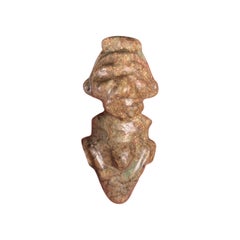
Ancient Jade Pre Columbian Figure Supernatural Human, 1000-400 BC
Located in South Burlington, VT
Here's a beautifully hand carved effigy artifact from ancient America.
This carving appears to be neither human nor supernatural but an idealized surreal other worldly form.
Depicting a typical Olmecoid, elongated head and face with almond-shaped eyes and a toothless slightly down turned mouth, this standing figure is carved from jade in elegant simplistic detail. Its harmonious proportions are indicative of the sophistication attained by ancient jade...
Category
15th Century and Earlier Mexican Antique Pre-Columbian Asian Art and Furniture
Materials
Jade
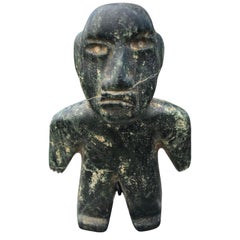
Caribbean Antique Treasure Jade 18-Karat Gold Amulet Necklace, Unique 500 Years
Located in South Burlington, VT
Unique jade pendant and 18-karat gold jewelry
Pre-Columbian, Hispaniola, Arawak Peoples, Taino Native Indians, 1000-1500 AD.
A fine authentic old Taino Jade Anthropic pendant of a standing "Hands over Head" Figure that has been expertly fashioned using 18-karat gold into a custom necklace setting. The jade figure measures 2.5 inches in length and the necklace is 20" in length. All our Jade jewelry is artisan inspired & hand crafted from authentic old Jades and 18-karat gold.
We will provide you with a custom black gift box and certificate of authenticity. ( please view photo)
Photographed in natural day light.
This Taino Jade Anthropic Fertility Figure, 1000-1500 AD is carved in a rich dark jade.
Taino jades are extremely uncommon due to lack of local island jade cobble resources. Jade was likely traded into this country hundreds of years ago and this work of art is just one of a small collection found in a cave in LaAltagracia Provonce, Dominican Republic in 1958.
Sometimes described as a jade -cemi- this work of art belongs to a broader category of Taino art also called -zemis-. This term refers to the physical incarnation of a Taino god, spirit or ancestor. This figure may represent a Taino in trance and might have adorned Cohoba ceremonies where hallucinogenic substances like cohoba were consumed to induce trances to communicate with the gods. It features decorative tattoo on the head top while the figure maintains a meditative pose.
While the precise function of such objects remain somewhat a mystery- they continue to impress us with their bold abstract form and magical associations.
This remarkable sculpture figure is carved in a dark, rich blue green jade...
Category
15th Century and Earlier American Antique Pre-Columbian Asian Art and Furniture
Materials
Jade
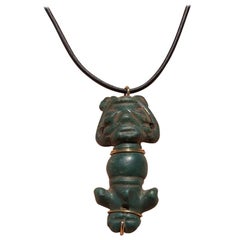
American Treasure Rich Jade "Tranced Being" Pendant, 500 Years Old
Located in South Burlington, VT
Pre-Columbian, Hispaniola, Arawak Peoples, Taino Native Indians, 1000 to 1500 CE. , #5
Taino Jade male dark jade pendant of a seated "in tranced" figure with hands on knees , 1000-...
Category
15th Century and Earlier American Antique Pre-Columbian Asian Art and Furniture
Materials
Jade
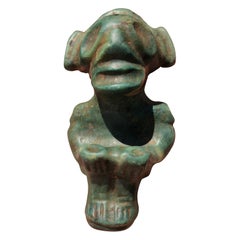
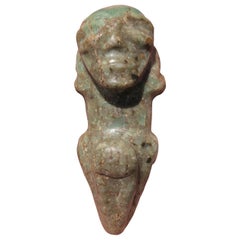
America’s Treasure Jade Find Hallucinogenic Pendant God, 500 Years Old #1
Located in South Burlington, VT
Pre-Columbian, Hispaniola, Arawak peoples, Taino native Indians, 1000-1500 CE.
This is a fine and important hand carved jade ancestor sculpture fashioned as a pendant from the Arawak Peoples of the Greater Antilles Islands, Dominican Republic. It is a rare, choice example and is accompanied by a certificate of authenticity as photographed.
Taino jades are extremely uncommon due to lack of local island jade cobble resources. Jade was likely traded into this country hundreds of years ago and this work of art is just one of a small collection found in a cave in LaAltagracia Provonce, Dominican Republic in 1958.
Taino Jade Anthropic Pendant of a female figure, 1000-1500 AD
"Certificate of Authenticity".
Dimensions: 3.1 inches high, 8 cm
Sometimes described as a jade -cemi- this work of art belongs to a broader category of Taino art...
Category
15th Century and Earlier American Antique Pre-Columbian Asian Art and Furniture
Materials
Jade
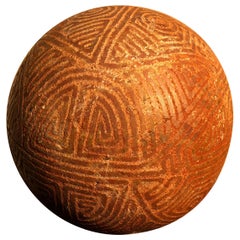
America Ancient Stone Game Ball "Batey", 500 Years Old
Located in South Burlington, VT
Pre-Columbian, Hispaniola, Arawak Peoples, Taino Native Indians, 1000-1500 CE.
This is a fine and important hand carved/pecked stone game ball (batey) from the Arawak Peoples of the Greater Antilles Islands. It is a choice and large example. It is finely incised on all planes with multiple stylized geometric motifs representing tattooing or scarification and faces, adding to the impressive aesthetic presence of this piece.
Batey (game) Batéy was the name given to a special plaza around which the Caribbean Taino built their settlements. It was usually a rectangular area surrounded by stones with carved symbols. The batey was the area in which batey events (e.g. ceremonies, the ball game, etc.) took place.
This form might have served as a marker or trophy symbol in a Taino inter- village ball game and ceremony. The exact purpose of ball games remain a mystery but they may have served to settle political disputes.
While the precise function of such objects remain somewhat a mystery- they continue to impress us with their bold abstract form and magical associations.
This remarkable sculpture is carved in a light colored iron rich hard stone like limestone. On the surfaces are finely incised stylized geometric motifs representing tattooing or scarification, adding to the impressive aesthetic presence of this piece.
A carving of this complexity, quality and size must have belonged to a chieftain or ranking member of the royal household. Although Taino left no written documents, Spanish settlers did record native practices and one account refers to special structures in which chieftains stored their Trove of zemi and other important carvings. The Taino believed in existence of afterlife and Shamanic ability to communicate with the dead. This sculpture may well have been present and on display in such a ceremony or perhaps a focus of ancestor worship. This remarkably evocative work allows us to peak into ancient splendors of their remarkable civilization.
Dimensions: 8.5 inches diameter
Hand-carved/pecked. Venerated. An important and scarce work of art from America's Caribbean islands.
Provenance: Old Puerto Rico collection collected 1950s-1960s, Frank Vasquez
Taino History:
The Taino flourished from 1200-1500.
When Columbus arrived in America, the first people he encountered were the Taino People- inhabitants of the islands of the northern Caribbean Sea, known as Hispaniola. They were Arawakan-speaking people who at the time of Christopher Columbus’s exploration inhabited Cuba, Jamaica, Hispaniola (Haiti and the Dominican Republic), Puerto Rico, and the Virgin Islands. Once the most numerous indigenous people of the Caribbean, the Taino may have numbered several million at the time of the Spanish conquest in the late 15th century.
Their highly developed belief system focused on zemi ancestor or god worship. A zemi was the physical manifestation of a god, spirit or ancestor. The chieftain -caciques- encouraged ancestor worship and were often deified after death. The religious leaders or shamans were thought to be able to communicate with the souls of the dead when intoxicated by the hallucinogenic cohoba. A preoccupation with death is evident in many Taino art-forms and partly explains the prevalence of zoomorphic images. Bats, owls and frogs were all popular motifs and were regarded as harbingers of life after death. The Taino believed that the dead could be reborn in animal form and some believe animals were their earliest ancestors in Taino creation myth. Hence we find their zoomorphic sculptures as combinations of human and animal forms particularly provocative and great conversational art...
Category
15th Century and Earlier American Antique Pre-Columbian Asian Art and Furniture
Materials
Stone
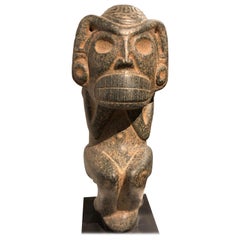
America’s Ancestor Hallucinogenic God, 500 Years Old
Located in South Burlington, VT
Pre-Columbian, Hispaniola, Arawak Peoples, Taino Native Indians, 1000 to 1500 CE.
This is a fine and important hand carved/pecked ancestor sculpture from the Arawak Peoples of the Greater Antilles Islands. It is a choice example.
Sometimes described as a -cemi- this work of art belongs to a broader category of Taino art...
Category
15th Century and Earlier American Antique Pre-Columbian Asian Art and Furniture
Materials
Stone
Fine America’s Chieftain Ceremonial Wood Seat “Duho”
Located in South Burlington, VT
Pre-Columbian style , Hispaniola, Arawak Peoples, Taino Native Indians
This is a finely carved Taino Cacique Chief's hand carved hard wood seat -Duho- a superb ancestor style ceremonial sculpture from the Arawak Peoples of the Greater Antilles Islands. It comes from a Florida collection.
This Duho or seat made from a single piece of wood, representing an anthropomorphic figure with sculptured head and finely engraved with a large Cacique face and linear motifs on the main flat top, and in ancient times similar would have been used by the principal practitioner of the cohoba ritual. In ancient times, Duhos were used by the Cacique while observing the ball games commonly played by the Taino's. circa 1200-1550 A.D.
While the precise ancient function of such objects remains somewhat a mystery- they continue to impress us with their bold abstract form and magical associations.
In the seminal book Taino, Pre-Columbian Art & Culture from the Caribbean published by the El Museo del Barrio, ancient duho are discussed at length as private power-objects used in egalitarian tribes and used in public ritual to legitimize the hierarchical social structure of complex chiefdoms. Please also refer to the excellent publication March 1994 seminal article Tribal Arts: The Sculptural Ancestry of the Taino- masterpieces from the Pre-Columbian West Indies. (photos).
This remarkable sculpture includes a Zemi figure face which was meticulously incised with round deep-socketed eyes, prominent nasal cavities, drilled ear lobes possibly for feather fetishes...
Category
20th Century American Pre-Columbian Asian Art and Furniture
Materials
Wood
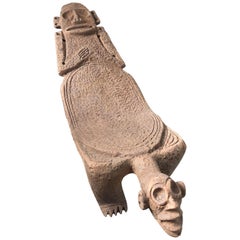
America’s First “Spirit God” Double Headed Ancestor 500 Years Old
Located in South Burlington, VT
Pre-Columbian, Hispaniola, Arawak Peoples, Taino Native Indians, 1000-1500 CE.
This is a fine and important ancestor sculpture from the Arawak Peoples of the Greater Antilles Islands. It is as nice as one will ever find.
Sometimes described as a -three-pointer stone or - trigonolitos- this work of art belongs to a broader category of Taino art...
Category
15th Century and Earlier American Antique Pre-Columbian Asian Art and Furniture
Materials
Stone
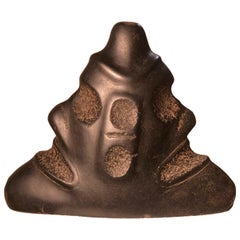
Gift of Ancient Jade Pre Columbian Figure, 1000-400 BC Human or Supernatural?
Located in South Burlington, VT
Here's a beautifully hand-carved effigy artifact from the ancient America.
Depicting a typical Olmecoid, elongated head and face with slanted, almond-shaped eyes and a toothless slightly down turned mouth, this seated figure is carved from jade in elegant simplistic detail. Its harmonious proportions are indicative of the sophistication attained by ancient jade...
Category
15th Century and Earlier Mexican Antique Pre-Columbian Asian Art and Furniture
Materials
Jade
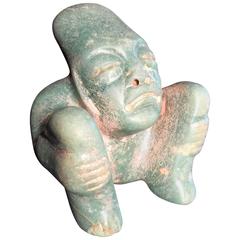
H 2.75 in W 2 in D 2 in
Pre-columbian asian art and furniture for sale on 1stDibs.
Find a broad range of unique Pre-Columbian asian art and furniture for sale on 1stDibs. It’s true that these talented designers have at times inspired knockoffs, but our experienced specialists have partnered with only top vetted sellers to offer authentic pieces that come with a buyer protection guarantee.