Want more images or videos?
Request additional images or videos from the seller
1 of 17
Japanese Old Spliced Indigo Dyed Cloth / Wabisabi Art / Tapestry/Wall Decoration
Price:$600
$1,000List Price
About the Item
About the Seller
5.0
Platinum Seller
Premium sellers with a 4.7+ rating and 24-hour response times
Established in 2015
1stDibs seller since 2020
1,704 sales on 1stDibs
Typical response time: 6 hours
Authenticity Guarantee
In the unlikely event there’s an issue with an item’s authenticity, contact us within 1 year for a full refund. DetailsMoney-Back Guarantee
If your item is not as described, is damaged in transit, or does not arrive, contact us within 7 days for a full refund. Details24-Hour Cancellation
You have a 24-hour grace period in which to reconsider your purchase, with no questions asked.Vetted Professional Sellers
Our world-class sellers must adhere to strict standards for service and quality, maintaining the integrity of our listings.Price-Match Guarantee
If you find that a seller listed the same item for a lower price elsewhere, we’ll match it.Trusted Global Delivery
Our best-in-class carrier network provides specialized shipping options worldwide, including custom delivery.You May Also Like
Meiji Period Japanese Indigo Double Ikat Futon Cover
Located in Point Richmond, CA
Meiji period Japanese Indigo double ikat futon cover
Japanese futon cover, a double ikat pattern in four panels depicting Kumamoto Castle with im...
Category
Antique 1890s Japanese Meiji Textiles
Materials
Cotton
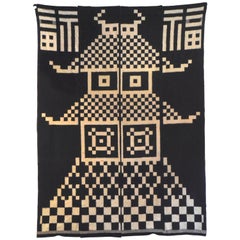
Japanese Indigo Antique Boro Futon Cover or Wall Panel
Located in Alessandria, Piemonte
Rare perfect antique collection Japanese Indigo Boro Futon cover : also to use.
The rare antique boros are now valued as pieces of art, therefore they are...
Category
Mid-20th Century Japanese Japonisme Textiles
Materials
Cotton
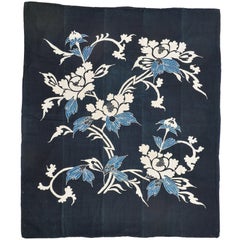
Framed Japanese Embroidery Dragon Tapestry Meiji Period
Located in Atlanta, GA
A striking Japanese embroidery tapestry circa 1890s Meiji period presented in a gilt wood frame under glaze. The design features four dragons coiling and slithering in the clouds. The most auspicious mythological creature, dragon was a very popular motif in Japanese textile art. Viewing this particular piece, one is struck by the superb craftsmanship with the profuse use of silver threads in satin stitches and complex chain stich coiling that create the background. The slight relief technique was also used on parts of the dragon heads, rendering the piece a strong sense of dimension and motion. The textile itself measures about 32.5"x46".
Japanese Meiji textiles were widely exhibited in the west during turn of the 20th century at the international exposition. It was used to showcase the Japanese aesthetics with the techniques at their pinnacle. These expositions solidified the country's images overseas and felled the Japanese craze in the west, which turned out to be a long-lasting influence on the western art. Many pieces were purchased and stayed in the west. As there is no brocade border present, the piece is likely the main part with the central motifs of a larger tapestry and was later framed for display.
For two similar dragon tapestries...
Category
Antique 1890s Japanese Meiji Textiles
Materials
Textile, Wood
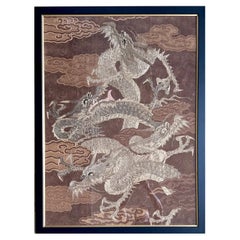
Framed Japanese Antique Embroidery Sennin Tapestry Meiji Period
Located in Atlanta, GA
A stunning Japanese embroidery tapestry circa 1880s-1900s from late Meiji period, presented with an original wood frame with inner gold trim. The tour-de-force embroidered tapestry s...
Category
Antique 1890s Japanese Meiji Textiles
Materials
Silk, Giltwood
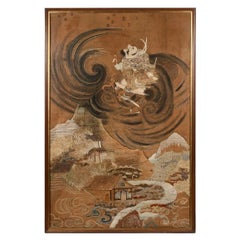
Vintage Japanese Indigo Folk Kamon Textile
Located in Chicago, IL
Dating to the mid-20th century, this vintage Japanese textile is a folk example of traditional stencil dyed fabric, known as katazome. Richly...
Category
Mid-20th Century Japanese Textiles
Materials
Cotton
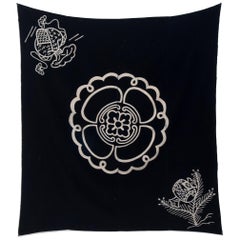
Vintage Japanese Indigo Folk Kamon Textile
Located in Chicago, IL
Dating to the mid-20th century, this vintage Japanese textile is a folk example of traditional stencil dyed fabric, known as katazome. Richly...
Category
Mid-20th Century Japanese Textiles
Materials
Cotton
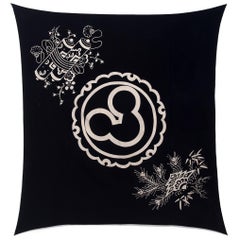
Antique Early 20th Century Japanese Hand Stitched Silk Framed Tapestry
Located in Lambertville, NJ
All hand work framed silk Japanese tapestry with embroidered boarder. A deep custom black lacquered frame. Originaly sold from Newman Galleries....
Category
Early 20th Century Japanese Meiji Textiles
Materials
Silk, Glass, Lacquer
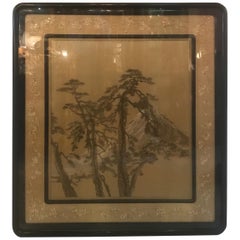
$3,250
H 42.5 in W 40 in D 1.5 in
Japanese Silk Embroidery Tapestry Meiji Period
Located in Atlanta, GA
A spectacular Japanese embroidered silk panel beautifully presented in a gilt frame suspended in a lucite shadow box with gilt wood border. The silk picture is dated to 1890-1910s toward the end of Meiji Period, when Japanese started to participate international expose by presenting its best art and craft. Elaborate embroidered silk tapestry like this was very popular among westerners due to its superb craftmanship and also exotic subject matter that was often derived from classic Japanese folklore, mythology and various motifs. The tapestry on offer is such an example. It depicts an old couple...
Category
Antique 1890s Japanese Japonisme Textiles
Materials
Fabric, Silk, Lucite
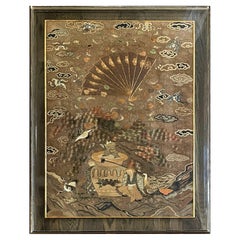
Large Framed Japanese Embroidery Dragon Tapestry
Located in Atlanta, GA
An impressive Japanese embroidery tapestry circa 1890s Meiji period, presented with brocade border on linen canvas in a Lucite shadow box. The stunning design features three dragons coiling and flying in the clouds. The high relief technique used to render the dragons using mostly the silver threads gives this piece a tremendous sense of motion. The most auspicious mythological creature in Japan and China, dragons were a very popular motif in textile art. In this particular piece, it is the impressive size, the superb craftsmanship, the profuse use of silver threads and near perfect condition that set it apart. Japanese Meiji textiles were widely exhibited in the west during turn of the 20th century at the international exposition. It was used to showcase the Japanese aesthetics with the techniques at their pinnacle. These expositions solidified the country's images overseas and felled the Japanese craze in the west, which turned out to be a long-lasting influence on the western art. Many pieces were purchased and stayed in the west. It is likely this estate piece was from one of the expositions based on its high quality.
For two similar dragon tapestries...
Category
Antique 1890s Japanese Japonisme Textiles
Materials
Textile, Lucite
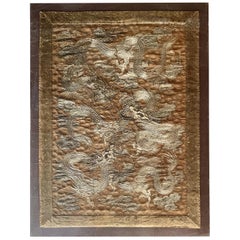
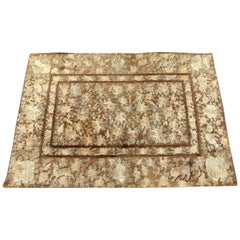
Antique Japanese Embroidery Tapestry Panel Edo Period
Located in Atlanta, GA
A large Japanese silk embroidery tapestry circa 18th century Edo period. Possibly an altar tablecloth originally, the embroidered textile pane...
Category
Antique 18th Century Japanese Edo Textiles
Materials
Silk
$3,200 Sale Price
20% Off
H 56 in W 80 in D 0.2 in
More From This Seller
View AllJapanese Indigo Dyed Old Embroidery Cloth / Japanese Toy Pattern / 1912-1960
Located in Sammu-shi, Chiba
It is a Japanese indigo dyed antique cloth.
It calls its name "fu-ro-shi-ki".
Originally used in the dressing room of the public bath "furo" during the...
Category
Early 20th Century Japanese Showa Textiles
Materials
Cotton
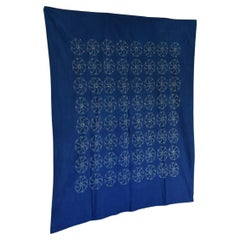
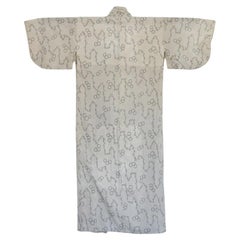
Old Japanese Kimono / 1912-1945 / Wall Hanging Decoration / Tapestry
Located in Sammu-shi, Chiba
I think this is a kimono woven from the Taisho era to the early Showa era (1912-1945) in Japan.
It is a modern design.
In the Taisho era, various things were made with reference to...
Category
Early 20th Century Japanese Taisho Tapestries
Materials
Cotton
Japanese Old Indigo Dyed Striped Fabric / Tapestry / early 20th century / BORO
Located in Sammu-shi, Chiba
This is an ancient Japanese indigo-dyed cloth produced between the end of the Meiji and Taisho periods. Three thin, evenly spaced yellowish lines create a regular rhythm on a deep in...
Category
Early 20th Century Japanese Taisho Textiles
Materials
Cotton
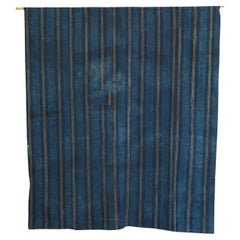
Antique Japanese Ink Painting Curtain/Wabi-Sabi Tapestry/1868-1920
Located in Sammu-shi, Chiba
This is an old Japanese noren curtain. It is believed to be made from a traditional Japanese fabric called asa or basho, made from banana leaf fibers. Noren curtains were originally ...
Category
Antique Late 19th Century Japanese Meiji Tapestries
Materials
Hemp

Old African Tapa (barkcloth) /20th century/Mbuti Barkcloth Textile/Tapestry
Located in Sammu-shi, Chiba
This cloth was made by the Mbuti people, a pygmy tribe living in the Democratic Republic of the Congo. The Mbuti are hunter-gatherers who live in the Ituri rainforest, a tropical rai...
Category
20th Century Congolese Other Textiles
Materials
Other
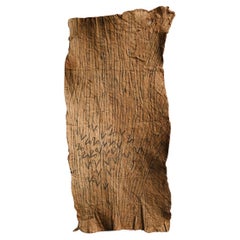
Japanese Antique Rag "BORO" 1800s-1860s / Abstract Art Wabi Sabi
Located in Sammu-shi, Chiba
This is an exceptionally old piece of Japanese fabric, dating back to the Edo period (1800s–1860s).
It has been carefully used to withstand the harsh winter cold.
Since ancient time...
Category
Antique Mid-19th Century Japanese Edo Textiles
Materials
Fabric
Still Thinking About These?
All Recently ViewedMore Ways To Browse
Alessio Nessi
Arabic Clothes
Persian Robe
Philippine Capiz Shells
Philippine Skirt
Chinese Silk Bedspread
Forbidden Stitch Silk Panel
Pua Kumbu
Hikeshi Banten
Chinese Bamboo Jacket
Japanese Fireman Jacket
Kira Textile
Vintage Japanese Tomesode
Chinese Embroidery Picture
Tablecloth 1970s
Used Fireman Jacket
Vintage 1950s Tablecloths
Indonesian Dyed Silk Lawon