1 of 4
Katagami (japanese Stencil), Meiji Era Japan
$166.42List Price
About the Item
- Dimensions:Height: 0.04 in (1 mm)Width: 12.6 in (32 cm)Depth: 16.15 in (41 cm)
- Style:Meiji (Of the Period)
- Materials and Techniques:Paper,Découpage
- Place of Origin:
- Period:
- Date of Manufacture:1868-1912
- Condition:Wear consistent with age and use.
- Seller Location:Saverne, FR
- Reference Number:1stDibs: LU8536237457712
Authenticity Guarantee
In the unlikely event there’s an issue with an item’s authenticity, contact us within 1 year for a full refund. DetailsMoney-Back Guarantee
If your item is not as described, is damaged in transit, or does not arrive, contact us within 7 days for a full refund. Details24-Hour Cancellation
You have a 24-hour grace period in which to reconsider your purchase, with no questions asked.Vetted Professional Sellers
Our world-class sellers must adhere to strict standards for service and quality, maintaining the integrity of our listings.Price-Match Guarantee
If you find that a seller listed the same item for a lower price elsewhere, we’ll match it.Trusted Global Delivery
Our best-in-class carrier network provides specialized shipping options worldwide, including custom delivery.You May Also Like
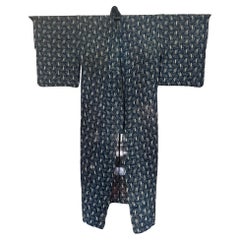
Japanese Woven Ikat and Stenciled Summer Usumono Kimono Meiji Period
Located in Atlanta, GA
On offer is a “Natsu No Kimono” (summer kimono) also called “Usumono" (thin clothes) dated from late Meiji Period circa late 19th to early 20th century. This well-preserved garment w...
Category
Early 20th Century Japanese Meiji Textiles
Materials
Linen
$1,600 / set
H 55 in W 45 in D 0.5 in
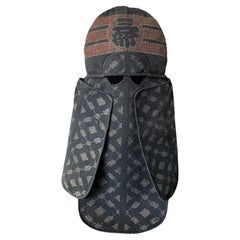
Japanese Fireman Hood with Stencil Inscription Meiji Period
Located in Atlanta, GA
A well-preserved Japanese fireman's hood (known as hikeshi zukin in Japanese) circa 1900s, late Meiji period. Woven with thick cotton with sashiko (co...
Category
Antique Early 1900s Japanese Japonisme Textiles
Materials
Cotton
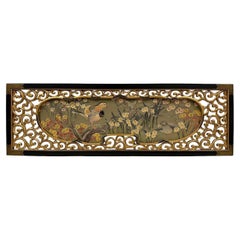
Antique Japanese Meiji era Framed Embroidery Wall Hanging
Located in Pomona, CA
Hand embroidered in Japan, this large framed silk embroidered wall art was made in Meiji era, approximated 1900s. Very detailed hand embroidere...
Category
Early 20th Century Chinese Chinese Export Textiles
Materials
Silk
$2,737 Sale Price
25% Off
H 24 in W 76 in D 1.5 in
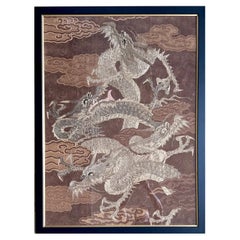
Framed Japanese Embroidery Dragon Tapestry Meiji Period
Located in Atlanta, GA
A striking Japanese embroidery tapestry circa 1890s Meiji period presented in a gilt wood frame under glaze. The design features four dragons coiling and slithering in the clouds. The most auspicious mythological creature, dragon was a very popular motif in Japanese textile art. Viewing this particular piece, one is struck by the superb craftsmanship with the profuse use of silver threads in satin stitches and complex chain stich coiling that create the background. The slight relief technique was also used on parts of the dragon heads, rendering the piece a strong sense of dimension and motion. The textile itself measures about 32.5"x46".
Japanese Meiji textiles were widely exhibited in the west during turn of the 20th century at the international exposition. It was used to showcase the Japanese aesthetics with the techniques at their pinnacle. These expositions solidified the country's images overseas and felled the Japanese craze in the west, which turned out to be a long-lasting influence on the western art. Many pieces were purchased and stayed in the west. As there is no brocade border present, the piece is likely the main part with the central motifs of a larger tapestry and was later framed for display.
For two similar dragon tapestries...
Category
Antique 1890s Japanese Meiji Textiles
Materials
Textile, Wood
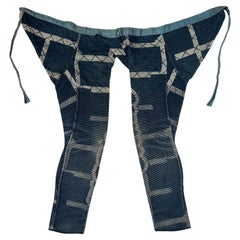
Antique Japanese Farmer
s Pants, Indigo, Cotton, Meiji
Located in Point Richmond, CA
Japanese farmer’s indigo cotton pants. Woven and dyed cotton, worn by farmers working in the field. Narrow legs and ties around the waist. As shown, the pants have been well used ...
Category
Early 20th Century Japanese Meiji Textiles
Materials
Cotton
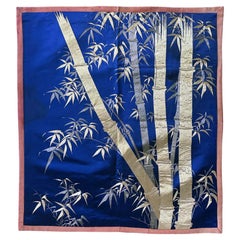
Japanese Embroidery Silk Bamboo Fukusa Meiji Period
Located in Atlanta, GA
A Japanese silk embroidery Fukusa panel circa 1890-1910s toward the end of Meiji Period. On the deep blue satin background, the artist showcases a clump of bamboos in a realistic sty...
Category
Early 20th Century Japanese Meiji Textiles
Materials
Silk
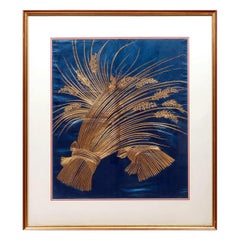
Framed Japanese Embroidery Silk Panel Meiji Period
Located in Atlanta, GA
A Japanese silk embroidery Fukusa panel presented in mat and glazed gilt wood frame circa 1890-1910s (end of Meiji Period). The blue silk pane...
Category
Antique 1890s Japanese Meiji Textiles
Materials
Silk
Meiji Period Japanese Indigo Double Ikat Futon Cover
Located in Point Richmond, CA
Meiji period Japanese Indigo double ikat futon cover
Japanese futon cover, a double ikat pattern in four panels depicting Kumamoto Castle with im...
Category
Antique 1890s Japanese Meiji Textiles
Materials
Cotton
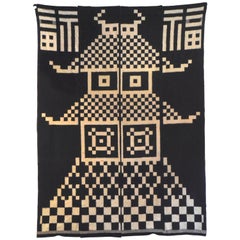
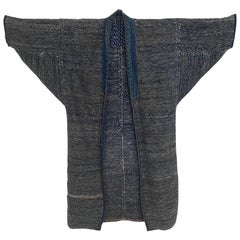
Saki-Ori Farmers Coat, Northern Japan, Meiji Period
Located in Point Richmond, CA
Saki-ori farmers coat, Northern Japan, Meiji period
A very heavy and substantial saki-ori coat, made of cotton with an indigo kasuri lapel. Several patches of hand sewn stitching ...
Category
20th Century Japanese Meiji Textiles
Materials
Cotton
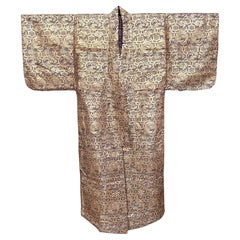
Japanese Brocade Noh Costume Kimono Robe Meiji Period
Located in Atlanta, GA
A Noh costume made from magnificent silk twill brocade woven with metallic gold threads circa 1930s. The robe is identified as "Atsuita", made for male actors in the Noh play. The luxuriant fabric has a deep blue background with golden interlocking hexagon pattern that resembles tortoise shells, the symbol of longevity. The motifs showcase three auspicious symbols in repetitive patterns: roundels of coiled dragon, phoenix and peony. The kimono robe...
Category
20th Century Japanese Meiji Textiles
Materials
Brocade, Silk
Still Thinking About These?
All Recently ViewedMore Ways To Browse
Antique Decoupage
Antique Furniture Stencils
Antique Japanese Kimono Kimonos And Textiles
Antique Decoupage Furniture
Decoupage Art
Vintage Silk Wall Hanging
Suzani Bedspread
Kaftan Saint Laurent
Yves Saint Laurent Kaftan
Antique Japanese Kimono Kimonos And Textiles
Moorish Caftan
Embroidered Bedspread
Antique Embroidered Persian Textiles
Antique Obi
Vintage Ikat Indonesia
Framed Chinese Embroidery
Uzbek Table
Uzbekistan Table