Items Similar to Rare Five Japanese Signed Oshi-E Textile Art Panels Meiji Period
Want more images or videos?
Request additional images or videos from the seller
1 of 21
Rare Five Japanese Signed Oshi-E Textile Art Panels Meiji Period
$1,800per item
£1,359.99per item
€1,558.13per item
CA$2,511.58per item
A$2,737.50per item
CHF 1,447.29per item
MX$32,954.28per item
NOK 18,369.73per item
SEK 16,841.29per item
DKK 11,639.32per item
Quantity
About the Item
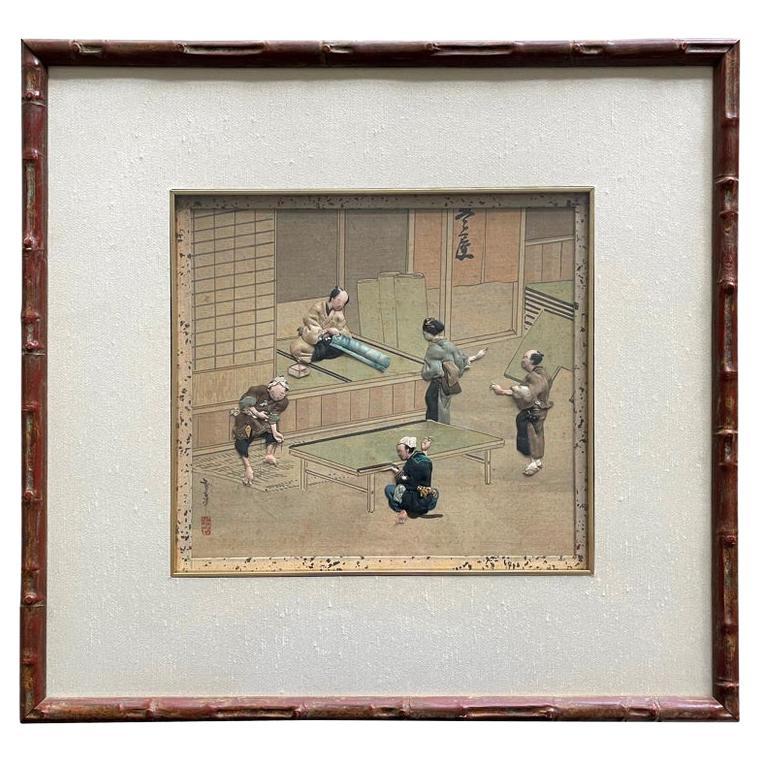
On offer is a set of five Japanese textile art panels called Oshi-E circa Meiji Period (1868-1912). This unusual set of panels depict various aspects of daily life in Edo time with beautiful details. Some of these panels are snapshots of the buzzling commercial activities at the marketplace, providing insight into the signages, architecture, costumes and how people interacted within a historical and pictorial context. Other panels depict daily leisure activities such as lounging in the park or visiting friends. The realistic rendering and attention to details are not short of "photographic" quality. From the signage of the shops to the motions and attires of the individual characters, from the hairstyle, small ornaments, down to the facial expression, were all recorded in great details. Each panel was signed with the artist's name Yukihana in Kanji with a red seal.
These panels are unframed and await your custom touch (framing with inner gilt spacer and mat costs about 250-500 depending on the material chosen, see a framed example in the last picture of a single framed panel we have for sale). We offer them for sale individually, but it will be great for a collector to consider the whole set so that they can stay together.
The Oshi-E (also known as kiritori zaiku) is a type of ornamental textile art dated back to the Muromachi period (1392-1573). It started among the elite aristocratic women in Kyoto before spreading wider in the Japanese society. Throughout Edo and Meiji period, Oshi-E were sometimes used to make offerings to the altars in the temple and in the late 19th century, it was exported to the west along with the other embroidery textile art. Oshi-E was made by using silk wadding to create a relief design. Various silk fabric swaps and sometimes wires and tassels, often recycled from older kimonos among the other pieces, were used to create different desired effects. Much detail was focused on the elaborate dresses, head wears, faces, and plants in the setting. Ink and watercolors were used to facilitate the details of the design such as the background painting and the facial detailing. The work was time-consuming and in Meiji period, it was considered as a feminine accomplishment along with ikebana, embroidery and tea ceremony.
According to the book: Threads of silk and gold: ornamental textile from Meiji Japan published by Ashmolean museum of art and archaeology University of Oxford, few examples survived to this day.
Reference: Threads of Silk and Gold: Ornamental Textile from Meiji Japan published by Ashmolean museum of art and archaeology University of Oxford. Page 178.
- Dimensions:Height: 10.5 in (26.67 cm)Width: 12 in (30.48 cm)Depth: 0.25 in (6.35 mm)
- Style:Meiji (Of the Period)
- Materials and Techniques:
- Place of Origin:
- Period:
- Date of Manufacture:1880-1900s
- Condition:Wear consistent with age and use. General minor surface wear consistent with age. Some panels show a bit more foxing. Wear on the raised edges that will not be visible once framed.
- Seller Location:Atlanta, GA
- Reference Number:1stDibs: LU945029234272
About the Seller
4.9
Platinum Seller
Premium sellers with a 4.7+ rating and 24-hour response times
Established in 2006
1stDibs seller since 2010
583 sales on 1stDibs
Typical response time: <1 hour
- ShippingRetrieving quote...Shipping from: Atlanta, GA
- Return Policy
More From This Seller
View AllFramed Japanese Oshi-E Textile Art Meiji Period
Located in Atlanta, GA
On offer is the last one of the set of seven framed Japanese textile art called Oshi-E circa Meiji Period (1868-1912). This rare set consists ...
Category
Antique 1890s Japanese Japonisme Textiles
Materials
Giltwood, Silk
Japanese Antique Fukusa Textile Art Meiji Period
Located in Atlanta, GA
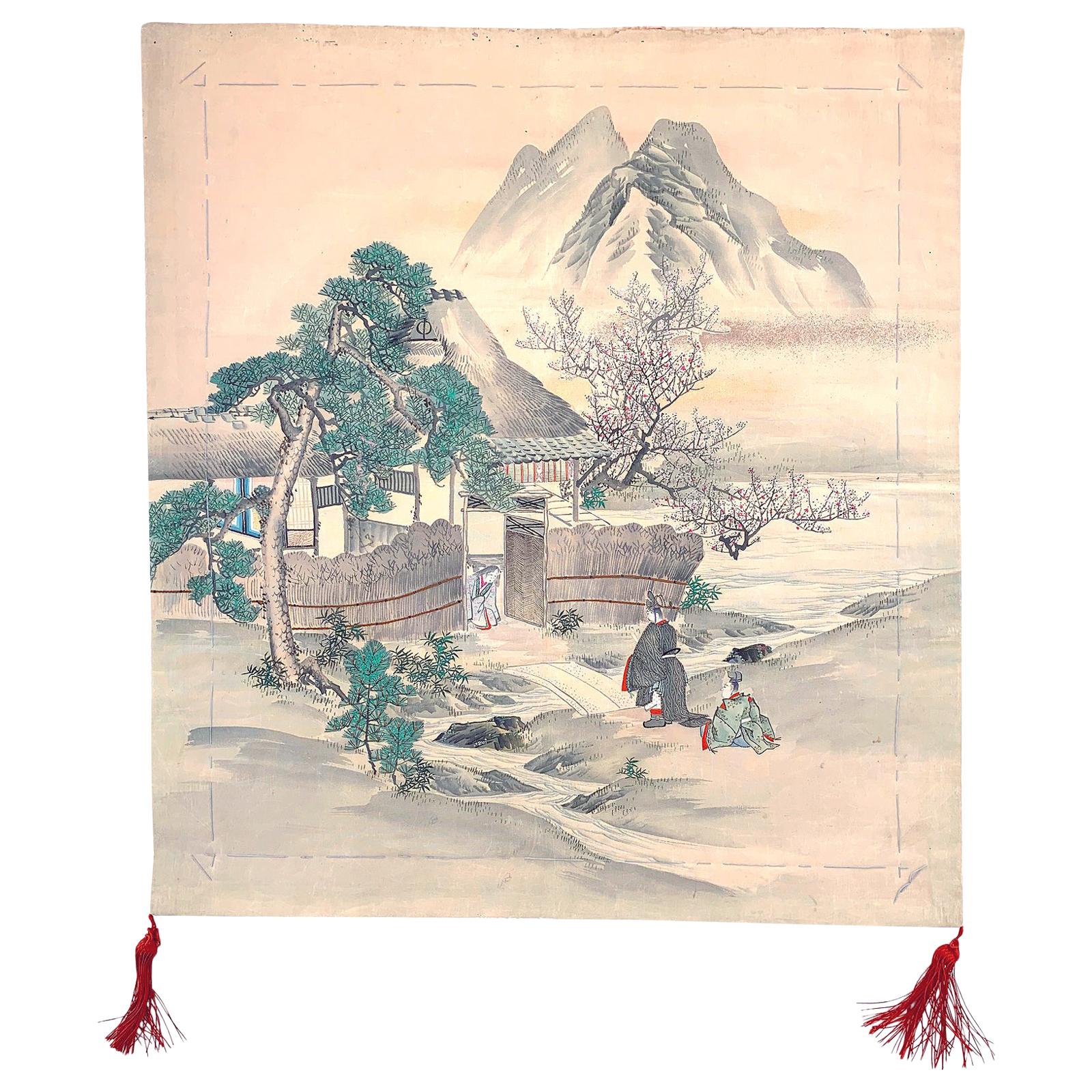
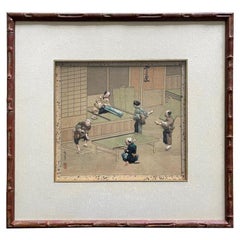
A Japanese silk Fukusa panel circa late 19th-early 20th century of Meiji Period. The front was beautifully decorated with Yuzen-zome, a labor intensive resist-dye technique invested by an artist monk Miyazaki Yuzensai (1654 -1736) of Edo period. The front cover likely depicts a scene from the Tale of Genji, showing a nobleman and his servant pays a visit to a lady in a fenced thatch-roof house under a high peak. The details of blossom trees and pines, as well as the characters, and scenery with a gradual color are astounding. It is telling that the Yuzen dying was used such an mastery.
The piece has a red silk backing and still retains two red tassels on the lower corners as well as decorative stitches along the edges. There is a patched design on the back likely a Mon symbol (family crest).
Fukusa is a traditional Japanese textile...
Category
Early 20th Century Japanese Japonisme Textiles
Materials
Silk
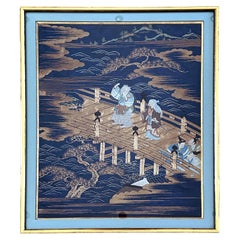
Framed Antique Japanese Embroidery Fukusa Panel Takasago Legend
Located in Atlanta, GA
A finely embroidered Japanese silk Fukusa panel presented in a beautiful silk-lined giltwood frame (newly framed and glazed), circa late 19th century of Meiji Period. Fukusa is a traditional Japanese textile art used to wrap and present gifts at important occasions. Depending on the occasion, the panel itself can be a very fine textile art on its own.
On the deep blue background, this elaborate textile art depicts an old couple standing on a bridge with three bystanders, flanked by pine trees with hills afar. The couple is Jotomba (Joo and Uba are their respective names), characters in the Legend of Takasago, one of the oldest Japanese mythologies, who are associated with old pines. The legend goes as: "At Takasago Shrine there is a very old pine tree, the trunk of which is bifurcated; in it dwells the spirit of the Maiden of Takasago who was seen once by the son of Izanagi who fell in love and wedded her. Both lived to a very great age, dying at the same hour on the same day, and since then their spirits abide in the tree, but on moonlight nights they return to human shape to revisit the scene of their earthly felicity and pursue their work of gathering pine needles. His pine tree is called “The Pine of Suminoe” while hers is "Takasago pine".
In Japan, Takasago couple...
Category
Antique Late 19th Century Japanese Meiji Textiles
Materials
Silk, Wood
Japanese Antique Fukusa Textile Art Meiji Period
Located in Atlanta, GA
A Japanese silk Fukusa panel circa late 19th-early 20th century of Meiji Period. The front was beautifully decorated with Yuzen-zome, a labor intensive resist-dye technique invested ...
Category
Early 20th Century Japanese Japonisme Textiles
Materials
Silk, Beads
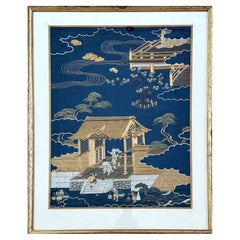
Framed Antique Japanese Embroidery Fukusa Textile Panel
Located in Atlanta, GA
A Japanese silk Fukusa Panel housed in a gilt frame circa late 19th century of Meiji Period. Fukusa is a traditional Japanese textile art used as a wrap for presenting gifts at important occasions. On the deep blue background, the elaborate embroidery work depicts a historical scene where street vendors selling goods to a royal household or an aristocratic residence. The scene focuses on the activities at the front gate where the couriers and servants were busying carrying the goods in. A peasant with straw coat...
Category
Antique Late 19th Century Japanese Meiji Textiles
Materials
Silk, Wood
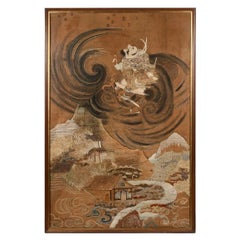
Framed Japanese Antique Embroidery Sennin Tapestry Meiji Period
Located in Atlanta, GA
A stunning Japanese embroidery tapestry circa 1880s-1900s from late Meiji period, presented with an original wood frame with inner gold trim. The tour-de-force embroidered tapestry s...
Category
Antique 1890s Japanese Meiji Textiles
Materials
Silk, Giltwood
You May Also Like
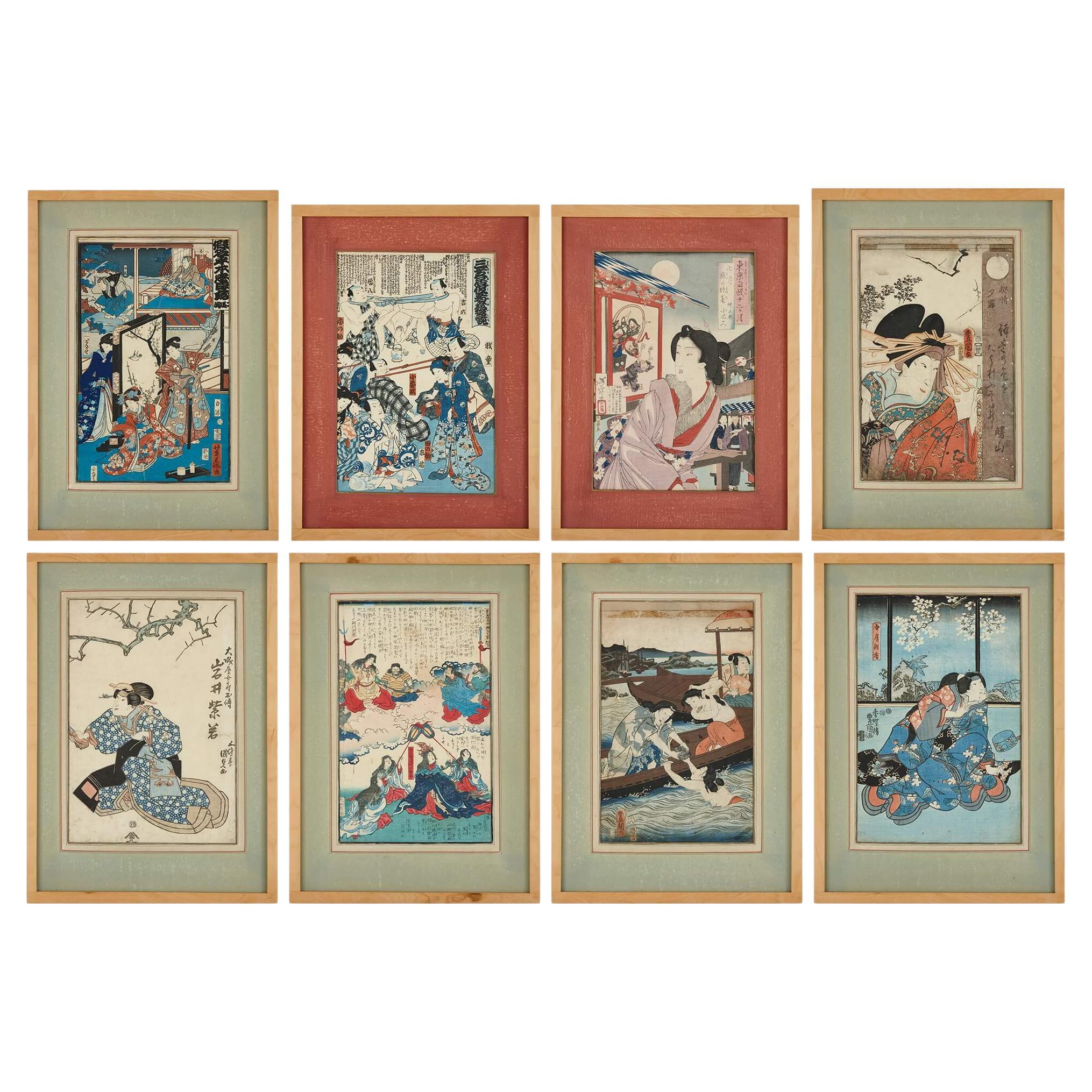
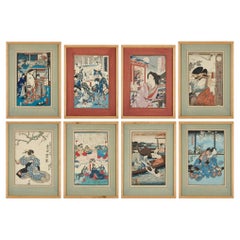
Set of Eight Japanese Meiji Era Woodblock Prints
Located in London, GB
A set of eight Japanese Meiji era woodblock prints
Japanese, Late 19th century
Measures: Frames: small: height 50cm, width 37cm, depth 1.5cm - prints 35 x 24
Large: height 52cm, w...
Category
Antique Late 19th Century Japanese Meiji Prints
Materials
Paper
$6,196 / set
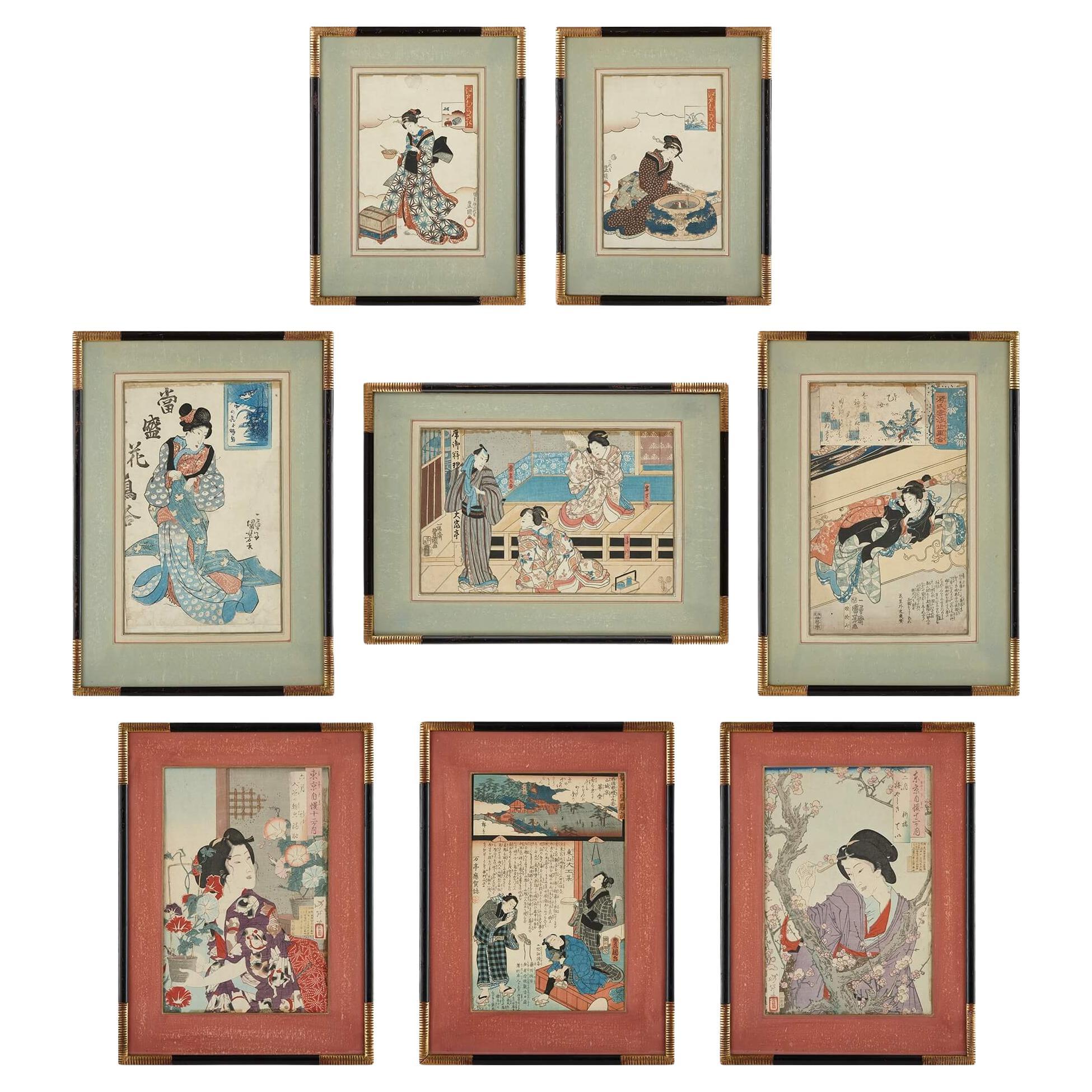
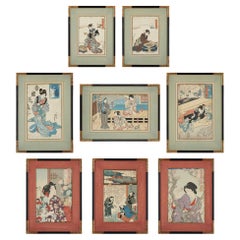
Set of Eight Japanese Meiji Era Woodblock Prints
Located in London, GB
A set of eight Japanese Meiji Era woodblock prints.
Japanese, Late 19th century.
Frames: small: height 40cm, width 31cm, depth 1cm - prints: 25 x 17.
Medium: height 49cm, width 37...
Category
Antique Late 19th Century Japanese Meiji Prints
Materials
Paper
$6,196 / set
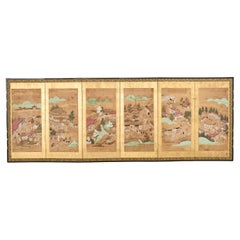
19th Century Japanese Edo Six Panel Screen Scenes of Kyoto
Located in Rio Vista, CA
Fascinating Japanese 19th century Edo period six-panel Rakuchu Rakugai folding byobu screen featuring scenes in and around the capitol Kyoto, Japan. This type of non-commissioned scr...
Category
Antique 19th Century Japanese Edo Paintings and Screens
Materials
Brass, Gold Leaf
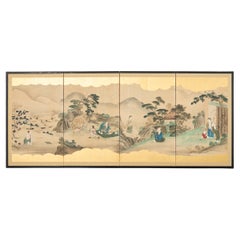
Japanese Edo Four Panel Screen Paragons of Filial Piety
Located in Rio Vista, CA
Late 19th century Edo period Japanese four panel folding byobu screen depicting four of the twenty-four paragons of filial piety. Beautifully painted in the Maruyama-Shijo style. The...
Category
Antique 19th Century Japanese Edo Paintings and Screens
Materials
Brass, Gold Leaf
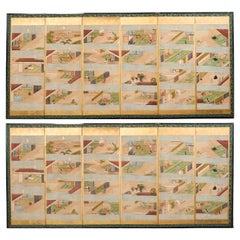
Pair Japanese Edo Six Panel Screens Tale of Genji
Located in Rio Vista, CA
Incomparable pair of late 18th century Japanese Edo period folding six-panel byobu screens depicting all 54 chapters of the tale of Genji in vignettes. Each illustration has a cartou...
Category
Antique 18th Century Japanese Edo Paintings and Screens
Materials
Brass, Gold Leaf
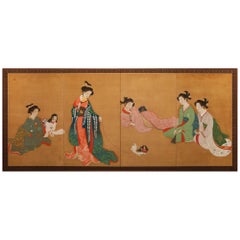
Meiji Period Japanese Four Panel Screen Bijin At Leisure
Located in Hudson, NY
Japanese four panel screen: Bijin At Leisure. Ladies in a tea house with a small dog. Seal reads "Ensan dai" (drawn by Ensan). Meiji Period (1868 - 1912) pa...
Category
Antique Late 19th Century Japanese Meiji Paintings and Screens
Materials
Silk, Wood
More Ways To Browse
Antique Fabrics And Textiles Fabric Textiles
Meiji Silk
Japanese Meiji Panel
Japanese 19th Century Meiji Period Silk Painting
Antique Japanese Kimono Kimonos And Textiles
Muromachi Period
Silk Bed Cover
Embroidered Wall Hangings
Vintage Asian Decor
Suzani Bed Cover
India Textile Art
Vintage Textile Wall Hanging
Middle Eastern Kaftan
Ikat Weavings
Ikat Indonesia
Indonesian Ikat
Japanese Obi
Japanese Silk Embroidered