Want more images or videos?
Request additional images or videos from the seller
1 of 21
Rare Historical Set Japanese Oshi-E Textile Art Panels Meiji Period
$6,600List Priceper set
About the Item
- Dimensions:Height: 8 in (20.32 cm)Width: 7.25 in (18.42 cm)Depth: 0.1 in (2.54 mm)
- Sold As:Set of 11
- Style:Meiji (Of the Period)
- Materials and Techniques:
- Place of Origin:
- Period:
- Date of Manufacture:1891
- Condition:Wear consistent with age and use. Fine antique condition with little toning and occasional wear along the edges. Slightly arched with nature. The tomobako box shows lots of wear and cracks.
- Seller Location:Atlanta, GA
- Reference Number:1stDibs: LU945038970402
About the Seller
4.9
Platinum Seller
Premium sellers with a 4.7+ rating and 24-hour response times
Established in 2006
1stDibs seller since 2010
588 sales on 1stDibs
Typical response time: 1 hour
Authenticity Guarantee
In the unlikely event there’s an issue with an item’s authenticity, contact us within 1 year for a full refund. DetailsMoney-Back Guarantee
If your item is not as described, is damaged in transit, or does not arrive, contact us within 7 days for a full refund. Details24-Hour Cancellation
You have a 24-hour grace period in which to reconsider your purchase, with no questions asked.Vetted Professional Sellers
Our world-class sellers must adhere to strict standards for service and quality, maintaining the integrity of our listings.Price-Match Guarantee
If you find that a seller listed the same item for a lower price elsewhere, we’ll match it.Trusted Global Delivery
Our best-in-class carrier network provides specialized shipping options worldwide, including custom delivery.You May Also Like
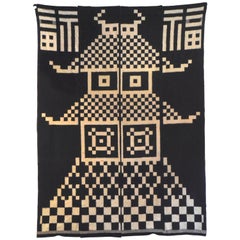
Meiji Period Japanese Indigo Double Ikat Futon Cover
Located in Point Richmond, CA
Meiji period Japanese Indigo double ikat futon cover
Japanese futon cover, a double ikat pattern in four panels depicting Kumamoto Castle with im...
Category
Antique 1890s Japanese Meiji Textiles
Materials
Cotton
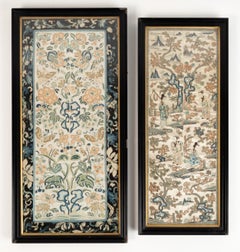
Pair of 19th Century Chinese Textile Qing Dynasty Embroidered Sleeve Panels
Located in London, GB
A Pair Of Chinese Embroidered Sleeve Panels.
China, 19th Century, Qing Dynasty.
Antique textile ff rectangular form, with a central seam, one decora...
Category
Antique 19th Century Chinese Qing Textiles
Materials
Silk
$7,309 / set
H 24.02 in W 11.82 in D 0.79 in
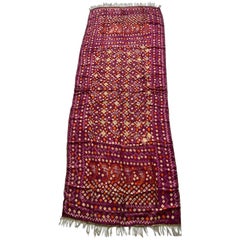
Antique Burnt Orange and Purple Silk Textile
Located in New York, NY
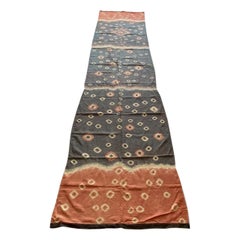
Stunning contrasting colors featuring a metallic fringe on this beautiful fine silk, tie dye ceremonial shoulder cloth from Palembang, Sumatra. Early 20 century.
There are 2 very small holes shown on the last image, to be expected due to the age. We only source the best. This beautiful shawl can be worn or used as a wall hanging framed...
Category
Early 20th Century Indonesian Tribal Textiles
Materials
Silk
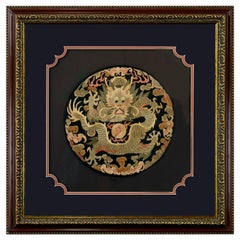
Chinese Dragon, Framed Silk Textile Surcoat Embroidery
Located in Soquel, CA
Late 19th century Chinese silk embroidery rank badge textile, with a finely detailed dragon along with other various symbols embro...
Category
Antique 1890s Chinese Qing Textiles
Materials
Silk
Linen and Cotton Antique Textile from Toraja Land
Located in New York, NY
Striking “pelangi” tie-dyed textile from Toraja Land, South Sulawesi. We added a linen border, double backed on both ends. This beautiful panel can be used as a wall hanging, draped ...
Category
Mid-20th Century Indonesian Tribal Textiles
Materials
Cotton, Linen
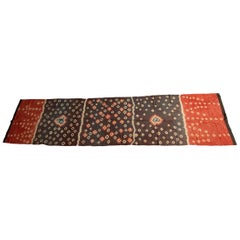
Linen and Cotton Antique Textile from Toraja Land
Located in New York, NY
Striking "pelangi" tie-dyed textile from Toraja Land, South Sulawesi. We added a linen border, double backed on both ends. This beautiful panel can be used as a wall hanging, draped ...
Category
Mid-20th Century Indonesian Tribal Textiles
Materials
Cotton, Linen
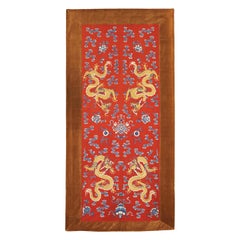
Five Clawed Dragon Chinese Silk and Metallic Thread Embroidered Textile
Located in Ferrara, IT
In this amazing textile, dragons with five claws are flying among the clouds and seem to be protecting a very special diamond. In the past, the dragon was a symbol of power and luck....
Category
Antique Late 19th Century Chinese Other Textiles
Materials
Metallic Thread
$11,246
H 85.04 in W 33.86 in D 0.12 in
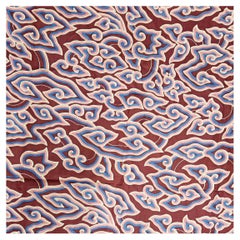
Vintage Hand Painted Oriental Cloud Batik Indonesian Textiles Interior Design
Located in London, GB
Fine Hand printed Oriental cloud batik
A Indonesian Cirebon batik hand printed in a traditional Chinese cloud style with graduated blue and red
Perfect...
Category
Mid-20th Century Indonesian Textiles
Materials
Cotton
$266
H 82.68 in W 37.8 in D 0.4 in
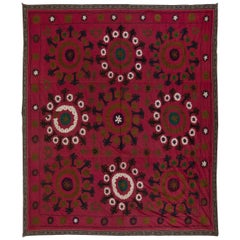
7x7.4 Ft Central Asian Suzani Textile, Embroidered Cotton
Silk Wall Hanging
Located in Spring Valley, NY
In the most technical sense of the word, "Suzani," in Central Asia and Iran, means needle and is used to describe this type of needlework, but to most people, such as decorators or c...
Category
Late 20th Century Uzbek Suzani Textiles
Materials
Cotton, Silk
$653 Sale Price
34% Off
Free Shipping
H 87.8 in W 81.89 in D 0.04 in
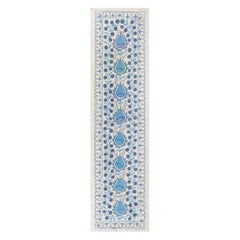
1.7x6.2 Ft Central Asian Suzani Textile. Embroidered Cotton
Silk Table Runner
Located in Spring Valley, NY
In the most technical sense of the word, "Suzani," in Central Asia and Iran, means needle and is used to describe this type of needlework, but to most people, such as decorators or c...
Category
2010s Uzbek Suzani Textiles
Materials
Cotton, Silk
$298 Sale Price
25% Off
Free Shipping
H 73.63 in W 19.69 in D 0.04 in
More From This Seller
View AllRare Five Japanese Signed Oshi-E Textile Art Panels Meiji Period
Located in Atlanta, GA
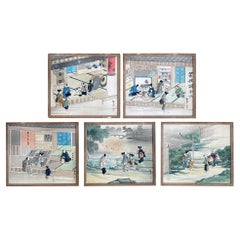
On offer is a set of five Japanese textile art panels called Oshi-E circa Meiji Period (1868-1912). This unusual set of panels depict various aspects of daily life in Edo time with beautiful details. Some of these panels are snapshots of the buzzling commercial activities at the marketplace, providing insight into the signages, architecture, costumes and how people interacted within a historical and pictorial context. Other panels depict daily leisure activities such as lounging in the park or visiting friends. The realistic rendering and attention to details are not short of "photographic" quality. From the signage of the shops to the motions and attires of the individual characters, from the hairstyle, small ornaments, down to the facial expression, were all recorded in great details. Each panel was signed with the artist's name Yukihana in Kanji with a red seal.
These panels are unframed and await your custom touch (framing with inner gilt spacer and mat costs about 250-500 depending on the material chosen, see a framed example in the last picture of a single framed panel we have for sale). We offer them for sale individually, but it will be great for a collector to consider the whole set so that they can stay together.
The Oshi-E (also known as kiritori zaiku) is a type of ornamental textile art dated back to the Muromachi period (1392-1573). It started among the elite aristocratic women in Kyoto before spreading wider in the Japanese society. Throughout Edo and Meiji period, Oshi-E were sometimes used to make offerings to the altars in the temple and in the late 19th century, it was exported to the west along with the other embroidery textile art. Oshi-E was made by using silk wadding to create a relief design. Various silk fabric swaps and sometimes wires and tassels, often recycled from older kimonos...
Category
Antique 1890s Japanese Meiji Textiles
Materials
Silk, Giltwood
Framed Japanese Oshi-E Textile Art Meiji Period
Located in Atlanta, GA
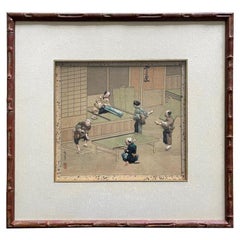
On offer is the last one of the set of seven framed Japanese textile art called Oshi-E circa Meiji Period (1868-1912). This rare set consists ...
Category
Antique 1890s Japanese Japonisme Textiles
Materials
Giltwood, Silk
Japanese Antique Fukusa Textile Art Meiji Period
Located in Atlanta, GA
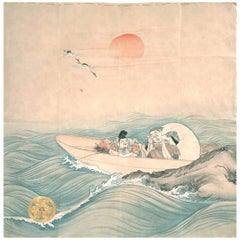
A Japanese silk Fukusa panel circa late 19th-early 20th century of Meiji Period. The front was beautifully decorated with Yuzen-zome, a labor intensive resist-dye technique invested ...
Category
Early 20th Century Japanese Japonisme Textiles
Materials
Silk, Beads
Japanese Antique Fukusa Textile Art Meiji Period
Located in Atlanta, GA
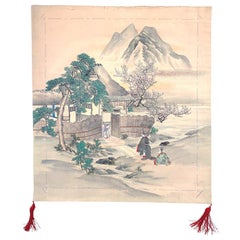
A Japanese silk Fukusa panel circa late 19th-early 20th century of Meiji Period. The front was beautifully decorated with Yuzen-zome, a labor intensive resist-dye technique invested by an artist monk Miyazaki Yuzensai (1654 -1736) of Edo period. The front cover likely depicts a scene from the Tale of Genji, showing a nobleman and his servant pays a visit to a lady in a fenced thatch-roof house under a high peak. The details of blossom trees and pines, as well as the characters, and scenery with a gradual color are astounding. It is telling that the Yuzen dying was used such an mastery.
The piece has a red silk backing and still retains two red tassels on the lower corners as well as decorative stitches along the edges. There is a patched design on the back likely a Mon symbol (family crest).
Fukusa is a traditional Japanese textile...
Category
Early 20th Century Japanese Japonisme Textiles
Materials
Silk
Japanese Antique Fusuka Textile Art Meiji Period
Located in Atlanta, GA
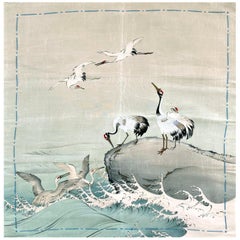
A Japanese silk Fukusa panel circa late 19th-early 20th century of Meiji Period. The front was beautifully decorated with Yuzen-zome, a labor intensive resist-dye technique invested by an artist monk Miyazaki Yuzensai (1654 -1736) of Edo period. The auspicious composition features a group of red-crown cranes, the symbol of longevity. Three of them perch on the rock by the ocean (East Sea) an two of them are in flight. Additionally, two egrets frolic in the wave. Yuzen dying was used extensively to showcase the amazing details such as the waves and the gradual coloring effect. Embroidery was used sparsely to highlight areas such as the legs of the crane to render it more dimensional details.
The piece has a red silk backing and still retains four blue tassels on corners as well as decorative stitches along the edges.
Fukusa is a traditional Japanese textile...
Category
Early 20th Century Japanese Japonisme Textiles
Materials
Brocade, Silk
Framed Japanese Woven Textile Panel with Dragon Meiji Period
Located in Atlanta, GA
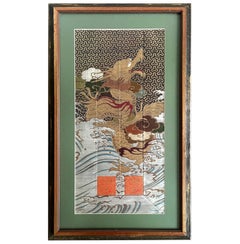
A framed Japanese woven textile circa late 19th century of Meiji Period. Likely a fragment of a priest robe or kesa, the multi-paneled textile was finely woven with gold foiled threads that depicts a five-clawed dragon slithering in the clouds and water...
Category
Antique 19th Century Japanese Meiji Textiles
Materials
Silk, Wood
Still Thinking About These?
All Recently ViewedMore Ways To Browse
Japanese 19th Century Meiji Period Silk Painting
Muromachi Period
Japanese Applique
Asian Fabric Panels
Embroidered Bedspread
Antique Embroidered Persian Textiles
Antique Obi
Vintage Ikat Indonesia
Framed Chinese Embroidery
Uzbek Table
Uzbekistan Table
Chinoiserie Embroidery
Qing Embroidery
Asian Men
Chinese Embroidered Panel
Rank Badge
Antique Chinese Robe
Brocade Kimono