Powder-Coated Fireplaces and Mantels
to
1
1
Height
to
Width
to
1
1
1
1
1
1
1
1
1
1
1
Technique: Powder-Coated
Wesix Portable Space Heater
By Wesix Electric Heater Co.
Located in Los Angeles, CA
Portable space heater by Wesix. The heater features a round bulbous shape with minimalist curved screen and the original porcelain heating element and wiring. The piece showcases an ...
Category
Mid-20th Century American Minimalist Powder-Coated Fireplaces and Mantels
Materials
Steel, Iron

Related Items
Arts
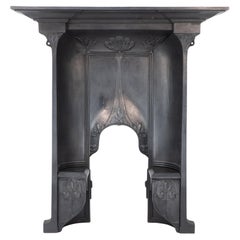
Crafts cast iron fireplace with curved sides
stylized floral decoration
Located in London, GB
An Arts and Crafts cast iron fireplace with curved sides designed to throw more heat into the room with stylized floral decoration throughout, pillars to the sides and heating shelve...
Category
Early 1900s English Arts and Crafts Antique Powder-Coated Fireplaces and Mantels
Materials
Berlin Iron

$3,854
H 50.6 in W 44.49 in D 8.67 in
19th Century French Green Enameled Cast Iron Heater Stove
By A. Klein
Located in Den Haag, NL
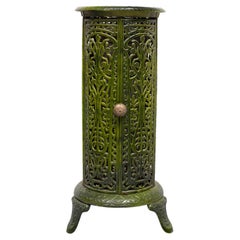
A late 19th century French enameled cast iron parlor heating stove. This antique stove features a tubular shaped body with two doors and a removable Cer...
Category
1890s French Victorian Antique Powder-Coated Fireplaces and Mantels
Materials
Enamel
Italian Four-Piece Brass Vintage Fireplace Fire Tool Set with Stand
Located in Carimate, Como
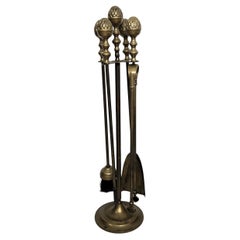
Italian brass four-piece fire tool set with stand. The set consists of a poker, a shovel and a pair of tongs, each with an ornate handle such as the stand.
Category
Late 20th Century Italian Hollywood Regency Powder-Coated Fireplaces and Mantels
Materials
Brass
Fire Cradle by VERMONTICA
By Scott Gordon
Located in Sharon, VT
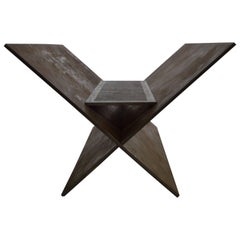
The Fire Cradle is an elemental fire feature crafted from intersecting planes of 3/8" corten steel. Designed by Scott Gordon and fabricated in Vermont, the Fire Cradle blends sculptu...
Category
21st Century and Contemporary American Minimalist Powder-Coated Fireplaces and Mantels
Materials
Steel
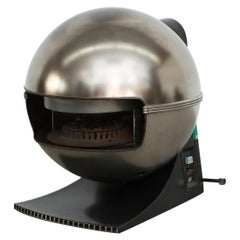
Mid-Century, Space Age, Model
2000
gas stove by Richard Wolthekker, 1965
Located in Los Angeles, CA
A Model '2000' gas stove in steel, a strikingly beautiful, Mid-Century, minimalist space age design by Richard Wolthekker from 1965. Made by Faber in The Netherlands. The spherical f...
Category
1960s Dutch Mid-Century Modern Vintage Powder-Coated Fireplaces and Mantels
Materials
Metal, Steel
$3,850
H 28.5 in W 25.25 in D 26 in
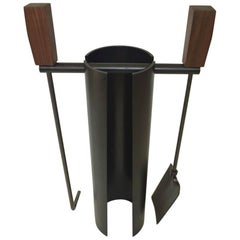
Contemporary Minimalist Blackened Steel or Walnut Fire Tools Set by Scott Gordon
By Scott Gordon
Located in Sharon, VT
The fire tools set, an original design offered exclusively by Vermontica, is designed and produced in Vermont by Scott Gordon. A sculptural element for the hearth that stands apart. Features walnut...
Category
21st Century and Contemporary American Minimalist Powder-Coated Fireplaces and Mantels
Materials
Steel
$1,760 Sale Price / item
20% Off
H 28 in Dm 10 in
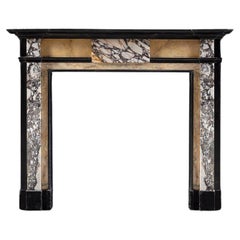
Striking George II Style Chimneypiece in Belgium Black, Siena
Breche Violette
Located in London, GB
A Striking George II Style Chimneypiece Carved from Belgium Black, with Veneers of Sienna and Specimen Breche Violette
These dramatic, contrasting marbles are united in this classic...
Category
19th Century English Regency Antique Powder-Coated Fireplaces and Mantels
Materials
Marble, Belgian Black Marble, Breccia Marble, Siena Marble
$17,208
H 57.49 in W 71.26 in D 7.09 in
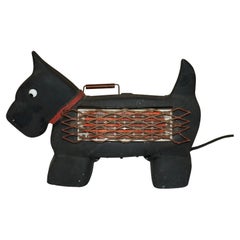
ORIGINAL RESTORED ART DECO ZOORAY HiGHLAND TERRIER SCOTTIE DOG ELECTRIC HEATER
Located in West Sussex, Pulborough
Royal House Antiques
Royal House Antiques is delighted to offer for this exquisite totally original fully restored Art Deco Zooray Highland Terrier electric heater...
Category
20th Century English Art Deco Powder-Coated Fireplaces and Mantels
Materials
Metal
$1,032
H 13 in W 19.3 in D 6.7 in
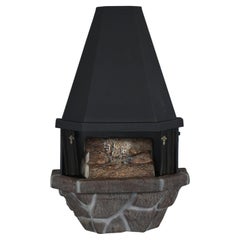
Mid-Century Wall Mounted Faux Stone Electric Fireplace with Space Heater
Located in Chattanooga, TN
A charming Mid-Century Modern wall-mounted electric fireplace by Sears Roebuck, complete with its original crackling illuminated logs and functional space heater. Combining nostalgic...
Category
1970s American Mid-Century Modern Vintage Powder-Coated Fireplaces and Mantels
Materials
Metal
$1,036 Sale Price
20% Off
H 56.5 in W 35.25 in D 13.5 in
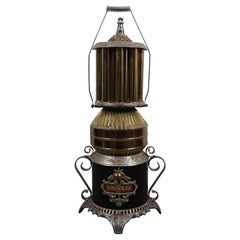
Rare Antique American Central Oil
Gas Lighthouse 110 Stove Heater 33"
Located in Dayton, OH
A rare and impressive American Central Oil & Gas Lighthouse 110 heater.
Dating back to the 1880s, they were manufactured at the American Oil Stove Co. in Gardner, later at the Cen...
Category
Late 19th Century Victorian Antique Powder-Coated Fireplaces and Mantels
Materials
Metal
$2,450 Sale Price
30% Off
H 33 in W 13 in D 14 in
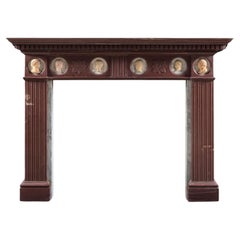
A Highly Important Empire Period Rosso Antico Chimneypiece with Portrait Reliefs
Located in London, GB
A Highly Important Empire Period Rosso Antico Chimneypiece Inset with Specimen Marble Portrait Reliefs of Roman Emperors
The carved and veneered surround comprising a moulded
shelf supported by a bold dentil cornice, above an inverted breakfront frieze carved with a central triglyph panel, flanked by a pair of rosettes carved in shallow relief, the frieze mounted with six carved hardstone profile portrait medallions of Roman Emperors, the stop-fluted jambs raised on moulded footblocks; in excellent condition with small restorations commensurate with age and use; the pale inclusions in the stone naturally formed.
This spectacular neoclassical marble chimneypiece is carved from Rosso antico, the frieze inset with six portrait reliefs of Roman Emperors, each carved in marmo giallo on a bardiglio background, five variously incised: VESPASIANUS, TIBERIVS, OTHO, JULIUS CAESAR, TITUS.
Rosso antico (marmor taenarium) is first recorded as being quarried in 1700 BC at Akra Tainaron (Cape Matapan), Greece.¹ The majority of this stone, however, was extracted throughout the Roman period, when it was one of the most coveted materials for carving due to its rich red colouring and association with highly prized Egyptian ‘Imperial’ Porphyry.² Rosso antico was chosen in antiquity for portrait busts, notably depicting Bacchic subjects such as Dionysus and satyrs due to its rich red wine colour which symbolised conviviality whilst conveying the education and cultivated taste of the owner.³ In the Renaissance, Rosso antico was also used for architectural detail on important buildings, such as the steps leading up to the choir in the medieval church of S. Prassede, and the large columns at the entrance to the Camera dell'Aurora.⁴
In 121 AD, G. Suetonius Tranquillus, secretary to Emperor Hadrian, wrote a biographical history of the first twelve emperors of Rome entitled De vita Caesarum (The Twelve Caesars). A Renaissance edition of Tranquillus’ work was published in 1470, followed by further reprints and translations into all the main European languages. Many of these were illustrated with prints of emperors taken from coins and statues, or imagined by the artist based on Tranquillus’ accounts. These interpretations were copied, in turn, by Renaissance designers for medals, Limoges enamels, and busts, as well as paintings such as the Eleven Caesars, a series of eleven half-length portraits of Roman emperors made by Titian in 1536–40 for Federico II, Duke of Mantua.⁵ These paintings were later given to King Charles I, before being passed in the Commonwealth to the Kings of Spain. Unfortunately, the series was destroyed in the catastrophic fire of 1734 at the Royal Alcazar of Madrid, and is now only known through copies and engravings.⁶
From the middle of the 17th century until the end of the 18th century, there was an insatiable demand for marble carvings, often sold as Roman or assembled from ancient fragments, thus perpetuating the reverence for antiquity that was the quintessence of the Grand Tour. Rosso antico was in extremely short supply, even after the ancient quarries at Skutari were rediscovered in 1830, and remained one of the most highly valued of all stones. Described in 1776 as ‘dark red; scarce and dear’, it was mostly used for small objects such as Grand Tour desk ornaments, inevitably using material re-cut from classical fragments, due to its rarity, as was the case with porphyry.⁷ The portrait roundels on this chimneypiece are typical of those produced in Rome and Florence in hardstones, semi-precious stones, gold, silver, bronze, and mother-of-pearl, which, being easily transportable, would be taken home from the Grand Tour to be mounted within wooden, gilded or brass frames, as fashion dictated.⁸ A group of gold portraits of Caesars, dating from around 1660, are in the Museo Nazionale del Bargello in Florence. Images of Roman emperors were not limited to Italy, England and France, however, as examples executed in Deshima for the Dutch East India Company (Verenigde Oost-Indische Compagnie) show. Medallions depicting Roman emperors, invariably made of black and gold Japanese hiramakie or takamakie lacquer on copper, were produced for the Dutch market at the end of the 18th century. Examples can be found in the Rijksmuseum, Amsterdam.⁹
There are two possible sources for the Imperial profiles on the chimneypiece: the engravings of The Twelve Caesars by Marcantonio Raimondi, or the Imperatorum Imagines by Hubert Golz.¹⁰ The portrait medallions also bear remarkable resemblance to a set of eighteen carved portrait reliefs of Roman Emperors, also of marmo giallo, almost certainly bought by David Ker (1742–1811) of Portavo, Co. Down, on his Grand Tour between 1792–4 in either Florence or Rome. Ker’s diary entry for 17th October 1793 is interesting as it reveals that he was offering his brother a choice of chimneypiece designs, which further supports a Roman origin for the offered example.¹¹ Indeed, fire surrounds incorporating antique fragments had been promoted from the late 1760s by Giovanni Battista Piranesi (1720–78), encouraged by Rome-trained architects including Robert Adam (d.1792). One such example, inset with mythological tablets carved from Rosso antico, was acquired by the 9th Earl of Exeter from Piranesi himself for Burghley House.¹² Another can be found at Islington House, Dorset.¹³ A third, inset with giallo antico and Rosso antico, follows Piranesi’s engraved design dated 1769 for a fire surround mounted with three marble portrait reliefs.¹⁴ It should be re-emphasised that Rosso antico was so precious that it was only ever used for small tablets or details rather than an entire chimneypiece, as with the offered example; likewise, while portrait reliefs are occasionally seen on the jambs of Italian surrounds, it is exceptionally rare to see the frieze mounted with a group, especially of this scale: the combination indicates an architectural commission by an extremely wealthy patron.
The sophisticated lines of this chimneypiece epitomise the French Empire influence on the Italian states at the turn of the 18th century. This idiosyncratic ‘Roman’ taste is encapsulated by that of Napoleon, who identified with Rome’s Imperial past. Napoleon’s desire to establish a visual link between himself and Roman emperors is demonstrated by the portraits of his court painter, Jacques-Louis David, inspired by portraits of Emperor Augustus. This Imperial taste extended to architecture, furniture and porcelain, the latter two of which are combined in a group of magnificent ormolu-mounted guéridons commissioned in Sèvres between 1803–11, made to immortalise Napoleon’s reign.¹⁵ The second guéridon in the series, the Table des Grands Capitaines (Table of the Great Commanders of Antiquity), commissioned in 1806, is made almost entirely of hard-paste Sèvres porcelain. The top, painted in imitation of sardonyx, is centred by a portrait cameo of Alexander the Great, surrounded by twelve smaller heads of commanders and philosophers from antiquity: Pericles, Scipio Africanus, Pompey, Augustus, Septimus Severus, Constantine, Trajan, Caesar, Mithridates, Hannibal, Themistocles and Miltiades.¹⁶ Louis XVIII presented the table to the Prince Regent (later King George IV) in 1817 as a token of appreciation for Napoleon’s defeat two years earlier, and George IV treasured it so highly that it became part of the ceremonial backdrop for all his state portraits. The table remains in the Royal Collection.¹⁷
This chimneypiece remained, until recently, in the possession of a noble Dutch family, who acquired it from the owners of a bombed Knightsbridge house in the 1940s; unfortunately, its provenance prior to this has been lost.
The use of Rosso antico on this scale, inset with these splendid Imperial profile medallions, appears unparalleled.
1. J. B. Grossman, 'Looking at Greek and Roman Sculpture in Stone' (Los Angeles, 2003). Grossman states that this material was ‘...quarried in three places during antiquity: on Cape Tainaron present day Matapan on the Peloponnese of Greece; on Crete; and at the site of Iasos in Asia Minor.
2. L. Lazzarini, ‘Rosso antico and other red marbles used in antiquity: a characterization study’, Marble, Art Historical and Scientific Perspectives on Ancient Sculpture’ (1990), 237–252. C. Gorgoni, L. Lazzarini, P. Pallante, ‘New archaeometric data on Rosso antico and other red marbles used in antiquity, ASMOSIA VI, Interdisciplinary Studies on Ancient Stone’ (2002), pp. 199–206. J. Deér, trans. G.A. Gilhoff, The Dynastic Porphyry Tombs of the Norman Period in Sicily (Cambridge, 1959), p. 144. R. Gnoli, Marmora Romana (Rome, 1988), pp. 187–191.
3. A notable example is a satyr from the Emperor Hadrian's villa at Tivoli, now in the Capitoline Museum, Rome. Another is the head of a satyr in the Minneapolis Institute of Arts, accession no. 2006.110. See T. Opper, Hadrian. Empire and Conflict (London, 2008), p. 165, fig. 149.
4. De Luca, Marmi antichi (Rome, 1998), p. 126. Faustino Corsi, Catalogo ragionato d’una collezione di pietre di decorazione (Rome, 1833), p. 93.
5. For related Limoges medallions, see set of ten circular Limoges enamel medallions depicting Roman emperors, en grisaille with gilding, from the workshop of Jacques I Laudin, sold Christie’s London, Fine Renaissance Bronzes and Works of Art, 19 December, 1977, lot 95.
6. See set of drawings sold Sotheby’s London, Of Royal and Noble Descent, 24 February, 2015, lot 184.
7. J. J. Ferber, Raspe’s Travels through Italy in the Years 1771–1772 (London, 1776), p. 218.
8. See Sotheby’s London, Pelham, the Public and the Private, 8 March 2016, lot 75: ‘A set of twelve mother-of-pearl cameos of Roman Emperors, Southern Italian, early 19th century’
9. Oliver Impey, Christiaan J.A. Jörg, Cynthia Viallé, Japanese Export Lacquer 1580–1850 (Amsterdam, 2005) pp. 48–57, no. 56 & 57.
10. For a further reference, see the candlesticks by Jacques I Laudin in the Waters Art Gallery, illustrated in P. Verdier, Catalogue of the Painted Enamels of the Renaissance (Baltimore, 1967), p. 389, nos. 207 & 208.
11. John Ingamells, A Dictionary of British and Irish travellers in Italy 1701–1800 (London, 1997), pp. 572–3.
12. Oliver Impey, Four Centuries of Decorative Arts from Burghley House (Virginia, 1998),
p. 53, fig. 23.
13. Country Life, 12 June, 1997, p. 162, figs. 9–11.
14. A. González-Palacios, Il Tempio del Gusto, Roma e il Regno delle due Sicilie, Vol. II (Milan, 1984), pp. 592–93, p. 260.
15. S. Grandjean, 'Napoleonic Tables...
Category
Early 19th Century English Empire Antique Powder-Coated Fireplaces and Mantels
Materials
Marble
$172,086
H 48.82 in W 66.93 in D 12.01 in
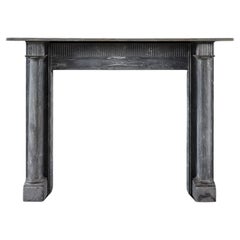
An Irish Regency Column Chimneypiece Carved in Solid Italian Bardiglio Marble
Located in London, GB
The jambs in the form of free-standing Doric columns on socle bases, resting on square footblocks. The frieze is carved with a reeded motif that runs over the cornerblocks, supportin...
Category
Early 19th Century Irish Regency Antique Powder-Coated Fireplaces and Mantels
Materials
Marble
$33,040
H 50.01 in W 67.92 in D 11.03 in
Read More
24 Perfect Patios with Fire Pits and Fireplaces
In these stylish spaces, the outdoor season extends year round.
40 Spectacular Spaces Warmed by Fireplaces
As the days grow colder, the desire to gather around the fire grows stronger. Take a peek at these well-appointed rooms featuring extraordinary sculptural and historic fireplaces.
Tour the Wabi-Sabi New York Apartment of Andrianna Shamaris
As her sun-filled home reveals, the furniture maker and dealer puts a contemporary spin on antiques from around the globe.
April’s Most-Liked Interiors on Instagram
Our feed is filled with the world's most beautiful spaces. See the 10 our followers have deemed the best of the best this month.