Want more images or videos?
Request additional images or videos from the seller
1 of 5
Italian Fiori Blanco Lavabo Wall Fountain and Cistern
Price:$950
About the Item
- Creator:Ardalt (Designer)
- Attributed to:Fiori Bianco 1 (Workshop/Studio)
- Dimensions:Height: 23 in (58.42 cm)Width: 13 in (33.02 cm)Depth: 6 in (15.24 cm)
- Sold As:Set of 3
- Style:Mid-Century Modern (Of the Period)
- Materials and Techniques:
- Place of Origin:
- Period:
- Date of Manufacture:1955
- Condition:Wear consistent with age and use.
- Seller Location:Soquel, CA
- Reference Number:Seller: GP361stDibs: LU121523509142
About the Seller
5.0
Platinum Seller
Premium sellers with a 4.7+ rating and 24-hour response times
Established in 1986
1stDibs seller since 2015
186 sales on 1stDibs
Authenticity Guarantee
In the unlikely event there’s an issue with an item’s authenticity, contact us within 1 year for a full refund. DetailsMoney-Back Guarantee
If your item is not as described, is damaged in transit, or does not arrive, contact us within 7 days for a full refund. Details24-Hour Cancellation
You have a 24-hour grace period in which to reconsider your purchase, with no questions asked.Vetted Professional Sellers
Our world-class sellers must adhere to strict standards for service and quality, maintaining the integrity of our listings.Price-Match Guarantee
If you find that a seller listed the same item for a lower price elsewhere, we’ll match it.Trusted Global Delivery
Our best-in-class carrier network provides specialized shipping options worldwide, including custom delivery.You May Also Like
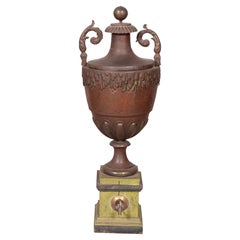
Louis XVI Painted Tole Lavabo
Located in Essex, MA
Urn form with a ball finial with domed cover flanked by scrolled handles, square base with brass spigot.
Category
Antique 1760s French Louis XVI Planters, Cachepots and Jardinières
Materials
Tin
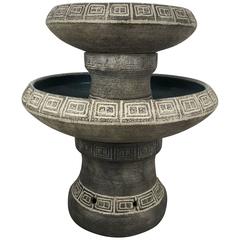
Monumental Four-Piece Studio Pottery Fountain, Manner of Raymor, Italy
By Raymor
Located in Buffalo, NY
Monumental four-piece studio pottery Fountain, manner of Raymor, Italy. Wonderful scale and proportion. Glazed ceramic, incised geometric designs, Versatile: can be separated and used as two jardiniers...
Category
Mid-20th Century Italian Mid-Century Modern Fountains
Materials
Pottery, Clay
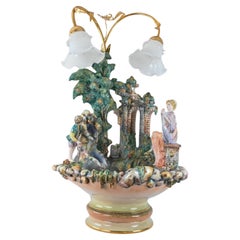
Gianni Lorenzon Italian Porcelain Illuminated Water Fountain Light or Bird Bath
Located in Miami, FL
A very good quality Italian porcelain illuminated water fountain or bird bath comes in a scale that is perfect for any interior or exterior space. The lovely handcrafted porcelain is...
Category
20th Century Italian Mid-Century Modern Fountains
Materials
Porcelain
$1,275 Sale Price
25% Off
H 33.5 in W 19.63 in D 19 in
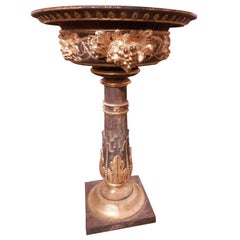
19th Century Continental Iron and Gilt Pedestal Birdbath or Fountain
Located in Dallas, TX
Large and impressive 19th century Continental iron and parcel gilt fountain or birdbath. Beautiful detail and quality.
Category
Antique Late 19th Century Italian Classical Roman Planters, Cachepots an...
Materials
Iron
19th Century Country French Fountain with Porcelain Reservoir and Basin
Located in Dallas, TX
19th century Country French fountain with porcelain reservoir and basin is a charming ode to a bygone era! Back before hot and cold running water, it was desirable for family members...
Category
Antique Early 19th Century French French Provincial Fountains
Materials
Porcelain, Oak
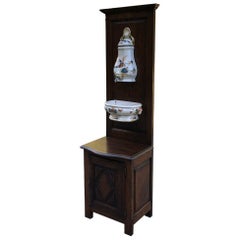
$1,480
H 68 in W 21.5 in D 15 in
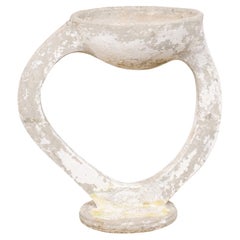
Spanish Mid-Century Sculptural Abstract Planter or Fountain
Located in Atlanta, GA
A Spanish abstract sculptural planter or fountain from the mid 20th century. This vintage garden art piece from Spain has been created of cast-stone and features a large, playful open-shaped center design which supports the rounded basin...
Category
Mid-20th Century Spanish Planters, Cachepots and Jardinières
Materials
Cast Stone
Carrara Marble Fountain with Its Gray Sainte Anne Marble Base, circa 1700
Located in Saint-Ouen, FR
Carrara marble fountain with its gray Sainte Anne marble base.
French.
circa 1700
18th century.
It works as a source.
It has a small restoration as can be seen in the photo.
...
Category
Antique Late 17th Century French Fountains
Materials
Marble
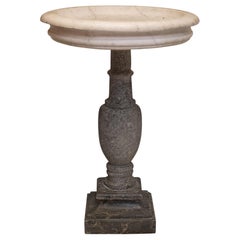
$23,399
H 40.56 in Dm 29.14 in
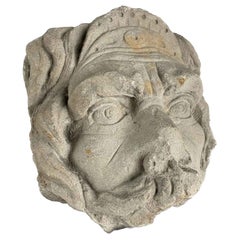
20th Century Italian Stone Fountain Mask
Located in Milano, MI
This antique stone mask was probably used in a fountain. It is a very decorative Italian antique object. The mask fits as decorative object on a bureau o...
Category
Early 20th Century European Classical Roman Animal Sculptures
Materials
Stone
Italian Ancient Marble Sculpture Fountain, Late 16th Century
Located in Milano, IT
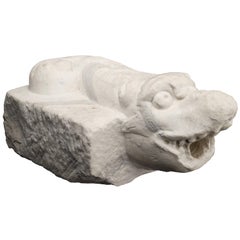
Sea monster
Carrara marble mouth fountain
Italy, late 16th century
It measures 13.8 x 31.5 x 18.9 in (35 x 80 x 48 cm)
State of conservation: some small evident gaps and widespread signs of wear due to outdoor exposure. The gray marks crossing it do not come from restoration, but are rather the natural veins of the marble.
This work has some morphological characteristics typically associated with the iconography of the sea monster: an elongated muzzle, sharp teeth, protruding eyes, elongated ears, and a coiled serpent's tail.
An in-depth series of studies on artistic depictions of the sea monster attempted to verify how this symbol evolved in antiquity in the European and Mediterranean contexts and how it gradually changed its image and function over time. The iconography itself is mutable and imaginative and its history is rich with cultural and artistic exchange, as well as the overlapping of ideas. This occurred so much that it is difficult to accurately pinpoint the "types" that satisfactorily represent its various developments.
However, we can try to summarize the main figures, starting from the biblical Leviathan and the marine creature that swallowed Jonah (in the Christian version, this figure was to become a whale or a "big fish", the “ketos mega”, translation of the Hebrew “dag gadol”). Other specimens ranged from the dragons mentioned in the Iliad (which were winged and had legs) to "ketos” (also from Greek mythology), the terrifying being from whose Latinized name (“cetus”) derives the word "cetacean". See J. Boardman, “Very Like a Whale” - Classical Sea Monsters, in Monsters and Demons in the Ancient and Medieval Worlds, in Papers presented in Honor of Edith Porada, Mainz am Rhein 1987, pp. 73-84).
In Italy the monster underwent yet further variations: it can be found in Etruscan art on the front of some sarcophagi representing the companion of souls, while among the Romans we find the “Pistrice” (cited by Plinio in Naturalis Historia PLIN., Nat., II 9, 8 and by Virgilio in Eneide: VERG., Aen., III, 427), which appeared in the shape of a stylized hippocampus or a very large monstrous cetacean and evolved into a hideous being with a dragon's head and long webbed fins.
During the Middle Ages, the sea monster was the object of new transformations: at this time, it is often winged, the head is stretched like a crocodile, the front legs are often very sharp fins - sometimes real paws - until the image merges with dragons, the typical figures of medieval visionary spirituality widely found throughout Europe (on this topic and much more, see: Baltrušaitis, J., Il Medioevo fantastico. Antichità ed esotismi nell’arte gotica, Gli Adelphi 1997).
In Italy during the 15th and 16th centuries, the revival of classicism - representative of the humanistic and Renaissance periods - led to a different reading of these "creatures". Indeed, the sea monster was also to find widespread use as an isolated decorative motif, especially in numerous fountains and sculptures where dolphins or sea monsters were used as a characterizing element linked to water (on this theme see: Chet Van Duzer, Sea Monsters on Medieval and Renaissance Maps, London, The British library, 2013).
From the morphological point of view, the "sea monsters" of this period are mostly depicted as hybrid figures, in which the body of a mythological or real being (a hippocampus, a sea snake, a dolphin), is joined to a head with a rather indistinct appearance. It was usually characterized by large upright ears, an elongated snout, sharp teeth and globular, protruding eyes; a complex and indefinite figure, both from the symbolic point of view and from that of its genesis.
The work we are examining is placed as a cross between the medieval sea serpent and the Renaissance dolphin, with stylistic features which recall the snake as often used in heraldry (such as the "snake" depicted in the coat of arms of the Visconti - the lords and then dukes of Milan between 1277 and 1447 - and which, for some, may be derived from the representations of the “Pistrice” that swallowed Jonah).
In the search for sources, Renaissance cartography and in particular woodcuts should not be neglected. See for example the monsters of Olaus Magnus, from the editions of the “Historia de gentibus septentrionalibus” (“History of the peoples of the north”) and the natural histories of Conrad Gesner, Ulisse...
Category
Antique 16th Century Italian Renaissance Animal Sculptures
Materials
Carrara Marble
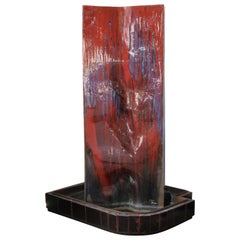
Monumental Artist Made Ceramic Fountain
Located in Bridgeport, CT
Well made with spectacular presence and color. The fountain stands in a hand-fashioned tiled metal basin. May be used in the garden, on the deck, or in an...
Category
20th Century American Mid-Century Modern Fountains
Materials
Ceramic
More From This Seller
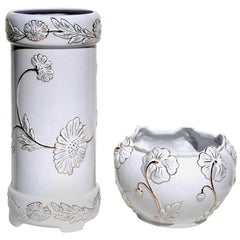
View AllHollywood Regency Style Umbrella Stand and Jardiniere
Located in Soquel, CA
Lovely pair of white and gold Hollywood Regency style ceramic umbrella stand and jardiniere made by Alcobaca Portugal. Raised gold flowers, vines and leaves add depth and interest.
...
Category
Vintage 1960s Portuguese Hollywood Regency Planters, Cachepots and Jardi...
Materials
Ceramic
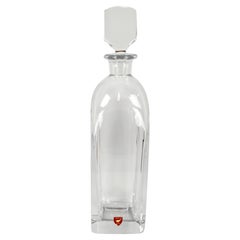
Vintage Mid-Century Orrefors Crystal Decanter with Stopper
By Orrefors
Located in Soquel, CA
Elegant Mid-Century Modern vintage crystal decanter with stopper by Orrefors (Swedish, founded 1898), c. 1960's. Engraved signature to base Orrefors HM 2498 - this particular style was by Edvard Hall.
Includes original red Orrefors Sweden sticker with logo.
"Orrefors HM 2498" etched into base.
Measures 11.5" H x 3" W x 3" D.
Orrefors Glassworks was founded in 1898 on the same site where ironworks operations had been run since 1726. In the same year that the glassworks was founded, a hot shop was built for making technical, medical and household glass and stemware to make use of waste wood and labour. Glass now replaced the less profitable ironworks operations.
In 1913, Consul Johan Ekman from Gothenburg became the new owner of Orrefors Glassworks. He appointed Albert Ahlin as manager of the glassworks and this marked the start of a new era. In 1914, Orrefors started manufacturing crystal products, and as well as cut crystal according to purchased patterns and samples, Orrefors made art glass using the overlay technique with etched decoration. The new management quickly saw that artists were needed in the business, so Simon Gate was employed in 1916 and was joined by Edward Hald a year later.
That same year, Gate and Hald made their first tentative attempts at figure engraving. They also experimented with the new innovative graal (grail) glass technique that was developed at Orrefors by the master glassblower Knut Bergqvist. The major successes were achieved a few years later at the Gothenburg Exhibition in 1923, and in particular at the Paris Exhibition in 1925. The thin engraved glass was admired by the surrounding world, and both Orrefors and the artists themselves were awarded the Grand Prix.
The successes of Simon Gate and Edward Hald in Paris in 1925 constituted the start of the long Orrefors tradition of creative design closely combined with genuine and innovative craftsmanship.
Since then, new designers and skilled glassmakers have continued in the spirit of Gate and Hald. Vicke Lindstrand and Edvin Öhrström with the new glass technique called Ariel in the 1930s. Sven Palmqvist with Kraka and Ravenna in the 1940s. And in the 1950s with Fuga, which, along with Nils Landberg’s slender tulip-shaped glass “Tulpan” and Ingeborg Lundin’s apple-shaped vase “Äpplet”, are now seen as symbols of the renaissance of Swedish design. The 1960s are associated with Gunnar Cyrén’s Pop glass, and in the 1970s, Eva Englund, Olle Alberius, Lars Hellsten and Jan Johansson as well as Cyrén worked at the glassworks.
Since the 1980s, designers such as Anne Nilsson, Erika Lagerbielke, Helen Krantz, Matz Borgström, Per B Sundberg, Martti Rytkönen, Lena Bergström, Ingegerd Råman, Malin Lindahl and Efva Attling...
Category
Mid-20th Century Swedish Mid-Century Modern Bottles
Materials
Crystal
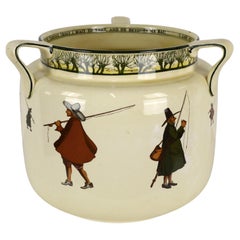
Royal Doulton Isaac Walton Series Ware Jardiniere by Charles Noke, Signed
By Royal Doulton, Charles Noke
Located in Soquel, CA
Large late 19th century stoneware jardiniere, a Royal Doulton Isaac Walton Series Ware piece by Charles Noke (English, 1858-1683). This large jardiniere has three handles and is decorated with several detailed figures; characters based on the 17th century English author Isaac Walton's book The Complete...
Category
Early 20th Century English Planters, Cachepots and Jardinières
Materials
Stoneware
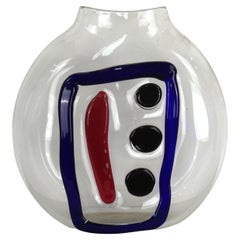
Nadine Saylor
s Hand Blown Glass Vase, Dash
Three Dots
Located in Soquel, CA
Wonderfully modern clear blown glass vase with boxed dash and three dots by Nadine Saylor (American, 20th Century), 2004. Signed and dated on bottom. Con...
Category
Early 2000s American Modern Vases
Materials
Blown Glass
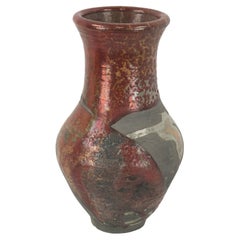
Raku Ceramic Vase by Andy Ruble
Located in Soquel, CA
Dramatic raku style ceramic vase by ceramic artist Andy Ruble (American, b 1970). Metallic russet, grays and orange lend to earthy organic aesthetic. Signed...
Category
Early 2000s American Minimalist Vases
Materials
Ceramic
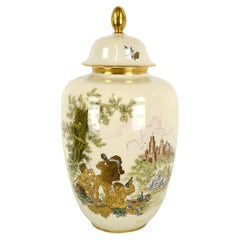
Mid Century Hertel Jacob German Porcelain Ginger Jar, Signed Fuchs-Nadler
Located in Soquel, CA
A lovely mid-century Bavarian porcelain ginger jar with gold trim and gilt details by Hertel-Jacob Porzellan (German, 1906-1979). This large ginger jar is ornately decorated with a highly detailed romantic figurative landscape scene, in which three men depicted in gold enjoy an opulent picnic of wine, meat, and fruit under a tree, in front of a large medieval castle complete with a canon and canon balls. A gold leaf motif decorates the backside of the piece. The signature "Fuchs-Nadler" can be found within the picnic scene, underneath the tray of food and wine.
Stamped on bottom with mark "Hertel-Jacob Porzelan / Bavaria Germany", and the serial number 1266.
Measures 14"H x 7"D.
**Please note: The top of the lid has been re-attached and a hairline crack in the gold is visible (see photos).
Hertel-Jacob Porzelan History:
Porzellfabrik Jacob, Schödl & Co. (1906 until 1912)
The factory was founded in 1906 by the industrial Jacob together with his financial partner Schödl and its product range during the first years included giftware items, vases, storage canisters...
Category
Mid-20th Century German Biedermeier Jars
Materials
Gold Plate
Still Thinking About These?
All Recently ViewedMore Ways To Browse
Wall Fountain Italy
Wall Lavabo
Brass Spigot
Italian Lavabo
Ardalt Italy
Lavabo Wall Fountain
Vintage Ardalt
Retro Wall Pocket Planter
Garden Limestone Wall Fountains
Large Antique Fountain
Garden Spout
Antique Spout
Dolphin Patio
Mid Century Bronze Garden Fountain
Antique Iron Fountain
Metal Basin
Stone Fountain Basin
Pedestal Basin