1 of 9
Pair Chinese Carved Marble Fish Fountains
$36,000List Price
About the Item
- Dimensions:Height: 40 in (101.6 cm)Width: 58.5 in (148.59 cm)Depth: 13 in (33.02 cm)
- Sold As:Set of 2
- Place of Origin:
- Period:
- Date of Manufacture:circa 1700
- Condition:Wear consistent with age and use. Minor losses. chipping and wear around open mouths, small break on a lower fin.
- Seller Location:Woodbury, CT
- Reference Number:1stDibs: 1310028626554
Authenticity Guarantee
In the unlikely event there’s an issue with an item’s authenticity, contact us within 1 year for a full refund. DetailsMoney-Back Guarantee
If your item is not as described, is damaged in transit, or does not arrive, contact us within 7 days for a full refund. Details24-Hour Cancellation
You have a 24-hour grace period in which to reconsider your purchase, with no questions asked.Vetted Professional Sellers
Our world-class sellers must adhere to strict standards for service and quality, maintaining the integrity of our listings.Price-Match Guarantee
If you find that a seller listed the same item for a lower price elsewhere, we’ll match it.Trusted Global Delivery
Our best-in-class carrier network provides specialized shipping options worldwide, including custom delivery.You May Also Like
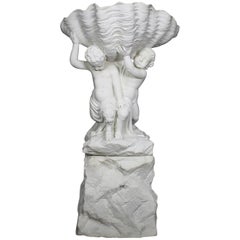
Italian 19th Century Carved Carrara Marble Figural Fountain Jardinière Planter
By Giovanni Battista Lombardi
Located in Los Angeles, CA
A very fine Italian 19th century carved Carrara marble figural fountain "Jardinière" modelled as a standing Putto and a Satyr supporting a sea-sh...
Category
Antique 19th Century Italian Baroque Figurative Sculptures
Materials
Carrara Marble
$28,950 Sale Price
35% Off
H 50.5 in W 31 in D 26 in
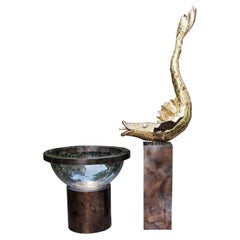
Henri Fernandez Golden Fish Indoor Fountain, France, 1970
By Henri Fernandez
Located in Munich, DE
Amazing indoor fountain in brass and lucite designed by Henri Fernandez France, 1970s. The brutalist fish is made in brass with turquoise gems eyes and ...
Category
Vintage 1970s French Hollywood Regency Animal Sculptures
Materials
Brass
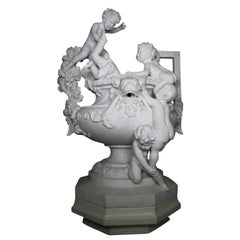
A French 19th Century Carved Marble Whimsical Figural Urn Fountain with Children
By Joseph Reynés I Gurgui
Located in Los Angeles, CA
A very fine large, rare and charming, French, 19th century. Belle Époque carved white marble whimsical figural urn fountain depicting children climbing on an urn with flowers and garlands, influenced in the Louis XV style, by Joseph Reynés I Gurgui (Barcelona, 1850-1926). Signed: Reynes. Barcelona, circa 1890.
An almost identical Carrara marble fountain also by Josep Reynés carved in 1893 currently at the Parc de la Ciutadella in Barcelona, Spain.
Measures: Overall height: 55 inches (140 cm)
Marble height: 49 inches (124.5 cm)
width: 37 inches (94 cm)
depth: 30 inches (76.3 cm)
Joseph Reynes Gurguí (Barcelona, 1850 - 1926) is a Catalan sculptor, also known as Reynesy-Gurgui, Spanish school.
He studied at the Ecole de la Llotja, studied for a time in Paris, in the workshops of the great French sculptors Jean-Baptiste Carpeaux (1827-1875) and Carrier-Belleuse (1824-1887). He devoted himself mainly to interior decoration. His works were profoundly marked by a French influence. He exhibited in Paris in 1895 where he received an honorable mention. In 1890 he obtained the first medal in Madrid for "The Violinist".
Literature:
E. Benezit Dictionaire des Peintres, Sculpteurs, Dessinateurs et Graveurs by Grund - Nouvelle Edition, 1976 - Volume 8, Page 714.
Cristina Mensoza, Ramon Casas...
Category
Antique 19th Century Spanish Louis XV Fountains
Materials
Marble
$98,450 Sale Price
21% Off
H 55 in W 37 in D 30 in
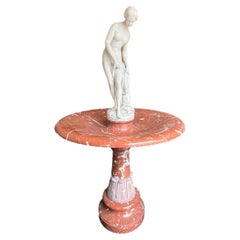
Fountain in Marble, Year: 1920, France
Located in Ciudad Autónoma Buenos Aires, C
Fountain: Marble Roso Verona
Rosso Francia marble, also known as Rouge incarnat or Languedoc, is a historical French marble used since the 19th century for churches and noble palace...
Category
Vintage 1920s Italian Art Deco Figurative Sculptures
Materials
Marble
A French 19th-20th Century Carved White Marble Fountain Sculpture with Children
Located in Los Angeles, CA
A fine and charming French 19th-20th century carved white marble whimsical group sculpture depicting two putti (Children) playing with a dolphin, fitted for use as a fountain, Paris,...
Category
Antique Early 1900s French Louis XV Fountains
Materials
Marble
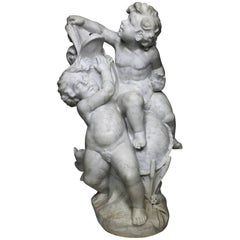
$9,985 Sale Price
20% Off
H 36.25 in W 21.25 in D 18 in
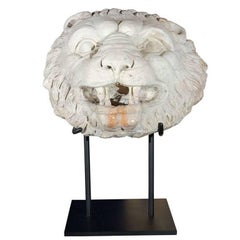
17th Century, Carrera Marble Lion Fountain Head
Located in Los Angeles, CA
Stunning, solid white, Carrara marble lions head from a fountain in Florence featuring a flowing main and a fabulous patina. Mounted on a custom, iron base. The piece hails from the ...
Category
Antique Early 1600s Italian Sculptures
Materials
Marble
American Cast Bronze Garden Fountain with Figural Boy Holding Koi Fish. C. 1870
Located in Charleston, SC
American cast bronze garden fountain with standing figural boy holding Koi fish on a two-tiered shell form scrolled base with turtle at his feet, Late 19th century.
Category
Antique 1870s American American Empire Fountains
Materials
Bronze, Copper
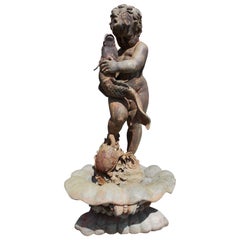
$14,800
H 54.5 in W 28 in D 31 in
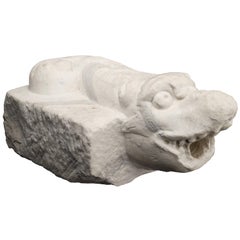
Italian Ancient Marble Sculpture Fountain, Late 16th Century
Located in Milano, IT
Sea monster
Carrara marble mouth fountain
Italy, late 16th century
It measures 13.8 x 31.5 x 18.9 in (35 x 80 x 48 cm)
State of conservation: some small evident gaps and widespread signs of wear due to outdoor exposure. The gray marks crossing it do not come from restoration, but are rather the natural veins of the marble.
This work has some morphological characteristics typically associated with the iconography of the sea monster: an elongated muzzle, sharp teeth, protruding eyes, elongated ears, and a coiled serpent's tail.
An in-depth series of studies on artistic depictions of the sea monster attempted to verify how this symbol evolved in antiquity in the European and Mediterranean contexts and how it gradually changed its image and function over time. The iconography itself is mutable and imaginative and its history is rich with cultural and artistic exchange, as well as the overlapping of ideas. This occurred so much that it is difficult to accurately pinpoint the "types" that satisfactorily represent its various developments.
However, we can try to summarize the main figures, starting from the biblical Leviathan and the marine creature that swallowed Jonah (in the Christian version, this figure was to become a whale or a "big fish", the “ketos mega”, translation of the Hebrew “dag gadol”). Other specimens ranged from the dragons mentioned in the Iliad (which were winged and had legs) to "ketos” (also from Greek mythology), the terrifying being from whose Latinized name (“cetus”) derives the word "cetacean". See J. Boardman, “Very Like a Whale” - Classical Sea Monsters, in Monsters and Demons in the Ancient and Medieval Worlds, in Papers presented in Honor of Edith Porada, Mainz am Rhein 1987, pp. 73-84).
In Italy the monster underwent yet further variations: it can be found in Etruscan art on the front of some sarcophagi representing the companion of souls, while among the Romans we find the “Pistrice” (cited by Plinio in Naturalis Historia PLIN., Nat., II 9, 8 and by Virgilio in Eneide: VERG., Aen., III, 427), which appeared in the shape of a stylized hippocampus or a very large monstrous cetacean and evolved into a hideous being with a dragon's head and long webbed fins.
During the Middle Ages, the sea monster was the object of new transformations: at this time, it is often winged, the head is stretched like a crocodile, the front legs are often very sharp fins - sometimes real paws - until the image merges with dragons, the typical figures of medieval visionary spirituality widely found throughout Europe (on this topic and much more, see: Baltrušaitis, J., Il Medioevo fantastico. Antichità ed esotismi nell’arte gotica, Gli Adelphi 1997).
In Italy during the 15th and 16th centuries, the revival of classicism - representative of the humanistic and Renaissance periods - led to a different reading of these "creatures". Indeed, the sea monster was also to find widespread use as an isolated decorative motif, especially in numerous fountains and sculptures where dolphins or sea monsters were used as a characterizing element linked to water (on this theme see: Chet Van Duzer, Sea Monsters on Medieval and Renaissance Maps, London, The British library, 2013).
From the morphological point of view, the "sea monsters" of this period are mostly depicted as hybrid figures, in which the body of a mythological or real being (a hippocampus, a sea snake, a dolphin), is joined to a head with a rather indistinct appearance. It was usually characterized by large upright ears, an elongated snout, sharp teeth and globular, protruding eyes; a complex and indefinite figure, both from the symbolic point of view and from that of its genesis.
The work we are examining is placed as a cross between the medieval sea serpent and the Renaissance dolphin, with stylistic features which recall the snake as often used in heraldry (such as the "snake" depicted in the coat of arms of the Visconti - the lords and then dukes of Milan between 1277 and 1447 - and which, for some, may be derived from the representations of the “Pistrice” that swallowed Jonah).
In the search for sources, Renaissance cartography and in particular woodcuts should not be neglected. See for example the monsters of Olaus Magnus, from the editions of the “Historia de gentibus septentrionalibus” (“History of the peoples of the north”) and the natural histories of Conrad Gesner, Ulisse...
Category
Antique 16th Century Italian Renaissance Animal Sculptures
Materials
Carrara Marble
Antique Italian Hand-Carved Marble Fountain with a Classic Fish Spout c1920
s
Located in BENSENVILLE, IL
Antique Italian Hand-Carved Marble Fountain with a Classic Fish Spout, that was removed from a Chicago mansion. We have been told by the previous owner that the home where the antiqu...
Category
Vintage 1920s Italian Fountains
Materials
Stone, Marble, Carrara Marble
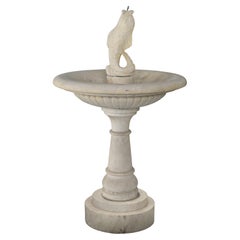
$2,290
H 60.5 in Dm 35 in
Wooden Carved Black Forest Garden Fountain Water Spout 19th century
Located in Berghuelen, DE
Wooden Carved Black Forest Garden Fountain Water Spout 19th century
A large Black Forest wooden carved water spout featuring "Ruebezahl", which is the mountain spirit of the giant m...
Category
Antique Late 19th Century German Black Forest Fountains
Materials
Wood
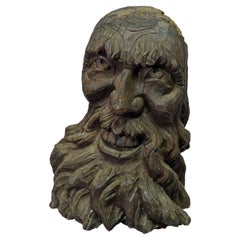
$2,575
H 31.89 in W 21.66 in D 11.42 in
Still Thinking About These?
All Recently ViewedMore Ways To Browse
Chinese Fountain
Cherub And Dolphin
Copper Basin
Copper Spout
Antique Cast Iron Garden Fountain
Cast Stone Fountains
Fountain Pump
French Cast Iron Fountain
Italian Water Fountain
Round Hand Carved Water Fountain
Shell Fountains
Swan Fountain
Bird Fountains
Putti Fountains
Lion Spout
Antique Water Pumps
Dolphin Spout
Vintage Copper Fountain