1990s Decorative Dishes and Vide-Poche
to
5
35
462
523
2,997
678
328
1,654
621
46
22
77
126
61
301
436
347
76
35
11
5
1
1
16
11
7
4
4
23
11
27
13
6
6
4
Height
to
Width
to
35
35
35
3
3
2
2
2
Period: 1990s
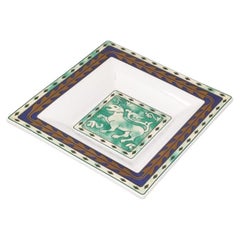
1990s Gorgeous Ashtray or Catch-All in Porcelain by Paloma Picasso for Villeroy
Located in Milano, IT
1990s Gorgeous ashtray or catch-All in porcelain by Paloma Picasso "Hongkong" for Villeroy
Boch, limited edition. Marked on the bottom.
It's excellent condition
Dimensions:
...
Category
Italian Mid-Century Modern 1990s Decorative Dishes and Vide-Poche
Materials
Porcelain
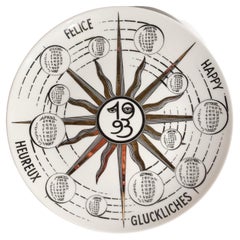
Piatto Calendario in Ceramica di Fornasetti Anni 1993
Located in Milano, MI
Piatto Calendario in ceramica di Fornasetti, realizzato per l'anno 1993
Ø cm 24
I piatti calendario sono una tradizione Fornasetti dal 1968, originariamente concepiti come strenna ...
Category
Italian Mid-Century Modern 1990s Decorative Dishes and Vide-Poche
Materials
Ceramic
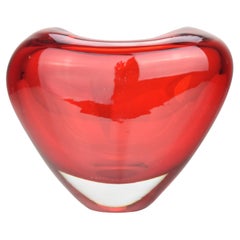
Murano Red Heart "Cuore" Art Glass Vase by Maria Christina Hamel for Salviati
Located in Bad Säckingen, DE
This striking Murano art glass heart-shaped vase was designed by Maria Christina Hamel in the 1990s and produced by the renowned Venetian glasshouse Salviati. Expertly mouth-blown on...
Category
Italian Mid-Century Modern 1990s Decorative Dishes and Vide-Poche
Materials
Glass, Art Glass, Blown Glass, Sommerso
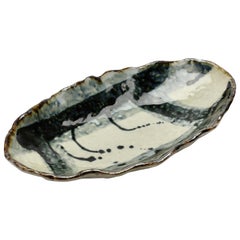
Decorative Handmade Organic Studio Pottery Glazed Ceramic Dish or Vide-Poche
Located in Landau an der Isar, Bayern
A beautiful handmade ceramic dish or vide-poche by unknown studio potter / maker with an organic oval form and hand painted glaze of cream and dark grey / blue color (color).
Would be perfect for serving nuts or other little bar snacks...
Category
Unknown Organic Modern 1990s Decorative Dishes and Vide-Poche
Materials
Ceramic, Pottery
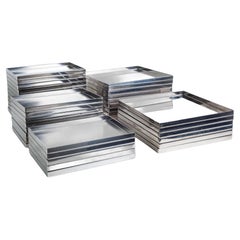
Phillipe Starck Custom Stainless Steel Dishes, set of Thirty-Eight
Located in Chicago, IL
Phillips Starck Custom Stainless Steel Dishes set of Thirty-Eight, from The Clift Hotel, San Francisco, California.
Two sizes:
Both 1/2" high
Smaller 23" in total
9" x 6"
Larger 15 i...
Category
Italian Art Deco 1990s Decorative Dishes and Vide-Poche
Materials
Stainless Steel
Tapio Wirkkala Polipo Venini Plate Murano Sculpture, 1990
By Tapio Wirkkala, Venini
Located in Paris, IDF
Rare beautiful Tapio Wirkkala “Polipo” plate for Venini, from the serie “Piatti di Tapio” signed and dated Venini TW 90 on the back, made of Murano glass using Incalmo technique. The...
Category
Italian Mid-Century Modern 1990s Decorative Dishes and Vide-Poche
Materials
Murano Glass

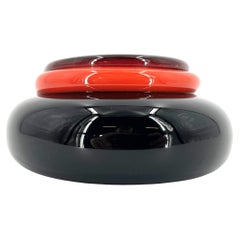
Vide poche or ashtray by Ettore Sottsass for Venini, 1990s
Located in Leuven, Vlaams Gewest
Hand made murano glass ashtray or vide poche by designe Ettore Sottsass for Venini.
The piece is signed underneath and we believe it to be limited to 97 pieces.
1990s - italy
Good...
Category
Italian Mid-Century Modern 1990s Decorative Dishes and Vide-Poche
Materials
Murano Glass
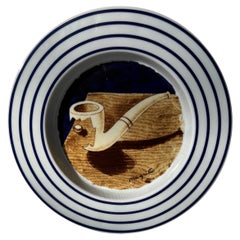
Rene Magritte ceramic decorative plate , marked edition with original box .
Located in Los Angeles, CA
Beautiful decorative plate made by Adage et Flammarion , for the Magritte Collection .edition 330/1000 Box measures 9.5 x 9.5 x 1 high . shows light ware and scratches in cardboard .
Category
French Post-Modern 1990s Decorative Dishes and Vide-Poche
Materials
Ceramic
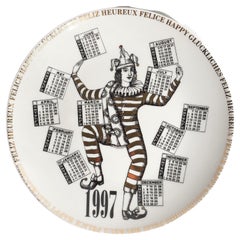
Piatto Calendario in Ceramica Anni 1997 di Fornasetti
Located in Milano, MI
Piatto Calendario in ceramica di Fornasetti, raffigurante l'anno 1997.
Ø cm 24
È un piatto decorativo in porcellana, parte di una serie prodotta in edizione limitata a partire dal...
Category
Italian Mid-Century Modern 1990s Decorative Dishes and Vide-Poche
Materials
Ceramic
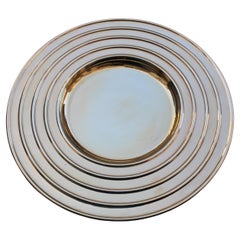
24KT gold bathroom design round dish tidy tray
Located in Palermo, Sicily
Round Dish in 24KT gold bath metal design .
Category
Italian Modern 1990s Decorative Dishes and Vide-Poche
Materials
Gold Plate

$376 Sale Price
30% Off
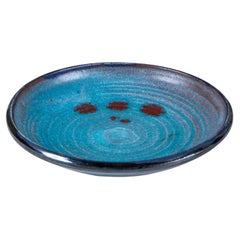
Otto Heino Ceramic Dish
By Otto Heino
Located in Los Angeles, CA
A small studio pottery dish by significant 20th Century ceramicist Otto Heino. This example features the finger ribbing with a blue and red glaze, blending to a purplish haze in some...
Category
American Mid-Century Modern 1990s Decorative Dishes and Vide-Poche
Materials
Ceramic, Stoneware
$1,200
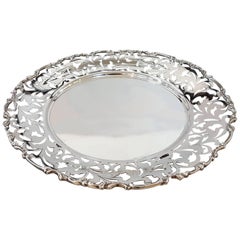
20th Century Italian Sterling Silver Pierced Dish
Located in VALENZA, IT
Round sterling silver centrepiece on feet with pierced by hand and finished with Baroque edge.
835 grams.
Category
Italian Baroque 1990s Decorative Dishes and Vide-Poche
Materials
Sterling Silver
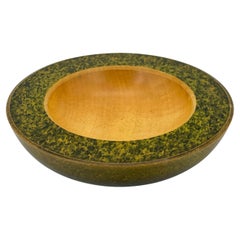
Vintage Turned + Veneered Bowl Signed Unknown Asian Artist 1997
Located in Hyattsville, MD
A wonderful small bowl, seems turned and also veneered.
Category
Post-Modern 1990s Decorative Dishes and Vide-Poche
Materials
Wood
“Roses” Vide-Poche by Daum – Pâte de Verre in Mauve and Green Tones
By Daum
Located in NICE, FR
A gracefull creation by Daum, this pâte de verre vide-poche captivates with its refined form and delicate palette.
Shaped like a blooming flower, it unfolds translucent petals in sof...
Category
French Belle Époque 1990s Decorative Dishes and Vide-Poche
Materials
Art Glass
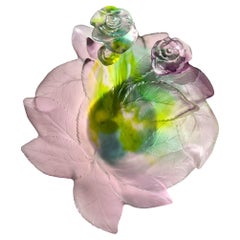
Piatto Calendario in Ceramica di Fornasetti Anni 1995
Located in Milano, MI
Piatto Calendario in ceramica di Fornasetti, realizzato per l'anno 1995
Ø cm 24
I piatti calendario Fornasetti sono oggetti da collezione in porcellana decorata, prodotti in edizio...
Category
Italian Mid-Century Modern 1990s Decorative Dishes and Vide-Poche
Materials
Ceramic
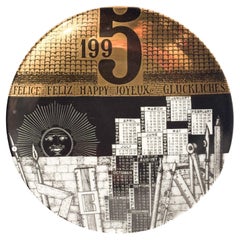
1990s Gorgeous Ashtray or Catch-All in Porcelain by Paloma Picasso for Villeroy
Located in Milano, IT
1990s Gorgeous ashtray or catch-All in porcelain by Paloma Picasso "Bangkok" for Villeroy
Boch, limited edition. Marked on the bottom.
It's excellent condition
Dimensions:
5,51...
Category
German Mid-Century Modern 1990s Decorative Dishes and Vide-Poche
Materials
Porcelain
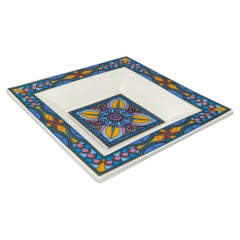
Pop Art Andy Warhol Self Portrait Square Glass Tray, Rosenthal, 1990s
Located in Bochum, NRW
Self-portrait Curved Glass Tray, designed by the iconic artist Andy Warhol, edited by Rosenthal Studio Line.
This glass tray is both a practical accessory and a captivating piece of ...
Category
German Post-Modern 1990s Decorative Dishes and Vide-Poche
Materials
Glass
$465 Sale Price
35% Off
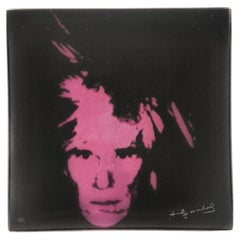
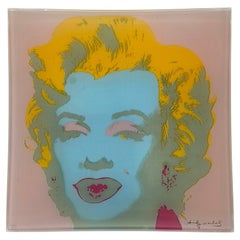
HOLIDAY GIFT - Marilyn Monroe by Andy Warhol, Rosenthal Studio Line, 1990s
Located in Bochum, NRW
Andy Warhol, Marilyn Monroe, Rosenthal Studio Line Limited Edition Plate.
This glass tray is both a practical accessory and a captivating piece of contemporary art. Squared in shape...
Category
German Post-Modern 1990s Decorative Dishes and Vide-Poche
Materials
Glass
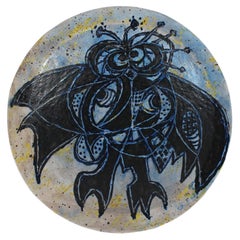
Danish Leif Messell Round Ceramic Dish with Figurative Bat Motif 1997
By Asger Jorn
Located in Silkeborg, Silkeborg
Danish mid-century low ceramic bowl by Leif Messell made at his own ceramic workshop in Sejs, Silkeborg, Denmark in 1997.
The low bowl has a figurative decoration of a flying bat ...
Category
Danish Mid-Century Modern 1990s Decorative Dishes and Vide-Poche
Materials
Ceramic
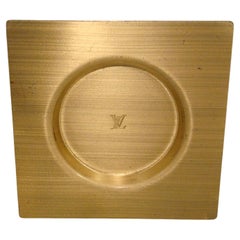
Vintage Louis Vuitton Jewelry Dish / Keys / Coins Plate
Located in Buenos Aires, Olivos
Vintage Rare to see Louis Vuitton Small Tray. Very chic
Louis Vuitton Jewelry Dish / Keys / Coins Plate
This piece is a handsome Tray. Can be use as a jewelry dish. Perfect size. Tri...
Category
French Modern 1990s Decorative Dishes and Vide-Poche
Materials
Metal
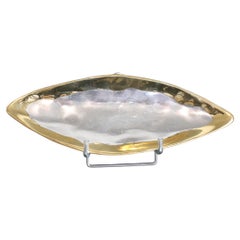
Brass and Aluminium Tray by David Marshall (circa 1990s)
Located in London, GB
A leaf-shaped aluminium and brass brutalist style tray by David Marshall (circa 1990s). The shiny aluminium forms the base structure and the brass features on the edges of the piece....
Category
Spanish 1990s Decorative Dishes and Vide-Poche
Materials
Aluminum, Brass
$600 Sale Price
20% Off
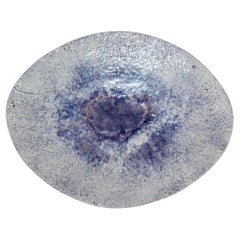
Blue ceramic decorative vide poche
Located in grand Lancy, CH
Blue ceramic decorative vide poche
Category
European 1990s Decorative Dishes and Vide-Poche
Materials
Ceramic
$304 Sale Price
39% Off
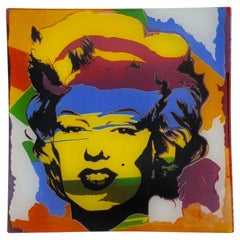
Set of Six Marilyn Monroe Glass Plates
By Andy Warhol
Located in Bochum, NRW
A set of six glass plates decorated with Marilyn Monroe's portrait made in the well-known Andy Warhol manner.
Curved glass squared plate, screen-printed.
Set of 6 Marilyn Monroe Pop...
Category
European Post-Modern 1990s Decorative Dishes and Vide-Poche
Materials
Glass
$1,433 / set
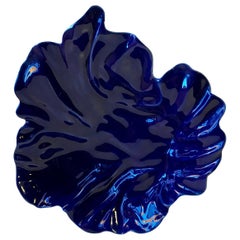
Blue Freeform Natura Dish by Ole Kortzau for Royal Copenhagen, 1990s
Located in Esbjerg, DK
Cobalt blue glazed faience bowl by danish designer Ole Kortzau. It is called Natura due to its freeform shape. The is a piece from the 1990s and its stamped by Royal Copenhagen.
Category
Danish Modern 1990s Decorative Dishes and Vide-Poche
Materials
Faience
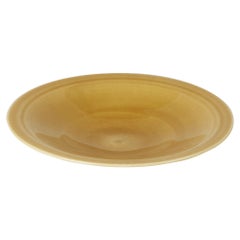
William Mehornay Studio Pottery Porcelain Iron Glazed Dish, 1990s
Located in Bishop
s Stortford, Hertfordshire
We have recently been extremely privileged to meet acclaimed American born studio potter and artist William Mehornay. We are also greatly honoured for him to have entrusted to us pie...
Category
British 1990s Decorative Dishes and Vide-Poche
Materials
Ceramic, Porcelain
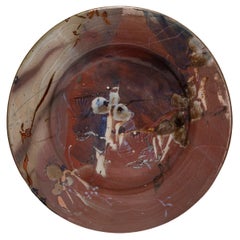
John Glick Plum Street Pottery Signed Monumental Ceramic Charger
By John Glick
Located in Bloomfield Hills, MI
The ceramic charger with scalloped edge is an example of the kind of work by which John Glick became so famous. He was seduced by the effects of the reduction kiln, which decreased the levels of oxygen during firing, inducing the flame to pull oxygen out of the clay and glazes changing the colors of the glazes depending on their iron and copper content. In this way he achieved the rich gradients of ochre and umber and variations in stippling and opacity. It is signed on verso.
John was an American Abstract Expressionist ceramicist born in Detroit, MI. Though open to artistic experimentation, Glick was most influenced by the styles and aesthetics of Asian pottery—an inspiration that shows in his use of decorative patterns and glaze choices. He has said that he is attracted to simplicity, as well as complexity: my work continually reflects my re-examination that these two poles can coexist… or not, in a given series. Glick also took influences from master potters of Japan, notably Shoji Hamada and Kanjrio Kawai, blending their gestural embellishments of simple forms with attitudes of Abstract Expressionism. He was particularly drown to the work of Helen Frankenthaler whose soak-stain style resonated with Glick’s multi-layered glaze surfaces, which juxtaposed veils of atmospheric color with gestural marks and pattern. He spent countless hours developing and making his own tools in order to achieve previously unseen results in his work with clay and glaze.
Glick’s “Plum Tree Pottery” (now a designated historic landmark in Farmington Hills, Michigan) studio opened around 1965 and closed in the summer of 2016. It was a private studio space for John and a number of his students and assistants. He believed his shapes evolved guided by forces apparently outside his control. This was instinctual, intellectual and due to his openness to change, fusing into what he thought was the most positive force behind a potter’s approach: evolution and growth. Some have called it inspiration.
John was not only a major figure in the Detroit creative community, but in the ceramics world at large. According to Shelley Selim in her book on John, “John Glick: A Legacy in Clay” John remains: “one of the most recognizable names in the field of studio pottery – known for lecturing, publishing, and offering workshops widely – and his work has been featured in well over a hundred local, national and international exhibitions since he was a college student in the late 1950s.” Along with this John has mentored over thirty studio apprentices over five and a half decades, received numerous grants and awards for his work, and has been prolific, with an estimated 300,000 ceramic wares throughout the world.
He received his Masters from Cranbrook Academy of Art in Bloomfield Hills, Michigan, working with Maija Grotell, a legendary and influential teacher. Grotell was noted for her deep interest in the human connection to nature’s rhythms and patters. These ideas often grounded her dialog with her students including Glick, affecting, a profund and lasting influence on his future work. This famous Art Academy was designed by architect and faculty member, Eliel Saarinen who collaborated with Charles and Ray Eames on chair and furniture design. Numerous creative artists who are alumni of Cranbrook include: Harry Bertoia, Florence Knoll, Jack Lenor Larsen, Donald Lipski, Duane Hanson, Nick Cave, Hani Rashid, George Nelson, Urban Jupena (Nationally recognized fiber artist), Artis Lane (the first African-American artist to have her sculpture, "Sojourner Truth," commissioned for the Emancipation Hall in the Capital Visitor Center in Washington DC), Cory Puhlman (televised Pastry Chef extraordinaire), Thom O’Connor (Lithographs), Paul Evans (Brutalist-inspired sculpted metal furnishings), Eugene Caples (small bronze images/abstract), Morris Brose (Bronze Sculptures), Herb Babcock (blown glass), Larry Butcher (mixed media) and Lauren Anais Hussey...
Category
American Expressionist 1990s Decorative Dishes and Vide-Poche
Materials
Ceramic
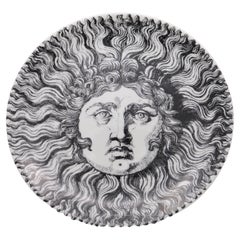
Re Sole
Fornasetti Modernist Charger
Located in New York, NY
'Re Sole' Barnaba Fornasetti large plate. Made by Fornasetti, Milan Porcelain, white, glazed, black and white lithographed pattern. Marked: Maker's mark, FORNASETTI MILANO MADE IN IT...
Category
Italian 1990s Decorative Dishes and Vide-Poche
Materials
Porcelain
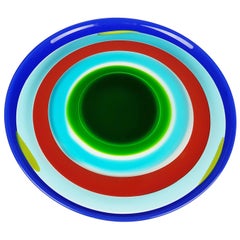
Multicolored Murano Glass Plate by Berit Johansson for Salviati, 1991
Located in Varese, Lombardia
Murano glass centerpiece dish designed by Berit Johansson for Salviati in 1991. Signature of the maker engraved on the back.
Perfect condition.
Category
Italian Post-Modern 1990s Decorative Dishes and Vide-Poche
Materials
Murano Glass
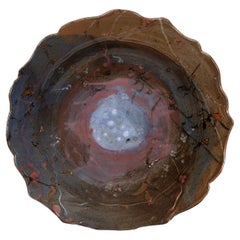
John Glick Plum Street Pottery Ceramic Charger Monumental
By John Glick
Located in Bloomfield Hills, MI
The ceramic charger is an example of the kind of work by which John Glick became so famous. He was seduced by the effects of the reduction kiln, which decreased the levels of oxygen during firing, inducing the flame to pull oxygen out of the clay and glazes changing the colors of the glazes depending on their iron and copper content. In this way he achieved the rich gradients of ochre and umber and variations in stippling and opacity. It is signed by the artist and stamped with Plum Street Pottery #129 on the verso.
John was an American Abstract Expressionist ceramicist born in Detroit, MI. Though open to artistic experimentation, Glick was most influenced by the styles and aesthetics of Asian pottery—an inspiration that shows in his use of decorative patterns and glaze choices. He has said that he is attracted to simplicity, as well as complexity: my work continually reflects my re-examination that these two poles can coexist… or not, in a given series. Glick also took influences from master potters of Japan, notably Shoji Hamada and Kanjrio Kawai, blending their gestural embellishments of simple forms with attitudes of Abstract Expressionism. He was particularly drown to the work of Helen Frankenthaler whose soak-stain style resonated with Glick’s multi-layered glaze surfaces, which juxtaposed veils of atmospheric color with gestural marks and pattern. He spent countless hours developing and making his own tools in order to achieve previously unseen results in his work with clay and glaze.
Glick’s “Plum Tree Pottery” (now a designated historic landmark in Farmington Hills, Michigan) studio opened around 1965 and closed in the summer of 2016. It was a private studio space for John and a number of his students and assistants. He believed his shapes evolved guided by forces apparently outside his control. This was instinctual, intellectual and due to his openness to change, fusing into what he thought was the most positive force behind a potter’s approach: evolution and growth. Some have called it inspiration.
John was not only a major figure in the Detroit creative community, but in the ceramics world at large. According to Shelley Selim in her book on John, “John Glick: A Legacy in Clay” John remains: “one of the most recognizable names in the field of studio pottery – known for lecturing, publishing, and offering workshops widely – and his work has been featured in well over a hundred local, national and international exhibitions since he was a college student in the late 1950s.” Along with this John has mentored over thirty studio apprentices over five and a half decades, received numerous grants and awards for his work, and has been prolific, with an estimated 300,000 ceramic wares throughout the world.
He received his Masters from Cranbrook Academy of Art in Bloomfield Hills, Michigan, working with Maija Grotell, a legendary and influential teacher. Grotell was noted for her deep interest in the human connection to nature’s rhythms and patters. These ideas often grounded her dialog with her students including Glick, affecting, a profund and lasting influence on his future work. This famous Art Academy was designed by architect and faculty member, Eliel Saarinen who collaborated with Charles and Ray Eames on chair and furniture design. Numerous creative artists who are alumni of Cranbrook include: Harry Bertoia, Florence Knoll, Jack Lenor Larsen, Donald Lipski, Duane Hanson, Nick Cave, Hani Rashid, George Nelson, Urban Jupena (Nationally recognized fiber artist), Artis Lane (the first African-American artist to have her sculpture, "Sojourner Truth," commissioned for the Emancipation Hall in the Capital Visitor Center in Washington DC), Cory Puhlman (televised Pastry Chef extraordinaire), Thom O’Connor (Lithographs), Paul Evans (Brutalist-inspired sculpted metal furnishings), Eugene Caples (small bronze images/abstract), Morris Brose (Bronze Sculptures), Herb Babcock (blown glass), Larry Butcher (mixed media) and Lauren Anais Hussey...
Category
American Expressionist 1990s Decorative Dishes and Vide-Poche
Materials
Ceramic
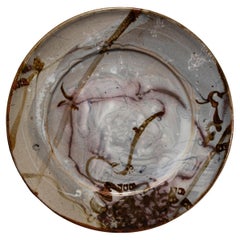
John Glick Plum Street Pottery Ceramic Charger Monumental
By John Glick
Located in Bloomfield Hills, MI
The ceramic charger is an example of the kind of work by which John Glick became so famous. He was seduced by the effects of the reduction kiln, which decreased the levels of oxygen during firing, inducing the flame to pull oxygen out of the clay and glazes changing the colors of the glazes depending on their iron and copper content. In this way he achieved the rich gradients of ochre and umber and variations in stippling and opacity. It is signed by the artist and stamped with Plum Street Pottery on the verso.
John was an American Abstract Expressionist ceramicist born in Detroit, MI. Though open to artistic experimentation, Glick was most influenced by the styles and aesthetics of Asian pottery—an inspiration that shows in his use of decorative patterns and glaze choices. He has said that he is attracted to simplicity, as well as complexity: my work continually reflects my re-examination that these two poles can coexist… or not, in a given series. Glick also took influences from master potters of Japan, notably Shoji Hamada and Kanjrio Kawai, blending their gestural embellishments of simple forms with attitudes of Abstract Expressionism. He was particularly drown to the work of Helen Frankenthaler whose soak-stain style resonated with Glick’s multi-layered glaze surfaces, which juxtaposed veils of atmospheric color with gestural marks and pattern. He spent countless hours developing and making his own tools in order to achieve previously unseen results in his work with clay and glaze.
Glick’s “Plum Tree Pottery” (now a designated historic landmark in Farmington Hills, Michigan) studio opened around 1965 and closed in the summer of 2016. It was a private studio space for John and a number of his students and assistants. He believed his shapes evolved guided by forces apparently outside his control. This was instinctual, intellectual and due to his openness to change, fusing into what he thought was the most positive force behind a potter’s approach: evolution and growth. Some have called it inspiration.
John was not only a major figure in the Detroit creative community, but in the ceramics world at large. According to Shelley Selim in her book on John, “John Glick: A Legacy in Clay” John remains: “one of the most recognizable names in the field of studio pottery – known for lecturing, publishing, and offering workshops widely – and his work has been featured in well over a hundred local, national and international exhibitions since he was a college student in the late 1950s.” Along with this John has mentored over thirty studio apprentices over five and a half decades, received numerous grants and awards for his work, and has been prolific, with an estimated 300,000 ceramic wares throughout the world.
He received his Masters from Cranbrook Academy of Art in Bloomfield Hills, Michigan, working with Maija Grotell, a legendary and influential teacher. Grotell was noted for her deep interest in the human connection to nature’s rhythms and patters. These ideas often grounded her dialog with her students including Glick, affecting, a profund and lasting influence on his future work. This famous Art Academy was designed by architect and faculty member, Eliel Saarinen who collaborated with Charles and Ray Eames on chair and furniture design. Numerous creative artists who are alumni of Cranbrook include: Harry Bertoia, Florence Knoll, Jack Lenor Larsen, Donald Lipski, Duane Hanson, Nick Cave, Hani Rashid, George Nelson, Urban Jupena (Nationally recognized fiber artist), Artis Lane (the first African-American artist to have her sculpture, "Sojourner Truth," commissioned for the Emancipation Hall in the Capital Visitor Center in Washington DC), Cory Puhlman (televised Pastry Chef extraordinaire), Thom O’Connor (Lithographs), Paul Evans (Brutalist-inspired sculpted metal furnishings), Eugene Caples (small bronze images/abstract), Morris Brose (Bronze Sculptures), Herb Babcock (blown glass), Larry Butcher (mixed media) and Lauren Anais Hussey...
Category
American Expressionist 1990s Decorative Dishes and Vide-Poche
Materials
Ceramic
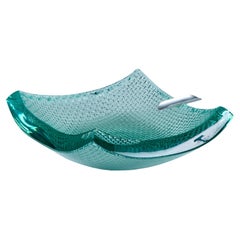
Stephen Schlanser Postmodern Glass Ashtray
Located in Los Angeles, CA
Thick textured glass ashtray by Stephen Schlanser, c.1996, USA. This piece features a deep well with textured glass and one metal divot at one side to place a cigarette or other smok...
Category
American Post-Modern 1990s Decorative Dishes and Vide-Poche
Materials
Metal
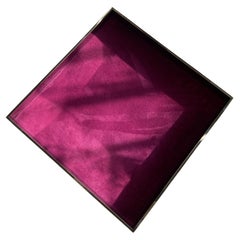
1990
s ilver plated and leather vide poche by Hermès
By Hermès
Located in Bois-Colombes, FR
1990's Silver plated and purple leather vide poche by Hermès
Great quality and condition
Made in France
Category
French 1990s Decorative Dishes and Vide-Poche
Materials
Bronze
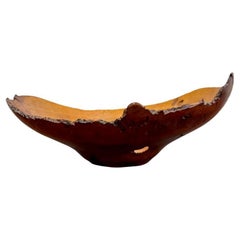
Mid-Century Modern Artisan Studio Made Bowl / Vessel, Cherry Burl, Signed
Located in Manhasset, NY
Mid-Century Modern Artisan Studio Made Bowl / Vessel, Cherry Burl
Unique live edge tableware entirely made of cherry burl by Tom Frey. This work is signed and dated on it's undersid...
Category
American Mid-Century Modern 1990s Decorative Dishes and Vide-Poche
Materials
Cherry, Burl
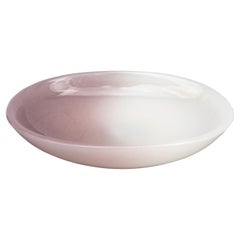
Murano Dual Toned Hand Blown Glass Centerpiece
Located in Pasadena, TX
Striking Murano Hand Blown 2 Tone White Italian Art Glass Bowl.
Beautiful Murano hand blown opal Italian art glass bowl. Can be used as a display piece on any table. Measures: 13"...
Category
Italian Modern 1990s Decorative Dishes and Vide-Poche
Materials
Blown Glass
$1,520 Sale Price
20% Off
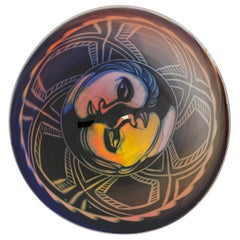
Figurative Glass Dish by Eva Englund
By Eva Englund
Located in London, England
Height: 5cm
Diameter: 46cm
Designer: Eva Englund
Manufacturer: Wilke Adolfsson (blower) and Dorothy Konnberg (engraver)
Date: 1993
Description: This impressive bowl is decoration o...
Category
Swedish Modern 1990s Decorative Dishes and Vide-Poche
Materials
Blown Glass
Still Thinking About These?
All Recently ViewedMore Ways To Browse
Agresti Jewelry Safe
Ann Getty
Antique Distillery
Antique Farrier
Antique Japanese Rings
Antique Kitchen Counter
Antique Matchbox Holders
Antique Oak Pediment
Antique Ostrich
Antique Sewing Storage
Arched Gothic Door
Bath Cabinet
Birch Bark Furniture
Bitossi Fish
Black Bachelors Chest
Black Gustavian Chest
Black Lacquer Bedroom Sets
Bleached Burl