Want more images or videos?
Request additional images or videos from the seller
1 of 8
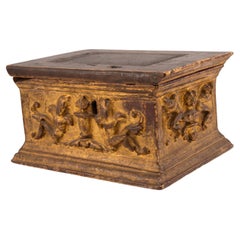
Gothic Chest, Spain, Late 15th Century
$17,764.79List Price
About the Item
- Dimensions:Height: 6.7 in (17 cm)Width: 9.06 in (23 cm)Depth: 5.91 in (15 cm)
- Style:Gothic (Of the Period)
- Materials and Techniques:
- Place of Origin:
- Period:
- Date of Manufacture:Late 15th Century
- Condition:Wear consistent with age and use. Minor losses.
- Seller Location:Madrid, ES
- Reference Number:Seller: Z54571stDibs: LU295139458373
About the Seller
4.9
Vetted Professional Seller
Every seller passes strict standards for authenticity and reliability
Established in 1985
1stDibs seller since 2017
360 sales on 1stDibs
Typical response time: 1 to 2 days
Authenticity Guarantee
In the unlikely event there’s an issue with an item’s authenticity, contact us within 1 year for a full refund. DetailsMoney-Back Guarantee
If your item is not as described, is damaged in transit, or does not arrive, contact us within 7 days for a full refund. Details24-Hour Cancellation
You have a 24-hour grace period in which to reconsider your purchase, with no questions asked.Vetted Professional Sellers
Our world-class sellers must adhere to strict standards for service and quality, maintaining the integrity of our listings.Price-Match Guarantee
If you find that a seller listed the same item for a lower price elsewhere, we’ll match it.Trusted Global Delivery
Our best-in-class carrier network provides specialized shipping options worldwide, including custom delivery.You May Also Like
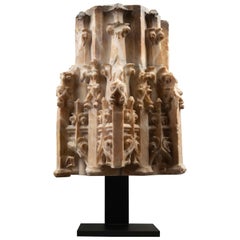
Gothic Canopy, France, 15th Century
Located in Bruxelles, BE
Gothic canopy
France, 15th century
Alabaster, some traces of polychromy
33 x 23 x 20 cm
Provenance:
- Private collection Genève, Switzerland
...
Category
Antique 15th Century and Earlier French Gothic Figurative Sculptures
Materials
Alabaster
$23,686 Sale Price
20% Off
Free Shipping
H 13 in W 9.06 in D 11.03 in
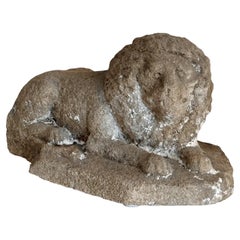
French Gothic Stone Lion, 15th Century
Located in Charlottesville, VA
French Gothic Stone Lion. a reclining stone lion with shaped base, 15th Century. Found at St. Sulpice. Height: overall 7 in. x Width: 11 in. x Depth: 6 1/2 in.
Category
Antique 15th Century and Earlier French Gothic Animal Sculptures
Materials
Stone
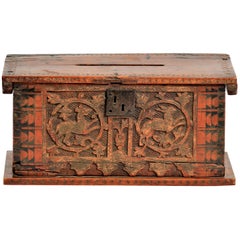
Very Rare Casket Minnekästchen or Box, Germany or Italy, 15th Century
Located in Beuzevillette, FR
Wooden coffret, call minnekästchen, engraved with a dog, a hare and foliage with
polychromy remains. During the Middle Age, the hare is a symbol of fertility, joy and represents the Christ...
Category
Antique 15th Century and Earlier European Gothic Decorative Boxes
Materials
Iron
$11,369 Sale Price
20% Off
H 5.91 in W 12.6 in D 5.91 in
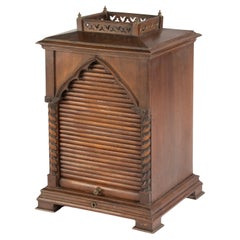
Late 19th Century French Gothic style Walnut Cigar cabinet
Located in Casteren, Noord-Brabant
Elegant 19th-century French cigar cabinet in the Gothic style. This beautifully crafted piece features a tambour roll-top door that opens to reveal compartments for cigars and two sm...
Category
Antique 1880s French Gothic Cigar Boxes and Humidors
Materials
Brass
$947
Free Shipping
H 15.36 in W 10.63 in D 9.45 in
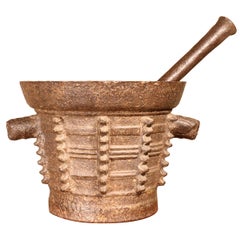
Mortar and Pilar End 15th Century Gothic Period
Located in Brussels, Brussels
Iron mortar with its original pestle end 15th beginning 16th century Gothic period, France
Beautiful original object with a beautiful patina and in good condition
Category
Antique 16th Century French Gothic Urns
Materials
Iron
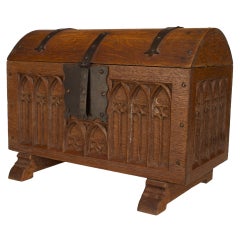
French Gothic Oak Coffer Chest
Located in Queens, NY
French Gothic-style (19/20th Century) oak coffer chest on stand with tracery carved panels and a domed lid with iron strap work
Category
Antique 19th Century French Gothic Boxes
Materials
Iron
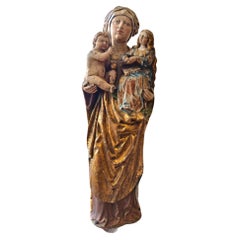
15th Century Gothic Virgin
Located in Madrid, ES
15th century Gothic Virgin
Gothic Virgin of the 15th century Virgin in carved and polychrome wood of the 15th century. In its original state, muse...
Category
Antique 15th Century and Earlier Figurative Sculptures
Materials
Wood
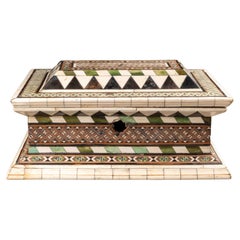
Embriachi workshop marquetry casket - Northern Italy, 15th century
Located in Bruxelles, BE
Embriachi workshop marquetry casket
Northern Italy, 15th century
Alla certosina inlays (bone, stained bone, pewter and wood)
H 28.2 x W 18 x D 14 cm
This beautiful casket of rectangular form is richly decorated with the characteristic geometric patterns of the Embriachi style.
The intricate geometric patterns are fashioned by juxtaposing lighter and darker pieces of wood, (colored) bone, horn and pewter. The lid and base are framed by a broad band of horn. When ivory became scarce in Europe due to disrupted trade routes, bone was substituted.
The attention to Symmetry and balance created an harmonious visual effect
Enhancing the overall aesthetic appeal of the casket.
The application of geometrical motifs is in Italy known as marquetry ‘alla Certosina’, named after the Certosina Church in Pavia with its famous altarpiece decorated in this way. This is ‘intarsia technique’, a term derived from the Arabic 'tarsi', which means ‘incrustation' recalling ancient mosaics made from various materials.
These geometric elements not only enhance the aesthetic appeal of the caskets but also demonstrate the versatility and skill of the artisans in creating multifaceted works of art.
‘Alla Certosina’ became famous through the Northern Italian Embriachi family who achieved a particularly high standard in working in this technique. Venice in particular was known for the production of these luxurious boxes. The caskets, hexagonal or rectangular, surmounted by a lid decorated in several registers constitute the secular, albeit equally renowned component of the workshop’s production, in addition to mirror frames and various everyday objects.
The method of fabrication of those objects was based on two concepts that underlay pre-industrial production: standardization and modularity, thanks to a distribution of skills according to the different phases of fabrication.
even the realization of the marquetry motifs (in the form of ingots from which portions of the desired size were cut) were therefore entrusted to various specialized craftsmen, as were the assembly phase.
Today better known thanks to the extensive research work recently carried out by Michele Tomasi, this workshop owes its name to its founder and owner, the Florentine Baldassare Ubriachi (or degli Embriachi), a merchant and banker established in the Tuscan capital before he settled in Venice in 1395. Together with sculptor Giovanni di Jacopo, who directed the workshop, from the last years of the fourteenth century, Baldassare oversaw a production that was truly original, and still easily recognizable today, comprising monumental altarpieces and various objects, primarily triptychs and caskets.
The precise location of the workshop is unknown, except that it originated in Florence and in ca. 1431 there was apparently a workshop in Venice, in the area of S Luca. They employed local workers specializing in 'certosina' (inlay of stained woods, bone and horn), and the workshop produced items carved in bone (usually horse or ox) with wood and bone marquetry.
The geometric decoration of Embriachi caskets reflects the artistic complexity and attention to detail that characterized their work.
this inlaid casket is a testament to the skill and artistry of the Embriachi family and serves as a stunning example of the decorative arts of the late Middle Ages.
Related Literature :
E. Berger, Prunk-Kassetten: Europäischen Meisterwerke aus acht Jahrhunderten / Ornamental Caskets...
Category
Antique 15th Century and Earlier Italian Renaissance Decorative Boxes
Materials
Pewter
$20,133 Sale Price
22% Off
Free Shipping
H 11.11 in W 7.09 in D 5.91 in
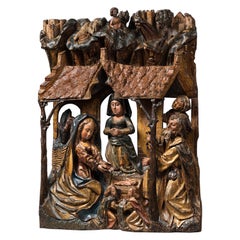
Late 15th Century Polychrome Wood Carving Depicting the Nativity
Located in Saint-Ouen, FR
While the birth of Christ is briefly told in the Gospel of Luke (2, 7) it is in the apocryphal texts that we find most of the elements and details that have then inspired artists. As of the 14th century and even more of the 15th century the subject of the Adoration of the Child replaces in Western art the scene of the Birth, much favoured in Byzantine art. Instead of being depicted lying with the new-born swathed in the manger, the Virgin is now kneeling, her hands joined in prayer in front of the naked child. This change was probably hastened by the popularity of the visions of Saint Bridget of Sweden to whom the Virgin allegedly appeared to show how she had given birth to Jesus (Visions, VII, chap. 21).
Sheltered by a thatch-roofed structure the Virgin is kneeling in front of the Child Jesus. She wears a magnificent red dress under a large gold cloak. Her curled blond hair is partially veiled. The newborn is lying on a straw mat. Joseph is depicted with a parted beard and stands opposite from the Virgin. He wears a tunic and a coat with a purse hanging from the belt. His costume reminds us of the long journey him and Mary have accomplished to reach Bethlehem.
Two other women are present. One is looking through the stable’s window to observe the Holy Family while another one kneels in prayer in front of the divine child. The rich costume of the lady might indicate she is a donator.
However they could also both represent the women who took part in the birth of Christ, Zelemi and Salome. Salome, incredulous did not believe in the virginal conception of Mary and she is represented far from the scene. The artist has depicted her with an expression of doubt on her face. Zelemi, on the contrary, is a believer. She is rewarded by a place of honour at the heart of the scene, close to Mary.
To the left the donkey and ox that have accompanied Mary and Joseph to Bethlehem observe quietly the scene.
On the foreground two angels hold a scroll reading an excerpt from the Gloria : “/Gloria/ in excelsis /Deo/.” One of the angels wears a blue cape while the other’s is red Those two colours are very significant as during Middle-Ages blue symbolises hope and red charity. Together they express the hope in redemption thanks to the advent of Christ and his sacrifice to come.
Above the main scene, up a cliff, a small shepherd lets his herd of sheep graze amidst the trees. He is framed by two walled cities.
This wood carving is the work of a very skilled and inventive artist. The piece bears witness to his exceptional talent. The realism of the scene is emphasised by the amount of details depicted. The refinement of the carving itself is highlighted by the well preserved polychromy.
This key moment of the New Testament is set in a contemporary context thanks to the clothes of the characters and the scenes of rural life. The universal dimension of the scene is intensified while allowing contemporary viewers to grasp its meaning more easily.
This care for details, the picturesque realism as well as the extraordinary rendition of the cloths suggest it was made by a Flemish artist during the late 15th century.
This relief can be compared with the panel of the Nativity from the Saint-Vaast altarpiece made by Jacques Daret between 1433 and 1435, today in Madrid’s Thyssen-Bronemisza Museum.
Literature
Louis Réau, Iconographie de l’Art chrétien...
Category
Antique 15th Century and Earlier Dutch Gothic Figurative Sculptures
Materials
Wood
$53,294
H 23.63 in W 17.72 in D 3.35 in
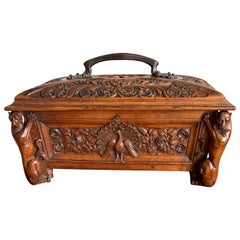
Stunning Handcrafted Late 1800s Gothic Casket with Peacock
Gargoyle Sculptures
Located in Lisse, NL
Beautiful and rare Gothic Revival treasure box with bronze handle.
If you are a collector of antique boxes and/or if you are looking for an extraordinary jewelry box to grace your credenza or side table then this unique and top quality made specimen in the Gothic style could be perfect. Gothic Revival boxes are very hard to find and we have never seen one with such prodigious carvings on all sides. The unique and cat-like dragon gargoyles (with fangs) that look like they are carrying this casket, are just some of the stunningly carved and detailed sculptures that make this antique rarity even more artistic and impressive.
Another great feature are the peacock sculptures. In Christianity the peacock is the symbol of purity. Christians believe that once someone has passed their soul rises and goes to heaven. This is why in earlier times Christians would spread the feathers of a peacock over the deceased since it symbolized a pure soul that was immune to corruption. The peacock also represents immortality, resurrection, and the spiritual teachings of Jesus Christ and the Christian church.
Have you also noticed the top quality details on both ends of the bronze handle on top? The quality of that ornamental work is of the absolute highest standard also. There are many more incredibly beautiful, hand carved details and together they show that no expense was spared to create one of the most amazing Gothic caskets...
Category
Antique Late 19th Century Italian Gothic Religious Items
Materials
Bronze, Iron
$6,158
Free Shipping
H 10 in W 17.5 in D 9.7 in
More From This Seller
View AllChest, Leather, Wrought Iron, Textile, Wood, Spain, circa 1500
Located in Madrid, ES
Rectangular body casket with semicircular lid made of carved wood and covered with a worked leather that has been reinforced with a series of forged iron fittings, material in which ...
Category
Antique 16th Century Spanish Gothic Jewelry Boxes
Materials
Wrought Iron, Other

Chest. Carved wood, metal. Spanish school, 16th century.
Located in Madrid, ES
Chest. Carved wood, metal. Spanish school, 16th century.
Rectangular casket with a flat lid decorated on the outside with a series of figurative reliefs in a symmetrical arrangemen...
Category
Antique 16th Century Spanish Renaissance Decorative Boxes
Materials
Metal, Other
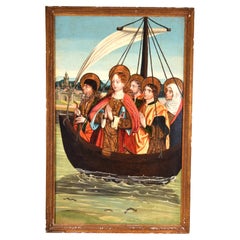
Mary Magdalene on her way to Marseille. Castilian school, 15th century.
Located in Madrid, ES
Mary Magdalene on her way to Marseille. oil on board. Castilian school, towards the last third of the century XV. Oil on panel showing a landscape in the background with a walled city, some mountains and the shore of a watercourse (from the theme it is seen that it is the shore from sea). In the foreground and in full body, a boat with a sail appears with a circus richly dressed characters and with their respective nimbus (these decorated with geometric elements and engraved vegetables), two women and three men. Note the anecdotal detail of the fish crossing the waters under the ship. In the Golden...
Category
Antique 15th Century and Earlier Spanish Gothic Religious Items
Materials
Other
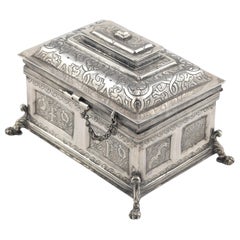
Silver Chest, After 17th Century Models, circa 20th Century
Located in Madrid, ES
Arquette inspired by 17th century models. Silver, Spain, 20th century
Rectangular casket made of silver in its color, with four legs in the corners in the form of roll and finished ...
Category
20th Century European Other Decorative Boxes
Materials
Silver, Other
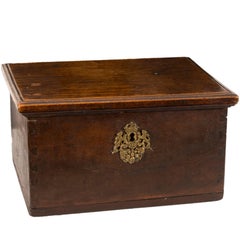
Walnut and Metal Small Chest, 17th Century
Located in Madrid, ES
Small rectangular ark with a flat lid, with a lock of golden metal worked (crown on two facing lions, located on a garland of great size, and all around a symmetrical composition wit...
Category
Antique 17th Century European Baroque Jewelry Boxes
Materials
Metal
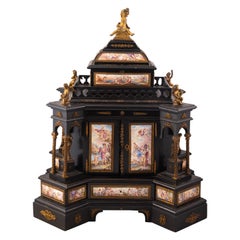
Viennese tabletop jewelry box or chest. Austria, 19th century.
Located in Madrid, ES
Viennese tabletop jewelry box or chest. Wood, enamels, bronze. Austria, second half of the 19th century.
Requires restoration.
Rectangular table...
Category
Antique 19th Century Austrian Neoclassical Revival Jewelry Boxes
Materials
Bronze, Enamel, Other
Still Thinking About These?
All Recently ViewedMore Ways To Browse
Spanish Gothic Furniture
15th Century Spanish
Spanish Furniture 15th Century
Gothic Velvet
Antique Wood Plane
Bible Boxes
Scandinavian Wood Box
Sea Shell Box
Vizagapatam Furniture
Antique Enamel Pill Box
Antique Leather Hat Box
Antique Mahogany Writing Box
Antique Military Boxes
Antique Necessaire Box
Antique Post Box
Antique Tunbridge Box
Bombe Box
Brass Betel Box