Items Similar to Mid 17th Century Dutch Engraved Silver Wedding Casket or knottekist, Circa 1660
Want more images or videos?
Request additional images or videos from the seller
1 of 20
Mid 17th Century Dutch Engraved Silver Wedding Casket or knottekist, Circa 1660
$12,979.39
£9,500
€11,065.36
CA$17,880.05
A$19,617.82
CHF 10,333.73
MX$233,374.68
NOK 132,373.79
SEK 120,875.34
DKK 82,668.90
About the Item
A museum-grade mid-17th century Dutch silver marriage casket or knottekistje, circa 1660.
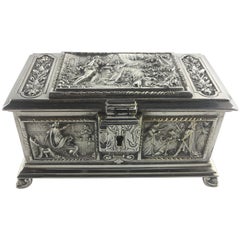
Raised on solid silver bun feet the miniature casket is profusely engraved to all faces depicting a courting couple and architecture entwined in scrolling foliage. The reverse of the casket depicts the last supper, however, if you look closely, you can see a boy stealing food or wine from underneath! Possibly, this is the courting gentleman showing that he had a sense of humour.
The scratch lined moulded top is surmounted with an intricate handle (once gilt) and floral patera to the centre. There are two inscriptions each within a cartouche 'In Lÿfde Beltact het al' and 'Getrouw tot in den doot' which loosely translates to 'faithful until the death' and 'love is everything'.
Wedding caskets such as this were a speciality of Friesland. Traditionally, a man's promise of marriage to his future bride and was formal when he presented her with a coin knotted into a costly cloth (knottedoek). This later became a textile bag and then in the seventeenth century, the silver casket (knottekistje). Though, examples such is this were reserved for the rich and noble.
The Dutch Golden Age in the Netherlands began in circa 1588, when the Dutch Republic was established, to 1672, when the Rampjaar occurred. Dutch trade flourished the most prominent in Europe.
Later struck with two Dutch tax marks in the form of a dolphin.
Weight 3.9oz.
- Dimensions:Height: 2.76 in (7 cm)Width: 3.08 in (7.8 cm)Depth: 1.58 in (4 cm)
- Style:Baroque (Of the Period)
- Materials and Techniques:
- Place of Origin:
- Period:
- Date of Manufacture:1660
- Condition:Wear consistent with age and use. Lovely original condition in line with age and use. Though we cannot be certain of the style, it is likely that it once had a cast push release.
- Seller Location:Oxfordshire, GB
- Reference Number:1stDibs: LU4936235491472
About the Seller
5.0
Recognized Seller
These prestigious sellers are industry leaders and represent the highest echelon for item quality and design.
1stDibs seller since 2019
24 sales on 1stDibs
Typical response time: 1 to 2 days
Associations
LAPADA - The Association of Arts
Antiques Dealers
- ShippingRetrieving quote...Shipping from: Faringdon , United Kingdom
- Return Policy
More From This Seller
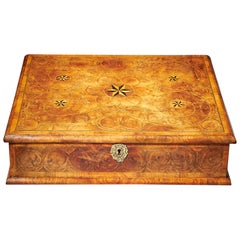
View All17th Century William and Mary Olive Oyster Lace Box, Circa 1680-1700
Located in Oxfordshire, United Kingdom
A fine and rare 17th-century William and Mary period olive oyster lace box of perfect proportions. 1680-1700, England
The cross-grain moulded top is entirely covered in well-place...
Category
Antique 17th Century English William and Mary Decorative Boxes
Materials
Olive, Holly
Fine William and Mary 17th Century Olive Oyster Lace Box
Located in Oxfordshire, United Kingdom
A fine late 17th-century olive oyster 'Lace Box' of small proportions, circa 1680-1690, England.
The cross-grain moulded and holly banded top is finely veneered in hand-cut veneers ...
Category
Antique 17th Century English William and Mary Decorative Boxes
Materials
Olive
Large William and Mary 17th Century Inlaid Olive Oyster Lace Box, Circa 1690
Located in Oxfordshire, United Kingdom
A fine and rare large parquetry inlaid 17th-century William and Mary period olive oyster lace box. 1680-1700, England
The cross-grain moulded top is ent...
Category
Antique 17th Century English William and Mary Decorative Boxes
Materials
Oak, Olive, Ebony
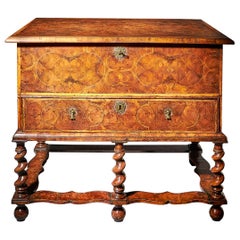
17th Century William and Mary Olive Oyster Chest on Stand or Table Box
Located in Oxfordshire, United Kingdom
A fine and extremely rare 17th century William and Mary baroque olive oyster chest on stand or 'table box', circa 1675-1690.
The exquisite...
Category
Antique Late 17th Century English William and Mary Commodes and Chests o...
Materials
Olive
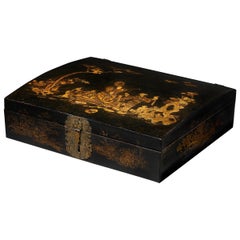
18th Century George I Domed Topped Japanned Chinoiserie Falconry Box, circa 1710
Located in Oxfordshire, United Kingdom
A rare and important Queen Anne-George I japanned chinoiserie domed topped box depicting scenes of falconry, circa 1710-1720. England
Falconry is ...
Category
Antique Early 18th Century English Chinoiserie Decorative Boxes
Materials
Oak
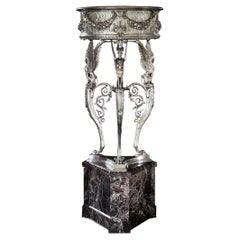
19th Century Silvered Bronze Athénienne Jardinière by Ferdinand Barbedienne
By Ferdinand Barbedienne
Located in Oxfordshire, United Kingdom
A French silvered-bronze athénienne by Ferdinand Barbedienne, Paris, last quarter 19th century with a revolving liner, the frieze applied with bucrania suspending ribbon-tied berried laurel swags above a border of bellflowers on a stippled ground above three seated female sphinxes issuing stylised foliage and scrolls on lion monopodia cast with the mask of Hercules, scrolling foliage and anthemions joined by stretchers, raised on a concave-sided triform marble base on a further thin silvered-bronze base, inscribed to the tripod base 'F. BARBEDIENNE'
Measures: 103.3cm. high, 41.5cm. diameter; 3ft. 4 3/8 in, 1ft. 4 1/4.
This impressive athénienne is a key reminder of the longevity of a particular model and design’s success from Antiquity through to the 19th century and up until this day. Typically known as the ‘Trépied du Temple d’Isis’, this athénienne is designed after the Roman antique originally found at Pompeii and now at the Museo Archeologico Nazionale, Naples (fig.1). From being for example an inspiration for the baptismal font of Napoléon’s son in 1811, this model was the inspiration to many highly skilled makers throughout the 19thcentury such as the Manfredini brothers from Milan and of course the Parisian well-established bronze founder Ferdinand Barbedienne who executed the present example.
The Temple of Isis was a Roman temple dedicated to the Egyptian goddess Isis and was among one of the first discoveries during the excavation of Pompeii in 1764. Certainly considered as one of the most elegant examples of antique tripods, the existence of this model was then popularized to the rest of Europe via prints, one of the first being by Giovanni Battista Piranesi in 1779. This type of tripod was also popularised by an engraving in C. Percier and P. Fontaine’s, Receuil de Décorations Intérieures of 1801. Interestingly, there is also a watercolour now in the Musée Carnavalet, Paris, showing this type of tripod displayed at the 1801 Exposition des Produits de L’Industrie in the Louvre.
The passion for Greek and Roman Art in the 19th century.
The discovery of Pompeii and Herculaneum around the middle of the 18th century gave rise to a new passion for Antiquity and the excavated masterpieces renewed the repertoire of fine and decorative arts and served as models for Neoclassicism. Members of the aristocracy as well as connoisseurs, particularly in England, completed their education by undertaking a ‘Grand Tour’ of Italy and often fell victim to the recently unearthed Greek and Roman artefacts...
Category
Antique 19th Century French Grand Tour Planters, Cachepots and Jardinières
Materials
Marble, Silver Plate, Bronze
You May Also Like
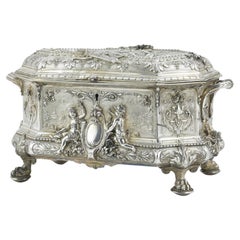
French 19th Century Silver Plated Casket
Located in London, GB
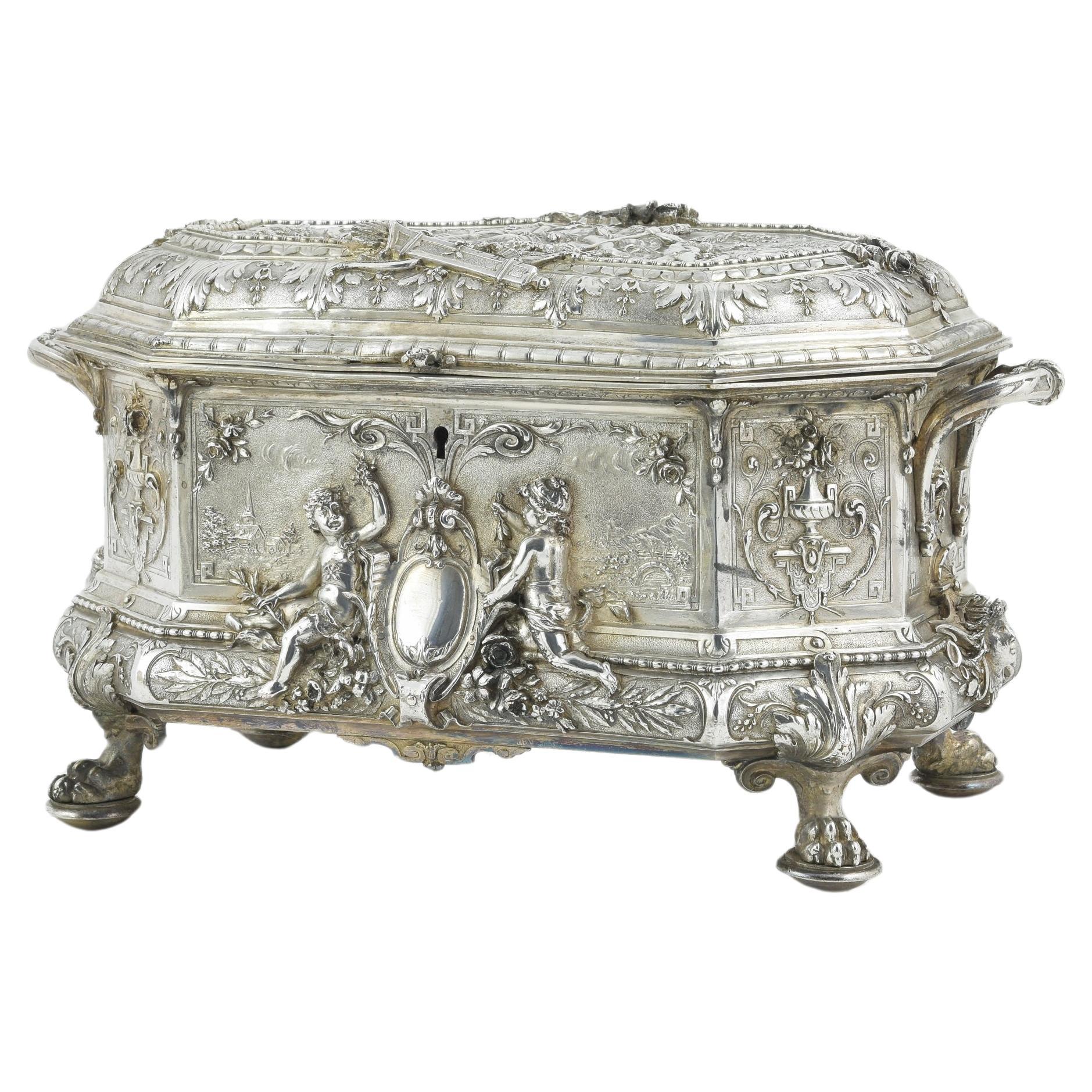
The whole casket is richly decorated. Standing on lions paw feet adorned with baroque motifs the scene on top depicts cupid stood beside two lovers (possibly) Daphne and Apollo. The ...
Category
Antique 19th Century French Jewelry Boxes
Materials
Silver Plate
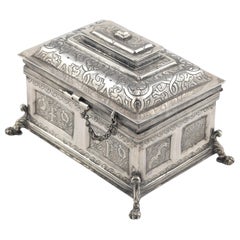
Silver Chest, After 17th Century Models, circa 20th Century
Located in Madrid, ES
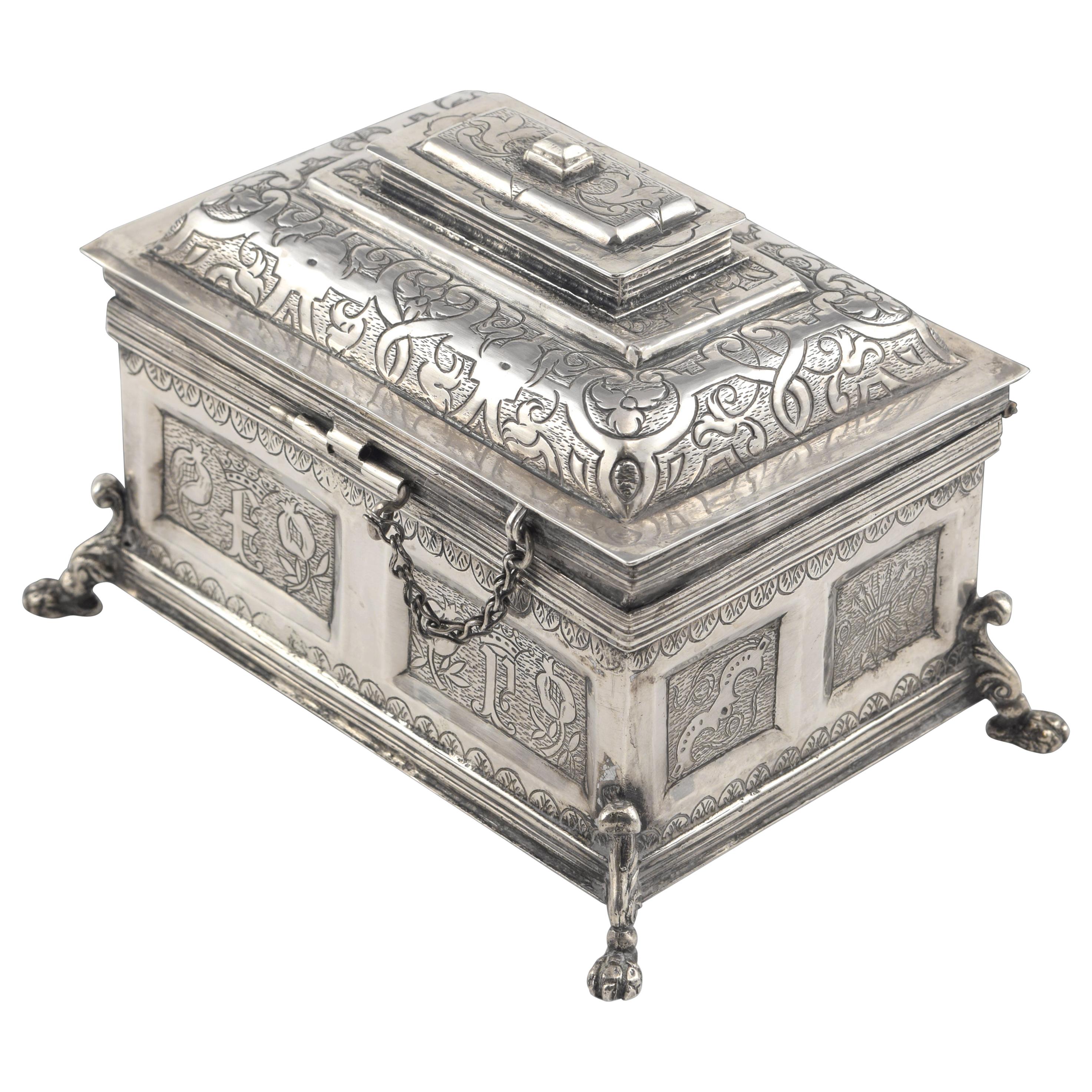
Arquette inspired by 17th century models. Silver, Spain, 20th century
Rectangular casket made of silver in its color, with four legs in the corners in the form of roll and finished ...
Category
20th Century European Other Decorative Boxes
Materials
Silver, Other
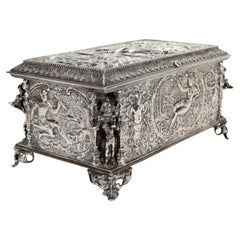
Antique German Figural Renaissance Revival Solid Silver Table Box or Casket
Located in Philadelphia, PA
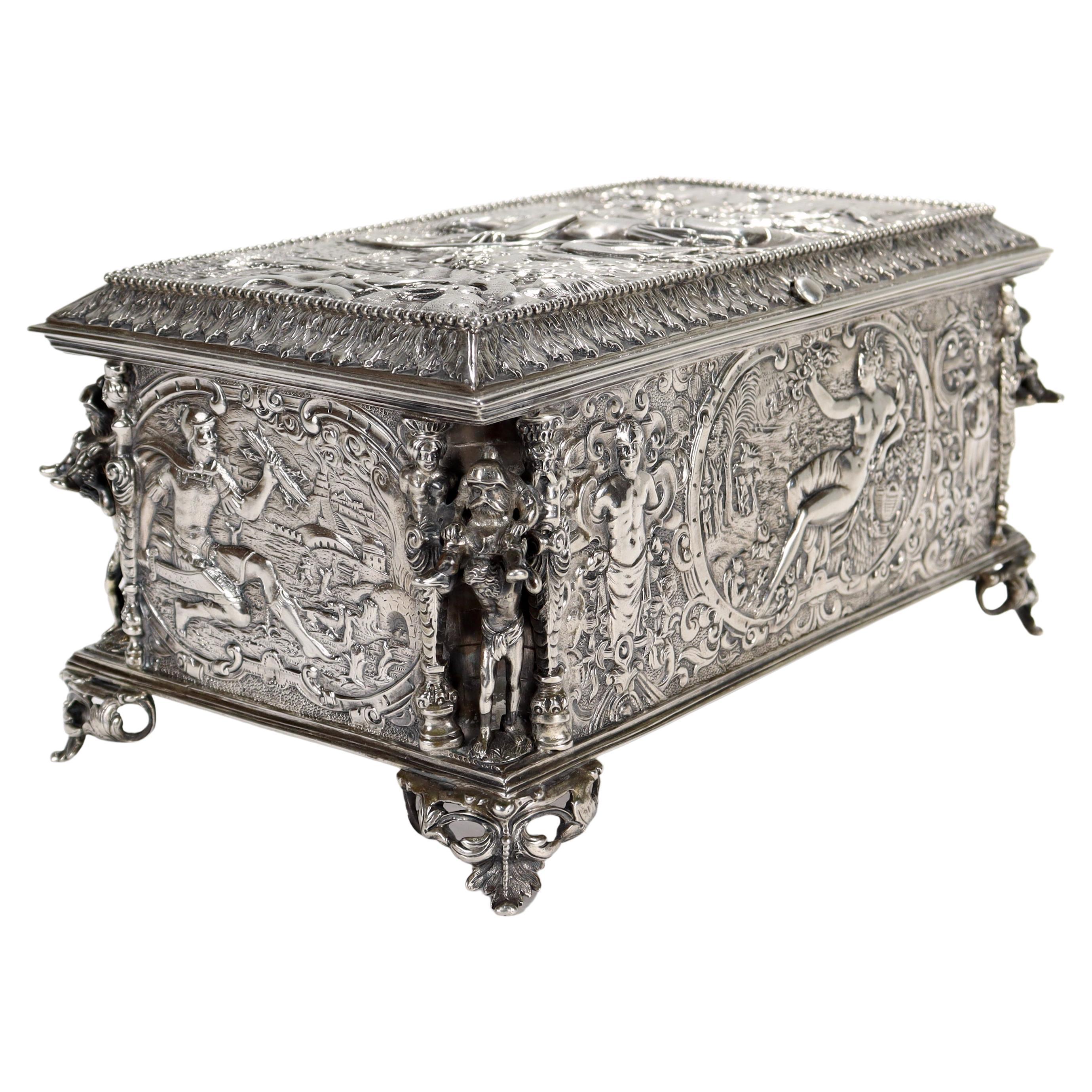
A very fine Renaissance Revival table box or casket.
In solid silver (likely 800 fine).
Likely by Gebrüder Neumann or Storck & Sinsheimer of Hanau, Germany. (Storck & Sinsheimer ex...
Category
Early 20th Century German Renaissance Revival Boxes and Cases
Materials
Silver
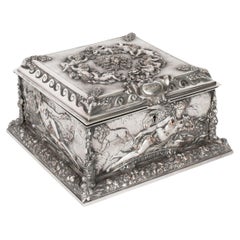
Antique Victorian Silver Plated Jewellery Casket Walker and Hall 19thC
Located in London, GB
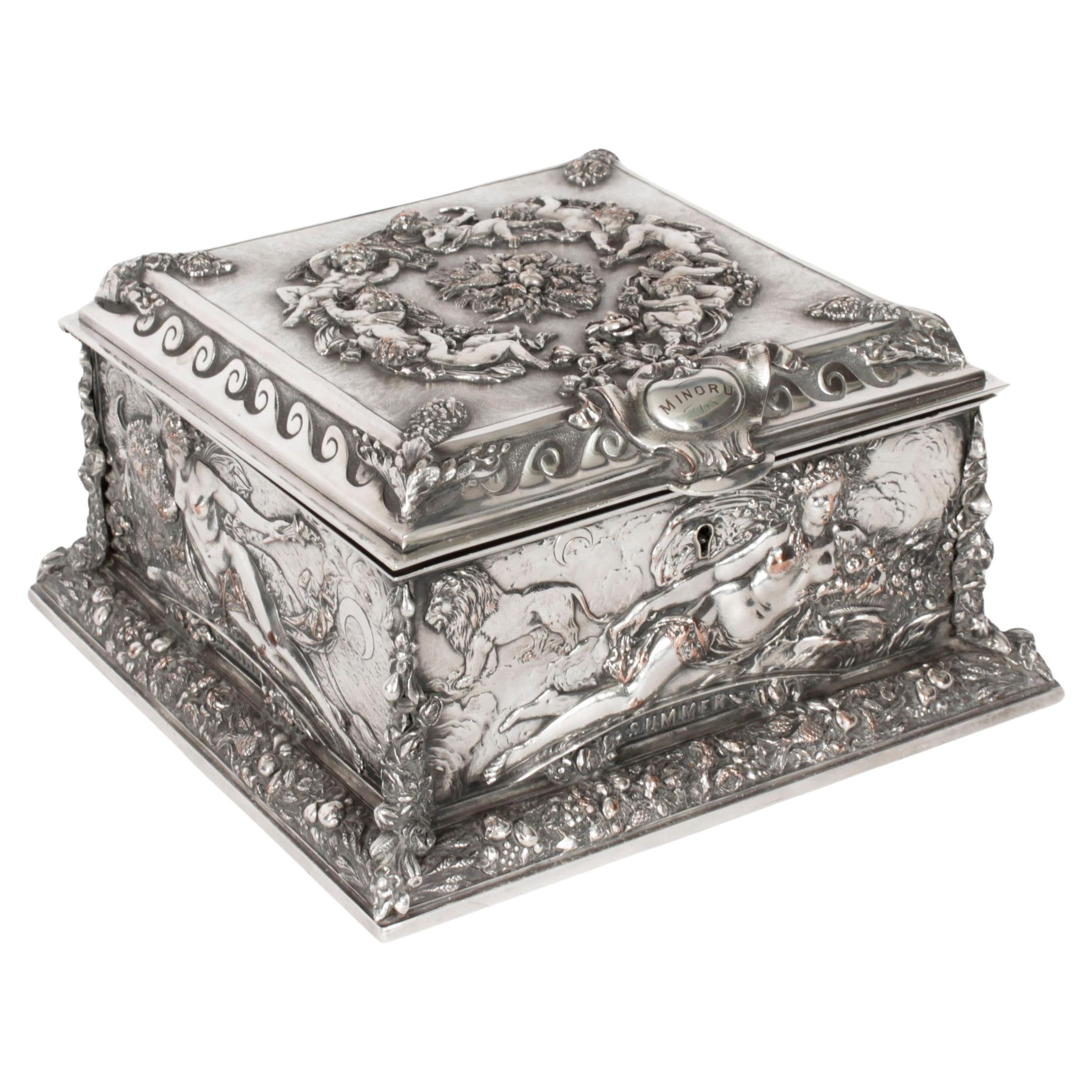
This is a lovely antique Victorian silver plated casket bearing the makers mark of the renowned silversmiths, Walker and Hall, Circa 1840 in date.
The square casket freatures an epic mythological scene of the four seasons with eight winged cherubs on the lid.
Each side features the four seasons: spring features a bull and a goddess, summer has a lion and a goddess, autumn has a scorpion and a goddess and winter has a cherub and goddess.
The interior of the box features its original quilted buttoned silk upholstery.
Add some elegance to your home with this lovely casket.
Condition:
In excellent condition with no dings, dents or signs of repair. Please see photos for confirmation.
Dimensions in cm:
Height 15 cm x Width 24 cm x Depth 24 cm
Dimensions in inches:
Height 6 inches x Width 9 inches x Depth 9 inches
Walker & Hall
the business was established in Sheffield in 1845 by George Walker who become an assistant of Dr John Wright. Dr John Wright had conducted important experiments on electroplating, Walker secured the royalty of electroplating for Sheffield.
The business was joined by Henry Hall and became in 1853 Walker & Hall. The factory was at Howard Street, Sheffield, while showrooms were opened in 45 Holborn Viaduct, London. Branches were opened in Liverpool, Manchester, Leeds, Glasgow, Edinburgh, Newcastle, Cardiff, Belfast, Hull, Bristol, Melbourne and Adelaide (Australia), Cape Town (South Africa).
Walker & Hall was converted into a limited liability company in 1920 under the style Walker & Hall Ltd and combined in 1963 under the British Silverware...
Category
Antique 1840s Decorative Boxes
Materials
Silver Plate
French Medieval Style Silver Jewelry Box, circa 1880
Located in Miami, FL
A remarkable intricately designed, handcrafted silver box, circa 1880s.
We were told that this box is sterling silver and that the makers mark "M" is that of "M. Mayer". Maurice MAYER was a very prestigious silversmith. Research shows that he was an "Orfèvre de l'Empereur", Napoleon Bonaparte, 1860-1870.
The Minerva hallmarks are not visible, may have been rubbed off from use and cleaning. No documentation.
This intricately carved box depicts the romantic poem of Le Roman de la Rose (The Romance of the Rose). Comes with the original lock and key.
Le Roman de la Rose, begun by Guillaume de Lorris circa 1230 and completed, in a different style, circa 1270-1280, by Jean de Meun, builds on the concept of courtly love found in the poetry of the troubadours. The authors create a complex allegory of the romance between the Lover and the Rose. In the quest to pick the Rose (to achieve the conquest of love), the flower and its attendants represent the Lady and her sentiments while being wooed.
In the first part of the poem, written by de Lorris, the Lover recounts his dream, ending with the winning of a kiss from the Lady. In the dream, the Lover discovers a walled garden and gains entrance thanks to a beautiful young woman. He meets Diversion and dancers who represent courtly values such as Beauty and Generosity. A tour of the garden brings him to a beautiful bed of roses by the Fountain of Love...
Category
Antique 19th Century French Jewelry Boxes
Materials
Sterling Silver
IMPORTANT MUSEUM QUALITY ANTIQUE 1680 TO 1720 GERMAN SiLVER SAFE STRONGBOX
Located in West Sussex, Pulborough
Royal House Antiques
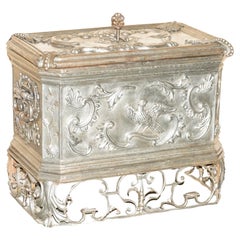
Royal House Antiques is delighted to offer for sale this important, Museum Quality German safe circa 1680-1720 attributed to Johann Gottlied Dittman and Sigmund Gatchen
Please note the delivery fee listed is just a guide, it covers within the M25 only for the UK and local Europe only for international, if you would like an accurate quote please send me your postcode and I’ll provide you with the exact price
Where to begin, if you are looking at this listing then the chances are you know something about antique safes, if you do, then you will recognise just how rare this piece is, I have in all my online research only found one other that was in a terrible condition, it sold in the Sotheby’s Carlton Towers sale on the 4th November 2009, the sale price was £73,250 plus commission which at the time was 30% making the final sale amount £95,225 This example was missing the original key, all the silver finish had polished off and it was rusty, mine by comparison is in absolutely sublime order throughout
The original key is present, it operates the exceptionally heavy top lock which has 22 separate locks, each lock works independently so if a thief tried to force one open, it would have no affect on the remaining 21 locks
The front of the safe depicts a bird possibly an eagle, the top has a medieval locking plate cover which splits down the middle to reveal the entrance to the lock, it looks similar to a fleur de lis, it springs closed when the key is removed and has its own lock, it has a secret to unlock it, if you don’t know it, you can never fit the key. The sides have oversized handles as they need to be, the safe must weight in excess of 100kgs, the rear has a similar medieval crest
The finish is sublime, truly exquisite, this is a work of art and will be the centre piece and pride of any collection, I have absolutely no desire to sell it whatsoever, if it stays in my collection forever so be it, I will never have the chance to own such a piece again and it is an absolute pleasure to see it each day
For a similar strong box signed to the interior by Dittman and Gatchen and worthy of comparison see a very fine example from The Alphonse de Rothschild Collection which was sold on the 26th of March 1973 at the De Rede sale in Monaco as lot 167. The Rothschild box...
Category
Antique 1680s Charles II Trunks and Luggage
Materials
Iron, Nickel
More Ways To Browse
Antique 17th Century Dutch
17th Century Dutch Furniture
Courting Couples
Mark Dutcher
Dutch Silver Box
Casket Silver Box
Mid Century Casket
Antique Last Supper
Antique Dutch Silver Boxes
17th Century Dutch Silver
Baroque Casket
17Th Century Casket
Silver Bun Feet
Miniature Casket
Wedding Casket
19th Century French Cut Crystal Box
Antique Keepsake Box
Antique Treen Treen