Want more images or videos?
Request additional images or videos from the seller
1 of 19
Pair of Mongolian Yak Butter Containers, c. 1900
$1,184List Priceper set
About the Item
- Dimensions:Height: 9.75 in (24.77 cm)Diameter: 8.25 in (20.96 cm)
- Sold As:Set of 2
- Materials and Techniques:
- Place of Origin:Mongolia
- Period:
- Date of Manufacture:circa 1900
- Condition:Wear consistent with age and use.
- Seller Location:Chicago, IL
- Reference Number:Seller: Y139C Y139E1stDibs: LU820013932672
About the Seller
5.0
Platinum Seller
Premium sellers with a 4.7+ rating and 24-hour response times
Established in 1997
1stDibs seller since 2006
1,746 sales on 1stDibs
Typical response time: 2 hours
Authenticity Guarantee
In the unlikely event there’s an issue with an item’s authenticity, contact us within 1 year for a full refund. DetailsMoney-Back Guarantee
If your item is not as described, is damaged in transit, or does not arrive, contact us within 7 days for a full refund. Details24-Hour Cancellation
You have a 24-hour grace period in which to reconsider your purchase, with no questions asked.Vetted Professional Sellers
Our world-class sellers must adhere to strict standards for service and quality, maintaining the integrity of our listings.Price-Match Guarantee
If you find that a seller listed the same item for a lower price elsewhere, we’ll match it.Trusted Global Delivery
Our best-in-class carrier network provides specialized shipping options worldwide, including custom delivery.You May Also Like
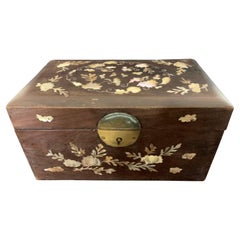
Indochinese Box in Wood and Mother of Pearl circa 1900
Located in Beuzevillette, FR
Nice wooden and mother-of-pearl box from the 1900s. The mother-of-pearl inlays form plant motifs (flowers and foliage), incised to give volume to the different parts. It closes with ...
Category
Antique Late 19th Century Asian Decorative Boxes
Materials
Wood
$268 Sale Price
20% Off
H 4.41 in W 8.15 in D 4.81 in
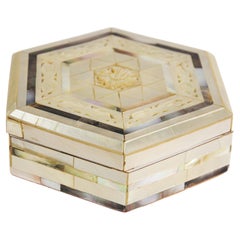
Handcrafted White Mother of Pearl Inlaid Moorish Octagonal Box
Located in Moreno Valley, CA
Exquisite handcrafted white mother of pearl inlaid and hand carved lidded box.
Small octagonal Anglo Indian decorative box intricately decorated with Moorish motif designs which hav...
Category
Mid-20th Century Indian Moorish Decorative Boxes
Materials
Shell, Fruitwood, Abalone, Mother-of-Pearl
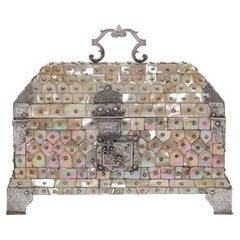
16th-Century Indo-Portuguese Colonial Mother-of-pearl Gujarat Casket
Located in Amsterdam, NL
An exceptional Indo-Portuguese colonial mother-of-pearl veneered casket with silver mounts
India, Gujarat, 2nd half of the 16th century, the silver mounts Goa or probably Lisbon
Measures: H. 16 x W. 24.6 x D. 16.1 cm
An exceptional Gujarati casket with a rectangular box and truncated pyramidal lid (with slopes on each side and a flat top) made from exotic wood, probably teak (Tectona grandis), covered with a mother-of-pearl mosaic. The tesserae, cut from the shell of the green turban sea snail (Turbo marmoratus, a marine gastropod) in the shape of fish scales, are pinned to the wooden structure with silver ball-headed nails. The casket is set on bracket feet on the corners. The masterfully engraved decoration of the silver mounts follows the most refined and erudite Mannerist repertoire of rinceaux and ferroneries dating from the mid-16th century. The high quality and refinement of the silver mounts and, likewise, the silver nails that replaced the original brass pins used to hold the mother-of-pearl tesserae in place indicate the work of a silversmith probably working in Lisbon in the second half of the 16th century.
The Indian origin of this production, namely from Cambay (Khambhat) and Surat in the present state of Gujarat in north India, is, as for the last three decades, consensual and fully demonstrated, not only by documentary and literary evidence - such as descriptions, travelogues and contemporary archival documentation - but also by the survival in situ of 16th-century wooden structures covered in mother-of-pearl tesserae. A fine example is a canopy decorating the tomb (dargah) of the Sufi saint, Sheik Salim Chisti (1478-1572) in Fatehpur Sikri in Agra district in the state of Uttar Pradesh, north India. This is an artistic production, geometric in character and Islamic in nature, where usually the mother-of-pearl tesserae form complex designs of fish scales or, similar to the dishes also made using the same technique, with the thin brass sheets and pins, stylized lotus flowers. The truncated pyramidal shape corresponds, like their contemporary tortoiseshell counterparts also made in Gujarat, to a piece of furniture used in the Indian subcontinent within the Islamic world prior to the arrival of the first Portuguese. This shape, in fact, is very old and peculiar to East-Asian caskets, chests or boxes used to contain and protect Buddhist texts, the sutras.
A similar chest is the famous and large reliquary chest from Lisbon cathedral that once contained the relics of the city's patron saint, Saint Vincent. Both match in shape, having the same kind of socle or pedestal and bracket feet, and in their engraved silver mountings, featuring the same type of refined, erudite decoration. Their differences lie in the silver borders that frame the entire length of the edges of the chest (both the box and the lid), pinned with silver nails, and on the lock plate, shaped like a coat of arms in the Lisbon example. Given the exceptional dimensions of the reliquary casket...
Category
Antique 16th Century Indian Jewelry Boxes
Materials
Silver
$275,502
Free Shipping
H 6.3 in W 9.69 in D 6.34 in
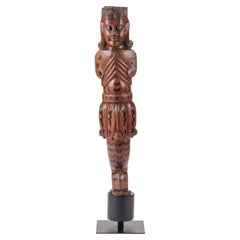
Splendid Indo-Portuguese Colonial Sculpture of Nagini from Goa, 17th Century
Located in Amsterdam, NL
A fine Indo-Portuguese inlaid teak wood figure of Nagini
India, Goa, 17th century
Measure: H. 55 cm
(with stand, and with ring for wall hanging)
The sculpture can be perceived as such but probably is one of four legs of an Indo-Portuguese contador...
Category
Antique 17th Century Indian Jewelry Boxes
Materials
Teak, Ebony
$4,950
Free Shipping
H 21.66 in W 5.91 in D 5.91 in
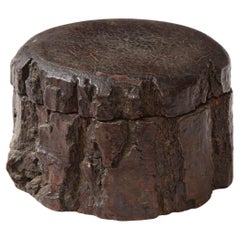
Chinese Carved Root Wood Box
Located in New York, NY
The circular box and conforming cover carved in realistic detail, with grainy texture and undulating bark-like sides, overall glazed or stained in a dark molasses color, the interior...
Category
Antique 19th Century Chinese Decorative Boxes
Materials
Wood, Paper
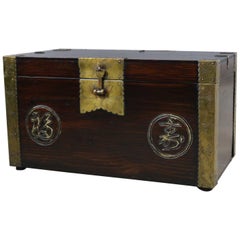
Antique Korean Trunk Chest or Box circa 1920s with Luck and Longevity Characters
Located in Topeka, KS
Handsome antique Korean trunk or chest with beautiful brass details and the auspicious Chinese characters for luck and longevity carved into the f...
Category
Early 20th Century Korean Chinoiserie Decorative Boxes
Materials
Brass
$976 Sale Price
30% Off
H 14.5 in W 26.5 in D 13.5 in
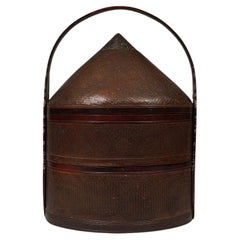
Qing Dynasty (Ca. 1870), Wood and Bamboo Two-tiered Hat Box, China
Located in Point Richmond, CA
Two-tiered Hat Box
China
Qing dynasty (ca. 1870)
Wood, bamboo
H: 20 in x D: 14.75 in :: 50.8 cm x 37.5 cm
The box holds two Mandarin’s cone shaped hats: the summer hat in the top ti...
Category
Antique 19th Century Chinese Tribal More Asian Art, Objects and Furniture
Materials
Bamboo, Wood
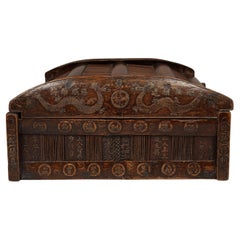
Late 19th/20th Century Shopkeeper
s Money Box with Blessings, Southern China
Located in Point Richmond, CA
Shopkeeper’s Money Box with Blessings
Southern China
Late 19th/early 20th century
Wood, bamboo
H: 7 in x W: 14.75 in x D: 11.75 in
Two dragons sit surrounding a pearl of wisdom on t...
Category
Antique Late 19th Century Chinese Tribal More Asian Art, Objects and Fur...
Materials
Wood, Bamboo
$1,500
H 7 in W 14.75 in D 11.75 in
18th century Dutch-Colonial ‘Vizagapatam’ pen-engraved bone inlaid ebony box
Located in Amsterdam, NL
A large Indian Colonial ‘Vizagapatam’ pen-engraved bone inlaid ebony box
Masulipatnam or Vizagapatam, 2nd half 18th century
H. 10.8 x W. 47 x D. 34 cm
...
Category
Antique Late 18th Century Indian Dutch Colonial More Asian Art, Objects ...
Materials
Bone, Ebony
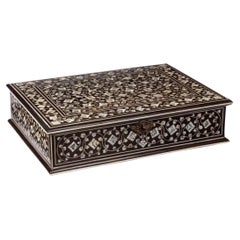
$41,924
Free Shipping
H 4.26 in W 18.51 in D 13.39 in
Colonial Islamic Arabian Market Jewelry Box, 18th Century, India/Malabar Coast
Located in Amsterdam, NL
AN INDIAN ROSEWOOD AND EBONY BRASS MOUNTED BOX FOR THE ISLAMIC MARKET
Malabar Coast, 18th century
With a large drawer with several compartm...
Category
Antique 18th Century Indian Islamic Jewelry Boxes
Materials
Brass
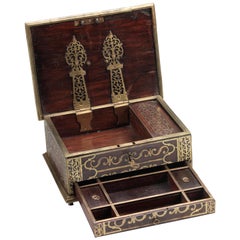
$10,181
Free Shipping
H 4.85 in W 10.4 in D 7.68 in
More From This Seller
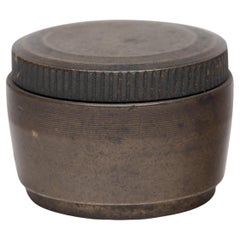
View AllChinese Bronze Opium Box, c. 1900
Located in Chicago, IL
A petite bronze canister once used to store a smoker's personal supply of opium paste. A keepsake from a bygone era, the small box dates to the early 20th century and provided an air...
Category
Early 20th Century Chinese Qing More Asian Art, Objects and Furniture
Materials
Bronze
Chinese Bronze Opium Box, c. 1900
Located in Chicago, IL
A petite bronze canister once used to store a smoker's personal supply of opium paste. A keepsake from a bygone era, the small box dates to the early 20th century and provided an air...
Category
Early 20th Century Chinese Qing More Asian Art, Objects and Furniture
Materials
Bronze
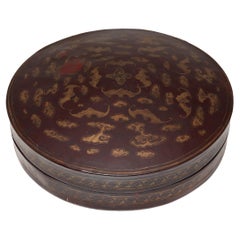
Chinese Gilt Lacquer Hat Box, c. 1900
Located in Chicago, IL
No self-respecting man in Qing-dynasty China would leave the house without some kind of hat. In fact, headgear was so central to social status that even the containers used to store ...
Category
Antique Late 19th Century Chinese Qing Decorative Boxes
Materials
Hide, Fabric, Wood
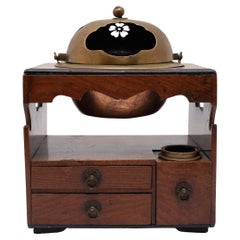
Japanese Keyaki Elm Tabako-Bon, c. 1900
Located in Chicago, IL
This box with many drawers is a Japanese tabako-bon, or 'tobacco tray,' used to store tobacco and smoking accessories. Believed to have evolved from the t...
Category
Antique Late 19th Century Japanese Meiji Snuff Boxes and Tobacco Boxes
Materials
Brass
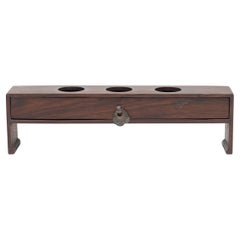
Chinese Hardwood Opium Bowl Stand, c. 1900
Located in Chicago, IL
Designed to resemble a scroll-form altar table, this narrow footed box has an elegant silhouette with waterfall sides and minimal ornamentation. Dated to the late 19th century, the b...
Category
Early 20th Century Chinese Qing More Asian Art, Objects and Furniture
Materials
Hardwood
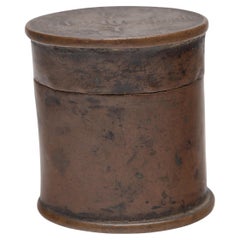
Chinese Copper Coin Opium Box, c. 1900
Located in Chicago, IL
A petite 19th century canister once used to store a smoker's personal supply of opium paste. A keepsake from a bygone era, the small box is formed of antique coins and copper and pro...
Category
Antique Late 19th Century Chinese Qing More Asian Art, Objects and Furni...
Materials
Copper
Still Thinking About These?
All Recently ViewedMore Ways To Browse
Yak Butter
Antique Brass Slipper Box
Antique Dazey Churn
Antique Playing Card Holder
Capodimonte Box Xxth Century
Chinese Money Box
Civic Pewter
Japanese Puzzle Box Wood
Kralik Box
Lalique Eglantines
Limoges Bow
Louis Vuitton Box Decor
Pepsi Wooden Crate
Silver Peanut Box
Vintage Cloisonne Pill Box
Antique Mailbox Doors
Beaver Silk Top Hat
Beer Crates