1 of 9
Silver Inlaid Islamis Brass Koran Box, Damascus, Syria, circa 1900
$900List Price
About the Item
- Dimensions:Height: 2 in (5.08 cm)Width: 5 in (12.7 cm)Depth: 3.5 in (8.89 cm)
- Style:Islamic (In the Style Of)
- Place of Origin:
- Period:1900-1909
- Date of Manufacture:1900
- Condition:Wear consistent with age and use. Minor fading.
- Seller Location:New York, NY
- Reference Number:1stDibs: LU162925928943
Authenticity Guarantee
In the unlikely event there’s an issue with an item’s authenticity, contact us within 1 year for a full refund. DetailsMoney-Back Guarantee
If your item is not as described, is damaged in transit, or does not arrive, contact us within 7 days for a full refund. Details24-Hour Cancellation
You have a 24-hour grace period in which to reconsider your purchase, with no questions asked.Vetted Professional Sellers
Our world-class sellers must adhere to strict standards for service and quality, maintaining the integrity of our listings.Price-Match Guarantee
If you find that a seller listed the same item for a lower price elsewhere, we’ll match it.Trusted Global Delivery
Our best-in-class carrier network provides specialized shipping options worldwide, including custom delivery.You May Also Like
Maranao Silver Inlaid Betel Box, c. 1900
Located in Chicago, IL
Decorated with silver inlay and cloaked in an antique patina, this curious brass case is an early 20th century betel nut box, attributed to the Maranao people of the island of Mindan...
Category
Early 20th Century Philippine Folk Art Snuff Boxes and Tobacco Boxes
Materials
Brass, Silver
Antique Southeast Asian Filipino Maranao Silver Inlaid Brass Betel Nut Box
Located in Forney, TX
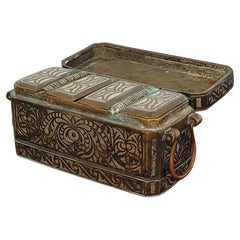
A scarce fine quality antique silver-inlaid solid brass betel nut box (Lutuan), dating to the second half of the 19th / early 20th century, hand-crafted in Mindanao, Philippines.
Boxes such as this were used to store the areca nut (also known as the betel nut) which would be wrapped in a betel leaf with lime paste and other ingredients, often tobacco, for chewing. Similar to the European tea caddy, these boxes often served as a way to impress while showing off ones wealth.
Betel chewing was prevalent in the southern Philippines as in much of the rest of Southeast Asia. Wealthier Maranao families on Mindanao were able to afford elaborate silver-inlaid brass betel boxes such as this example. Such boxes were used to show off to guests and from which they were offered betel and the other component such as leaves and lime to make up the betel quid.
Rare large size, most extant examples of such boxes tend to measure around 5 inches in length. At slightly more than 7.75 inches the example here is larger than most.
The distinctive decorative box features a very heavy strong-box like rectangular shaped chest form with canted corners, copper handles, and a conforming hinged lid, lifting open to reveal an interior divided into three compartments covered by four hinged lids. Each of these doors is inlaid with silver in stylized orchid flower patterns.
Exceptionally executed throughout, the arabesque silver inlaid exterior is decorated to the top with a large orchid motif within scrolling obid-obid (stylized rope) borders. The front, back and sides are inlaid with sets of stylized tail feathers of the sari-manok bird beneath which are unusual, highly stylized whimsical zoomorphic faces that appear like cat or tiger faces. (Such stylisation is accounted for by Southeast Asian Islamic preferences to avoid the overt and this potentially idolatrous representation of animal and human forms. Designs such as these are drawn from a local design repertoire that has its origins in wood carving.
Although the spread of Islam in the Philippines began in the 14th century, mostly through the influence of Muslim merchants from the western Malay Archipelago, decorative arts in this design remain exceptionally rare. This lutuan represents a fine example of Islamic metalwork from the most eastern outreach of Islamic art and civilisation: Mindanao island being significantly further east than even China – artwork from Islamic Southeast Asia remains chronically under-represented in the world’s major collections of Islamic art.
PROVENANCE / ACQUISITION
Acquired from highly reputable auction house, Austin Auction Gallery, established 1983, Austin, Texas.
References
Brownrigg, H., Betel Cutters...
Category
Antique 19th Century Philippine Islamic Decorative Boxes
Materials
Silver, Brass, Bronze, Copper
$1,100
H 3.25 in W 7.75 in D 3.25 in
Continental Silver Pineapple Box, circa 1900
Located in New York, NY
In a pineapple-shaped box.
Category
Antique Early 1900s Decorative Boxes
Materials
Silver

Syrian Intricately Inlaid Wood and Mother of Pearl Jewelry Box
Located in Queens, NY
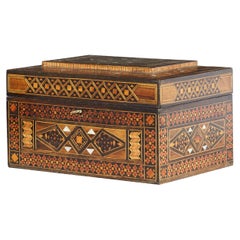
Middle Eastern Syrian style wooden jewelry box intricately inlaid with geometric patterns and accented with pieces of mother of pearl, with patinated brass hardware and a hinged lid ...
Category
20th Century African Moorish Jewelry Boxes
Materials
Brass
Beautiful Moorish Damascus or Asian Inlaid Inlay Wood Box Storage Chest Trunk
Located in Studio City, CA
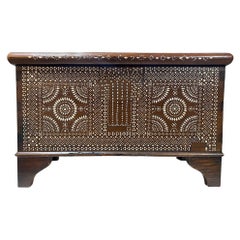
Stunning mosaic, geometric design, and gorgeous craftsmanship. This work is made of beautiful dark wood and shell and/or bone inlay. The iron handles are also a nice touch. A genuine...
Category
20th Century Asian Moorish Decorative Boxes
Materials
Wood
$1,450
H 15 in W 24.5 in D 13 in
Italian Modern Architectural Brass Inlaid Travertine Box, Circa 1970s
Located in West Palm Beach, FL
Italian Modern Architectural Brass Inlaid Travertine Box, Circa 1970s
Italy, Circa 1970s
A sleek and sophisticated Italian modern architectural travertine box with brass inlay, mad...
Category
20th Century Italian Mid-Century Modern Decorative Boxes
Materials
Travertine, Brass

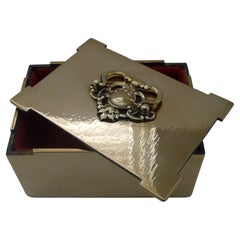
Antique French Cast Brass Jewellery Box / Casket, circa 1900
Located in Bath, GB
A wonderful and heavy jewelry box or casket. The rectangular box has a lift off lift with the aide of the folding handle to the centre of the lid. The brass has a slight naturalistic...
Category
Antique Early 1900s French Edwardian Jewelry Boxes
Materials
Brass
$546
Free Shipping
H 3 in W 5.5 in D 3.75 in
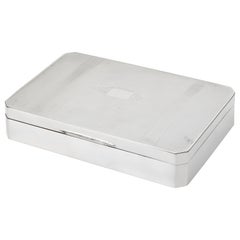
Hallmarked Silver Plated Keepsake Box, Sheffield, UK, circa 1900
Located in Colorado Springs, CO
Offered is a stunning silver plated keepsake box dating to 1900, with associated hallmark. This small box includes a wooden interior with two slots and a blank square on top where initials could have been engraved. A well maintained, elegant piece, this antique silver box is an excellent addition to any silver or home decor collection.
Trinket or keepsake boxes have taken on many forms since their first conception in ancient times. However their purpose remains the same; to store jewelry and other items precious to the owner. Originally, these boxes were used specifically for jewelry. These were in common use as early as 5000 BC in Ancient Egypt, when the majority of Egyptians, both male and female, wore jewelry. Boxes were used to keep these gemstone encrusted items safe. In Ancient Rome, jewelry was a status symbol. Rings and brooches were utilized to represent ones status in society. Again, boxes were needed for security and storage purposes. Finding early examples of these are quite rare.
Victorian and Edwardian examples of trinket boxes are far more common. This is because owning jewellery was a luxury until the Victorian era- let alone possessing so much a box was needed to store it all. Fine jewelry and other items became available to the masses after the industrial revolution due to the reduction in production costs. This led to a demand for trinket boxes, which were much smaller than jewelry boxes and therefore better suited to the needs of the middle class who did not yet possess an abundance of jewelry.
In Victorian households, collectables and other items of interested were also stashed inside these boxes. This is why they are known as trinket or keepsake boxes, rather than just jewelry boxes, although of course jewelry was also stored in them. Trinket boxes were produced in large numbers around this time. Many were lined with colored plush or velvet or rich wood. More elaborate designs had interior divisions and trays for rings and other pieces of jewellery. It was also common to see trinket boxes so small that they could only contain one item, such as a single ring. Ornate exteriors were created to reflect the value of the trinket boxes contents.
The Edwardian era saw the introduction of new styles of trinket box. These included small circular or oblong boxes...
Category
Antique Early 1900s English Art Deco Decorative Boxes
Materials
Silver
$600 Sale Price
20% Off
H 4.63 in W 7.63 in D 1.13 in
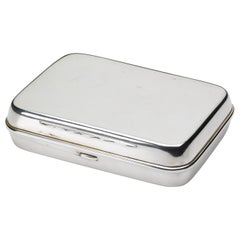
Hallmarked Silver Plated Keepsake Box, Sheffield, Uk, Circa 1900
Located in Colorado Springs, CO
Offered is a stunning Sheffield silver keepsake box dating to 1900, with associated hallmark. This small box includes a clean interior and rounded corners. The box is free of names or initials, but would have been used to house keepsakes such as jewelry or cufflinks. A well maintained, elegant piece, this antique silver box is an excellent addition to any silver collection.
Trinket or keepsake boxes have taken on many forms since their first conception in ancient times. However their purpose remains the same; to store jewelry and other items precious to the owner. Originally, these boxes were used specifically for jewelry. These were in common use as early as 5000 BC in Ancient Egypt, when the majority of Egyptians, both male and female, wore jewelry. Boxes were used to keep these gemstone encrusted items safe. In Ancient Rome, jewelry was a status symbol. Rings and brooches were utilized to represent ones status in society. Again, boxes were needed for security and storage purposes. Finding early examples of these are quite rare.
Victorian and Edwardian examples of trinket boxes are far more common. This is because owning jewellery was a luxury until the Victorian era- let alone possessing so much a box was needed to store it all. Fine jewelry and other items became available to the masses after the industrial revolution due to the reduction in production costs. This led to a demand for trinket boxes, which were much smaller than jewelry boxes and therefore better suited to the needs of the middle class who did not yet possess an abundance of jewelry.
In Victorian households, collectables and other items of interested were also stashed inside these boxes. This is why they are known as trinket or keepsake boxes, rather than just jewelry boxes, although of course jewelry was also stored in them. Trinket boxes were produced in large numbers around this time. Many were lined with colored plush or velvet or rich wood. More elaborate designs had interior divisions and trays for rings and other pieces of jewellery. It was also common to see trinket boxes so small that they could only contain one item, such as a single ring. Ornate exteriors were created to reflect the value of the trinket boxes contents.
The Edwardian era saw the introduction of new styles of trinket box. These included small circular or oblong boxes...
Category
Antique Early 1900s British Art Deco Decorative Boxes
Materials
Silver
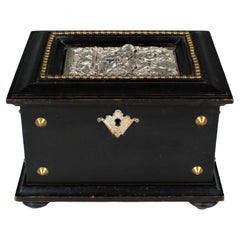
Antique Jewelry Box, Small Chest, Silver Ornament, circa 1900
Located in Greven, DE
Beautiful box with silver ornament plate at the top.
The wood box ist painted black and the colour is in a good condition.
Category
Antique Early 1900s Unknown Decorative Boxes
Materials
Metallic Thread
Still Thinking About These?
All Recently ViewedMore Ways To Browse
Brass Damascus
Tiffany And Co Bunny Bank
Tiffany Bunny Bank
Tiffany Keepsake Box
Tiffany Wave Box
Tiger Pen Shell
Toffee Tin
Toothpick Box
Tramp Art Sewing Box
Travel Decanter
Trinity House Box
Trinket Box Herend
Used Furniture Margate
Val Bennett
Vaseline Glass Box
Victor Mayer Faberge
Vintage Army Cooler
Vintage Box Woodenware