Want more images or videos?
Request additional images or videos from the seller
1 of 10
Antique Sadeli Ware Box, Anglo-Indian, Jewelry, Late 19th Century
Price:$539.16
About the Item
- Dimensions:Height: 2.37 in (6 cm)Width: 10.04 in (25.5 cm)Depth: 10.04 in (25.5 cm)
- Style:Anglo-Indian (Of the Period)
- Materials and Techniques:
- Place of Origin:
- Period:
- Date of Manufacture:circa 1900
- Condition:Wear consistent with age and use. Minor losses. Presented in good antique condition. Replaced lower strip to one side and minor losses. Wear commensurate with age and careful use.
- Seller Location:Hele, Devon, GB
- Reference Number:Seller: 18.58291stDibs: LU2645317189281
About the Seller
5.0
Platinum Seller
Premium sellers with a 4.7+ rating and 24-hour response times
Established in 2005
1stDibs seller since 2017
1,090 sales on 1stDibs
Authenticity Guarantee
In the unlikely event there’s an issue with an item’s authenticity, contact us within 1 year for a full refund. DetailsMoney-Back Guarantee
If your item is not as described, is damaged in transit, or does not arrive, contact us within 7 days for a full refund. Details24-Hour Cancellation
You have a 24-hour grace period in which to reconsider your purchase, with no questions asked.Vetted Professional Sellers
Our world-class sellers must adhere to strict standards for service and quality, maintaining the integrity of our listings.Price-Match Guarantee
If you find that a seller listed the same item for a lower price elsewhere, we’ll match it.Trusted Global Delivery
Our best-in-class carrier network provides specialized shipping options worldwide, including custom delivery.You May Also Like
19th Century Anglo-Indian Sadeli Mosaic Jewelry Box with Lidded Compartments
Located in Moreno Valley, CA
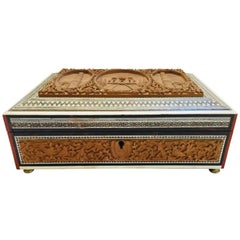
19th century Anglo-Indian sandal wood box, Sadeli mosaic box fitted with various compartments finely hand-carved with the Taj Mahal.
Of sarcophagus form ...
Category
Antique Late 19th Century Indian Anglo-Indian Decorative Boxes
Materials
Sandalwood
$1,850
H 3.5 in W 9 in D 6.5 in
Antique Anglo-Indian Vizagapatam Jewelry Inlaid Sadeli Footed Box
Located in Moreno Valley, CA
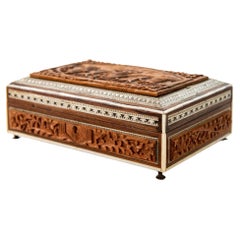
Antique 19th century Anglo-Indian jewelry, trinket footed box, inlay with ebony, mosaic marquetry Sadeli work and a carved Hindu scene on top.
The box case is made from sandalwood wi...
Category
Early 20th Century Indian Anglo-Indian Decorative Boxes
Materials
Bone, Mother-of-Pearl, Wood
19th Century Anglo-Indian Sadeli Inlaid Work Box Traveling Writing Desk
Located in Stamford, CT
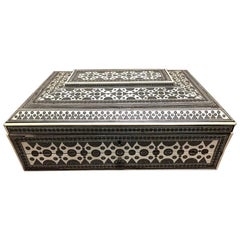
An Anglo Indian bone, ebony and metal inlaid sadeli work box with portable writing desk, Bombay, circa 1850.
The sandalwood body of faceted recta...
Category
Antique Mid-19th Century Indian Anglo-Indian Decorative Boxes
Materials
Metal
$2,140
H 7 in W 17 in D 11.5 in
19th Century Anglo-Indian Mughal Box
Located in Moreno Valley, CA
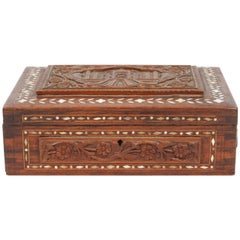
19th century Anglo-Indian Mughal wood box, inlaid and hand carved with the Taj Mahal and some flowers all around.
Jewelry box, Anglo-Raj box from India in great condition.
Nice Mughal Bombay Box...
Category
Antique Late 19th Century Indian Anglo Raj Decorative Boxes
Materials
Sandalwood
19C Anglo Indian Bombay MOP Sadeli Mosaic Trinket Box
Located in Dallas, TX
PRESENTING a LOVELY 19C Anglo Indian Bombay MOP (Mother of Pearl) Sadeli Mosaic Trinket Box from circa 1875-85.
Gorgeously detailed and hand-crafted ‘sadeli mosaic’ inlay, from the Bombay Area, with deep greens with silver, pewter, mother of pearl, bone and ebony in geometric patterns.
The box case, is made of sandalwood but completely covered in MOP, bone, faux ivory, ebony and mosaic inlay.
Edged with faux ivory and banded with a different pattern of sadeli mosaic.
Some minor damage to the top (repair is obvious in pics) and ivorine replacements to some edging, but it still a BEAUTIFUL BOX and of real QUALITY!
The mosaic work is FABULOUS!
Box opens to reveal its original blue velvet lining.
It sits on 4 (recently added) silvered button feet.
SADELI MOSAIC: “Anglo Indian boxes were made in India for the English residents from the early part of the 18th century. They were brought back or sent back to England usually by the people who had commissioned them. From the beginning of the nineteenth century they were imported more commercially, although not in any significant numbers until the middle decades. They were very highly valued, especially the early ones, to the extent that the designs were copied on late 19th and early 20th century tins.
The ancient art of Sadeli Mosaic is said to have been introduced from Shiraz in Persia via Sind to Bombay, a long time before the Anglo Indian boxes were made. It was a technique, which required a high degree of skill and patience. It was executed very lavishly, in that the frequent cuts wasted a great amount of the precious materials used. The workmanship was however more than commensurable to the value of the materials.
Ivory, silver, pewter (or other metals), wood and horn were cut into faceted rods which were bound together to form geometric patterns. When the glue has set, the rods were sliced in transverse sections. This gave the maker a number of angled circular pieces in the original pattern. Several variations of patterns could be achieved by combining the materials in different ways. The ivory was sometimes dyed green to give an extra color.
The mosaic pieces in a combination of patterns, often separated by ivory, ebony, horn or silver stringing were used to veneer sandalwood boxes. In the early boxes, which date from the turn of the 18th to the 19th century, there are large panels of mosaic covering tops and sides of boxes. It took incredible skill to cover such large areas without any shakes or wavering of the pattern. The corners and joins on these boxes are impeccably matched.
The makers (reputed to be Persian) of Sadeli mosaic made in the first two decades of the 19th century displayed a total understanding of the qualities of the different materials they used. They combined substances, which can expand and contract according to atmospheric conditions with others, which are hard and unyielding. The result was a sharp definition of the lines and patterns, which made up the whole design.
On the early boxes the designs look deceptively simple. The fact is, they emerged from a culture, which had mastered geometry and understood how to generate a pattern from a set number of points. The patterns are so harmoniously combined that their incredible complexity is not immediately apparent.
The earliest Sadeli boxes...
Category
Antique Late 19th Century Indian Anglo-Indian Jewelry Boxes
Materials
Silver
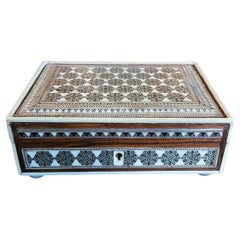
1950s Anglo Indian Micro Sadeli Mosaic Inlaid Jewelry Box
Located in Moreno Valley, CA
1950s Anglo Indian Micro Sadeli Mosaic Inlaid Jewelry Box.
DIMENSIONS: 7ʺW × 7ʺD × 2.5ʺH.
Indo Persian Moorish style micro mosaic inlaid jewelry box with lid.
Intricate inlaid Anglo ...
Category
Mid-20th Century Indian Moorish Decorative Boxes
Materials
Bone, Fruitwood
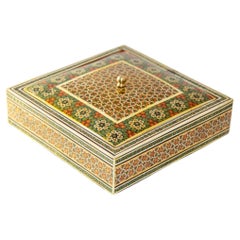
19C Anglo Indian Highly Carved Sadeli Mosaic Sarcophagus Sewing Box
Located in Dallas, TX
PRESENTING A GORGEOUS 19C Anglo Indian Highly Carved Sadeli Mosaic Sarcophagus Sewing Box.
Made in Bombay, India circa 1860-80.
Box made of sandalwood with highly carved teak wood reliefs and panels on all sides.
Edged with bone and ebony veneers and glorious sadeli mosaic, made from tiny pieces of faux ivory, pewter, green semi-precious stone.
The box is in a sarcophagus form with domed lid.
The original brass carry handles are on the sides.
The interior is in great condition and consists of a removeable mirror under the lid portion, with the original red velvet lining behind it.
The base is removeable and contains a number of lidded compartments.
6 of the interior lids on the base, are each inlaid with sadeli mosaic banding. The rest are also carved and chased.
The interior is fully complete with 7 lidded faux ivory/bone, thread canisters with sadeli domes and the original bone thimble.
The box sits on 4 brass ball or bun feet with the original velvet lining on the base.
Some minor repairs and losses, but this box is fully complete. This is ‘rare’ as many of these boxes have not survived in such condition!
Included in the sale are 2 photos that were in the box (under the base tray). Interestingly, one of them is a view of downtown Nassau, New Providence (Bermuda) from the early 20C and stamped on the rear. What a ‘journey’ this piece has made! Made in India … travelled to Bermuda, probably via Britain … back to Ireland (where we bought it) …. then to Texas!
These boxes were made by superb Indian craftsmen, specifically for sale to the ruling British elite. These types of boxes, carved padouk and sandalwood, (whilst beautiful and superbly crafted) were of a lesser quality, than the more profusely and intricately mosaic inlay, tortoiseshell and ivory boxes, made for the British ‘Upper Classes’ in the areas of Bombay and Vizagapatam. These type of boxes were much more affordable back in 1880 (and indeed today) and would probably have been bought by mid-level diplomats, civil servants or visitors.
Sewing boxes (in general), were in EVERY Victorian home in Britain in the 19th Century and like other boxes etc were ‘status symbols’ of your place in society! The more ornate the box, the more ‘Upper Class’ you were!
Of it’s type, this one, is one of the very higher quality one’s, than the norm!
SADELI MOSAIC: “Anglo Indian boxes were made in India for the English residents from the early part of the 18th century. They were brought back or sent back to England usually by the people who had commissioned them. From the beginning of the nineteenth century they were imported more commercially, although not in any significant numbers until the middle decades. They were very highly valued, especially the early ones, to the extent that the designs were copied on late 19th and early 20th century tins.
The ancient art of Sadeli Mosaic is said to have been introduced from Shiraz in Persia via Sind to Bombay, a long time before the Anglo Indian boxes were made. It was a technique, which required a high degree of skill and patience. It was executed very lavishly, in that the frequent cuts wasted a great amount of the precious materials used. The workmanship was however more than commensurable to the value of the materials.
Ivory, silver, pewter (or other metals), wood and horn were cut into faceted rods which were bound together to form geometric patterns. When the glue has set, the rods were sliced in transverse sections. This gave the maker a number of angled circular pieces in the original pattern. Several variations of patterns could be achieved by combining the materials in different ways. The ivory was sometimes dyed green to give an extra color.
The mosaic pieces in a combination of patterns, often separated by ivory, ebony, horn or silver stringing were used to veneer sandalwood boxes. In the early boxes, which date from the turn of the 18th to the 19th century, there are large panels of mosaic covering tops and sides of boxes. It took incredible skill to cover such large areas without any shakes or wavering of the pattern. The corners and joins on these boxes are impeccably matched.
The makers (reputed to be Persian) of Sadeli mosaic made in the first two decades of the 19th century displayed a total understanding of the qualities of the different materials they used. They combined substances, which can expand and contract according to atmospheric conditions with others, which are hard and unyielding. The result was a sharp definition of the lines and patterns, which made up the whole design.
On the early boxes the designs look deceptively simple. The fact is, they emerged from a culture, which had mastered geometry and understood how to generate a pattern from a set number of points. The patterns are so harmoniously combined that their incredible complexity is not immediately apparent.
The earliest Sadeli boxes...
Category
Antique 19th Century Indian Anglo-Indian Decorative Boxes
Materials
Bone, Sandalwood, Teak
$1,250
H 5.5 in W 12.8 in D 9.15 in
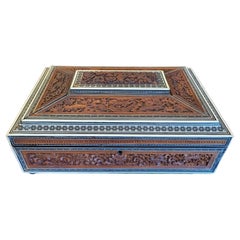
19C Anglo Indian Carved Teak Wood and Sadeli Mosaic Box
Located in Dallas, TX
PRESENTING A LOVELY 19th century Anglo-Indian Carved Teak Wood and Sadeli Mosaic Box, featuring a carving of a Hunt Scene.
Made circa 1870 in Bombay, India during the Rule of the Br...
Category
Antique Late 19th Century Indian Anglo-Indian Jewelry Boxes
Materials
Silver, Pewter
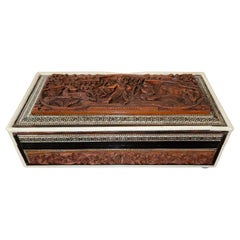
Antique Anglo Indian Bronze Jewelry Box
Located in Moreno Valley, CA
Antique Anglo Indian Hindu treasure jewelry metal bronze box.
19th century Anglo Indian antique metal box handcrafted with hinged lid with a swing ...
Category
Early 20th Century Indian Anglo-Indian Decorative Boxes
Materials
Bronze
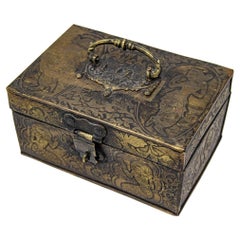
19C Anglo Indian Highly Carved Teak Sadeli Mosaic Inlaid Sewing Box
Located in Dallas, TX
PRESENTING A LOVELY 19C Anglo Indian Highly Carved Sadeli Mosaic Inlaid Sewing Box.
Made in Bombay, India, circa 1880.
The box is made of sandalwood with highly carved raised teak wood panels on all sides, depicting temple scenes, animals and foliage.
The box is in a sarcophagus form.
It is edged in bone (and we can tell it is bone and not ivory, from the color and evidence of capillaries, which are not found in ivory), and banded with Bombay Sadeli mosaic and ebony veneer.
The lid opens to reveal a removable tray with various open compartments and lidded compartments. 5 lidded compartments, 1 unlidded compartment and 8 holders for thimbles, etc
The tray lifts to reveal a blue velvet (original) lined section, for storing jewelry etc, with sections for collars etc.
The inside of the lid has a removable mirror (the mirror is missing on this one but can easily be replaced). Behind the mirror is the original green velvet lining.
It has its original brass carry handles on the sides and sits on 4 silvered button feet (of recent origin).
Some repairs to the exterior and condition issues (priced accordingly), but still a LOVELY COLLECTIBLE box!
These boxes were made by superb Indian craftsmen, specifically for sale to the ruling British elite. These types of boxes, carved padouk and sandalwood, (whilst beautiful and superbly crafted) were of a lesser quality, than the more profusely and intricately mosaic inlay, tortoiseshell and ivory boxes, made for the British ‘Upper Classes’ in the areas of Bombay and Vizagapatam. These type of boxes were much more affordable back in 1880 (and indeed today) and would probably have been bought by mid-level diplomats, civil servants or visitors.
Sewing boxes (in general), were in EVERY Victorian home in Britain in the 19th century and like other boxes etc were ‘status symbols’ of your place in society! The more ornate the box, the more ‘Upper Class’ you were!
SADELI MOSAIC: “Anglo Indian boxes were made in India for the English residents from the early part of the 18th century. They were brought back or sent back to England usually by the people who had commissioned them. From the beginning of the nineteenth century they were imported more commercially, although not in any significant numbers until the middle decades. They were very highly valued, especially the early ones, to the extent that the designs were copied on late 19th and early 20th century tins.
The ancient art of Sadeli Mosaic is said to have been introduced from Shiraz in Persia via Sind to Bombay, a long time before the Anglo Indian boxes were made. It was a technique, which required a high degree of skill and patience. It was executed very lavishly, in that the frequent cuts wasted a great amount of the precious materials used. The workmanship was however more than commensurable to the value of the materials.
Ivory, silver, pewter (or other metals), wood and Horn were cut into faceted rods which were bound together to form geometric patterns. When the glue has set, the rods were sliced in transverse sections. This gave the maker a number of angled circular pieces in the original pattern. Several variations of patterns could be achieved by combining the materials in different ways. The ivory was sometimes dyed green to give an extra color.
The mosaic pieces in a combination of patterns, often separated by ivory, ebony, Horn or silver stringing were used to veneer sandalwood boxes. In the early boxes, which date from the turn of the 18th to the 19th century, there are large panels of mosaic covering tops and sides of boxes. It took incredible skill to cover such large areas without any shakes or wavering of the pattern. The corners and joins on these boxes are impeccably matched.
The makers (reputed to be Persian) of Sadeli mosaic made in the first two decades of the 19th century displayed a total understanding of the qualities of the different materials they used. They combined substances, which can expand and contract according to atmospheric conditions with others, which are hard and unyielding. The result was a sharp definition of the lines and patterns, which made up the whole design.
On the early boxes the designs look deceptively simple. The fact is, they emerged from a culture, which had mastered geometry and understood how to generate a pattern from a set number of points. The patterns are so harmoniously combined that their incredible complexity is not immediately apparent.
The earliest Sadeli boxes...
Category
Antique Late 19th Century Indian Anglo-Indian Decorative Boxes
Materials
Bone, Sandalwood, Teak
More From This Seller
View AllAntique Campaign Correspondence Box, Anglo Indian, Colonial, Writing, Victorian
Located in Hele, Devon, GB
This is an antique campaign correspondence box. An Anglo-Indian, teak and bone inlaid colonial writing case with fitted interior, dating to the late...
Category
Antique Late 19th Century British Decorative Boxes
Materials
Teak
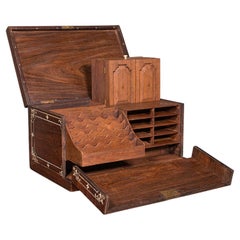
Antique Gentleman
s Travelling Box, Anglo Indian, Correspondence Case, Victorian
Located in Hele, Devon, GB
This is an antique gentleman's travelling box. An Anglo-Indian, teak and brass bound correspondence case, dating to the Victorian period, circa 1880....
Category
Antique Late 19th Century British Decorative Boxes
Materials
Teak
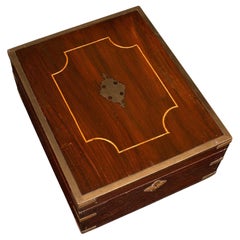
Small Antique Apprentice Chest, Anglo-Indian, Colonial Keepsake Box, Victorian
Located in Hele, Devon, GB
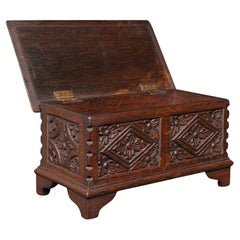
This is a small antique apprentice-piece chest. An Anglo-Indian, carved teak Colonial keepsake box, dating to the late Victorian period, circa 1880....
Category
Antique Late 19th Century Indian Late Victorian Decorative Boxes
Materials
Teak
Antique Teapoy English William iv Rosewood Work Box, 19th Century, circa 1835
Located in Hele, Devon, GB
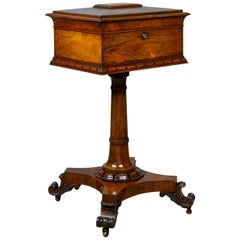
This is an antique teapoy, an English, William IV, rosewood work box dating to the early 19th century, circa 1835.
Superb color in the polished rosew...
Category
Antique Early 19th Century English William IV Tea Caddies
Materials
Rosewood
Antique Campaign Correspondence Box, Indian, Colonial Writing Case, Victorian
Located in Hele, Devon, GB
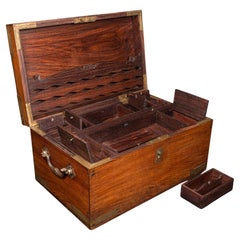
This is an antique Campaign correspondence box. An Anglo-Indian, teak and brass bound Colonial traveller's writing case, dating to the late Victorian period, circa 1880.
Captivati...
Category
Antique Late 19th Century Indian Campaign Decorative Boxes
Materials
Brass
Antique Deccan Oil Lamp, Indian, Bronze, Hamsa, Bird, Late 19th Century
Located in Hele, Devon, GB
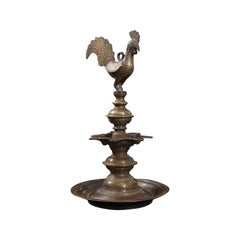
This is an antique Deccan oil lamp. An Indian, bronze hanging lamp with Hamsa bird finial, dating to the late 19th century, circa 1900.
Hanging ...
Category
Antique Late 19th Century Indian More Lighting
Materials
Bronze
Still Thinking About These?
All Recently ViewedMore Ways To Browse
Elsa Peretti Leather Box
Incolay Jewelry Box
Japanese Ship Chest
Jewerly Case
Medieval Bronze Jewelry Caskets
Nelsonic Watch Vintage
Owl Jewelry Box Vintage
Pierce Martin
Pink Casket Box
Tansu Jewelry Box
Tiffany Hand Ring Holder
Vienna Enamel Furniture Miniature
Vintage Charles Rennie Mackintosh Jewellery
George Nelson Miniature Jewelry
Alligator Jewelry Box
Ballerina Jewelry Box
Cartier Trinket
Carved Ivory Jewelry Box