Want more images or videos?
Request additional images or videos from the seller
1 of 20
Japanese Old Mulberry Small Container / 1912-1960 / Incense Container
$400List Price
About the Item
- Dimensions:Height: 1.19 in (3 cm)Diameter: 3.55 in (9 cm)
- Style:Taisho (Of the Period)
- Materials and Techniques:Other,Woodwork
- Place of Origin:
- Period:
- Date of Manufacture:1926-1960
- Condition:
- Seller Location:Sammu-shi, JP
- Reference Number:1stDibs: LU5487225096742
About the Seller
5.0
Platinum Seller
Premium sellers with a 4.7+ rating and 24-hour response times
Established in 2015
1stDibs seller since 2020
1,704 sales on 1stDibs
Typical response time: 6 hours
Authenticity Guarantee
In the unlikely event there’s an issue with an item’s authenticity, contact us within 1 year for a full refund. DetailsMoney-Back Guarantee
If your item is not as described, is damaged in transit, or does not arrive, contact us within 7 days for a full refund. Details24-Hour Cancellation
You have a 24-hour grace period in which to reconsider your purchase, with no questions asked.Vetted Professional Sellers
Our world-class sellers must adhere to strict standards for service and quality, maintaining the integrity of our listings.Price-Match Guarantee
If you find that a seller listed the same item for a lower price elsewhere, we’ll match it.Trusted Global Delivery
Our best-in-class carrier network provides specialized shipping options worldwide, including custom delivery.You May Also Like
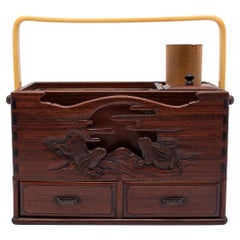
Japanese Tabako-bon with Two Rabbits, c. 1920
Located in Chicago, IL
This wooden box is a Japanese tabako-bon, or 'tobacco tray,' used to store tobacco and smoking accessories. Believed to have evolved from the traditional ...
Category
Early 20th Century Japanese Taisho Snuff Boxes and Tobacco Boxes
Materials
Bamboo, Bakelite, Hardwood
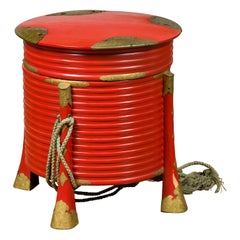
Japanese Taishō Red Lacquered Hokai Box with Brass Accents and Original Rope
Located in Yonkers, NY
A Japanese Taisho period Hokai box from the early 20th century, with red lacquer, ornate brass accents and original rope. This vibrant Japanese Taisho period...
Category
Early 20th Century Japanese Taisho Decorative Boxes
Materials
Brass
$1,500
H 16 in Dm 14.5 in
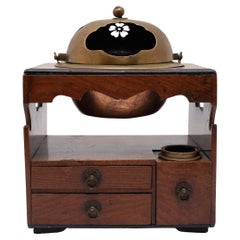
Japanese Keyaki Elm Tabako-Bon, c. 1900
Located in Chicago, IL
This box with many drawers is a Japanese tabako-bon, or 'tobacco tray,' used to store tobacco and smoking accessories. Believed to have evolved from the t...
Category
Antique Late 19th Century Japanese Meiji Snuff Boxes and Tobacco Boxes
Materials
Brass
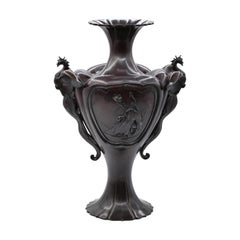
Meji Bronze Amphora, Japan, 1868-1912
Located in Roma, IT
This Meji bronze amphora is a superb bronze vase decorated with the depiction of flowers and frogs and on the sides a phoenix. A Japanese vase of the Me...
Category
Antique Late 19th Century Japanese Modern Vases
Materials
Bronze
Rustic Indian 19th Century Treasure Box with Carved Rosettes and Small Feet
Located in Yonkers, NY
A rustic Indian antique wooden treasure box from the 19th century, with iron braces, carved rosettes and petite feet. Created in India duri...
Category
Antique 19th Century Indian Rustic Decorative Boxes
Materials
Iron
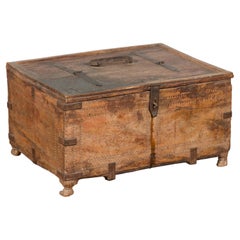
$495
H 9.5 in W 17.5 in D 13.25 in
Late 19th/20th Century Shopkeeper
s Money Box with Blessings, Southern China
Located in Point Richmond, CA
Shopkeeper’s Money Box with Blessings
Southern China
Late 19th/early 20th century
Wood, bamboo
H: 7 in x W: 14.75 in x D: 11.75 in
Two dragons sit surrounding a pearl of wisdom on t...
Category
Antique Late 19th Century Chinese Tribal More Asian Art, Objects and Fur...
Materials
Wood, Bamboo
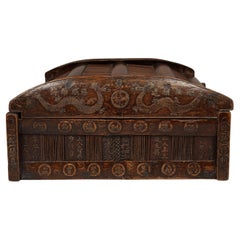
$1,500
H 7 in W 14.75 in D 11.75 in
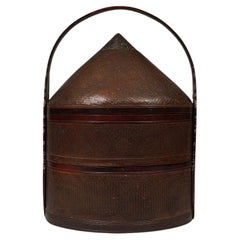
Qing Dynasty (Ca. 1870), Wood and Bamboo Two-tiered Hat Box, China
Located in Point Richmond, CA
Two-tiered Hat Box
China
Qing dynasty (ca. 1870)
Wood, bamboo
H: 20 in x D: 14.75 in :: 50.8 cm x 37.5 cm
The box holds two Mandarin’s cone shaped hats: the summer hat in the top ti...
Category
Antique 19th Century Chinese Tribal More Asian Art, Objects and Furniture
Materials
Bamboo, Wood
Anglo-Indian Vizagapatam Bombay Mughal Style Footed Box With Bone Overlay
Located in Moreno Valley, CA
Nice and unusual Indian Mughal style large decorative box, filigree and carved horn.
Anglo-Indian footed domed box with exceptional engraved details throughout with filigree and carved veneered bone plaques with arabesque carving.
Vizagapatam, late 19th century.
History of the Anglo-Indian Boxes
Beginning in the early part of the 18th century, Indian artisans made what came to be known as Anglo-Indian boxes for the English residents living in India, who eventually brought or sent them back to England. At the beginning of the 19th century, India began exporting these boxes commercially, although not in any significant numbers until the 1850s. People valued them so highly that manufacturers of tins copied the designs on them in the late 19th and early 20th century.
Anglo-Indian boxes fall into four groups: Rosewood or ebony boxes inlaid;
sandalwood boxes veneered; sandalwood boxes covered with Sadeli mosaic; and carved boxes often combined with Sadeli mosaic/
The first two categories came from Vizagapatam in East India while the last two came from Bombay in West India.
English traders discovered the rich woods and intricate workmanship of Indian artisans, so colonial government officials began to recognize the work of the Indian artists and craftsmen as a source for satisfying the need for furniture and boxes, which would both serve to enhance English households in India. This gave rise to the cabinetmaking workshops in Vizagapatam between Calcutta and Madras.
Craftsmen made the first boxes to be decorated with Sadeli mosaic of rosewood or ebony, incised to give further definition to the decoration, directly inlaid into the wood. The shape of the early boxes was either sloping at the front with a flatter section at the back, reminiscent of English writing slopes, or rectangular. Artisans inlaid the borders with stylized floral scrolls and the centers with a single floral motif following a circular or oval symmetrical or asymmetrical pattern. The edging was ornamental and protective, both helped protect the end grain against the weather.
Made in Vizagapatam, situated on the south east coast of India, near Madras
These exotic boxes...
Category
Antique Late 19th Century Indian Anglo Raj Decorative Boxes
Materials
Wood
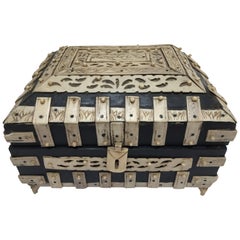
$1,650
H 6.5 in W 9.75 in D 8 in
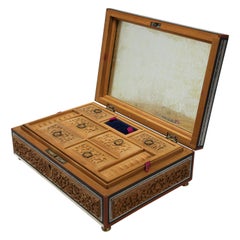
Anglo-Indian Footed Box with Lidded Compartments, 19th Century
Located in Moreno Valley, CA
19th century Anglo-Indian wooden box fitted with various compartments finely hand carved.
The top is finely hand carved with the Taj Mahal.
The interior with removable hand carved nine-lidded compartments, the front cover has a mirror, the whole exhibiting very fine workmanship.
This fine late Victorian Anglo-Indian box from India is in great condition for it age.
A beautiful example of an Anglo-Indian fine art...
Category
Antique Late 19th Century Indian Anglo-Indian Decorative Boxes
Materials
Sandalwood
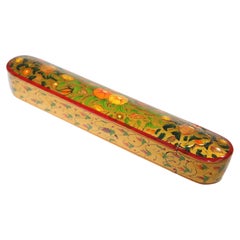
Persian Lacquer Pen Box Hand Painted with Floral and Gilt Design
Located in Moreno Valley, CA
Persian hand painted lacquer pen box in rectangular shape.
Decorated with floral designs on gold background, black interior.
Moorish Mughal pen box papier maché with miniature floral painting in the Persian style.
Great Islamic Art collector museum quality piece on this miniature painting on box.
Nice Mughal Indo Persian pen Box...
Category
Early 20th Century Indian Moorish Decorative Boxes
Materials
Paper
More From This Seller
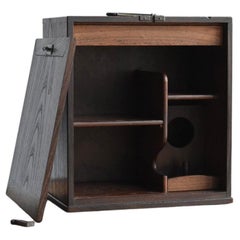
View AllJapanese Small Wooden Box with Beautiful Wood Grain Made of Mulberry
Located in Sammu-shi, Chiba
This is a small storage box for storing old Japanese tea utensils.
It is called [kikyoku] in Japanese.
This wooden box comes in a variety of mate...
Category
Early 20th Century Japanese Taisho Furniture
Materials
Other
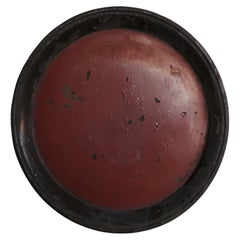
Old Round Plate with Japanese Lacquer / Meiji-Taisho / Urushi
Located in Sammu-shi, Chiba
A wooden vessel used from the Meiji era to the Taisho era.
Probably a beech tree.
It is made by hollowing out.
It's very cool, isn't it?
It is a lacquered tall foot round tray made ...
Category
Mid-20th Century Japanese Taisho Lacquer
Materials
Beech, Lacquer
Japanese antique pottery bowl/[Banko ware] Mie prefecture/1850-1912
Located in Sammu-shi, Chiba
Banko-yaki is a type of pottery that began in the northern part of Mie Prefecture in the middle of the Edo period. (The places marked with red circles on the map are the kilns of Banko ware...
Category
Antique Late 19th Century Japanese Edo Pottery
Materials
Pottery
![Japanese antique pottery bowl/[Banko ware] Mie prefecture/1850-1912](https://a.1stdibscdn.com/japanese-antique-pottery-bowl-banko-ware-mie-prefecture-1850-1912-for-sale/1121189/f_319674221672470538196/31967422_datamatics.jpg?width=240)
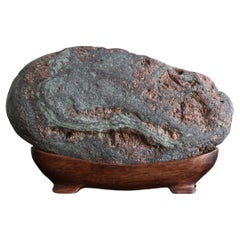
Old Japanese Scholar
s Stone / Beautiful Appreciation Stone/Natural Stone
Located in Sammu-shi, Chiba
This is a stone mined in Japan. Measure: w 22cm.
Not only in China but also in Japan from ancient times, rocks in the mountains have been shaved and stones for viewing have been qua...
Category
Early 20th Century Japanese Showa Scholar s Objects
Materials
Stone
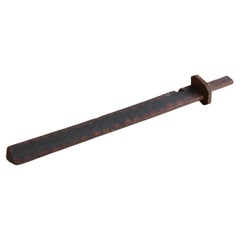
Wooden Sword of Old Japanese Buddha / 1800-1900 / Wall-Mounted Object
Located in Sammu-shi, Chiba
This is an introduction to a slightly unusual item.
This is a wooden sword possessed by the Buddha statue.
Only the sword remained.
Gods such as Fudo Myo, who reign as Buddhist guardians...
Category
Antique 19th Century Japanese Edo Sculptures and Carvings
Materials
Cedar
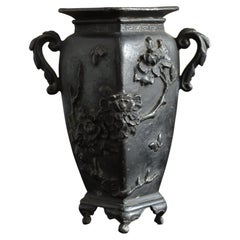
Japanese Antique Small Vase Made of Tin/1800s-1920/Casting Vase
Located in Sammu-shi, Chiba
This is a tin vase made from the late Edo period to the early Taisho period (1800s-1920).
It is made of cast iron and has detailed and beautiful expressions such as butterflies and ...
Category
Antique 19th Century Japanese Edo Vases
Materials
Tin
Still Thinking About These?
All Recently ViewedMore Ways To Browse
20th Century Japanese Jewelry Boxes
Incense Box
Japanese Jewelry Boxes
Japanese Containers
Japanese Incense Box
Old Vintage Jewellery Boxes
Chinese Jewellery Box
Chinese Jewelry Box
Chinese Jewlery Box
Jewlery Box Chest
Jewelry Box Wooden
Lacquer Jewelry Box
Inlaid Jewelry Box
Wooden Jewelry Boxes
Compartment Jewelry
Vintage Jewellery Displays
Antique Polish Jewelry
Carved Wood Jewelry Box