1 of 5
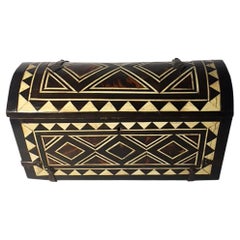
Rare Excellent 17th Century Spanish Mudejar Coffer Box
$3,850List Price
About the Item
- Dimensions:Height: 6 in (15.24 cm)Width: 15 in (38.1 cm)Depth: 6 in (15.24 cm)
- Materials and Techniques:
- Place of Origin:
- Period:
- Date of Manufacture:17th Century
- Condition:A couple cracks to wood as expected with age. Expected wear. Gorgeous Patina.
- Seller Location:Montecito, CA
- Reference Number:1stDibs: U1203198643319
Authenticity Guarantee
In the unlikely event there’s an issue with an item’s authenticity, contact us within 1 year for a full refund. DetailsMoney-Back Guarantee
If your item is not as described, is damaged in transit, or does not arrive, contact us within 7 days for a full refund. Details24-Hour Cancellation
You have a 24-hour grace period in which to reconsider your purchase, with no questions asked.Vetted Professional Sellers
Our world-class sellers must adhere to strict standards for service and quality, maintaining the integrity of our listings.Price-Match Guarantee
If you find that a seller listed the same item for a lower price elsewhere, we’ll match it.Trusted Global Delivery
Our best-in-class carrier network provides specialized shipping options worldwide, including custom delivery.You May Also Like
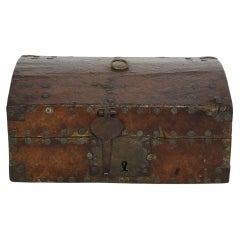
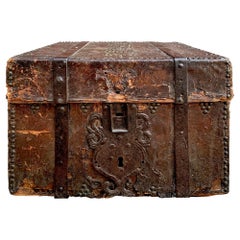
Small 17th Century, French Coffer or Box in Leather
Located in Buisson, FR
Extremely old box that is covered with leather and metal decorations.
Rare find.
France, circa 1600-1700
Weathered and some losses.
Category
Antique 17th Century French Decorative Boxes
Materials
Leather, Wood
$943 Sale Price
49% Off
H 3.94 in W 9.06 in D 6.3 in
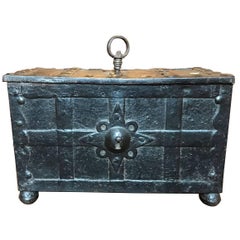
Early 17th Century Medieval Handcrafted Black Iron Coffer or Box
Located in Brescia, IT
The iron coffer, fully original in every part of it, was forged and handcrafted in German in the 1610. Complete with key. Full working iron mechanisms. It ...
Category
Antique Early 17th Century German Medieval Decorative Boxes
Materials
Iron
$18,987
Free Shipping
H 10.24 in W 15.75 in D 8.67 in
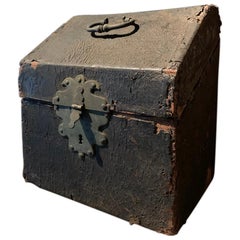
17th Century Cutlery Box
Located in Vosselaar, BE
A 17th century cutlery box with the original leather, metal hardware and interior.
Category
Antique 17th Century French Decorative Boxes
Materials
Leather, Softwood
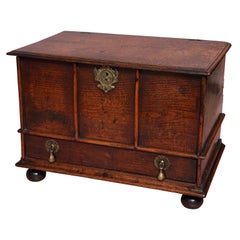
Very Rare 17th Century Charles II English Box
Located in Greenwich, CT
A very rare and desirable 17th century English oak box having moulded front and sides, original lock plate, drop pulls and bun feet, with superb color and patination. The box is made...
Category
Antique 18th Century and Earlier English Boxes
Materials
Oak
17th-18th Century Spanish Colonial Box With Domed Top
Located in Dallas, TX
Spanish Colonial inlaid bone and faux tortoiseshell domed top box. Original hammered iron hinges. Circa 1680-1740. Excellent condition and very rare.
Category
Antique 1690s Spanish Decorative Boxes
Materials
Iron
17th Century Italian Leather Box
Located in Chicago, IL
A stunning 17th century Italian leather covered wood trunk covered in brass nail heads, some spelling out a word on top, and with iron strap hinges a...
Category
Antique 17th Century Italian Baroque Decorative Boxes
Materials
Leather, Wood
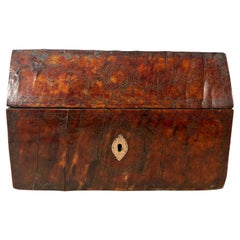
17th Century Spanish Colonial Tortoiseshell Box with Silver Piqué Inlay
Located in Dallas, TX
Exquisite 17th century Spanish Colonial tortoiseshell box, beautifully decorated with intricate silver piqué inlay in a repeating design across the surface. The craftsmanship is exce...
Category
Antique 1690s Spanish Decorative Boxes
Materials
Tortoise Shell
$5,500
H 5.75 in W 8.5 in D 4.25 in
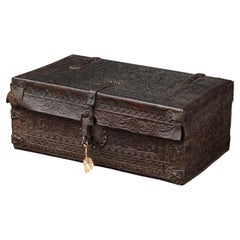
Boiled Leather Trunk, Spanish, 17th Century
Located in Bruxelles, BE
Leather trunk
Spanish, 17th century
Boiled Leather, wood and iron
Measures: 22 x 53 x 32 cm.
Provenance :
- collection Metz-Noblat, Château de Clevant, France
Rectangular trunk of the form and size of a small suitcase with wrought iron hinges and lock-plate.
Wood, covered with leather, cut and embossed with every surface of the thick cow hide covered in interlace, zoomorphic features.
The construction method is boiled leather, often referred to by its French translation cuir-bouilli: a process used to change flexible, vegetable-tanned leather into rigid, moulded objects. For shaping of the vegetable-tanned leather, heat and moisture were used, as indicated by the term boiled leather. No written medieval sources describing the production of decorated cuir bouilli objects survive, so knowledge of the process relies on the important studies of the Scottish leather historian John William Waterer. A large range of methods, materials and techniques could be used in various combinations. The vegetable-tanned leather, made supple with moisture and heat, was stuffed, shaped and nailed to the rigid wooden coffer support. The stuffing material was probably modeled beeswax or stearin wax. To shape the leather, to create its topography, « Cushions » were made by lacing a thread through an awl hole and attaching the flexible leather and stuffing to the rigid wooden support on the bottom. Then the decoration was done: lines were incised through the upper layer of the leather (epidermis) with different thicknesses of knives or needles. Contours were created with deep v-shaped cuts, decoration with thin incision and final details with a needle point. For the incision and pouncing stage, the leather was probably kept heated and moistened for suppleness.
Once dry, the leather would be hard and rigid.
the saturated leather is worked over a form, possibly even damp sand, with the pattern shaped using bone or wooden tools. Compare to metal, leather was lighter and it offered protection from cuts and punctures. Cuir bouilli objects were produced by specialist leather workers and needed skillful craftsmanship.
The surface is filled with roundels shaped foliages enclosing animals, lions and peacocks. The foliate arabesques creating a vegetal connection tweet the animals create the impression of a lush verdant space . The vegetal pattern here employed in combination with geometrical pattern came from the pre-islamic artistic traditions of the Byzantine and Sasanian empires. An aspect of Islamic geometry Is the basic symmetrical repetition and mirroring of the shapes that create a sense of harmony.
The decoration of this truck is inspired by the islamic « arabesque » a form of vegetal ornament composed of spirals, intertwining plants and abstract curvilinear motifs. An arabesque character is given to the birds of the decorations through extreme stylisation. This arabesque maintained the classical tradition of median symmetry, freedom in Detail and heterogeneity of ornament.
The presence of the peacocks is a paradisiacal allusion: in popular Islamic literature they were among the original inhabitants of the garden of Paradise expelled with Adam and Eve. Peacock as a decorative motif may have originated in the West, despite their eastern provenance. There was an ancient belief that the flesh and feathers of peacock do not decay. This led to the peacock becoming a christian symbol for Christ’s resurrection.
Renowned for their decorative wall hangings, seventeenth-century Spanish leatherworkers also produced utilitarian objects, such as this trunk. A similar trunk is on display at the Metropolitan museum of art ( 09.158.1).
Related literature :
Davies L. 2006. Cuir bouilli. Conservation of leather and related materials, 94-102, Oxford: elsevier Butterworth-Heinemann
Grabar, Oleg. The Mediation of Ornament. Princeton: Princeton University Press, 1992
Gabriela Germana Roquez, "El mueble en el Peru en el siglo XVIII...
Category
Antique 17th Century Decorative Boxes
Materials
Iron
$12,816 Sale Price
40% Off
Free Shipping
H 8.67 in W 20.87 in D 12.6 in
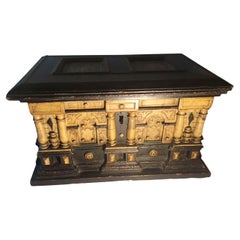
17th Century, Alabaster and Ebonised Wood Casket Malines Coffer
Located in Dallas, TX
A 17th century Malines alabaster and ebonised wood coffer or casket with engraved inset panels, arches and columns. The interior has a marbled paper lini...
Category
Antique 17th Century Belgian Decorative Boxes
Materials
Alabaster
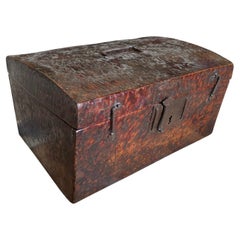
French 17th Century Leather Box, Coffre
Located in Round Top, TX
A very charming late 17th century French Coffre - Box crafted from beautifully patina'd leather. A wonderful piece to serve as a jewelry box or to adorn any table top.
Category
Antique 17th Century French Decorative Boxes
Materials
Leather
Still Thinking About These?
All Recently ViewedMore Ways To Browse
18th Century Walnut Box
Spanish Coffer
18th Century Spanish Box
Anglo Portuguese
18th Century Morocco
Spanish Mudejar
Rare Boxes
Antique Game Box
Gold Decorative Plates
Antique Bar Box
Antique English Boxes
Trinket Boxes
Antique Snuff
Modern Wood Box
Italian Silver Box
Jewelry Box France
French Jewellery Box
Antique Wooden Boxes