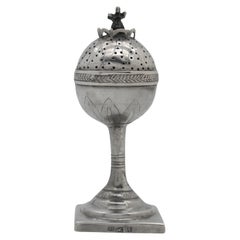
Items Similar to RARE Austrian silver (ALT WIEN) Havdalah spice container, Judaica ISRAEL MUSEUM
Want more images or videos?
Request additional images or videos from the seller
1 of 20
RARE Austrian silver (ALT WIEN) Havdalah spice container, Judaica ISRAEL MUSEUM
$6,500
£4,957.75
€5,645.68
CA$9,134.48
A$9,962.44
CHF 5,277.43
MX$119,435.47
NOK 67,210.96
SEK 61,459.44
DKK 42,178.73
About the Item
Up for sale is this museum quality Judaica Havdalah spice container, very rare with great provenance!!
This silver spice tower was made in Vienna Austria, on the early part of the 19th century
The silver mark is worn, but probably 1805!! thats a rare find in Austrian Judaica.
Since antiquity, the ceremony known as Havdalah has marked the conclusion of Jewish Sabbaths and holy days. As early as the first centuries of this era, the smelling of aromatic spices was part of this ritual. Nevertheless, the first literary mention of a container for Havdalah spices appears only in a twelfth-century source, this example is a small and private example used at the house
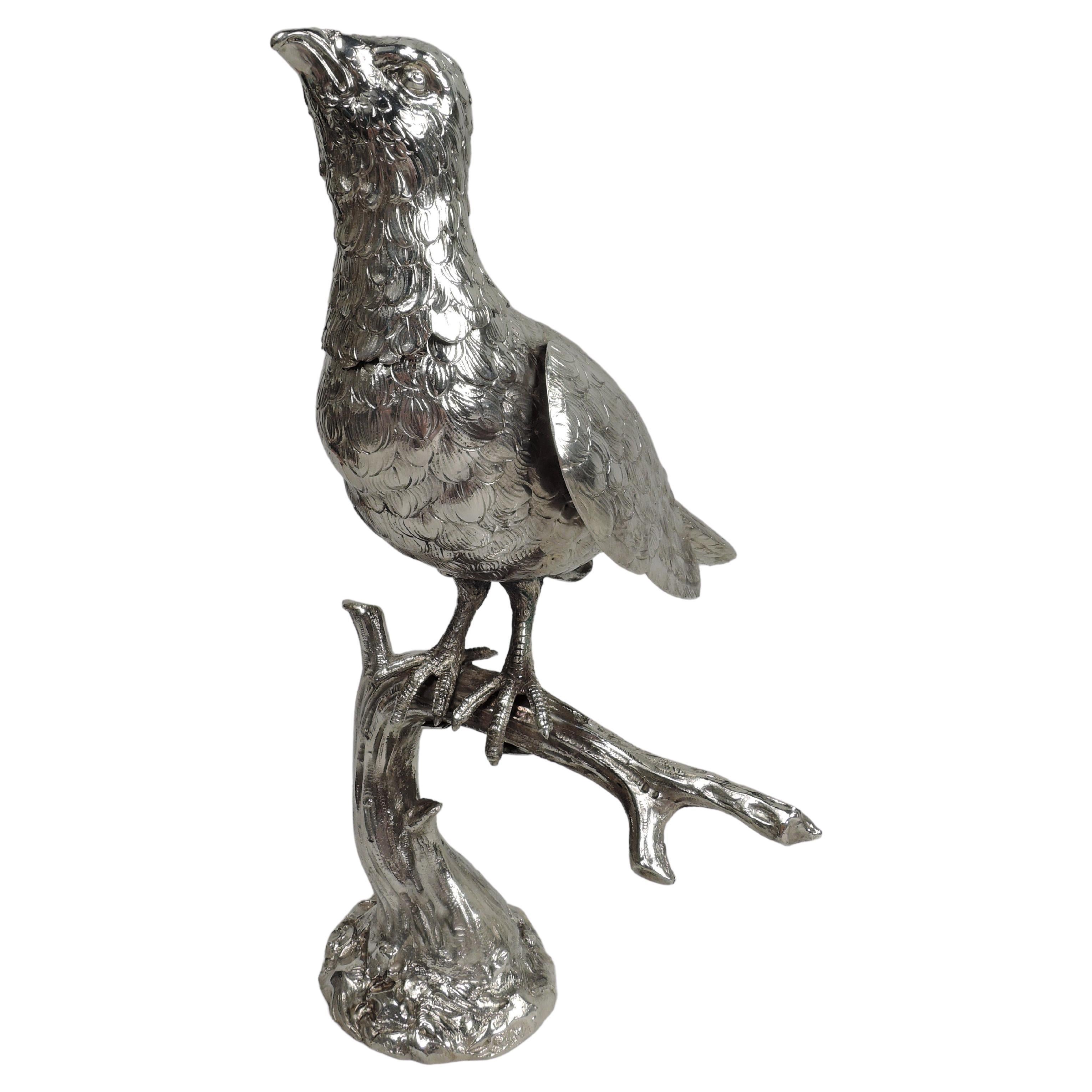
when the bird head opens the herbs and spices inside brings nice scents, which is a part of the Havdalah ritual.
The spice container is designed as a bird standing on a tree, with a round hand hammered base
The base has the silver marks for Vienna and a 3 letters makers mark which we cant figure out (probably the first letter is B)
In addition to the marks and the amazing condition, an almost exact example is exhibited in the Israel museum
And is a part of the Stieglitz collection, where its described : " parrot shaped spicebox with three fish base" poland 19th century
In our view they are both Austrian in origin and the one in Israel museum is described "Poland" but dosent say its marked, so the base was probably changed there or the marks are worn away. the example we offer here is 100% correct and original, just a treasure.
This is a rare Operatunity to buy and own this type of rare Judaica, that you can only see in museums
SIZE :
Height : 12.5 cm / 4.9 inch
Width : 4.8 cm / 1.88 inch
- Dimensions:Height: 4.9 in (12.45 cm)Diameter: 1.88 in (4.78 cm)
- Materials and Techniques:
- Period:
- Date of Manufacture:1805
- Condition:Wear consistent with age and use.
- Seller Location:Tel Aviv - Jaffa, IL
- Reference Number:1stDibs: LU8130246405042
About the Seller
No Reviews Yet
Vetted Professional Seller
Every seller passes strict standards for authenticity and reliability
1stDibs seller since 2023
- ShippingRetrieving quote...Shipping from: Tel Aviv - Jaffa, Israel
- Return Policy
More From This Seller
View AllJUDAICA SILVER ETROG BOX DESIGNED BY LUDWIG WOLPERT. New York, 20th century
Located in Tel Aviv - Jaffa, IL
This charming piece of jewish history in front of you is a one of kind modern Judaica object,
This box used to hold the Etrog To protect the it during the holiday of Sukkot, it is traditionally Wrapped in silky flax fibers and stored in a special decorative box, mostly made from silver.
Wolpert designed this amazing hand hammered Bauhaus style box in 1963-1964 while he was Working in New York. all of the boxes we could found from this design made by Wolpert have The upper part inscribed in a simple engraving with the phrase "Pri Etz Hadar"
In Hebrew ״פרי עץ הדר״. the box in front of you is the only example in existence as far as we Know where the letters are also repoussé and also engraved, such a beautiful and hard to get Combination, the rest of the box is shaped as a modernistic Etrog, all the body of the box is Skillfully hand hammered in a way it reflects the light in a warm and calm way, a true Masterpiece of modern judaica by the great and important artist Ludwig Yehuda Wolpert.
One of the the two great masters of 20th century Judaica.
the Box is marked "WOLPERT" AND "STERLING" and the base has the engraved inscription :
"ALAN WECHSLER GENERAL CHAIRMAN, ALLIED JEWISH APPEAL OF SOUTHERN NEW JERSEY 1978"
Similar boxes can be find in museum collections around the world
In the Jewish Museum New York
In the North Carolina Museum of Art
In The Derfner Judaica Museum
Another similar box was featured in the Israel Museum exhibition
"Forging Ahead, Wolpert and Gumbel, Israeli Silversmiths for the Modern Age"
Ludwig Yehuda Wolpert was born in Hildesheim, Germany, to an Orthodox family. In 1916-1920, He began his studies in sculpture at the Frankfurt School of Art. In 1925-1928, he studied Goldsmithing at the Frankfurt School of Art.
Following the presentation of the works in the 1930 exhibition "Kult und Form" ("Ritual and Form") at the Jewish Museum in Berlin, his works became well known in the German Jewish World. His works were greatly influenced by Modernist design, especially the Bauhaus Movement. Wolpert's works avoid decoration, relying on clean, geometric shapes. In 1933, Following the Nazi rise to power in Germany, he immigrated to the Mandatory Palestine with His family. There he worked for two years in the workshop of Bernhard Friedländer, where he Designed and produced silverware and Jewish ceremonial art.Together with Victor Solomon...
Category
Vintage 1960s Decorative Boxes
Materials
Silver
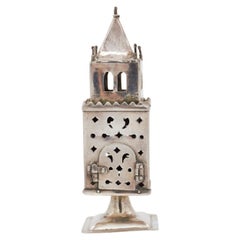
Early 20th Century Silver Spice Tower by Yehia Yemini, Bezalel School Jerusalem
Located in Tel Aviv - Jaffa, IL
Very rare Bezalel Jerusalem silver filigree spice tower, this amazing spice Tower was Made by Yehia Yemini, who was the best filigree artist in bezal...
Category
Vintage 1920s Israeli Sterling Silver
Materials
Silver
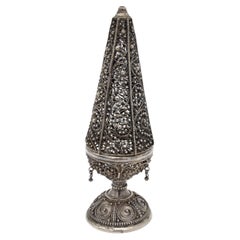
Early German Silver Augsburg Baroque Spice Tower, Hans Jacob Ernst , circa 169
Located in Tel Aviv - Jaffa, IL
One of the earliest spice towers we could find, it is very rare to see judaica
from the 17th century, and this 1690s spice tower is super scarce, a true gem of Baroque silver and ba...
Category
Antique 1690s Sterling Silver
Materials
Silver
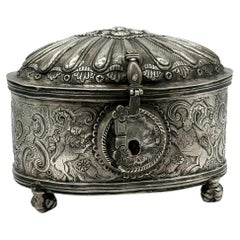
Rare silver Herb Box (Yerbera), Upper Peru, Potosí, c. 1775–90 great repoussé
Located in Tel Aviv - Jaffa, IL
Herb Box (Yerbera), Upper Peru, possibly Potosí, c. 1775–90, cast, repoussé, and chased silver,
the design is very intricate, with lions, cats and some other animals, and a women on the lid, it is made in a shell shape with a classical women on top of the lid, the body is all hand made with lions and wild cats with leafs designs, the inner part is divided into two compartments, as usually in this type of boxes. lock is not working but it is very nice and "primitive" looking.
Boxes have a long history across cultures and time. In Spanish America, containers of many types, styles, and materials were cherished as gifts. Known today as yerberas (herb boxes) or coqueras (coca boxes...
Category
Antique Late 18th Century Snuff Boxes and Tobacco Boxes
Materials
Silver
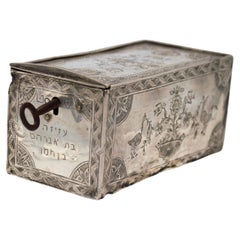
extremely rare Algerian Judaica silver, jewish Dowry box early 19th century
Located in Tel Aviv - Jaffa, IL
Amazing and scarce JUDAICA object, we have here one of the most touching jewish objects we had for a long time, this small silver dowry box was made in Algeria in the early 19th century, it is all covered with symbols of jewish faith and of couples, the sliding lid has 2 flanking birds with hamsa (protective hand) on each side and a flower vase in the middle.
one side shows two flanking lions with a tree in the middle and the other side shows again two big and two small birds with a flower bowl in the middle, front side has a key hole and next to it there is the Hebrew inscription ס״ט״" which says Siman tov or in English "a good sign" it is taken from the wedding blessing, underneath the lock there is another inscription with the name ״עזיזה בת אברהם בן חמו״ which is the name of the bride, her father and her grandfathers name.
the box is full marked a lot of times with the silversmith mark, every side of the box is marked.
this box was probably ordered by the grooms family to hold the jewelry they are giving to the bride as dowry, this type of objects are rare and there are just a few of them on museum collections.
DOWRY (Heb. נְדֻנְיָה), the property a wife brings to her husband at marriage; the Yiddish equivalent, nadn, is from the same root. The custom of nedunyah became clearly defined and institutionalized only in the talmudic period. In biblical times, mohar (מֹהַר), whereby the groom bought his wife from her father (Gen. 24:53; Ex. 22:15–16; Hos. 3:2), was the accepted practice. It was then customary that the groom give the bride gifts, and that she bring certain property to her husband's home upon marriage: slaves, cattle, real estate, etc. (cf. Gen. 24:59–61; 29; Judg. 1:14ff.; I Kings 9:16). Evidence of the custom of nedunyah is to be found in Tobit (7:14; 8:21) and in the Assuan papyri (Cowley, Aramaic, nos. 15, 18). Gradually, mohar was superseded by the ketubbah custom according to which the husband merely assumed the responsibility of compensation to his wife in case he divorced her: he had to pay her 200 zuzim if she had been a virgin at the time of marriage, and 100 zuzim if a widow or divorcée (see *Ketubbah).
By talmudic times, the institution of nedunyah was prevalent; the father gave a dowry to the bride since the daughter was excluded from paternal inheritance. Fifty zuzim (equivalent to the worth of 180 grams of silver) was the minimum amount a father was obliged to give to his daughter (Ket. 6:5). Parents usually gave much more, according to their social standing. Community funds provided the dowry for an orphan or a very poor girl (ibid.; cf. Sh. Ar., YD 251:8). In case of her father's death, the brothers of a minor girl were obliged to give her the minimum dowry, and the court estimated how much her father would have given her above the minimum dowry. The sum was then taken out of the father's estate and given to the daughter upon majority (Ket. 6:6; 68a–69b). In the absence of such an estimate, each daughter was entitled to receive one-tenth of the value of her father's estate in money, or in valuables (Yad, Ishut, 20:4–7; Sh. Ar., EH 113:4). If the father was unable or unwilling to pay the promised dowry at the betrothal ceremony, the groom could refuse to marry his bride (Ket. 13:5; Ket. 108b–109a). Insistence on exact payment of the promised dowry, however, was frowned upon by later rabbinic authorities (Rema to Sh. Ar., EH 2:1). In certain communities it was customary for the groom's father to make a dowry contribution equal to that of the bride's father (Ket. 102b). The dowry, whether given in real estate, slaves, money, or chattel was recorded in the marriage contract (the ketubbah) and in some instances one-third or one-fifth of the actual value of the dowry was added to the sum mentioned in the ketubbah. Based upon a decree enacted by *Simeon b. Shetah (first century C.E.), the Talmud ruled that the husband and his entire property were liable for compensation as stipulated in the ketubbah, either in case he died (when she collected the sum specified in the ketubbah from the heirs) or in case he divorced his wife (Ket. 82b). For the status of the dowry and the husband's rights and obligations, see below. The rabbinic enactments (Takkanot Shum) by R. Jacob *Tam and by the rabbinic synod of the communities of Speyer, Worms, and Mainz (Germany) stipulated that if a woman died...
Category
Antique Mid-19th Century Algerian Tribal Art
Materials
Silver
Rare German Parcel-Gilt Silver Canister, Abraham Drentwett i, Augsburg 1649-1666
Located in Tel Aviv - Jaffa, IL
Important German parcel-gilt silver canister, Abraham Drentwett I, Augsburg, circa 1649-1666 Abraham Drentwett I is one of Augsburg's foremost silversmiths during the Baroque period. He was Active 1641-1666 , he is best known for having executed Queen Christina's silver throne...
Category
Antique 17th Century German Baroque Sterling Silver
Materials
Silver
You May Also Like
A Miniature Silver Spice Container, Poland-Ukraine Circa 1830
Located in New York, NY
This exquisite early 19th-century silver spice container, crafted in the Poland–Ukraine region around 1830, is a remarkable example of miniature Judaica infused with refined naturali...
Category
Antique 1830s Polish Sterling Silver
Materials
Silver
A Silver Havdalah Spice Tower, Germany Circa 1900
Located in New York, NY
This exquisite German silver Havdalah spice container, crafted circa 1900, is a refined example of early 20th-century Judaica, blending delicate craftsmanship with elegant form. The ...
Category
Antique Early 1900s German Sterling Silver
Materials
Silver
Antique Sterling Silver Havdalah Box / Spice Box, London 1912, Joseph Zweig
Located in London, London
Hallmarked in London in 1912 by Joseph Zweig, this Antique Sterling Silver Havdalah Box, or Spice Tower, is of a traditional Eastern European form. The Havdalah box measures 9.75"(25...
Category
Vintage 1910s English Baroque Sterling Silver
Materials
Sterling Silver
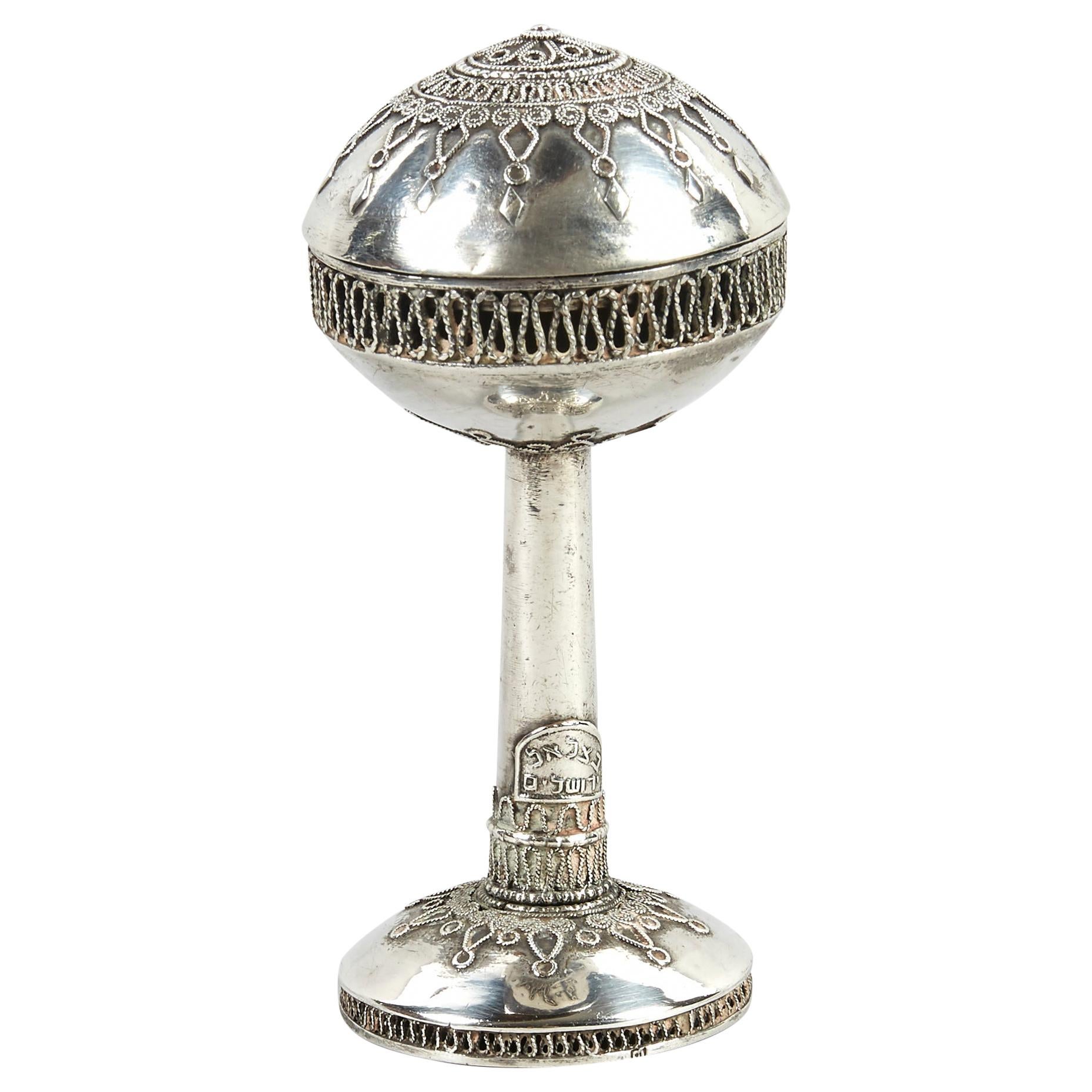
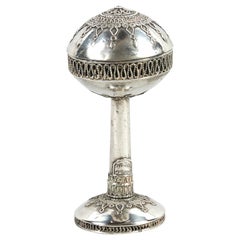
Early 20th Century Silver Spice Tower by Bezalel School Jerusalem
Located in New York, NY
Silver and silver filigree spice container, Jerusalem, circa 1920.
Ball spice container raised on a stem, On a round decorated base with fili...
Category
Early 20th Century Israeli Religious Items
Materials
Silver
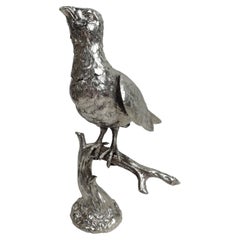
Large Antique German Silver Perched Bird Spice Box
Located in New York, NY
Large turn-of-the-century German 800 silver figural spice box. A bird grips a gnarly branch with scaly talons. Sweet and downy with tucked-down wings. Head detachable. Marked. Weight...
Category
Antique Late 19th Century German Victorian Decorative Boxes
Materials
Silver
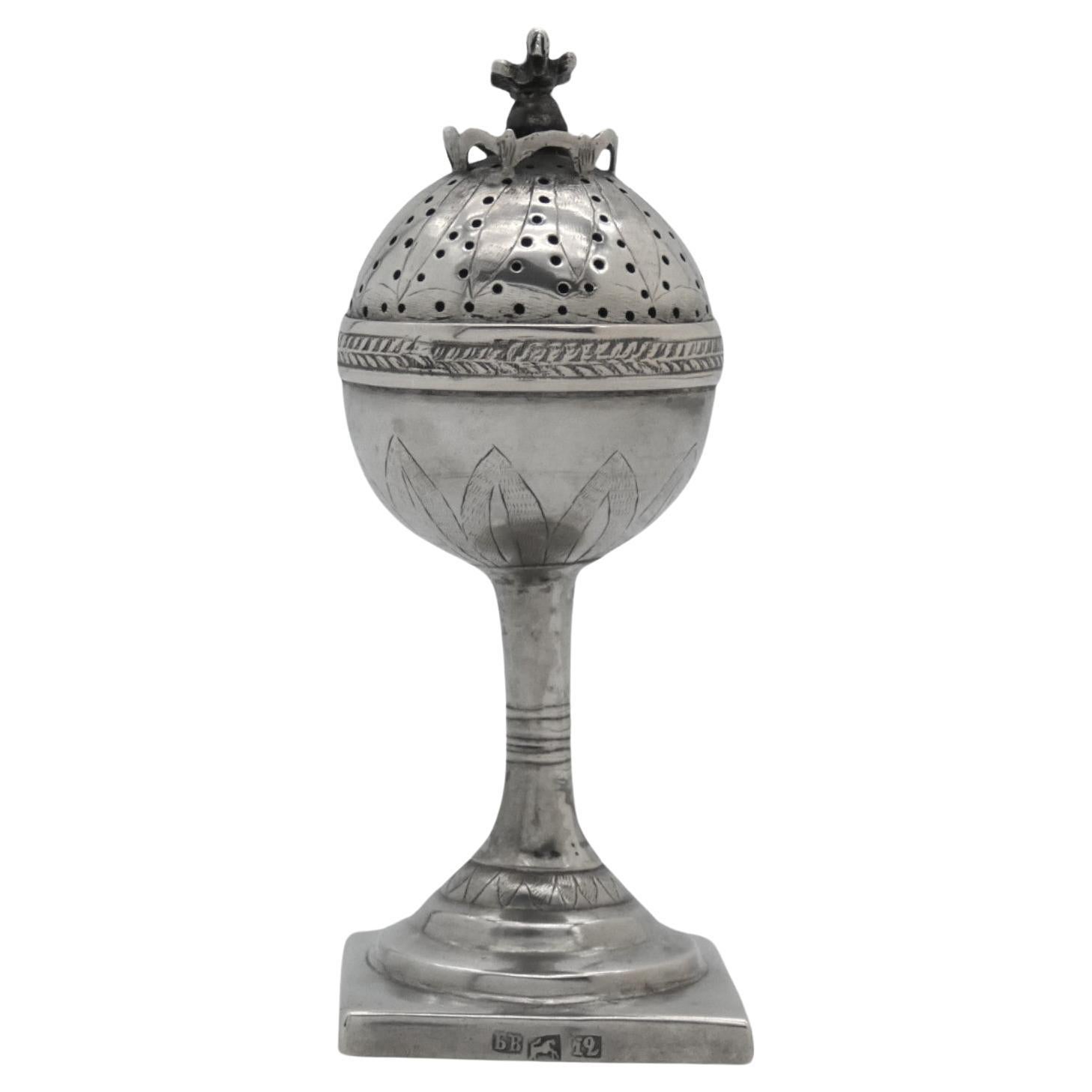
An Early 19th Century Polish Silver Spice Container
Located in New York, NY
An early 19th-century Polish spice container, like this one which was used for the Jewish ritual of Havdalah, reflects both the cultural and religious practices of Polish Jewry durin...
Category
Antique Early 19th Century Polish Sterling Silver
Materials
Silver