Want more images or videos?
Request additional images or videos from the seller
1 of 8

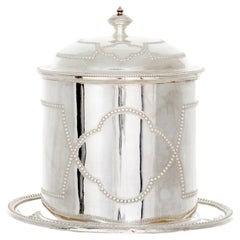
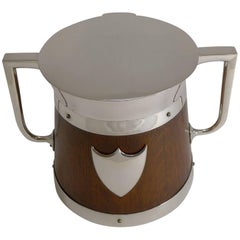
Christofle, Paris, Art Deco Silver Plated Tea Caddy

$585.45List Price

You May Also Like

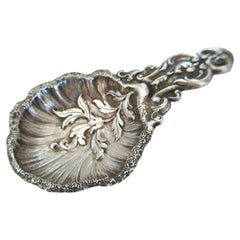
Rococo Style Repousse Silver Plate Tea Caddy Spoon, U.K., Mid-19th Century
Located in Chatham, ON
Antique Rococo style silver plate tea caddy spoon - featuring repousse shell shaped decoration with leaves - 'c' scrolls to the handle - fine quality workmanship and classic details ...
Category

Antique Mid-19th Century English Rococo Revival Sheffield and Silverplate

Materials

Silver Plate

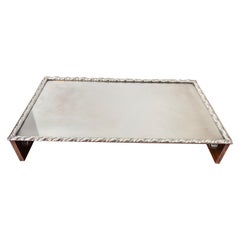
Deco Style Silver Plate Box
Located in Stockton, NJ
A deco style silver plate box. Interested riveted and heavy construction with concave base interior. Marked "Compesi".
Category

20th Century Italian Art Deco Jewelry Boxes

Materials

Silver Plate

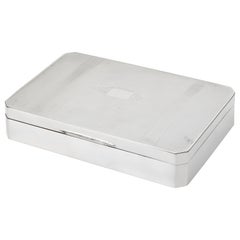
Deco Style Silver Plate Box
$595
H 1.75 in W 8.25 in D 4.25 in
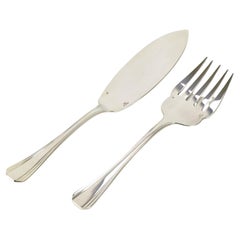
Art Deco Christofle Boreal Silver Plated Fish Serving Set Design Luc Lanel
By Christofle, Luc Lanel
Located in Bad Säckingen, DE
This elegant Art Deco silver-plated fish serving set by Christofle is part of the "Boréal" model, designed by the renowned Luc Lanel, celebrated for his modern and timeless designs. ...
Category

Vintage 1930s French Art Deco Decorative Boxes

Materials

Silver Plate

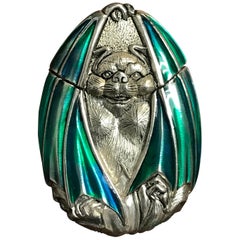
Silver Plated and Enameled Bat Matchsafe
Located in West Palm Beach, FL
Silver plated and enameled bat matchsafe, realistically cast and chased, with enameled wings, unmaked.
Category

20th Century English High Victorian Snuff Boxes and Tobacco Boxes

Materials

Silver Plate

Silver Plated and Enameled Bat Matchsafe
$387 Sale Price
34% Off
H 2.5 in W 1.5 in D 0.25 in
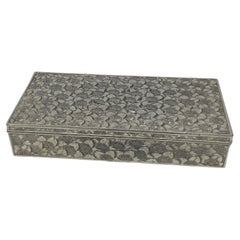
Vintage Christofle Silver Plated Decorative Box
By Christofle
Located in Chapel Hill, NC
Signed Vintage Christofle Silver Plated Decorative Box. Nicely cast with beautiful design. This would have held cigarettes or trinkets. In very good...
Category

Mid-20th Century Mid-Century Modern Decorative Boxes

Materials

Silver Plate

Vintage Christofle Silver Plated Decorative Box
$795
H 1.25 in W 6.75 in D 3.5 in
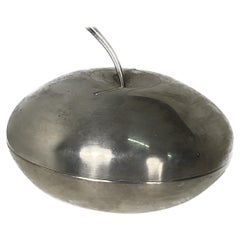
Christofle Silver Plated Metal Box, 60s
By Christofle
Located in Catania, IT
Apple” Christofle box in good condition in silver metaL.
Category

Vintage 1960s French Decorative Boxes

Materials

Metal

Christofle Silver Plated Metal Box, 60s
$219 Sale Price
20% Off
H 4.12 in W 5.9 in D 5.11 in
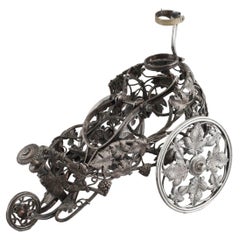
Christofle Wine Trolley with Grape Leaves, Silver Plated, late 19th
By Christofle
Located in Paris, FR
This wonderful wine trolley is adorned with the most delicate grapevine you may find. A system makes possible to modify the inclination of the bottle to gently pour your best red win...
Category

Antique 1880s French Sheffield and Silverplate

Materials

Silver Plate

English Silver Plate Tea Caddy / Thin Biscuit
Located in Tarry Town, NY
Mid 19th century English sheffield silver plate tea caddy / thin biscuit with exterior design details and attached covered top . The tea caddy ...
Category

Antique Mid-19th Century English Edwardian Tea Caddies

Materials

Silver Plate, Copper

Tea Caddy - Elie Bleu Paris
By Elie Bleu
Located in Casteren, Noord-Brabant
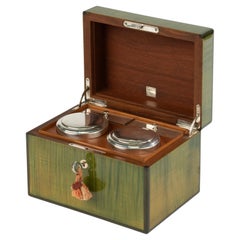
A beautiful vintage tea caddy, made by the French brand Elie Bleu Paris. The box is made of beautifully veneered / greened wood with black piping. Th...
Category

Early 2000s French Modern Tea Caddies

Materials

Silver Plate

Tea Caddy - Elie Bleu Paris
$1,311
Free Shipping
H 5.91 in W 8.67 in D 6.3 in
Hallmarked Silver Plated Keepsake Box, Sheffield, UK, circa 1900
Located in Colorado Springs, CO
Offered is a stunning silver plated keepsake box dating to 1900, with associated hallmark. This small box includes a wooden interior with two slots and a blank square on top where initials could have been engraved. A well maintained, elegant piece, this antique silver box is an excellent addition to any silver or home decor collection. Trinket or keepsake boxes have taken on many forms since their first conception in ancient times. However their purpose remains the same; to store jewelry and other items precious to the owner. Originally, these boxes were used specifically for jewelry. These were in common use as early as 5000 BC in Ancient Egypt, when the majority of Egyptians, both male and female, wore jewelry. Boxes were used to keep these gemstone encrusted items safe. In Ancient Rome, jewelry was a status symbol. Rings and brooches were utilized to represent ones status in society. Again, boxes were needed for security and storage purposes. Finding early examples of these are quite rare. Victorian and Edwardian examples of trinket boxes are far more common. This is because owning jewellery was a luxury until the Victorian era- let alone possessing so much a box was needed to store it all. Fine jewelry and other items became available to the masses after the industrial revolution due to the reduction in production costs. This led to a demand for trinket boxes, which were much smaller than jewelry boxes and therefore better suited to the needs of the middle class who did not yet possess an abundance of jewelry. In Victorian households, collectables and other items of interested were also stashed inside these boxes. This is why they are known as trinket or keepsake boxes, rather than just jewelry boxes, although of course jewelry was also stored in them. Trinket boxes were produced in large numbers around this time. Many were lined with colored plush or velvet or rich wood. More elaborate designs had interior divisions and trays for rings and other pieces of jewellery. It was also common to see trinket boxes so small that they could only contain one item, such as a single ring. Ornate exteriors were created to reflect the value of the trinket boxes contents. The Edwardian era saw the introduction of new styles of trinket box. These included small circular or oblong boxes...
Category

Antique Early 1900s English Art Deco Decorative Boxes

Materials

Silver

Hallmarked Silver Plated Keepsake Box, Sheffield, UK, circa 1900
$600 Sale Price
20% Off
H 4.63 in W 7.63 in D 1.13 in

More From This Seller

View All
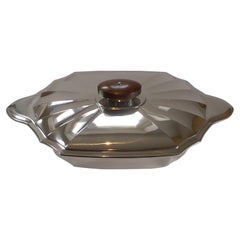
French Art Deco Christofle / Gallia Covered Serving Dish, c. 1930
By Christofle, Gallia
Located in Bath, GB
About as stylish as they come, this is a very fine example of an Art Deco entree / serving dish with lid. Made from silver plate, it has just returned from my silversmith's worksh...
Category

Vintage 1930s English Art Deco Platters and Serveware

Materials

Silver Plate

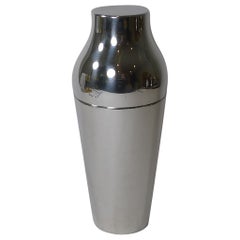
Two Part Modernist Cocktail Shaker by Orfèvrerie Christofle, Paris
By Christofle
Located in Bath, GB
A smart Bauhaus style two-part cocktail shaker with it's sleek modernist design in silver plate. Made by the top-notch Parisian silversmith, Christofle of Paris, signed on both pi...
Category

Mid-20th Century French Mid-Century Modern Barware

Materials

Silver Plate

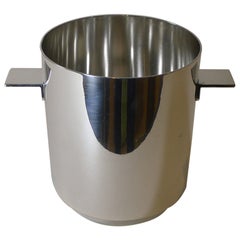
Lino Sabatinni For Christofle / Gallia, Paris - Ice Bucket, c.1960
By Lino Sabattini, Christofle
Located in Bath, GB
A fabulous ice minimalist / modernist silver plated ice bucket, I believe in the Windsor pattern, designed c.1960 by the world famous Lino Sabatinni, the preeminent figure in modern...
Category

Mid-20th Century French Mid-Century Modern Barware

Materials

Silver Plate

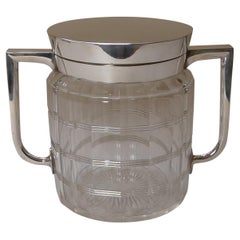
Early 20th Century Faceted Glass Silver Plated Biscuit Box, c.1920
By John Grinsell Sons
Located in Bath, GB
A heavy piece of glass was used to create this quality example, faceted all the way around and series of simple linear cuts around the circumference; the underside having a star cut....
Category

Vintage 1910s English Art Deco Decorative Boxes

Materials

Silver Plate

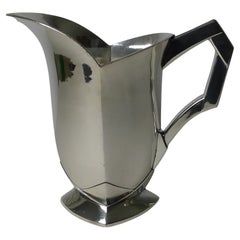
Sue et Mare for Orfèvrerie Gallia / Maison Christofle, Art Deco Jug c.1925
By Christofle, Sue et Mare
Located in Bath, GB
A highly sought-after silver plated jug designed by the famous French designers (see below) Louis Süe and André Mare for the Orfèvrerie Gallia / Maison Christofle c.1925. Just back from our silversmith's workshop, it has been professionally cleaned and polished, restoring it to it's former glory; any shading are reflections; minor wear to the interior commensurate with age and use. A magnificent piece of history and as relevant for today's interiors as it was nearly 100 years ago. Excellent condition spanning 7 1/2" handle to spout x 4" x 7" tall. Any black marks seen on the body of the jug / pitcher are shadows not marks. Item: 44016 FREE Worldwide Registered Airmail Directly From the UK Sue et Mare The spirit of collaboration was alive in the age of Art Deco. No duo quite exemplified this ideal more than the one known as Süe et Mare. Taking their knowledge of fine art and their shared experiences in the war with them, Louis Süe and André Mare were able to shape trends in the shift from Art Nouveau to Art Deco and beyond. Their designs, inspired by Cubism, excited the Paris Salon of the time and remain relevant even today. Louis Süe was born in Bordeaux in 1875 to a wine merchant and his wife. Drawn to the arts, Süe abandoned a path which would have led him into the École Polytechnique to attend the École des Beaux-Arts in 1893. There he studied painting as well as architecture design, and in 1902 was able to exhibit with a number of his contemporaries in the Salon des Indépendants and the Salon d’Automne. After working in various Parisian artists’ workshops and spending time in Vienna (where he was introduced to Cubism), Süe joined L’Atelier Français, an interior design firm made up of a number of his contemporaries, and where he first met André Mare. André Mare was born in the Norman town of Argentan in 1885. Feeling stifled by his conventional upbringing, he left in 1904 to enroll in the École des Arts Decoratifs. In 1906, Mare also exhibited at the Salon des Indépendants and the Salon d’Automne, showing his furniture design and setting himself apart as a leader among his cohort. In 1912, along with Marcel Duchamp and others (and concurrent to his involvement with L’Atelier Français) Mare created La Maison Cubiste, a section at that year’s Salon d’Automne dedicated to radical interior design. The outbreak of the First World War briefly interrupted the two men’s collaboration. Süe was drafted into the French Army and served in the Greek campaign. Mare, meanwhile, developed new camouflage techniques for the French, British, and Italian armies using his knowledge of Cubism. But this function did not keep him from the front. In 1916, he was wounded by shrapnel in Picardy while helping establish a lookout post, and in the same year was awarded the Military Cross by George V of England. In 1919, Süe and Mare resumed their professional relationship by cooperating with Gustave Jaulmes on designing the victory celebrations in Paris for the war’s end. The next year the pair founded the Compagnie des arts français, focusing on creating designs for furnishings and interior accessories. While adhering to the Art Deco style, their designs were more conventional, harking back to the Louis XIV and earlier periods, and less focused on geometric intricacy. Highly decorative, their pieces featured flair such as sculpted floral and fruit motifs, scalloped edges, and inlays of ivory and mother of pearl. Working primarily as decorators and furniture designers, Süe and Mare did find time to continue participating in exhibitions, particularly the 1925 Exposition internationale des arts décoratifs et industriels modernes, where they constructed an actual museum of contemporary art. Other projects included the booth for the Ambassade de France and the interiors of the steamship SS Île de France.
Category

Vintage 1920s French Art Deco Sheffield and Silverplate

Materials

Silver Plate

Antique English Oak and Silver Plate Biscuit Box by John Grinsell Sons
By John Grinsell Sons
Located in Bath, GB
A handsome and very stylish biscuit box dating to circa 1890 by the top notch silversmith, John Grinsell & Sons of Sheffield. Made from solid English oak, the box is fitted with e...
Category

Antique Late 19th Century English Late Victorian Decorative Boxes

Materials

Silver Plate

Still Thinking About These?

All Recently Viewed