1 of 1
French Green Painted Mantel Clock by Platel, Paris circa 1900
$2,211.66List Price
About the Item
- Creator:Platel, Paris 1 (Clockmaker)
- Dimensions:Height: 13 in (33.02 cm)Width: 9.5 in (24.13 cm)Depth: 6 in (15.24 cm)
- Place of Origin:
- Period:1900-1909
- Date of Manufacture:circa 1900
- Condition:Minor losses.
- Seller Location:Dublin, IE
- Reference Number:Seller: Stock No.1801stDibs: LU108182162942
Authenticity Guarantee
In the unlikely event there’s an issue with an item’s authenticity, contact us within 1 year for a full refund. DetailsMoney-Back Guarantee
If your item is not as described, is damaged in transit, or does not arrive, contact us within 7 days for a full refund. Details24-Hour Cancellation
You have a 24-hour grace period in which to reconsider your purchase, with no questions asked.Vetted Professional Sellers
Our world-class sellers must adhere to strict standards for service and quality, maintaining the integrity of our listings.Price-Match Guarantee
If you find that a seller listed the same item for a lower price elsewhere, we’ll match it.Trusted Global Delivery
Our best-in-class carrier network provides specialized shipping options worldwide, including custom delivery.You May Also Like
French Pendulum Clock / Mantel Clock, Boulle Style Paris, circa 1870
Located in Berlin, DE
French pendulum clock / mantel clock, Boulle style Paris, circa 1870.
Paris, circa 1880
The waisted case, veneered with red tortoiseshell and...
Category
Antique 19th Century French Napoleon III Table Clocks and Desk Clocks
Materials
Bronze

$4,063
H 22.45 in W 13.78 in D 5.91 in
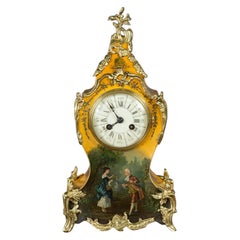
French Vernis Martin Mantel Clock by Vincenti, Paris
By Vincenti et Cie
Located in Norwich, GB
French Vernis Martin mantel clock with ormolu mounts. Beautifully decorated case featuring floral swags and foliage with central love...
Category
Antique 1880s French Mantel Clocks
Materials
Fruitwood
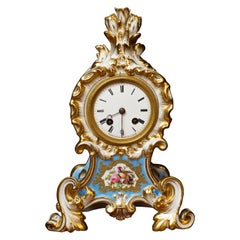
French Porcelain Mantel Clock by Aubert Klaftenberger, Paris
By Aubert
Klaftenberger
Located in Norwich, GB
French porcelain clock, beautiful gilded decoration with inset hand painted panels on a light blue background. Enamel dial with finely cut original steel hands signed ‘Aubert Klaften...
Category
Antique 1840s French Louis Philippe Mantel Clocks
Materials
Porcelain
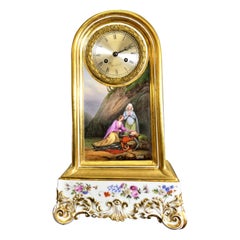
French Porcelain Mantel Clock by Raingo Freres, Paris
By Raingo Frères
Located in Norwich, GB
French Porcelain Mantel clock by Raingo Freres, Paris
French porcelain mantel clock housed in an arch top case with raised stepped plinth and resting on scroll feet. Outstanding hand painted panel to the front with gilt surround depicting two maidens attending a fatally wounded knight. Beautifully decorated to all sides with flowers, birds and butterfly on a white ground with gilt decorative border to the plinth.
Chased gilded bezel, silvered dial with Roman numerals and original ‘blued’ steel Moonpoise hands signed Raingo Fres, a Paris.
French eight day movement with silk suspension, anchor escapement and outside countwheel, striking the hours and halves on a silvered bell. The backplate signed Raingo Fres, a Paris and numbered 301. C.1850
Raingo Freres worked from Rue Vielle Du Temple c.1829, also from Rue De Saintonge between 1840 to 1850. The company continued trading in Paris until the early 1900’s.
Source: Dictionnaire Des Horlogers Francais, Tardy.
Raingo Freres began with Zacharie Joseph Raingo ( 1775-1847) a clockmaker born in Belgium in 1775. He specialised in creating astronomical...
Category
Antique 1850s French Mantel Clocks
Materials
Porcelain
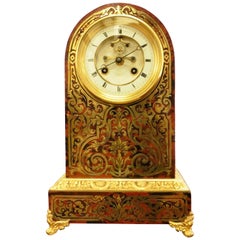
French Tortoiseshell Boulle Mantel Clock by Roskell, Paris
By Henri Marc, Paris 1
Located in Norwich, GB
Fine Tortoiseshell Boulle clock in an arch top case, standing on elaborate gilded Ormolu feet with raised base with Acanthus leaf decoration.
two-piece enamel dial with Brocot (vi...
Category
Antique 19th Century French Mantel Clocks
Materials
Tortoise Shell
French Ormolu and Green Marble Mantel Clock, Maple
Co, Paris
By Samuel Marti
Located in Norwich, GB
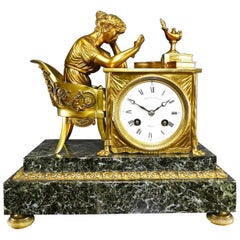
Ormolu And Green Marble Mantel Clock, Maple & Co Ltd, Paris
Ormolu and Verde marble mantel clock depicting a beautifully cast maiden studying her ...
Category
Antique 1880s French Mantel Clocks
Materials
Ormolu
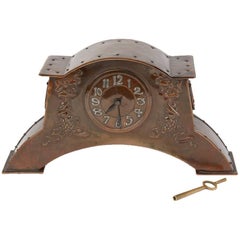
Arts
Crafts Copper Mantel Clock, circa 1900
Located in Bishop
s Stortford, Hertfordshire
An exceptional Arts & Crafts copper mantel clock standing on two rectangular shaped feet with an arched body with an embossed dial and silvered Arabic numerals flanked with ribbons a...
Category
Antique Early 1900s Arts and Crafts Mantel Clocks
Materials
Copper
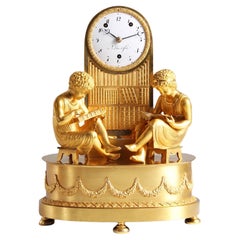
Empire Mantel Clock - La Bibliotheque, Ormolu, France, Paris, circa 1820
By Le Roi
Located in Greven, DE
Mantel Clock - La Bibliotheque - In the study room
Paris
fire-gilt bronze, enamel
Empire around 1820
Dimensions: H x W x D: 38 x 28 x 19 cm
Description:
Scenery mounted on an oval...
Category
Antique Early 19th Century French Empire Mantel Clocks
Materials
Bronze
$8,966
H 14.97 in W 11.03 in D 7.49 in
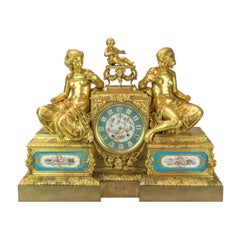
Bourdin À Paris Figural Ormolu Mantel Clock, circa 1890
By Bourdin
Located in New York, NY
A Monumental Bourdin French figural gilt bronze mantel clock, depicting two women seated on the plinth with garland decoration and a c...
Category
Antique Late 19th Century French Mantel Clocks
Materials
Ormolu
French Empire Ormulu Bronze Mantel Clock, Lepaute, Thomire, Paris, circa 1815
Located in Greven, DE
Ormulu pendule with depiction of friendship and love
Paris (Lepaute, Thomire)
fire-gilt bronze
Empire around 1815
Dimensions: H x W x D: 44 x 36 x 13 cm
French pendulum movement with eight days duration. Thread suspension and lock disc striking movement with strike on bell on the half and full hour.
White enamel dial with Roman hour numerals and Breguet hands.
Signature: LePaute & Fils / Hrl. du Roi (Pierre-Basile Lepaute (1750 - 1843) with his son Pierre-Michel Lepaute (1785-1849); from 1811 in joint workshop).
Description:
The extremely high quality pendulum shown here takes up a profound theme: Friendship, which combines with love and can thereby outlast time and death. As it is typical for the epoch of classicism, personifications and symbols are taken from the fund of ancient mythology and art and then developed further.
The main figure is a young woman in an antique, girded garment, standing barefoot and with crossed legs next to an altar, on which she is leaning with her left elbow. She gracefully bows her head towards a tempestuously approaching Cupid, grasps his right hand with her left and draws him to her bosom, the seat of the heart. The delicate ambivalence of flying towards and being held culminates in the trustingly intimate look that the two cast at each other.
The young woman personifies friendship, the winged Cupid love. As a sign of their intimate connection, two burning hearts appear on the altar next to the two, framed by the puffed scarf, which are closely bound together by a chain of flowers.
Next to them, on the altar slab, one can see an erected book with the title "Amitie" (French: amitie, friendship). Supporting the book is a pomegranate held by a ring of pomegranate flowers. The bursting seeds spill out of the cracked skin. Since ancient times, the pomegranate and its blossoms have been dedicated to the goddess Persephone, symbolizing the underworld and death, but also life and fertility. The myrtle interwoven in the pomegranate flower wreath of "friendship" also has a far-reaching symbolic power: the plant was dedicated to the goddess Aphrodite, stands for virginity, and was and is therefore obligatory in the bridal wreath...
Category
Antique Early 19th Century French Empire Mantel Clocks
Materials
Bronze, Enamel

$11,476
H 17.33 in W 14.18 in D 5.12 in
Still Thinking About These?
All Recently ViewedMore Ways To Browse
Green Clock
Antique Clock Bell
Green Mantel Clock
Eye Clocks
Antique Marble Clocks
Antique Clock Case
Antique Clock Cases
Gilt Bronze Mantel Clocks
French Ormolu Mantel Clock
Clock Dial
Antique Clock Hands
Antique Desk Clock
Antique Desk Clock Clocks
Antique Table Clock Clocks
Longcase Clock
Longcase Grandfather Clock
Antique Bronze And Enamel Mantel Clocks
Brown Grandfather Clock