Items Similar to Early 19th Century Vase Pendule, Pendulum-Clock, Tardy à Lyon, Empire circa 1820
Video Loading
Want more images or videos?
Request additional images or videos from the seller
1 of 15
Early 19th Century Vase Pendule, Pendulum-Clock, Tardy à Lyon, Empire circa 1820
$5,473.17
£4,072.16
€4,600
CA$7,581.09
A$8,123.02
CHF 4,357.43
MX$96,218.31
NOK 54,966.56
SEK 50,285.90
DKK 35,049.82
About the Item
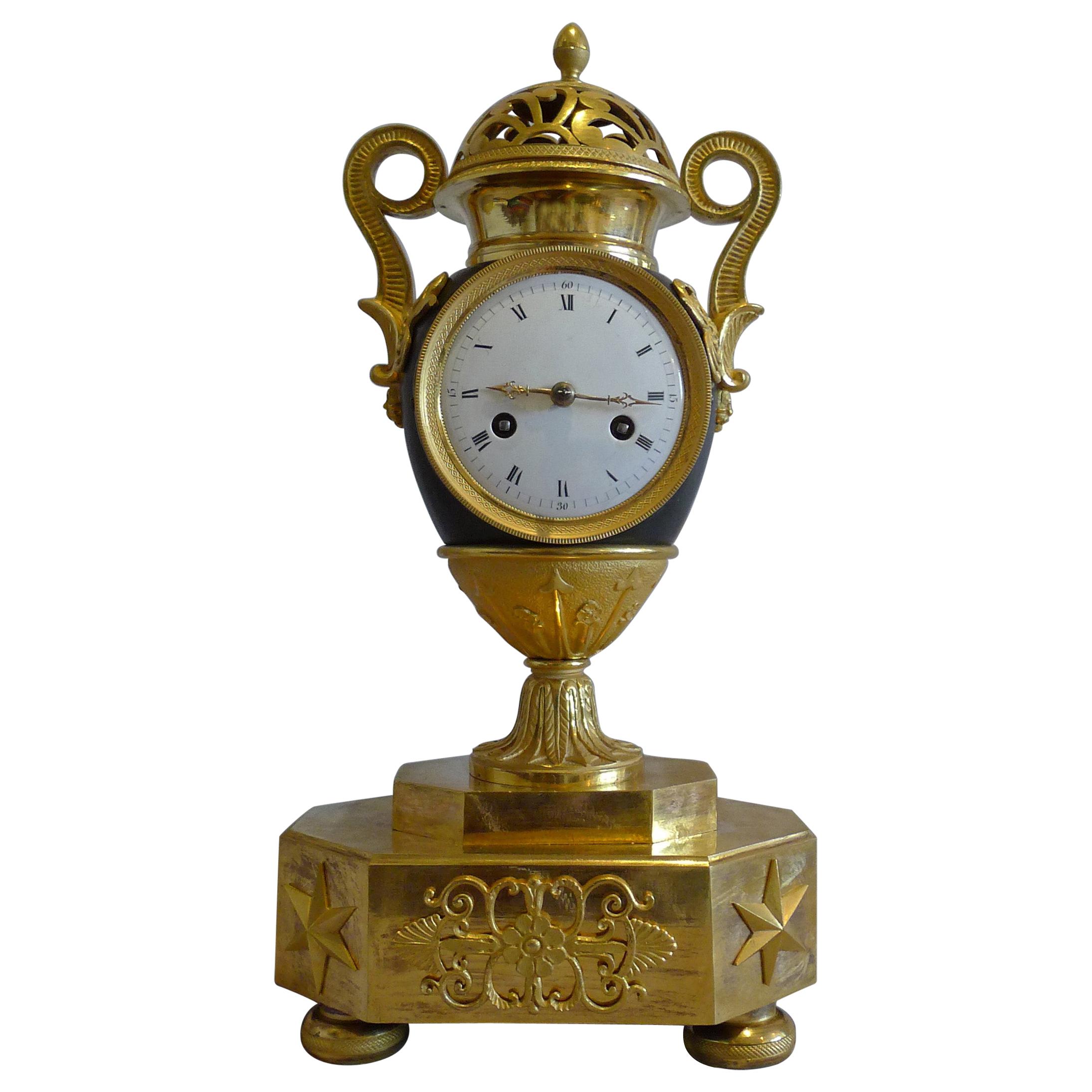
Antique vase clock
France
Fire gilded bronze
Empire around 1820
Dimensions: H x W x D: 41 x 13 x 12
Description:
Beautiful all gilt French mantel clock.
The basic form is in the shape of an urn vase with lid and side handles.
Approximately square base with applied flower basket in bas-relief.
The dial is centered in the front view of the vase and is framed by a finely chased bezel. In the four corners we see applied arrows.
The side-mounted female faces, so-called caryatids support the handles, which in turn end in heads of dolphins or mythical creatures at the top.
The heart of the clock is a classic French pendulum movement with thread suspension of the pendulum and lock wheel striking. Strike on bell on the half and full hour. The duration of the movement is one week.
Black Roman numerals, Breguet hands. In the lower part of the dial we can see the signature: Tardy à Lyon.
Condition:
Completely overhauled movement, flawless in function. Cleaned bronze with light rubbing of fire gilding on the sides.
This vase clock is illustrated in the literature:
Elke Niehüser - The French Bronze Clock p. 267.
- Dimensions:Height: 16.15 in (41 cm)Width: 5.12 in (13 cm)Depth: 4.73 in (12 cm)
- Style:Empire (Of the Period)
- Materials and Techniques:
- Place of Origin:
- Period:
- Date of Manufacture:1820
- Condition:Wear consistent with age and use. Completely overhauled movement, flawless in function. Cleaned bronze with light rubbing of fire gilding on the sides.
- Seller Location:Greven, DE
- Reference Number:1stDibs: LU5419227081202
About the Seller
5.0
Platinum Seller
Premium sellers with a 4.7+ rating and 24-hour response times
Established in 2014
1stDibs seller since 2020
219 sales on 1stDibs
Typical response time: 1 hour
- ShippingRetrieving quote...Shipping from: Münster, Germany
- Return Policy
More From This Seller
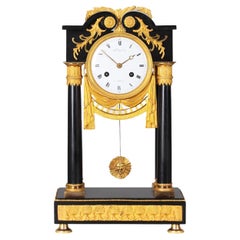
View AllEarly 19th Century French Empire Mantel Clock, Portal Pendule, Paris circa 1820
By Duval
Located in Greven, DE
Antique French round arch portal clock
France (Paris)
Bronze, enamel
Empire circa 1820
Dimensions: H x W x D: 47 x 26 x 12 cm
Description:
Very beautiful, strictly architecturally...
Category
Antique Early 19th Century French Empire Mantel Clocks
Materials
Bronze, Enamel
Early 19th Century French Mantel Clock, signed Ferey au Havre, Ormolu
Located in Greven, DE
Small mantel clock with bas-relief
France
Bronze, enamel
early 19th century
Dimensions: H x W x D: 33 x 19 x 9 cm
Description:
Antique, fire-gilt portal clock with figurative, Gre...
Category
Antique Early 19th Century French Empire Mantel Clocks
Materials
Bronze, Enamel, Ormolu
French Directoire Pendule, Black Marble, Firegilded Bronze, circa 1800
Located in Greven, DE
Antique portal clock
France
marble, bronze, enamel
Directoire around 1800
Dimensions: H x W x D: 46 x 28 x 14 cm
Description:
Antique portal c...
Category
Antique Early 19th Century French Directoire Mantel Clocks
Materials
Belgian Black Marble, Bronze
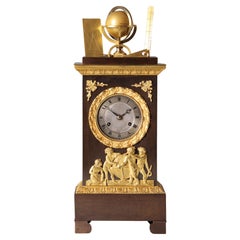
19th Century Mantel Clock "Astronomy", France circa 1830
Located in Greven, DE
Antique mantel clock on the theme of astronomy
France
Bronze
Charles X around 1830
Dimensions: H x W x D: 48 x 19 x 10 cm
Description:
Unusual and beautifully crafted bronze mante...
Category
Antique 19th Century French Charles X Table Clocks and Desk Clocks
Materials
Bronze
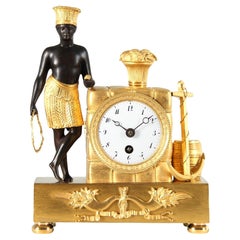
Early 19th Century Empire Clock, Miniature Matelot "Au Bon Sauvage", circa 1815
Located in Greven, DE
Miniature Empire Bronze Clock - Matelot
Paris
fire-gilded and patinated bronze
early 19th century
Dimensions: H x W x D: 18 x 14 x 9 cm
Description:
Very rare miniature of the famous Pendule Matelot "Au Bon Sauvage". The depiction deals with an important topic of the time, trade with the colonies.
The rectangular base stands on pressed ball feet. Attached to the front, we see two cornucopias filled with exotic fruits and held by a bow.
A young sailor, dressed in a raffia skirt and feather jewellery...
Category
Antique 1810s French Empire Mantel Clocks
Materials
Bronze
French Empire Ormulu Bronze Mantel Clock, Lepaute, Thomire, Paris, circa 1815
Located in Greven, DE
Ormulu pendule with depiction of friendship and love
Paris (Lepaute, Thomire)
fire-gilt bronze
Empire around 1815
Dimensions: H x W x D: 44 x 36 x 13 cm
French pendulum movement with eight days duration. Thread suspension and lock disc striking movement with strike on bell on the half and full hour.
White enamel dial with Roman hour numerals and Breguet hands.
Signature: LePaute & Fils / Hrl. du Roi (Pierre-Basile Lepaute (1750 - 1843) with his son Pierre-Michel Lepaute (1785-1849); from 1811 in joint workshop).
Description:
The extremely high quality pendulum shown here takes up a profound theme: Friendship, which combines with love and can thereby outlast time and death. As it is typical for the epoch of classicism, personifications and symbols are taken from the fund of ancient mythology and art and then developed further.
The main figure is a young woman in an antique, girded garment, standing barefoot and with crossed legs next to an altar, on which she is leaning with her left elbow. She gracefully bows her head towards a tempestuously approaching Cupid, grasps his right hand with her left and draws him to her bosom, the seat of the heart. The delicate ambivalence of flying towards and being held culminates in the trustingly intimate look that the two cast at each other.
The young woman personifies friendship, the winged Cupid love. As a sign of their intimate connection, two burning hearts appear on the altar next to the two, framed by the puffed scarf, which are closely bound together by a chain of flowers.
Next to them, on the altar slab, one can see an erected book with the title "Amitie" (French: amitie, friendship). Supporting the book is a pomegranate held by a ring of pomegranate flowers. The bursting seeds spill out of the cracked skin. Since ancient times, the pomegranate and its blossoms have been dedicated to the goddess Persephone, symbolizing the underworld and death, but also life and fertility. The myrtle interwoven in the pomegranate flower wreath of "friendship" also has a far-reaching symbolic power: the plant was dedicated to the goddess Aphrodite, stands for virginity, and was and is therefore obligatory in the bridal wreath...
Category
Antique Early 19th Century French Empire Mantel Clocks
Materials
Bronze, Enamel

You May Also Like
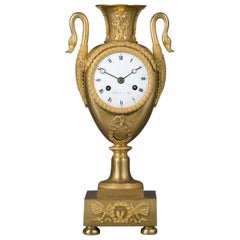
French Empire Patinated Bronze and Ormolu Vase Clock
Located in London, GB
French Empire patinated bronze and ormolu vase clock. Of unusual design set as it is on a spread ormolu base of eight sides, the front and back being long sides. The base sits upon f...
Category
Antique 1810s French Empire Mantel Clocks
Materials
Bronze, Ormolu
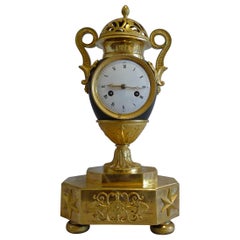
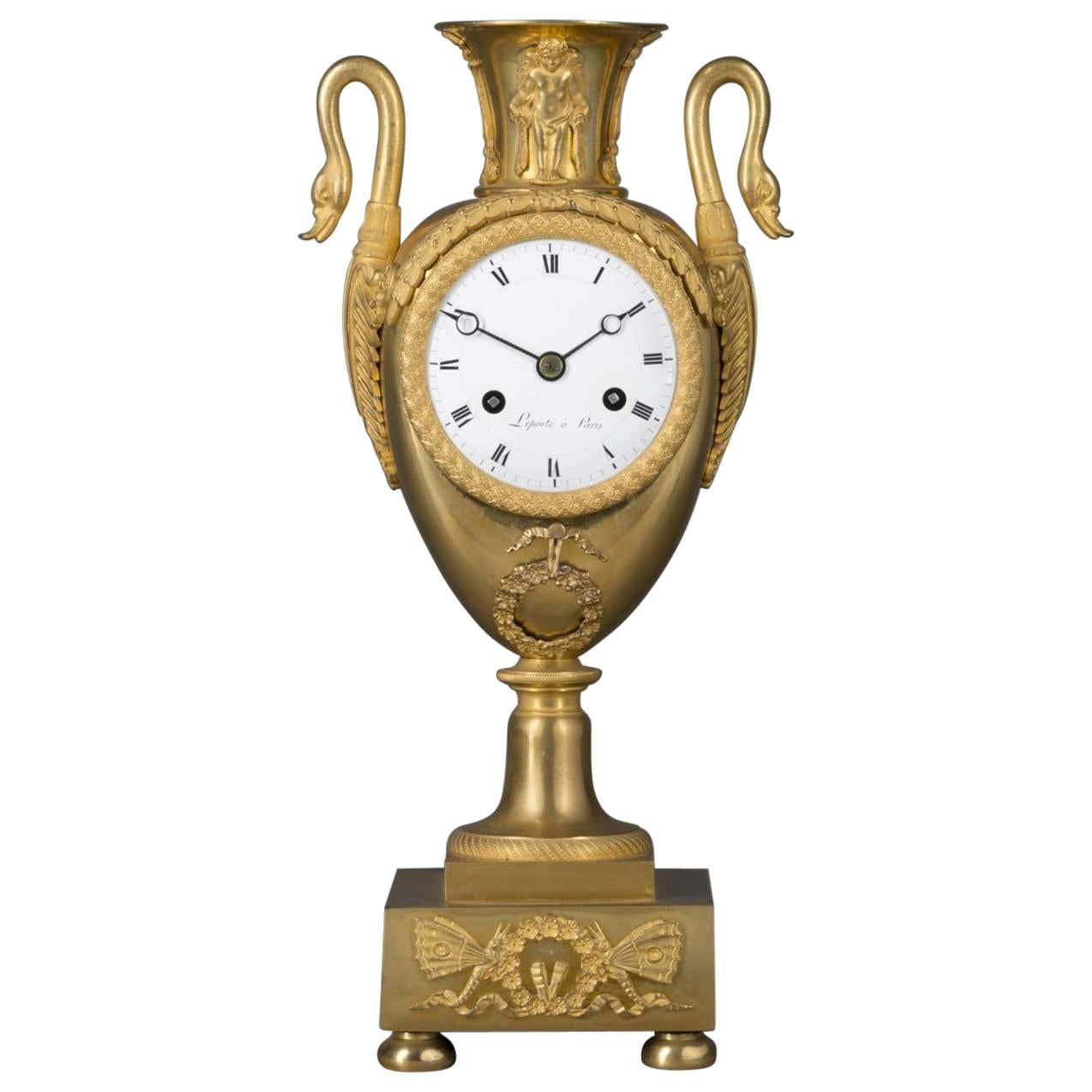
Empire Clock in the Form of a Classical Urn, by Maison Lepautre, circa 1825
By Pierre-Basile Lepaute
Located in Brighton, West Sussex
A gilt bronze Empire clock in the form of a classical urn, by Maison Lepautre.
French, circa 1825.
The dial signed 'Lepaute a Paris'.
The clock has an ornate cast bezel with a 3-inch porcelain dial with Roman numerals and Breguet style hands. The twin train eight-day movement with outside count wheel striking on a bell and silk thread suspension.
This elegant Empire style clock has a gilt bronze case in the form of a classical urn with swan neck handles and a winged cherub to the neck. The circular pedestal base is raised on a footed stepped square plinth.
The Lepaute family were the premier French clockmakers of their day. Their significance lies in their contribution to the clock making industry which had hitherto come under the trade of locksmiths. The family held the brevet Horlogers du Roi.
Jean-André Lepaute (1720–1789) arrived in Paris at an early age and in 1740 founded the family business. A skilled artist and mechanic, he quickly gained an excellent reputation. He was received as maître by the clockmakers guild in 1759, was granted royal lodgings from the king in The Luxembourg Palace, and was entrusted with the construction of the majority of the great public clocks of Paris. He executed, amongst others, those in The Luxembourg Palace, the Jardin des Plantes, the Château de Bellevue and the Château des Ternes. His clock at Paris’s École Militaire still works today. Three editions of his Traité d’Horlogerie were published in Paris in 1755, 1760 and 1767. A small volume, Description de Plusieurs Ouvrages d’Horlogerie appeared in 1764. Jean-André’s wife, Nicole-Reine Etable de la Brière (1723-1788), was a highly esteemed mathematician and astronomer. Her passion for science lent itself to Lepaute’s work and she played an active role in the scientific and mathematical aspects of the clock making.
Jean-André’s younger brother Jean-Baptiste Lepaute (1727-1802) joined him in Paris in 1747 and immediately started working for the family business. He was received as maître in 1776 and was known for the clocks he constructed for the Paris Hôtel de Ville (1780), destroyed in a fire of 1871, and for the Hôtel des Invalides (1784). Jean-Baptiste took over the workshop when Jean-André retired in 1775.
After Jean-Baptiste’s death in 1802, the firm was taken over by his nephew Pierre-Basil Lepaute (1750-1843) where he was duly joined by his own nephew Jean-Joseph (1768-1846) and son Pierre-Michel (1785-1849). By 1816, Pierre-Michel Lepaute was in charge of the business. His masterpieces include the astronomical clock in Paris’s Bureau...
Category
Antique Early 19th Century French Empire Mantel Clocks
Materials
Bronze
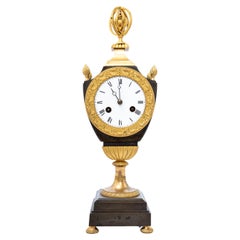
Patinated and Fire-Gilt Clock in the Form of a Vase c. 1800
Located in 263-0031, JP
A French patinated and fire-gilt clock in the form of a vase, Empire Era, 1800-1815. The silk-thread mechanism is in good working condition with key and pendulum.
Category
Antique Early 19th Century French Empire Table Clocks and Desk Clocks
Materials
Bronze
$2,064 Sale Price
20% Off
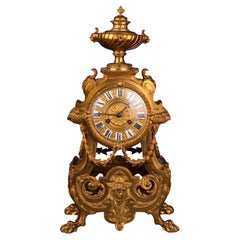
19th Century Historism Antique Chimney Clock Pendule
Located in Berlin, DE
Watch case standing on 4 feet. Bronze case crowned with a decorated Amphora.
Digits sheet: Arabic / Roman
Very richly ornate corpus with lush ornaments. An absolute eye-catcher.
Cloc...
Category
Antique 19th Century French Neoclassical Table Clocks and Desk Clocks
Materials
Bronze
$1,608 Sale Price
20% Off
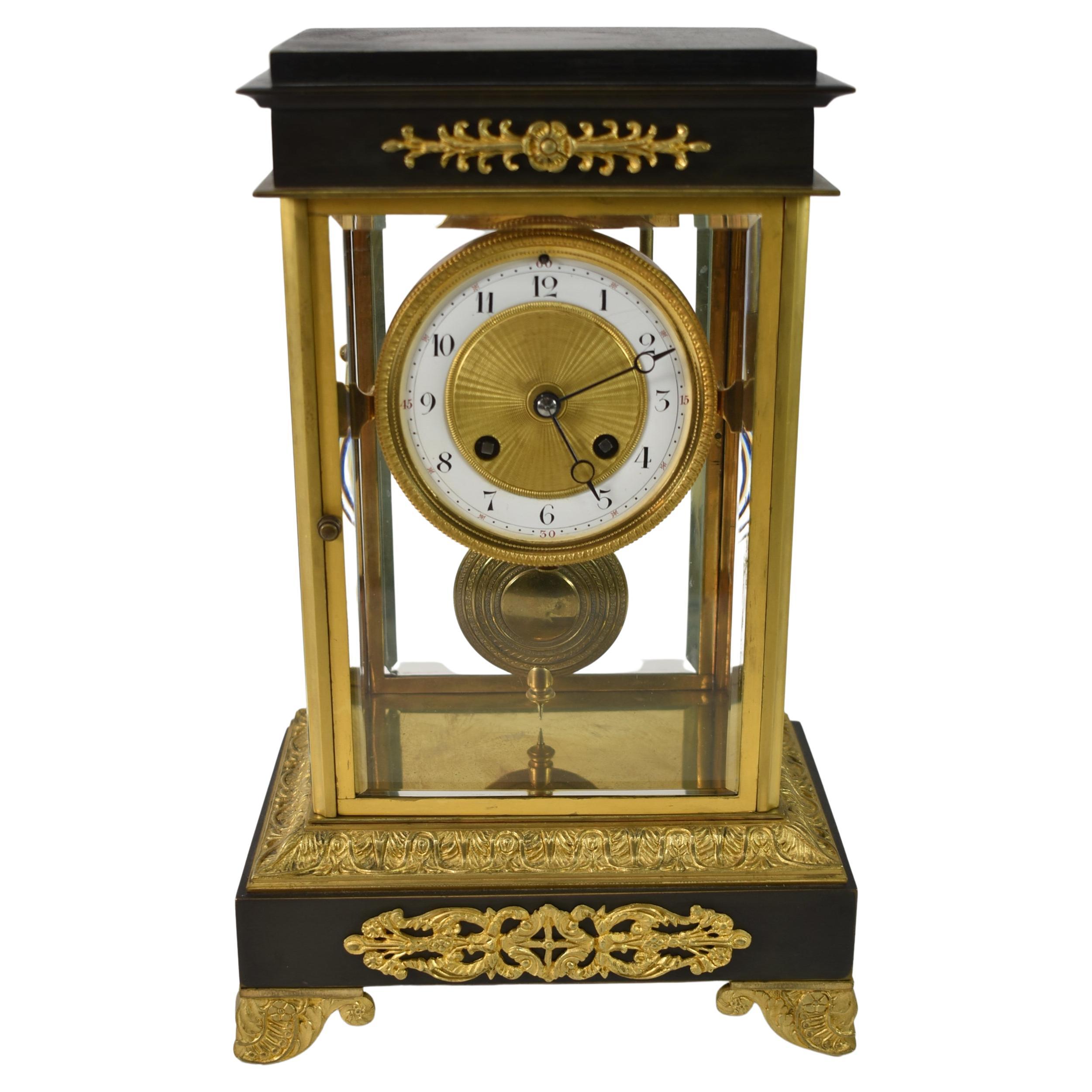
Antique French Empire Crystal Regulator Clock
Located in Toledo, OH
A beautiful brass clock with gold dore finish. Beveled glass panels with a porcelain dial and time and strike. French works. Running condition. Corner crack in one glass panel.
Category
20th Century European Empire Mantel Clocks
Materials
Brass

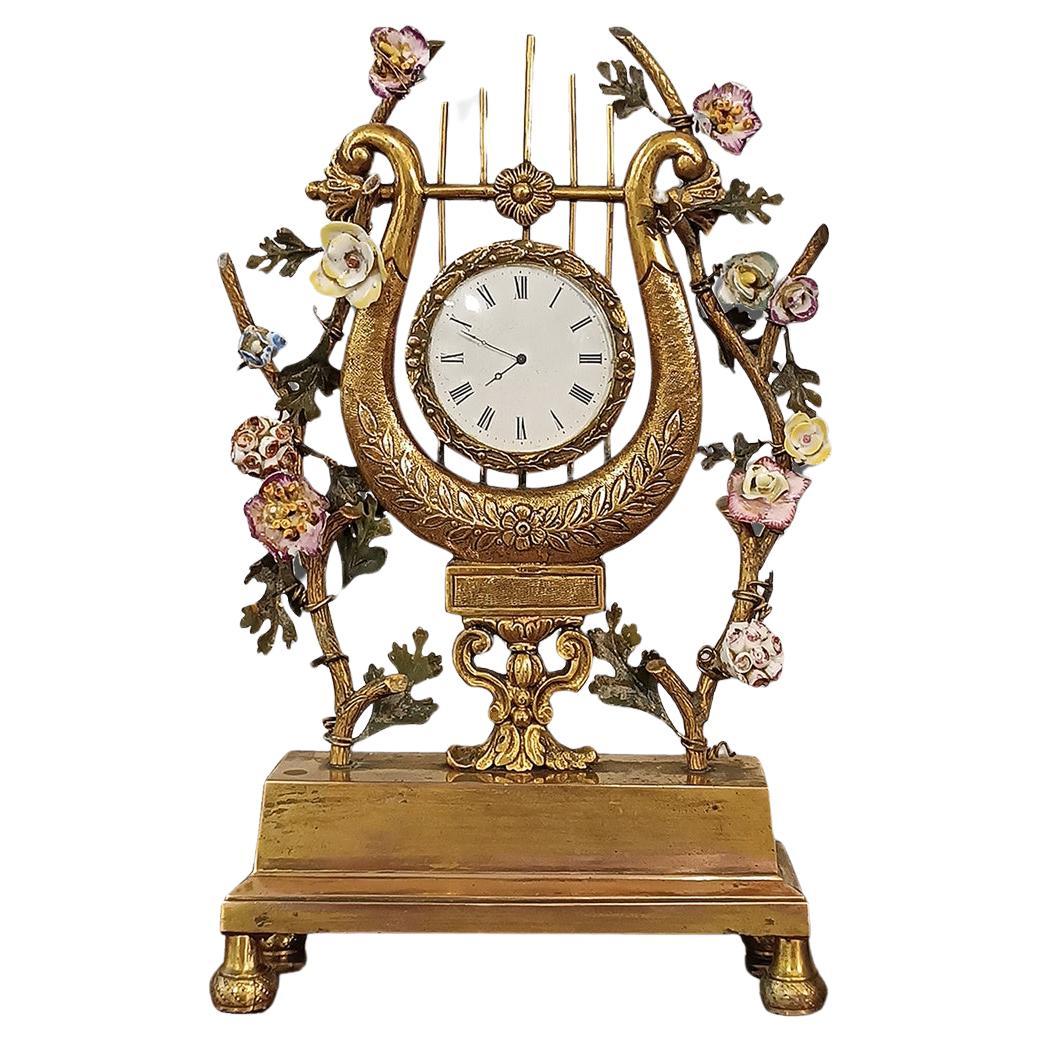
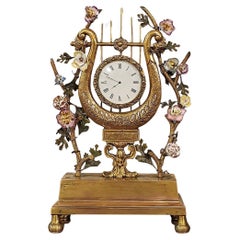
MID 19th CENTURY NAPOLEON III LIRE PENDULUM
Located in Firenze, FI
Splendid and refined lyre clock in gilded bronze, with spring winding. Its decoration with plant racemes and small roses in Meissen polychrome porcelain gives a touch of elegance and...
Category
Antique Mid-19th Century German Napoleon III Table Clocks and Desk Clocks
Materials
Bronze
More Ways To Browse
Lyon Antique
Breguet Numerals
Empire Bronze Vase
Pendule Antique
Antique Urn With Lid
French Gilded Antique Clocks
Antique Clock Pendulum Clocks
French Pendulum Clock
French Pendule
Pendule France
Pendulum Mantel Clock
Clock Heart
Pendule Empire
Clock Garniture Set
Sevres Porcelain Clock
Antique Victorian Mantel Clocks
19th Century Sevres Clock
Antique Clock Garniture Set