Want more images or videos?
Request additional images or videos from the seller
1 of 16
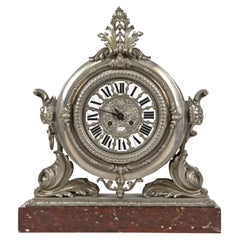
Twin Fusee mantel clock By William Payne
$7,852.79
£5,750
€6,763.25
CA$10,905.56
A$11,709.84
CHF 6,300.85
MX$138,574.54
NOK 79,379.18
SEK 72,398.24
DKK 50,533.47
About the Item
A very fine English twin fusee mantel clock in the Rococo Revival taste. The eight-day movement strikes on a bell and features a heavy pendulum bob with top adjustment, suspended from a ‘T’-bar suspension in the manner of Benjamin Vulliamy. The bronze case, mounted on a fixed base, is of exceptional quality, displaying remarkably crisp casting and beautifully chased decoration throughout. Notable details include the thick cast sound vents, backed with yellow silk grosgrain.
The gilded dial has an engine-turned centre with a sharply defined Roman chapter ring, surrounded by a guilloche bezel. It is fitted with Payne’s distinctive pierced heart-shaped hands. The movement is signed Payne, 163 New Bond Street.
The model for this case derives from an 18th-century design first created by the maître bronzier Jean-Joseph de Saint-Germain for a clock by Julien Le Roy in the 1750s. We have serviced the Le Roy clock in our workshops and have therefore been able to compare the two cases directly.
The fashion for Rococo, and particularly the Louis XV style, enjoyed renewed popularity in England during the Napoleonic Wars. This revival was, in part, a reaction against the more austere Neoclassical style adopted in post-Revolutionary France. With the French royal family in exile in Britain and the Prince Regent actively celebrating French decorative arts, the Rococo Revival was further popularised in the 1810s and 1820s. In conjunction with the address on the back plate, this suggests the present clock was made between circa 1825 and 1830.
William Payne is first recorded at 62 South Moulton Street, London, in 1816. By 1825, he had moved to 163 New Bond Street, where the firm remained until the 20th century. The company exhibited at the Great Exhibition of 1851. Examples of Payne
Co.’s work are held in the Royal Collection, the Victoria
Albert Museum, and the the collection of the National Trust at Clandon Park, Surrey.
- Creator:Payne and Co. 1 (Clockmaker)
- Dimensions:Height: 13.39 in (34 cm)Width: 9.06 in (23 cm)Depth: 5.71 in (14.5 cm)
- Style:Rococo Revival (In the Style Of)
- Materials and Techniques:
- Place of Origin:
- Period:
- Date of Manufacture:circa 1825
- Condition:Wear consistent with age and use. This clock will require overhaul before it can be shipped.
- Seller Location:Amersham, GB
- Reference Number:Seller: 4081stDibs: LU9135248221092
About the Seller
No Reviews Yet
Vetted Professional Seller
Every seller passes strict standards for authenticity and reliability
Established in 2021
1stDibs seller since 2023
8 sales on 1stDibs
Typical response time: 1 hour
- ShippingRetrieving quote...Shipping from: Amersham, United Kingdom
- Return Policy
More From This Seller
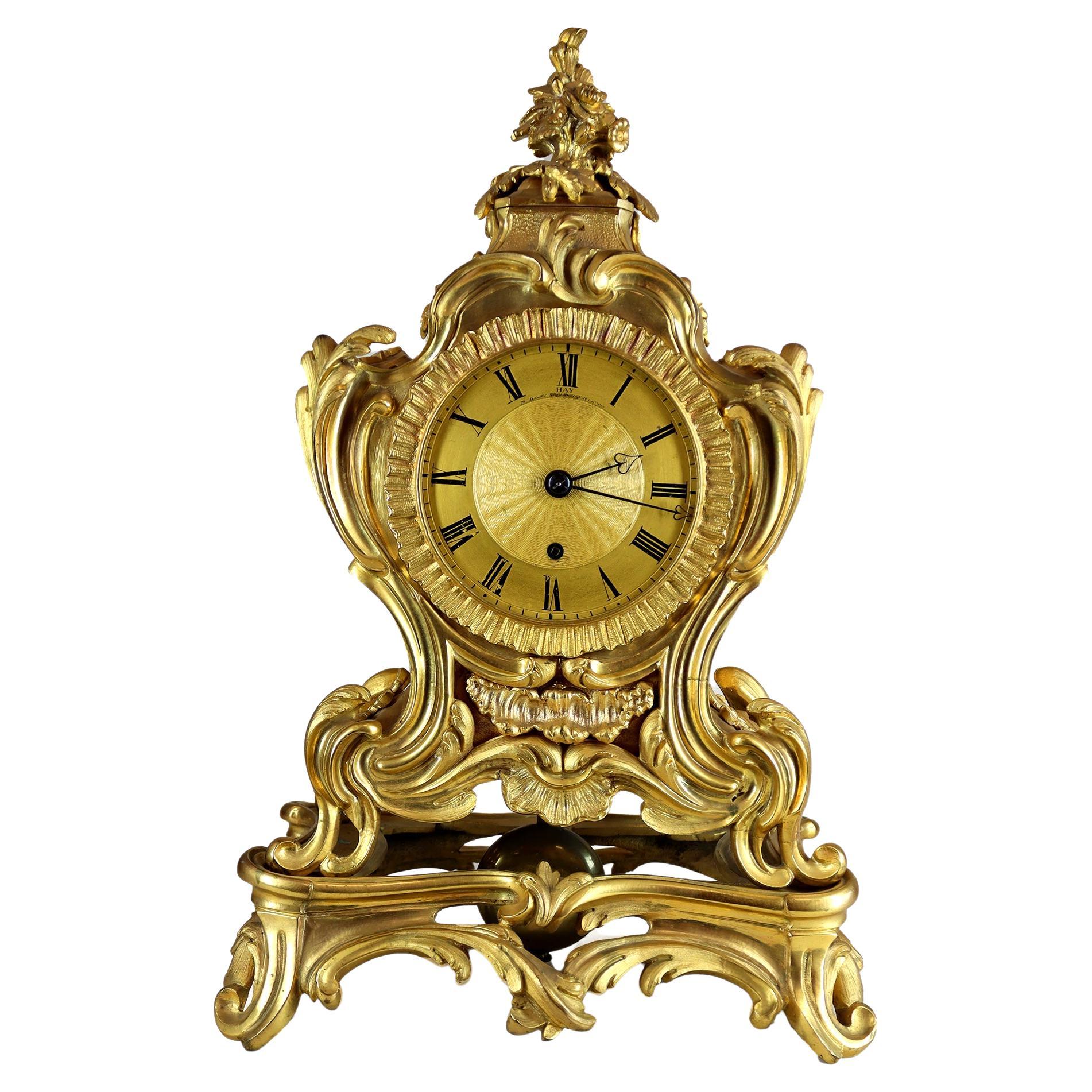
View AllSingle Fusee Mantel clock by Hay London
By HAY
Located in Amersham, GB
An unusual english single fusee mantel clock in a Louis XV style rocaille ormolu case in the french taste. The eight day fusee movement is of superb quality with a pendulum descendin...
Category
Antique Early 19th Century British Rococo Mantel Clocks
Materials
Bronze
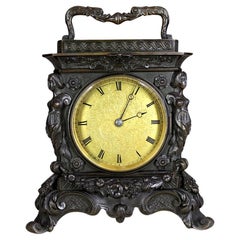
A Unique Twin Fusee English Carriage Clock by James Moore French
By Santiago James Moore French
Located in Amersham, GB
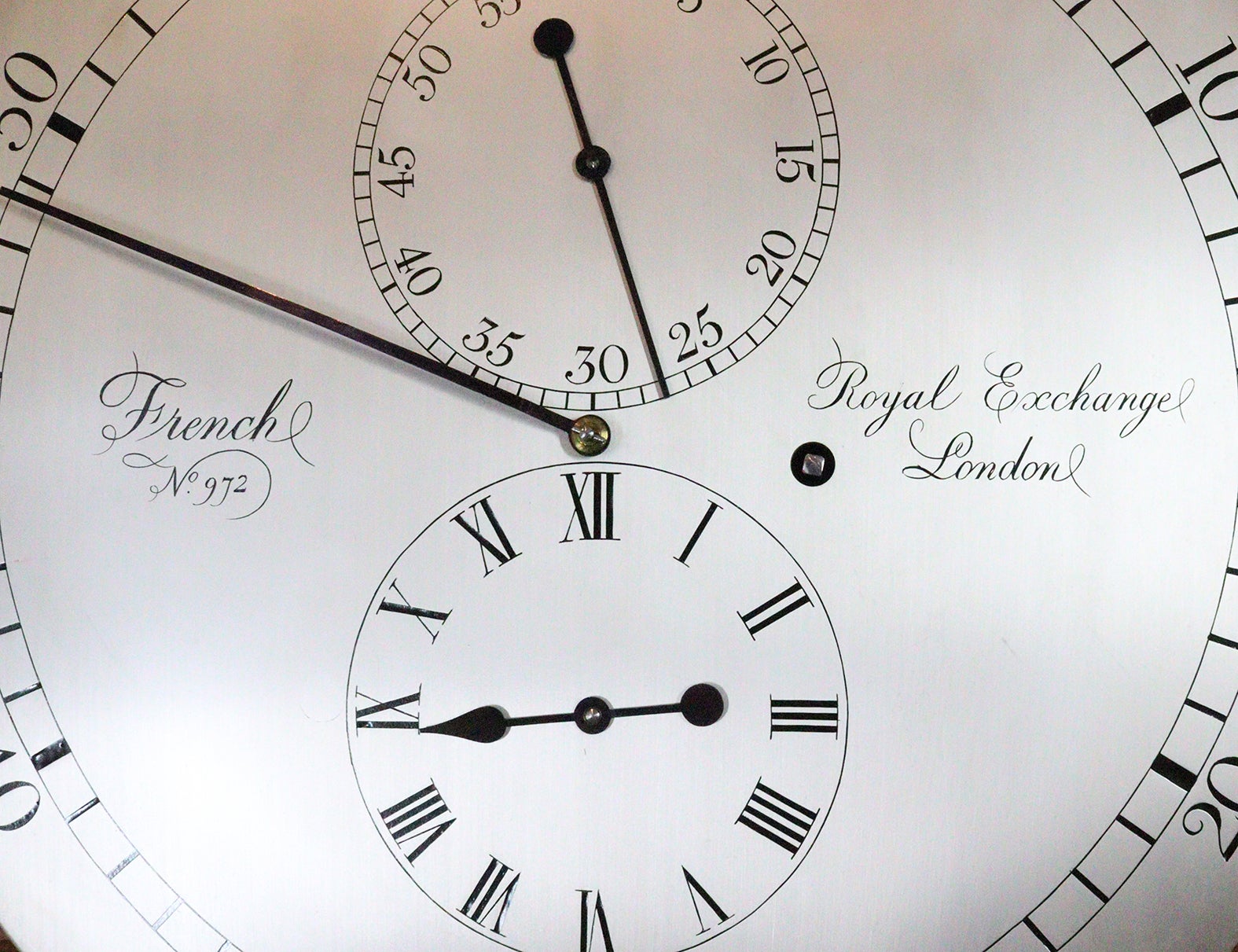
A one of a kind english twin fusee carriage clock by James Moore French. The eight day movement has a large English jewelled level escapement with compensated bimetallic balance. The movement is wound and set through a round glazed door at the back and can be regulated from the outside as the fast/slow arm extends through the back of the case with rack striking the hour and half hour on blued steel gong with trip repeat.
The gilt dial is signed as is th back plate of the movement, the centre of the dial is engraved with foliate scroll work with a roman chapter and breguet style moon hands.
The unusual case of case bronze in a rococo revival style is finely chased with fluted sides flanked by Cariatids with a swag of fruit and flowers strung between them, th handle is formed of two dolphins.
James Moore French was born in 1781 in County Antrim, Ireland. He was the son of Dr Hugh French and Sarah (née Arundel) French who married his father in 1763 and died in 1783, two years after James’s birth. In 1784, the year after Sarah’s death, Dr Hugh French married a widow named Judith Woodward who was to raise the young James French as her own, alongside his own and his half siblings. As a young man, James French moved from Ireland to London, where he worked with a relative, Peter Moore...
Category
Antique 19th Century English Rococo Revival Carriage Clocks and Travel C...
Materials
Brass, Bronze, Steel
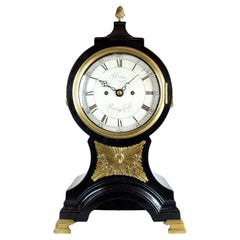
John Leroux, London. Twin Fusee Balloon Clock
By John Leroux
Located in Amersham, GB
An 18th century balloon shaped bracket or table clock by John Leroux of Charing Cross, dating from circa 1790. The waisted case surmounted by a brass pineapple finial over a drum housing the movement. The dial is behind a hinged convex glazed cast brass bezel to front and brass carrying handles to sides, over hipped concave-sided section forming the base. The front has an applied mount of a sunburst mask, the rear with keyhole shaped door incorporating fine scroll-pierced sound fret set within the frame of the case, on generous cavetto moulded skirt base incorporating break-arch recess to apron and with ogee bracket feet.
The five knopped pillar twin fusee bell striking movement with rounded angles to the rectangular plates and anchor escapement regulated by a long bob pendulum with an effective length of approximately 11.5 inches, the backplate signed J. Leroux, London to centre, the 7 inch circular single sheet silvered brass Roman numeral dial signed Leroux, Charing Cross to centre, with fine pierced steel hands and Arabic five minutes to outer track.
An identical clock is illustrated in English Bracket and Mantel Clocks by Andrew Nicholls...
Category
Antique 18th Century English George III Mantel Clocks
Materials
Brass
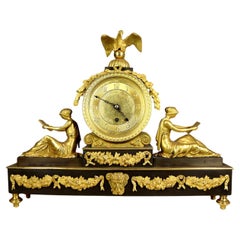
L
Etude Ormolu and Bronze Fusee Mantel Clock
Located in Amersham, GB
This impressive mantel clock with an eight day single fusee movement evokes the concept of time well spent in learning. It is crowned by Jupiter's eagle who bears sacred oak garlands above the dial, whose Ionic capital cradle is framed by addorsed studying nymphs. They are seated on a bronze plinth which is centred by an Arcadian Pan mask amongst golden flowered ormolu garlands, the whole resting on turned baluster feet. The dial is cast in ormolu and unusually has Arabic numerals, surround by a anthemion frieze bezel.
With the eagle a symbol of Jupiter and hence the divinity of learning, and the mask of Pan a reference to the natural world. This clock is, therefore, a celebration Natural Philosophy, the study of science and the natural world, and a display of classical learning and understanding.
The two seated figures derive from the model of L'Etude, which together with La Philosophie, was created for the Sèvres factory by Louis-Simon Boizot in 1780. Under the instructions of the marchand-mercier Dominique Daguerre, these figures were incorporated into a clock design, from which the present clock derives, by the cisleur-doreur François Rémond. In 1788 Daguerre delivered two clocks after his new design to Louis XVI for the Château de St. Cloud. The model obviously appealed to the Prince of Wales, later George IV, as he purchased two clocks of this model from Daguerre, one of which was in his bedroom, the other in his dressing-room one is now in Windsor Castle the other in Buckingham Palace.
This clock was probably made by Baetens & Co who specialised in bronze and ormolu decorative objects in the Regency period. No doubt identifying the fashionable subject matter and style after the Prince Regent popularised it at Carlton House. They made models in bronze ormolu and marble for many clock makers of the period. A near identical version of this clock was in the collection of the Marquess of Bath at Longleat House until its sale at Christies in 2002, made by Santiago James Moore French of the Royal Exchange. Other examples of this clock have been recorded by Barraud and Lund...
Category
Antique 1810s Regency Mantel Clocks
Materials
Bronze, Steel, Ormolu
A Paul Philip Barraud Bracket Clock in the manner of Thomas Hope
Located in Amersham, GB
A very striking twin fusee bracket clock in an Egyptian revival style case by Paul Philip Barraud. The eight day movement with unusual round plates of thick brass engraved on the bac...
Category
Antique Early 1800s English Egyptian Revival Mantel Clocks
Materials
Brass, Steel
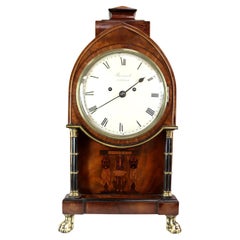
Gothic Bronze and Brass Mantel Clock
Located in Amersham, GB
A gothic revival bronze and brass bracket clock with a 5-inch silvered convex Roman dial. The twin fusee movement strikes on a bell, with a heavy high quality pendulum and hold fast...
Category
Antique 1830s English Gothic Revival Mantel Clocks
Materials
Brass, Bronze
You May Also Like
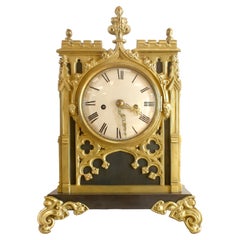
19th Century Boulle Mantel Clock
By Payne and Co. 1
Located in Brighton, Sussex
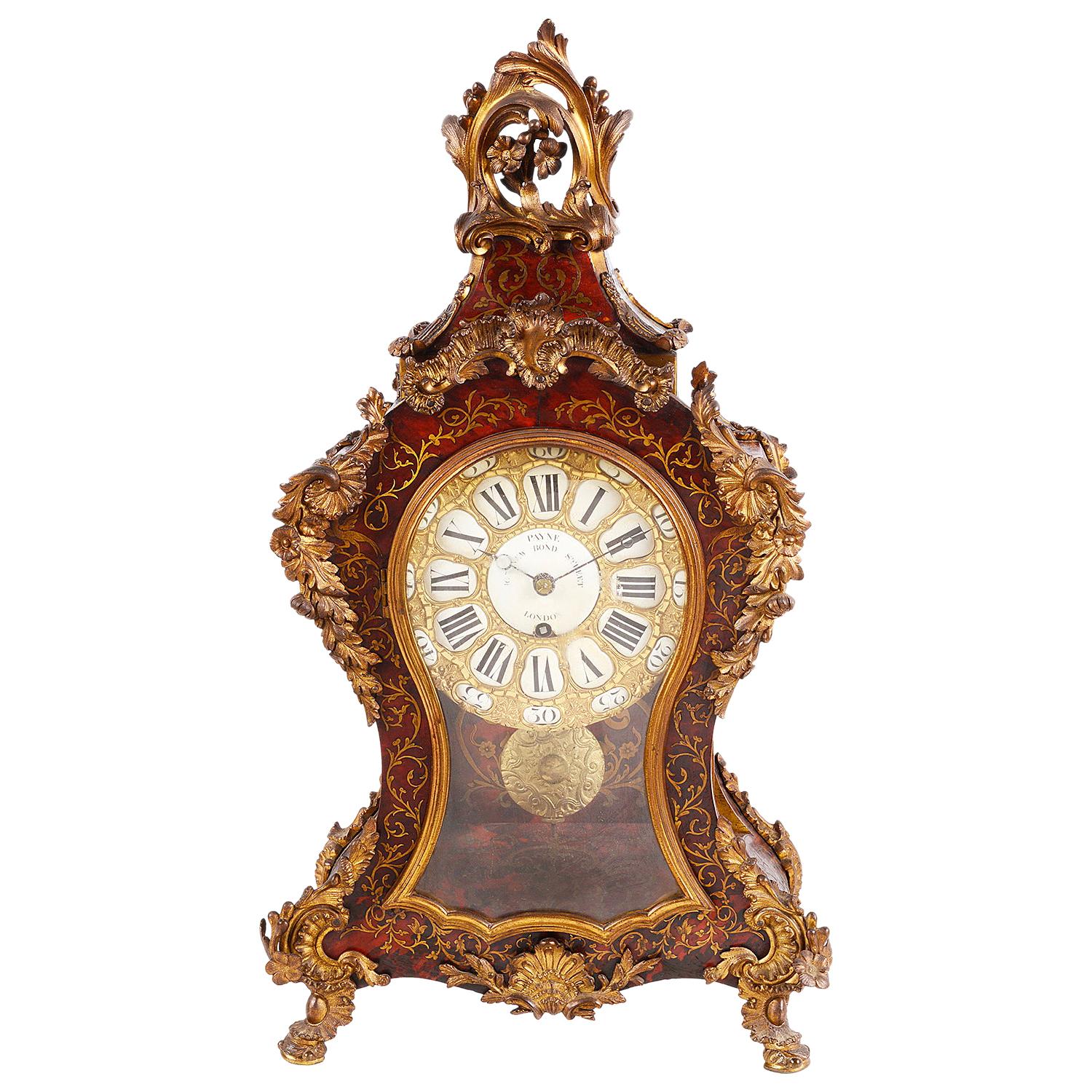
A very good quality 19th century French boulle mantel clock with wonderful scrolling foliate ormolu mounts to the surround, brass inlay to the red tortoiseshell. White enamel roman n...
Category
Antique Late 19th Century French Louis XVI Mantel Clocks
Materials
Tortoise Shell

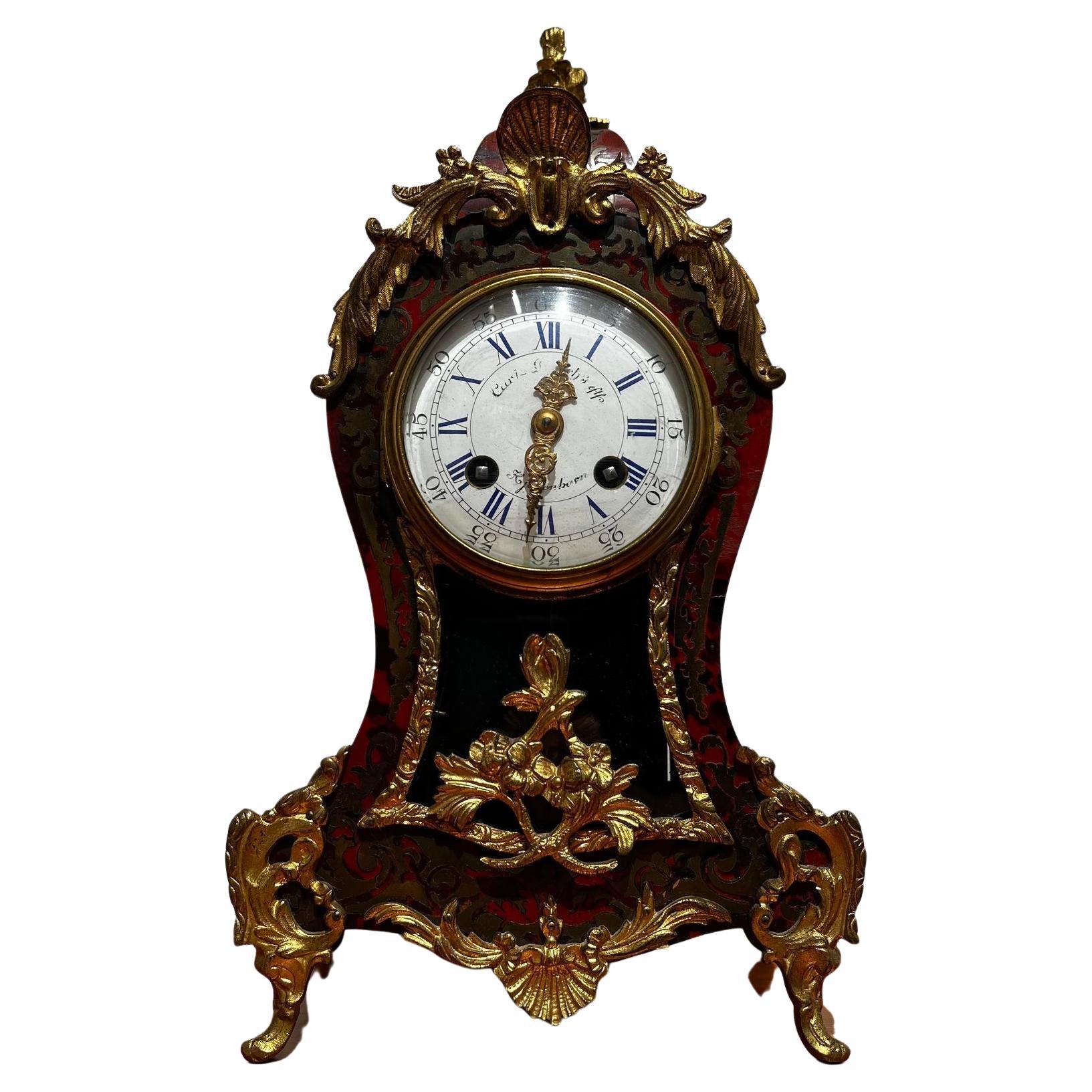
Carl Ranch
s efft Small Antique Mantel Clock From 1850s
Located in Lejre, DK
Carl Ranch's eff. small antique mantel clock is a beautiful and unique timepiece crafted in France in the 1850s. The case of this exquisite clock is designed in the Rococo Revival st...
Category
Antique 1850s French Rococo Revival Mantel Clocks
Materials
Brass
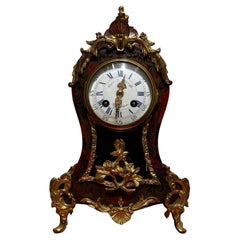
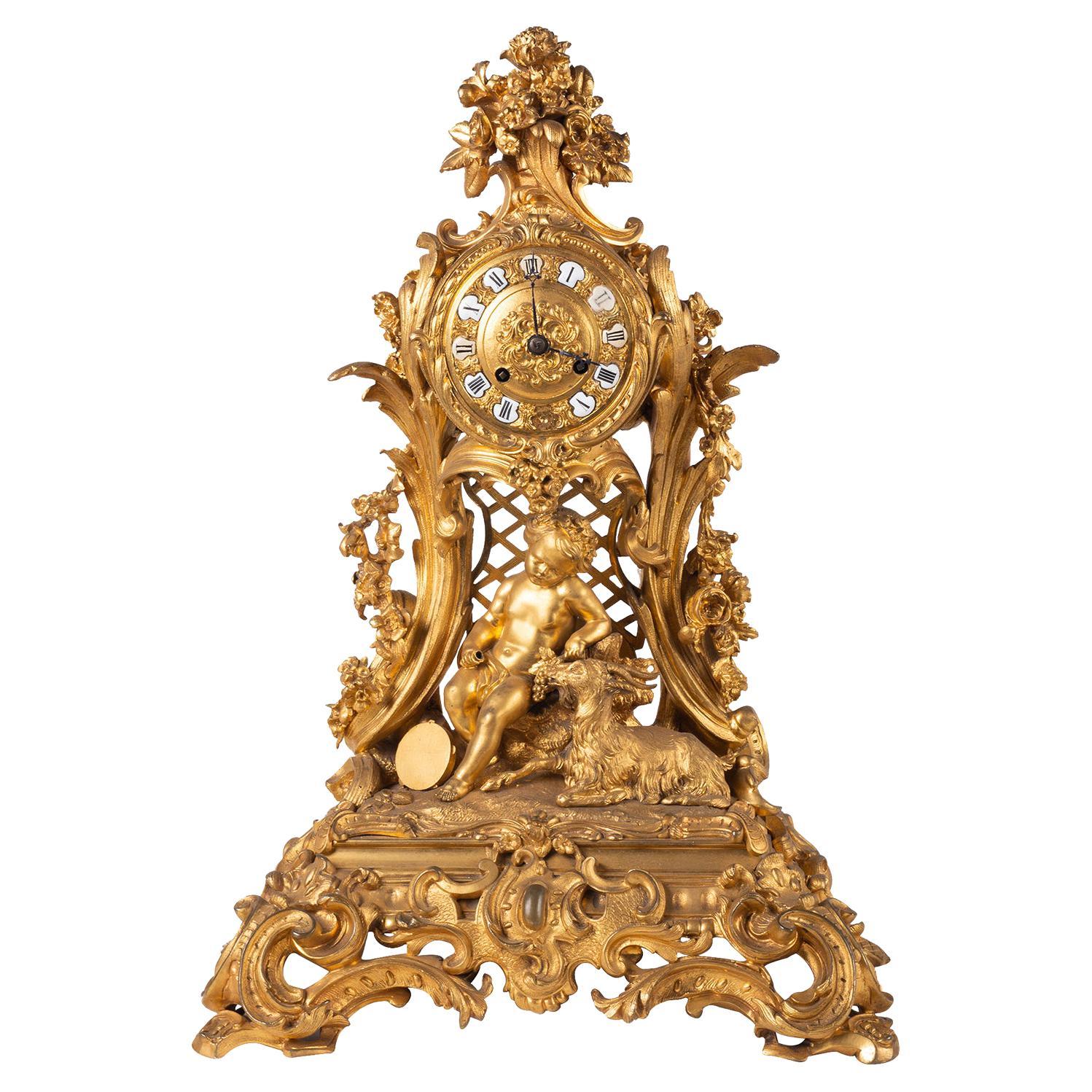
19th Century Rococo Style Mantel Clock
Located in Brighton, Sussex
A very good quality 19th Century French gilded ormolu Rococo influenced mantel clock, having wonderful scrolling foliate decoration, the clock face having enamel Roman numerals, an e...
Category
Antique Late 19th Century French Rococo Mantel Clocks
Materials
Ormolu
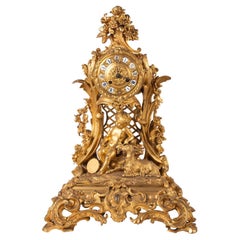
19th Century Westminster chiming mantel clock
By James Worrel Clarke
Located in Brighton, Sussex
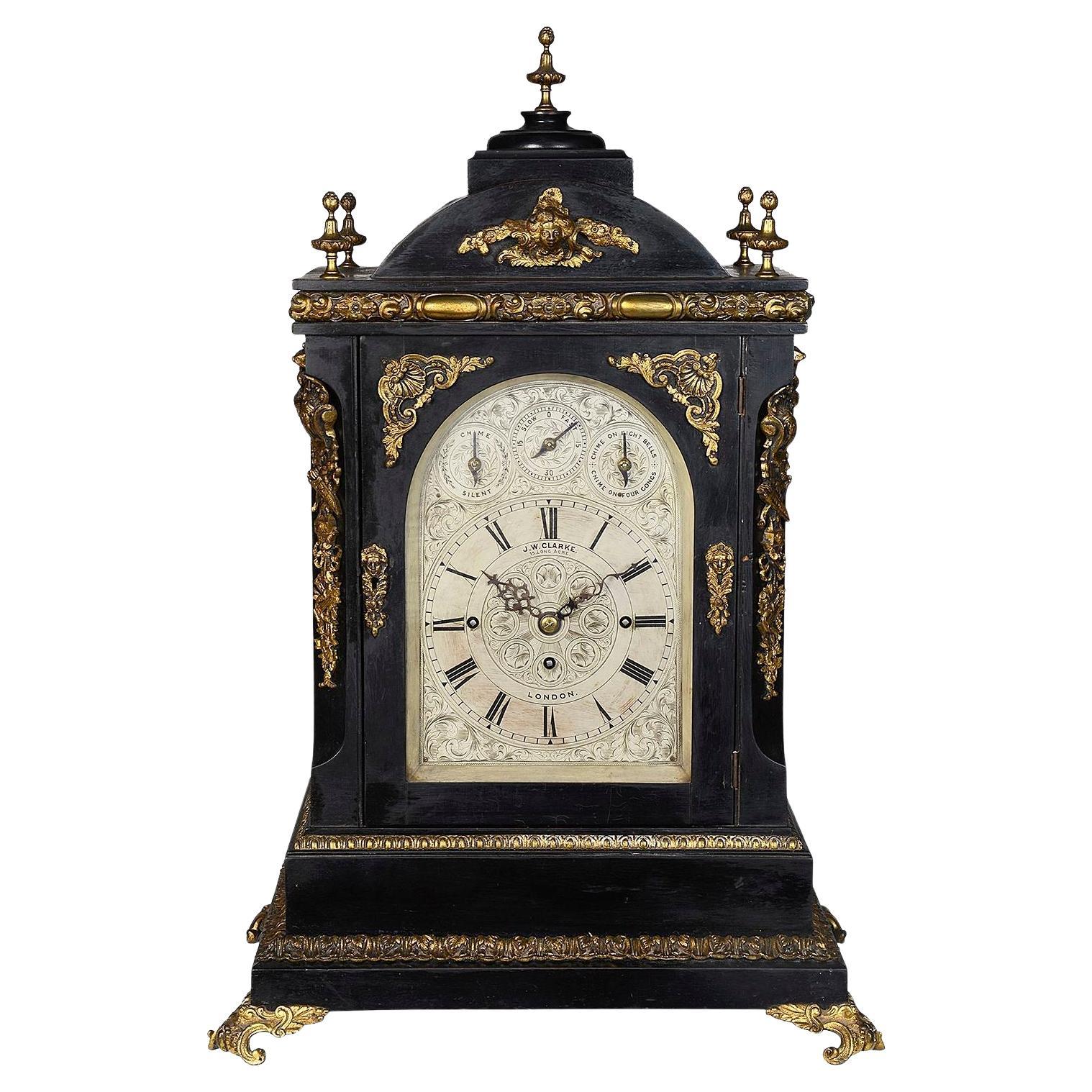
A very good quality late 19th Century ebonised Victorian silvered dial mantel clock, with Westminster chime on 8 bells or gong. Having a strike / silent dial, an eight day duration movement, striking on every quarter hour.
The ebonised case with gilded ormolu mounts, mouldings and finials and raised on scrolling feet.
Maker J.W.Clarke . 55 Long Acre...
Category
Antique Late 19th Century English Victorian Mantel Clocks
Materials
Mahogany
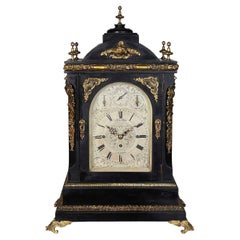
Raingo Freres Mantle Clock
Located in Atlanta, GA
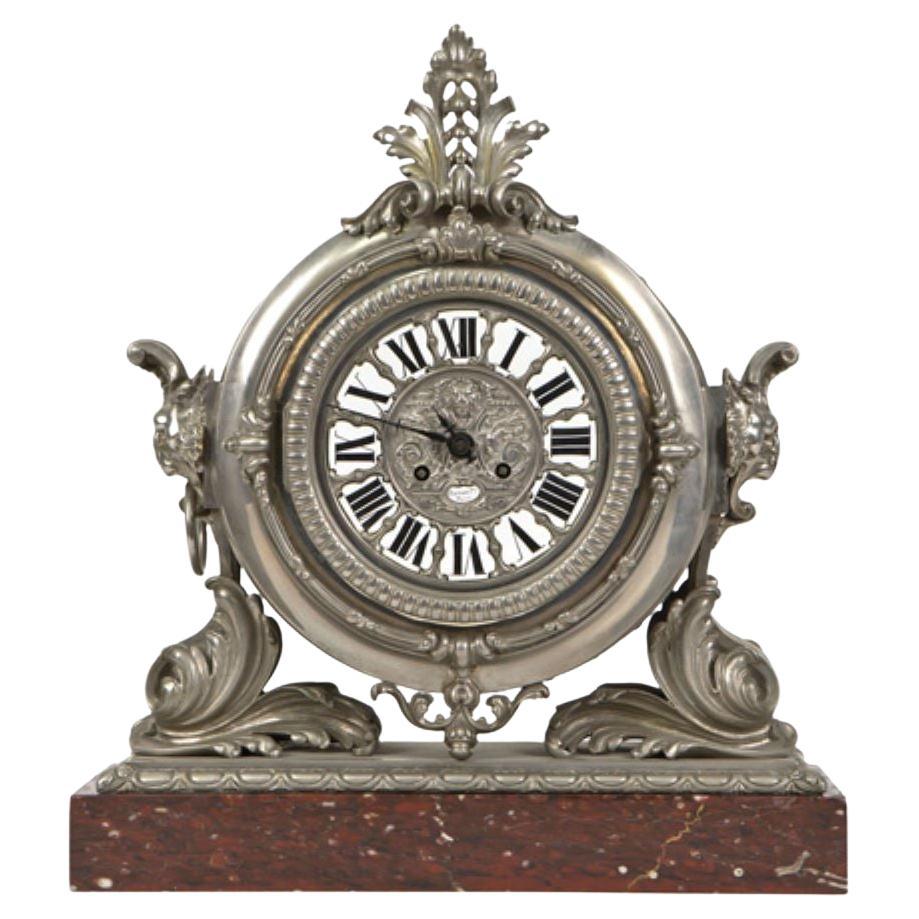
A superb French silver over bronze clock by Raingo Freres. Signed Raingo Frères on the dial and on the works, on a Rouge Griotte marble base.
Dimensions: Height 22" width 19 3/4" de...
Category
Antique 1890s French Neoclassical Mantel Clocks
Materials
Marble
Barbedienne French Mantel Clock, circa 1890
By F. Barbedienne Foundry
Located in Brighton, Sussex
A fine quality Louis XVI style French gilded ormolu mantel clock, signed Barbedienne. Having shield and foliate decoration to the top, white enamel roman numerals, a lyre shaped pend...
Category
Antique Late 19th Century French Louis XIV Mantel Clocks
Materials
Ormolu
