Late 18th Century More Clocks
to
1
15
49
200
89
79
23
39
15
5
1
4
2
1
3
5
6
3
4
4
2
2
8
6
6
5
4
11
4
14
8
5
3
1
Height
to
Width
to
15
15
15
1
1
1
Period: Late 18th Century
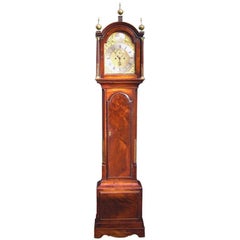
English Mahogany Tall Case Clock Signed by Maker M. Richardson, London, C. 1790
Located in Charleston, SC
English Mahogany tall case clock with brass finials, arched bonnet with brass fluted columns, gilt ormolu and chased polished steel fa...
Category
English George III Antique Late 18th Century More Clocks
Materials
Brass, Steel
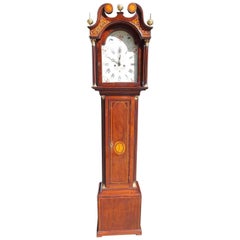
Scottish Mahogany Swan Neck Satinwood Patera Inlaid Tall Case Clock, Circa 1780
By Charles Campbell
Located in Charleston, SC
Scottish mahogany eight day tall case clock with three sphere brass finials, a swan neck satinwood inlay patera pediment, intricately carved fretwork, over an arched door with flanki...
Category
Scottish Regency Antique Late 18th Century More Clocks
Materials
Brass, Steel
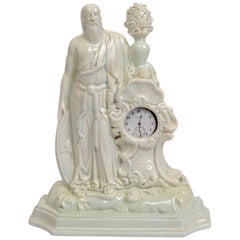
Italian, Late 18th Century Watch Holder with Father Time
Located in valatie, NY
Italian, late 18th century watch holder with Father Time. The robed figure of Father Time is standing on a raised plinth with rocks and a koi fish or carp....
Category
Italian Antique Late 18th Century More Clocks
Materials
Ceramic
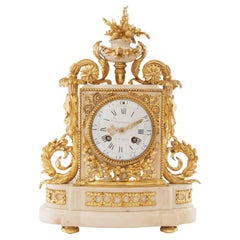
Mantel Clock 18th Century Louis XV Period, by Seigneurel À Paris
Located in Warsaw, PL
A Louis XV style marble mantel clock. Enamel dial with Roman numerals, signed with a red inscription "Seigneurez A Paris", finely pierced, engraved gold-plated hands, a broken arch (...
Category
French Louis XV Antique Late 18th Century More Clocks
Materials
Malachite

$3,093 Sale Price
25% Off
Mantel Clock 19th Century Styl Empire by Ferdinand Berthoud À Paris
Located in Warsaw, PL
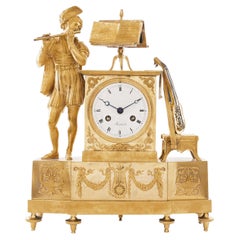
Ormolu bronze mantel clock flanked by a troubadour and musical instruments, signed 'Ferdinand Berthoud a Paris'.
The end of the 18th and beginning of the 19th century was a crucial time in which new technological advances helped to make watches more accurate and more portable. During the 1790s, the production of gilded bronze increased considerably as working conditions improved. The freedom of trade initiated by the French Revolution allowed many casters to develop large factories. The new factory environment gave them a chance to execute all stages of bronze work including drawing, casting, gilding, assembly, and trade of art objects. While the bronzers took creative liberty in creating all kinds of clocks in contrast to the noble and rigorous structure carried by the movement of neoclassicism. Under the reign of Empire, the case designs started gradually to develop away from a proportionate and strict classicism towards a baroque style and revival style. The rediscovery of medieval civilization was one of the intellectual curiosities of the beginning of the 19th century, with much input from the Ancien Régime and its institutions, rites and the medieval churches in which family ceremonies occurred.
This early nineteenth-century figural mantel clock is surmounted by a medieval musician. To be more precise, it is a french troubadour. Troubadours were known for composing and performing lyric poetry for the nobility back during medieval times. The clock is featuring a chiselled bronze troubadour, dressed in medieval fashion while holding a flute, playing a tune from sheet music called "Du Troubadour" that is resting on top of the rectangular clock case. In addition to that, the clock features a gilt bronze lute or vielle resting on a small stool on the opposite side of the clock’s case. The white enamel dial features the inscription Berthoud and is underlined by a bronze entourage chiselled with palmette motif, plus encompassed by c-scrolls and wreaths. The original hands are in blued steel and encircled by Roman numerals indicating hour next to Arabic numerals indicating minutes.
The small details that adorn the hexagonal plinth are reliefs, depicting two water fountains or basins on both sides with a lyre in between. The sculpted image of a lyre raised above the background features also foliage garlands tied on top with ribbons. The clock rests on seven spinning feet.
The clock was made in the well-known workshop of the Berthoud’s family that was recognized for their excellent work by the King.
Berthoud Clockmakers History.
Ferdinand Berthoud was a horologist and author of extensive treatises on timekeeping as well as a Swiss clockmaker serving the king of France, that produced many marine clocks, including a weight-driven version that inspired the first American sea-going clock. He was born in Plancemont, Switzerland, the son of an architect and judiciary. In 1741 he began a three-year apprenticeship as a clockmaker under his brother, Jean-Henri. He made his first marine chronometer in 1754 (sent for trial in 1761) and in 1764 was appointed a member of the Royal Society, London and Horloger Mécanicien de Sa Majesté et de la Marine ayant l'inspection de la construction des Horloges Marines. In 1769, Ferdinand Berthoud sent for his nephew Pierre-Louis Berthoud (1754–1813), commonly known as Louis Berthoud, a talented young watchmaker and clockmaker, inviting him to come to Paris from Couvet, Switzerland, to pursue his apprenticeship. Louis helped Ferdinand manufacture and repair the sea clocks...
Category
French Louis XVI Antique Late 18th Century More Clocks
Materials
Bronze
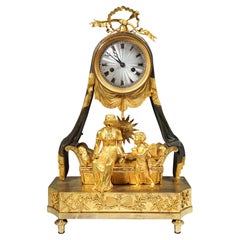
French Ormolu Mantle Clock, Pendule
Lit à Baldaquin
, Paris, Around 1790
Located in Vienna, AT
Excellent fire-gilded Empire bronze mantel clock: structure in the form of a rectangular, stepped pedestal that tapers at the front corners, on four spindle feet, with relief ornamen...
Category
French Louis XVI Antique Late 18th Century More Clocks
Materials
Bronze
Mantel Clock 18th Century, Louis XV Period
Located in Warsaw, PL
This striking mantel clock is a fine example of the Empire style, a period characterized by its grandeur and inspiration from classical antiquity. The clock showcases a masterful com...
Category
Louis XV Antique Late 18th Century More Clocks
Materials
Marble
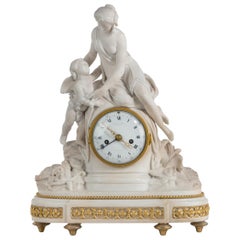
Louis XVI Period Carved Marble Clock by Bruel of Paris
By Bruel
Located in London, GB
A Louis XVI period mantel (fireplace) clock by Bruel of Paris
Constructed in Carrara marble and ormolu, rising from an ormolu dressed elliptical base supported by bronze toupie feet, the figures of Psyche and Cupid rest on a rocaille ground, housing the eight day twin train clock...
Category
French Louis XVI Antique Late 18th Century More Clocks
Materials
Carrara Marble
Fine George III 18th Century Period Mahogany Longcase Clock by Tomas Fowle
Located in Oxfordshire, United Kingdom
A fine George III period mahogany longcase clock of excellent colour, patination and proportions, circa 1780-1790
Surmounted with three ball and spike brass finials, the inverted ...
Category
English Chippendale Antique Late 18th Century More Clocks
Materials
Mahogany
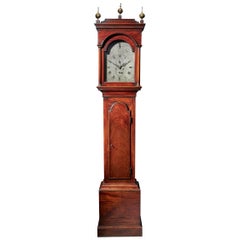
18th Century Carrara Marble and Dore Bronze Mantle Clock, F. Berthoud
Located in New York, NY
A fabulous and quite important 18th century Louis XVI period Carrara marble and dore bronze mantle clock, signed F. Berthoud, Paris. The body of the clock is exceptionally cast and f...
Category
French Louis XVI Antique Late 18th Century More Clocks
Materials
Carrara Marble, Bronze
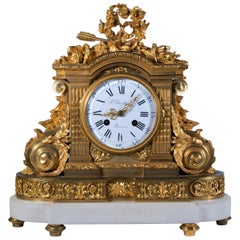
Georgian Mahogany Bracket Clock by Hector Simpson, London
Located in Norwich, GB
Georgian mahogany bracket clock by Hector Simpson, London.
Georgian bracket clock in a finely figured flame mahogany case standing on a r...
Category
British Georgian Antique Late 18th Century More Clocks
Materials
Mahogany
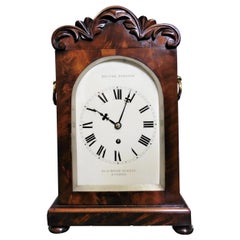
Mantel Clock 19th Century Louis XV Period
Located in Warsaw, PL
An exquisite 19th-century Louis XV-style mantel clock, showcasing a harmonious blend of Neoclassical and Rococo influences. This elegant timepiece features a finely crafted white ena...
Category
French Louis XV Antique Late 18th Century More Clocks
Materials
Marble, Bronze
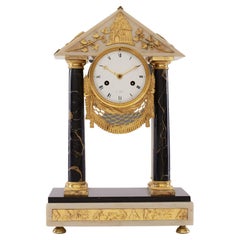
Mantel Clock 18th Century Louis XV Period by Kinable À Paris
Located in Warsaw, PL
"Late 18th Century - Kinable A Paris"
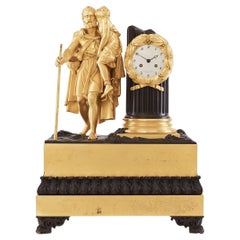
Along a winding dirt path, the blind Belisarius carries his young guide. The boy has been bitten by a snake, which remains coiled around his bleeding leg. With his right arm wrapped limply around Belisarius's neck and his eyes closed, the youth balances precariously between life and death. Belisarius's eyes are also closed, but guided by his stick he moves forward with determination and purpose. He rises heroically against the spectacular sunset, a monumental figure creating a powerful outline against the sky. But the flaring sunset also signals a chill night and the uncertainty of the path ahead.
Belisarius was a popular Byzantine general of the Roman Empire whose promising career was sabotaged by the jealous Emperor Justinian I. In 1767, a novel by Jean-François Marmontel revived interest in Belisarius. In Marmontel's novel, the emperor has the heroic general blinded, reducing Belisarius to begging. He is eventually rediscovered and aided by former officers and his family. This dramatic tale of patriotism, injustice, and redemption was widely embraced in revolutionary and post-revolutionary France and was a popular subject for artists--including Jacques-Louis David (François Gérard...
Category
French Louis XV Antique Late 18th Century More Clocks
Materials
Bronze
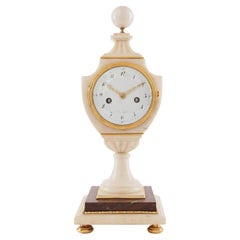
French Empire Ormolu and Marble Mantel Clock, ca.1790
Located in Warsaw, PL
This exquisite mantel clock exemplifies the refined aesthetic and masterful craftsmanship of the French Empire period. Crafted primarily from marble, this clock showcases a harmonio...
Category
French Regency Antique Late 18th Century More Clocks
Materials
Marble
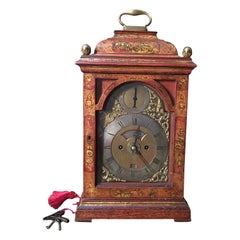
English Bracket in Red Lacquer with Chinoiseries and Bronze late 18th Century
Located in Saint-Ouen, FR
English bracket in red lacquer with chinoiseries and bronze finials, late 18th century
Signed in dial ''Jhon Waldron Cornhill London''
Movement cleaned and restored.
Eight days movem...
Category
English Antique Late 18th Century More Clocks
Materials
Bronze
Related Items
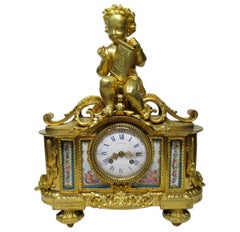
French Ormolu Bronze Sèvres Porcelain Mantle Clock Vincenti et Cie, Paris
Located in Dublin, Ireland
A fine early to mid-19th century French Ormolu and Porcelain Mounted mantel (fireplace) Clock of outstanding Quality and impressive proportions. Eight-day duration movement, striking...
Category
French Antique Late 18th Century More Clocks
Materials
Bronze, Ormolu
$2,645 Sale Price
24% Off
H 15.75 in W 13.5 in D 5.5 in
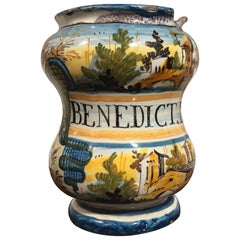
18th Century Italian Waisted Albarello
Located in Stamford, CT
An Italian Baroque Castelli albarllo, also known as a pharmacy or drug jar. It held 'Benedict Laxat' listed as far back as Aristotle as a medication used in by midwives. Beautifully decorated with buildings in landscapes in the free, almost impressionistic style typical of Castelli Maiolica...
Category
Italian Baroque Antique Late 18th Century More Clocks
Materials
Ceramic
Late 18th c Scottish Mahogany Tall Clock by Ebenezer Anderson, Auchtermuchty
Located in Milford, NH
A fine Scottish inlaid mahogany tall clock by Eben (Ebenezer) Anderson, Auchtermuchty, with a swans neck split pediment top with brass rosettes and ball & spire finial, and pierced f...
Category
Scottish Georgian Antique Late 18th Century More Clocks
Materials
Brass
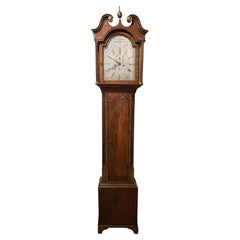
$4,400
H 88 in W 18 in D 9.38 in
Late 18th Century Louis XVI Period Bronze Ormolu Mantel Clock with Candelabras
Located in Casteren, Noord-Brabant
A finely bronze fire-gilded ormolu mantel clock set with matching candelabras. Rich ornate with typical Louis XVI mounts, floral garlands, scr...
Category
French Louis XVI Antique Late 18th Century More Clocks
Materials
Carrara Marble, Bronze, Ormolu, Enamel
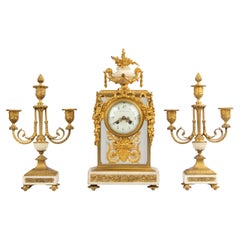
$5,020
H 16.54 in W 8.27 in D 5.12 in
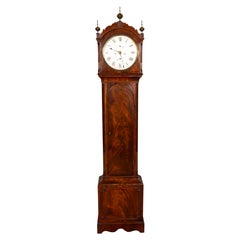
Regency Mahogany Tall Case Clock By W. Ashford, London
Located in Essex, MA
With arched bonnet with brass finials over a convex glass bezel opening to a steel clock face. Newly cleaned and put in ready to go condition. The case with pendulum door. Weights, k...
Category
English Regency Antique Late 18th Century More Clocks
Materials
Brass, Iron
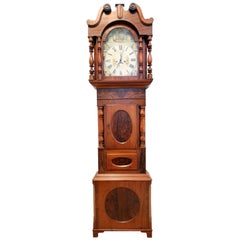
Tall Case Clock, Bristol, England, circa 1830, Victorian
Located in Darmstadt, DE
The case of the grandfather clock is made of mahogany and was possibly made by the watchmaker Nathaniel Edgecombe. The clock is from Bristol England, circa 1830.
+ The ship in the d...
Category
English Early Victorian Antique Late 18th Century More Clocks
Materials
Nutwood, Spruce
$6,932 Sale Price
34% Off
H 92.52 in W 25.2 in D 10.24 in
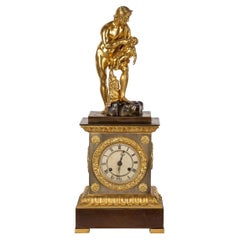
19th Century French Empire Style Bronze Mantel Clock, circa 1870
Located in Royal Tunbridge Wells, Kent
Antique 19th century French Empire style gilt bronze mantle clock. The foliate and fruit engraved gilt-brass dial with enamel painted roman numerals. Inside with eight day movement w...
Category
French Empire Antique Late 18th Century More Clocks
Materials
Brass, Bronze, Enamel
$4,242
H 20.87 in W 8.27 in D 5.91 in
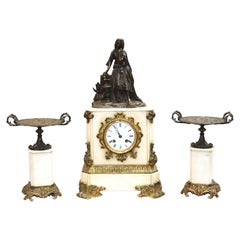
French Empire Marble Ormolu Mantle Clock Set Bronze Figurine
Located in Potters Bar, GB
- Gorgeous French Empire antique clock set
- Mantle clock is flanked by two bronze urns on pedestals
- Clock is surmounted by bronze fem...
Category
Vintage Late 18th Century More Clocks
Materials
Other
$671 Sale Price
30% Off
H 19 in W 10 in D 6 in
19th Century Louis XV Style Mantel Clock
Located in Belmont, MA
Unique French 19th century mantel clock.
This exquisite mantel clock has a Sevres porcelain dial plate and other Sevres porcelain decorations.
The movement with spring suspension. ...
Category
French Louis XV Antique Late 18th Century More Clocks
Materials
Ormolu

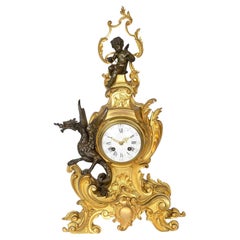
19th Century French mantel clock
Located in Brighton, Sussex
A very good quality late 19th Century French gilded ormolu and patinated bronze mantel clock, having a seated cherub holding the rains of a winged dragon pulling a scrolling foliate ...
Category
French Louis XVI Antique Late 18th Century More Clocks
Materials
Ormolu
French 19th Century Mantle Clock
Located in Brighton, Sussex
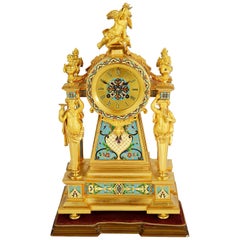
A very good quality French late 19th century gilded ormolu and champleve enamel mantel (fireplace) clock. Having urns and a cherub above the eight day clock that chimes...
Category
French Louis XVI Antique Late 18th Century More Clocks
Materials
Enamel, Ormolu
Classical 19th Century French Enamel Mantel Clock
Located in Brighton, Sussex
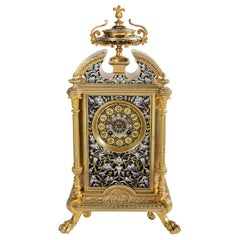
A very good quality late 19th century French Louis XVI style gilded ormolu mantel clock. Having a broken arch pediment with a twin handled urn to the centre. The inset champlevé enam...
Category
French Louis XVI Antique Late 18th Century More Clocks
Materials
Enamel, Ormolu
Previously Available Items
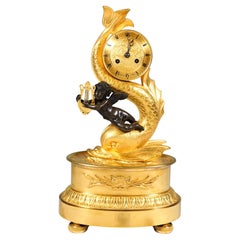
French Ormolu Mantle Clock, Pendule
Au Dauphin
, Paris, Around 1800/1830
Located in Vienna, AT
Exquisite fire-gilded Empire bronze mantel clock: Structure in the form of a tall oval, stepped base with lotus leaf relief, standing on four tubular feet with side engraving, with a...
Category
French Charles X Antique Late 18th Century More Clocks
Materials
Bronze
H 20.87 in W 14.57 in D 5.71 in
George III Chinoiserie Tall Case Clock, Faux Bois, 18th Century, Tall Case
Located in Manhasset, NY
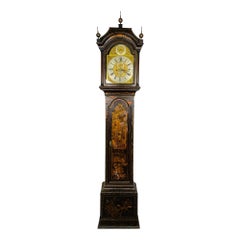
George III Chinoiserie Tall case clock, Grandfather Clock, Faux Bois, 18th Century,
Finest Chinoiserie Tall Case Clock. Stunning 18th Century pedimented bonnet top with finials. A...
Category
English Chinoiserie Antique Late 18th Century More Clocks
Materials
Metal
Elegant Balloon Bracket Clock by Payne, London
Located in Lincolnshire, GB
An 8 day ebonised ballon bracket clock by Payne, London. The silvered dial with the original elegant heart shaped hands.
The elegant case has an unusual moulded tunnel design to the...
Category
English Georgian Antique Late 18th Century More Clocks
Materials
Wood
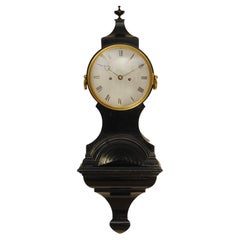
Mantel Clock 18th Century Louis XV Period by Merra À Paris
Located in Warsaw, PL
Mantel clock 18th century Louis XV period By Merra À Paris.
The clock is in excellent and perfect working condition. In addition, it was recently cleaned and serviced by a professio...
Category
French Louis XVI Antique Late 18th Century More Clocks
Materials
Bronze
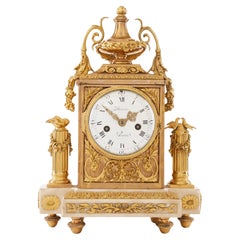
Aaron Willard Mahogany Tall Case Clock with Moon Phase Dial 1793
Located in Milford, NH
A fine mahogany tall case clock with wonderful proportions by Aaron Willard (1757-1844), with a reticulated carved crest with three ball and spire finial...
Category
American Federal Antique Late 18th Century More Clocks
Materials
Brass
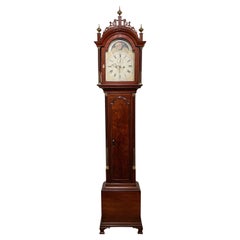
The Clock is in a Excellent and Perfect Working Condition, Also it Has Recently
Located in Warsaw, PL
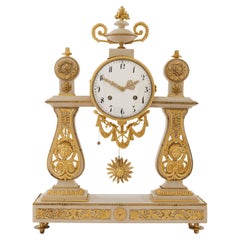
Portico clock signed “Persevalle à Reims”
This refined portico clock crafted in transitional Louis XVI – Empire style from ormolu and black marble is signed on the dial “Persevalle à Reims”. The Empire style was based on elements of the Roman Empire and its culture, which had been rediscovered starting in the eighteenth century. Bronze was the main material used in Empire style timepieces and both the patina and ormolu techniques were vastly used for ornamentation during this period. As for the source of inspiration for decorative motifs of Louis XVI style, it was coming from nature and antiquity thus many characteristic elements would reoccur in architecture, interior decoration and furniture. Many ornaments were borrowed from flora, and this love for nature appeared into decoration by the presence of a wreath of roses, baskets, palmettes, bows and ribbons.
The portico clock is mainly crafted from black marble and ormolu bronze embellishments, which with their minimalistic touch compliments one another. As mentioned before, the source of inspiration for this portico clock derived from antiquity. The columns which are a key feature of portico clocks are constructed in Greco-Roman architecture. The two front black pillars are made in Tuscan style with gilded capital and base, they are also entwined with an acanthus spiral around the pillar. The back columns, in contrast to the front one, are square and has only a face adorned with a gilded bronze floral garland. The four columns are connected on top with an entablature with a cylinder-shaped dial in the middle cast from bronze. The entablature is adorned on both sides with gilded lyres and flower vases.
The dial of the clock is signed ‘Persevalle à Reims’ and consists of blue Breguet-style hands that indicate hours laid out in Roman numerals and minutes in Arabic numerals on the enamel dial. The Breguet hands have a circle with a filled crescent shape on the side and have been featured its founder's watch hands for over two centuries now. This unique shape is sometimes referred to by the French word for apple, pomme.
Above the dial is situated a small black marble plinth and a marble medicis vase...
Category
French Louis XVI Antique Late 18th Century More Clocks
Materials
Marble, Bronze
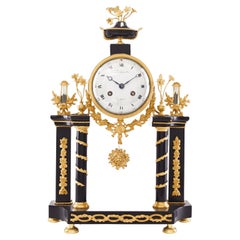
H 18.9 in W 12.6 in D 4.34 in
Mantel Clock 18th Century Louis XVI Period by Arnoux À Paris
Located in Warsaw, PL
This elegant portico clock crafted in transitional Louis XVI – Empire style from ormolu, white and black marble, is signed on the dial “Arnoux à Paris”. Decorative motifs of Louis XV...
Category
French Louis XVI Antique Late 18th Century More Clocks
Materials
Marble, Bronze
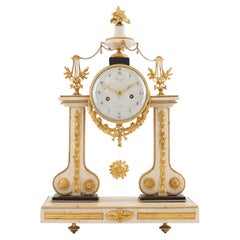
Mental Clock Lepatue a Paris
Located in Warsaw, PL
Antique French Louis Philippe style gilded bronze mantel clock from early 19th century, signed on the dial Lepaute à Paris. This clock is uniquely beautiful in that it combines true ...
Category
French Louis XVI Antique Late 18th Century More Clocks
Materials
Bronze
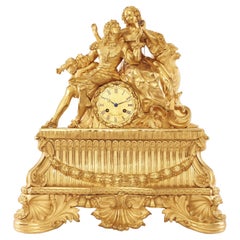
Mantel Clock 19th Century Styl Empire by Verdiere À Paris
Located in Warsaw, PL
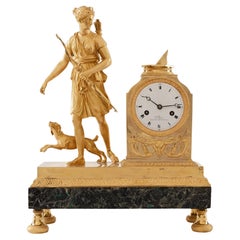
Profiled and finely chiselled disc feet with a tapered attachment. Rectangular green marble base with a palmette profile on top and a finely gilded, shiny base zone, with Diana walki...
Category
French Empire Antique Late 18th Century More Clocks
Materials
Marble, Bronze
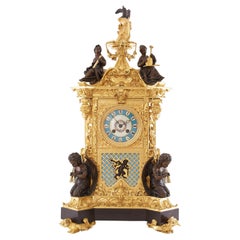
Mantel Clock 18th Century Louis XV Period
Located in Warsaw, PL
The mantel clock is composed of a tall rectangular case with a break arch above which is topped by a patinated bronze bird. At the centre of the case is a circular dial with Roman nu...
Category
French Louis XVI Antique Late 18th Century More Clocks
Materials
Bronze
Mantel Clock 18th Century Directoire Period by Tourtay a Rouen
Located in Warsaw, PL
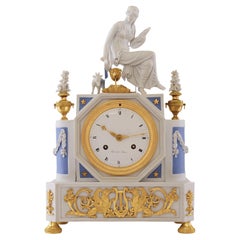
A rare white and bleu bisque "borne" clock depicting a sitting spinner on top. The large white enamle dial and the refined gilded bronze decoration.
Paris, factory of Nast circa ...
Category
French Louis XV Antique Late 18th Century More Clocks
Materials
Bronze
Mantel Clock 18th Century Louis XVI
Located in Warsaw, PL
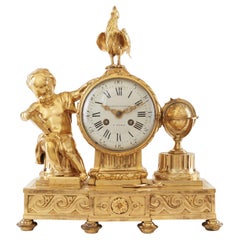
The enamel dial with Roman hours and Arabic minutes signed Ferdinand Berthoud, pierced gilt hands , the case surmounted by a cock on top, with a bronze putto seated on books on one side and the globe on the other. The base with foliate bosses and panels of entrelac centred with acanthus, on toupie feet. Berthoud is considered one of the fathers of the marine chronometer. He became a master clockmaker in Paris and was appointed clockmaker to the French king and navy. One version of an equation clock...
Category
French Louis XVI Antique Late 18th Century More Clocks
Materials
Bronze
More Ways To Browse
Chess Timer
Excelsior Pocket Watch Antique
Excelsior Pocket Watch
Gosselin Clock
Green Horn Clocks
Harrison Clock
Jeco Japan
Jewel Encrusted Watch
Mechanical Gear Clock
Mondrian Clock
Peter Max Ashtray
Vintage Waltham Wall Clock
Waltham 8 Day Clock
William Barrow
Wristwatch In Spanish
3573 Patek
Antique Clock With Gears
Asser And Sherwin