Revival Clocks

to
22
112
1
5
82
25
1
16
5
4
3
1
1
2
3
1
463
371
355
269
255
248
213
187
175
121
109
71
46
36
34
23
16
11
96
64
39
33
19
72
34
103
63
14
9
5
Height
to
Width
to
113
113
113
3
2
2
2
2
Style: Revival
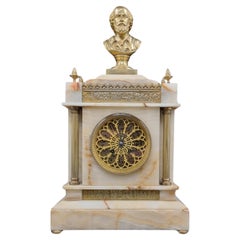
Antique French Mantel Clock in Gilt Brass Marble, 19th century Eclecticism
Located in Esbjerg, DK
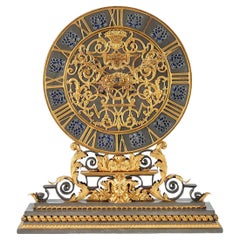
Ornate mantel clock in ormolu gilt brass upon a marble base. Extensive details: guarding eagles, center code of arms, Roman numerals, partially pierced and engraved hands upon a star...
Category

Early 20th Century European Revival Clocks

Materials

Marble, Gold Plate, Brass

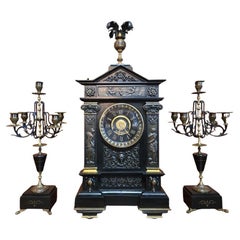
19C French Mantle Clock with Candelabra Garnitures by J. Marti (Paris)
Located in Dallas, TX
PRESENTING A STUNNING Mid 19th Century French Slate & Bronze Mantel Clock by Marti with pair of slate and bronze candelabra’s as garnitures. This ‘large’ mantle clock, was made circ...
Category

Mid-19th Century French Antique Revival Clocks

Materials

Slate, Brass, Bronze

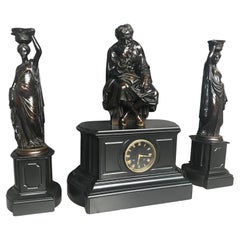
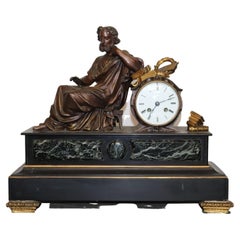
Rare Bronze Black Marble Clock Set by Deniere A Paris the Philosopher, c.1860
Located in Lisse, NL
Rare & fabulous Antique Napoleon lll clock garniture with incredible quality bronze sculptures. You will rarely see a clock garniture with bronzes of this quality and detail. The bearded thinker/philosopher on top of the marble clock is simply astonishing. His natural poisture, his hair, face and hands, but also his clothes, it is all of a quality and detail that only a master sculptor can achieve. And the patina also is just perfect. The philosopher is marked on the back and it reads 'BE x'. The two bronze female (classical maiden) sculptures are in fact two stunning candle holders and they too stand on beautifully shaped black marble bases with cartouches. These majestic candle holders are marked on the sides 'L.V.E. ROBERT' (Louis Valentin Elias Robert) and on the back they read 'AD x'. The black marble clock comes with a circular dial face with gilt Roman numerals and this clock has a well working movement. The movement is stamped 'DENIERE / A PARIS' and '2165'. On the bottom it reads A.Blacher and there also is a cachet with 'MEDAILLE D'OR / Paris / 1827'. If you like this one of a kind, clock set as much as we do then you will love our price. Especially, since perfect packing (in a custom made crate) and worldwide delivery from our store to your door in just 4 days are complimentary. Maximum clock height x width x depth: 22 x 17 x 8.5 inches. The large figure candle holders...
Category

Mid-19th Century French Antique Revival Clocks

Materials

Marble, Bronze

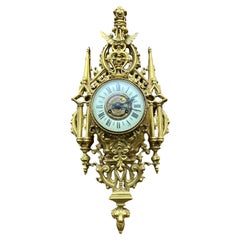
Rare Antique Gothic Revival Gilt Bronze Wall Cartel Clock with Griffin Sculpture
Located in Lisse, NL
Stunning and perfect running Gothic architectural design bronze wall clock, from circa 1880. If you like rare antiques in general and one of a kind clocks in particular then this handcrafted specimen for wall mounting could be the perfect addition to your collection or Gothic (inspired) interior. This fine quality antique...
Category

Late 19th Century French Antique Revival Clocks

Materials

Brass, Bronze

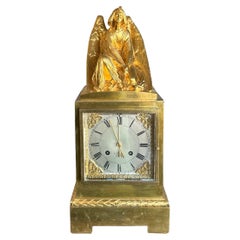
Gilt Bronze Gothic Revival Table Clock w. Earth Angel Sculpture by Devaulx Paris
By devaulx
Located in Lisse, NL
Rare and wonderful antique clock from the early 1800s. Marked: S. Devaulx, Paris. Having an impressive, stylish and sizable antique clock like this gracing your mantel piece or sid...
Category

Early 19th Century French Antique Revival Clocks

Materials

Brass, Bronze

Jaeger-LeCoultre Gilt Brass Desk 8 day Clock, Mid-Century 1950s–60s
Located in Las Vegas, NV
LeCoultre, Ref. 5501, Swiss. Made circa 1960s. A fine and rare brass half-hour and hour striking 8-day going desk clock. Jaeger-LeCoultre Gilt Brass Desk Clock, An elegant mid-cent...
Category

1960s Swiss Vintage Revival Clocks

Materials

Brass

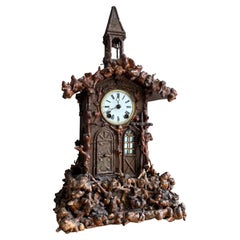
Rare Folk Art Black Forest Root Wood Table Clock w. Bell Ringer Monk, Cuckoo St.
Located in Lisse, NL
Rare and great folk-art workmanship mantel clock for the collectors and enthousiasts. Over the years we have had the pleasure of owning and selling a number of beautiful Black Forest antiques, but never did we come accross a 19th century Black Forest, Folk Art table clock of this design and subject matter and with such amazing natural organic details. This small church or chapel-like 'clockhouse' is entirely handcrafted out of all kinds of wood, but the most eye-catching is ofcourse the organic root wood. Each piece is like an abstract sculpture and depending on how you see things, they may look like one thing to you, but like something completely different to the next person. Because of all the natural materials that were used this small church has a stunning organic look and feel, but what really takes it to another level is the bell striking mechanism. Every six hours the church bell will ring many times, the door on the left will open at every 'strike', revealing the original monk sculpture inside (as shown in the attached video in this listing). With the hand carved crucifix on the right side being made of the same color and materials, it totally blends in with the entire organic design of this Christian antique. Over the many decades this good size and rare antique clock has also grown the most amazing patina and with the natural beauty and unique artisanship that it radiates people will want to stop and study its uniqueness. This work-of-art-table-clock comes with a single day clock mechanism, protected from dust by the original 'back door'. It runs and strikes perfectly and comes with an antique key for winding it. Apart from a few minor imperfections, this rare antique is in excellent condition, which makes it perfect for lovers of unique and rare clocks in general and for Black Forest and Christian Folk Art collectors in particular. Mind you, our fair price for this sizable antique cuckoo clock...
Category

19th Century German Antique Revival Clocks

Materials

Brass, Iron

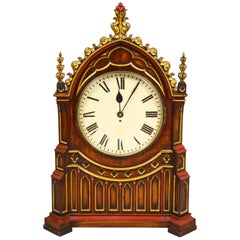
English Gothic Fusee Clock
Located in Greenwich, CT
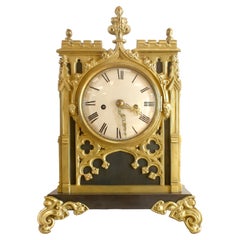
Very fine English early to mid-19th century Gothic clock of important scale having carved and gilt pediment and polychrome decorated case with trefoil tr...
Category

Mid-19th Century English Antique Revival Clocks

Materials

Oak

Fine French Verdi Marble and Bronze Mantel Clock of an Enrobed Wise Old Scholar
Located in Swedesboro, NJ
This fine French Verdi marble and bronze mantel clock, circa late 19th century, is a remarkable example of neoclassical artistry and precision timekeeping. The piece features a beaut...
Category

1920s French Vintage Revival Clocks

Materials

Marble, Slate, Bronze

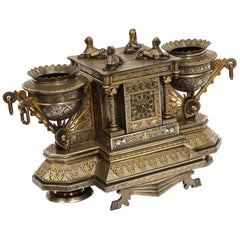
Rare Important Spanish Damascene, Iron, Steel, Gold Inlaid Clock, Eibar, Spain
By Plácido Zuloaga 1
Located in Queens, NY
A highly rare and important Spanish damascene, "Egyptian Revival" iron, steel, gold, and silver inlaid clock, circa 1900 Exceptional quality, damascened in gold and silver inlay. Measures: 10" high x 16" wide x 9" deep. Definitely made by one of Placido Zuloaga...
Category

Early 20th Century Spanish Revival Clocks

Materials

Steel, Iron

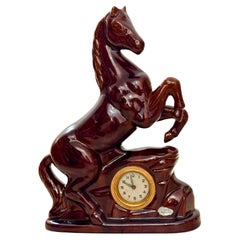
Scheurich Greulich Ceramic Horse Figurine Desk Clock Labeled S&G Keramik
Located in Torquay, GB
Delightful and rare Scheurich & Greulich Keramik horse figurine desk clock labeled S&G Keramik Germany. Both 'Ks' on the silver foil Keramik label has red rings indicating this is a ...
Category

Mid-20th Century German Revival Clocks

Materials

Steel

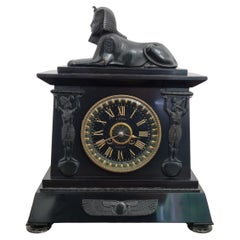
19th Century Egyptian Revival Mantel Clock by D. Munsey of Cambridge
Located in Hoddesdon, GB
A fine Egyptian Revival mantel clock retailed by D. Munsey of Cambridge, circa 1880s, black marble and slate clock case with elaborate bronze mounts. The architectural case is surmo...
Category

19th Century British Antique Revival Clocks

Materials

Belgian Black Marble, Slate, Bronze

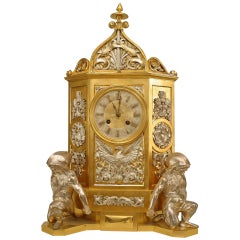
Gothic Revival Gilt Mantel Clock
Located in Queens, NY
English Gothic Revival style (19th Cent) gilt mantle clock with silver plate decoration and supported by 2 gnome figures with a pediment having a fi...
Category

19th Century English Antique Revival Clocks

Materials

Metal

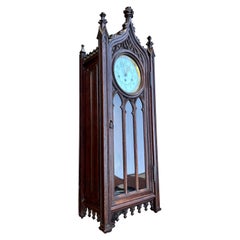
Large and Hand Carved Gothic Revival with Carillon Sound Wall Clock, ca 1900
Located in Lisse, NL
Stunning clock for the collectors of rare and truly stylish Gothic antiques. Gothic wall clocks are a rare find and this more than three feet tall specimen probably is the best an...
Category

Early 20th Century French Revival Clocks

Materials

Brass, Enamel, Wrought Iron

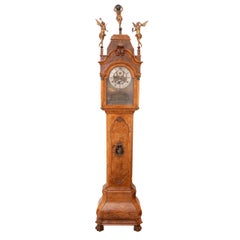
Amsterdam Burl long case clock . Wuba Warmink 1960s
By J. P. Kroese 1
Located in Den Haag, NL
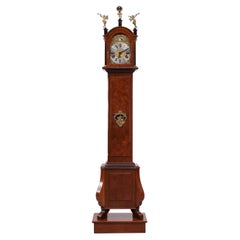
Beautiful Amsterdam long case clock Wuba/Warmink - Period 1960. This clock has a well-functioning 8-day movement westminster percussion with quarter-hourly striking mechanism on gong rods. Beautiful brass dial with engraved bar. In the arch of the dial is the silver-plated working moon phase. The silver-plated dial has Roman numerals and is in good condition. Around the chapter ring, in the corners, you will see figures cast in bronze that depict the seasons. The cabinet is veneered in burl walnut and has a nice warm colour. The whole stands on a burl walnut veneered plateau which is also in good condition. Both sides of the hood are fitted with openwork windows, covered with fabric on the inside. On top of the hood of this clock are cast brass angels with trumpets on the left and right and in the middle is the figure Atlas...
Category

1960s Dutch Vintage Revival Clocks

Materials

Burl

French Egyptian Revival Patinated Bronze and Marble Mantle Clock
Located in Bronx, NY
The clock having domed trapezoidal case, dome with bronze relief to front depicting a partial gilt Egyptian goddess, Isis, flanked by cobras and lotus scrolls, red marble ribbed columns to sides, clock face with gilt egg-and-dart border, gilt hands and mounts, clock face engraved BIGELOW KENNARD & CO. BOSTON, double-barrel clock movement by Achille Brocot, down to chained sphinx protruding from lower case, raised on stepped plinth. This vintage mantle clock...
Category

Late 19th Century American Antique Revival Clocks

Materials

Marble

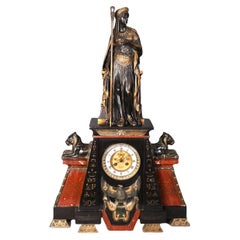
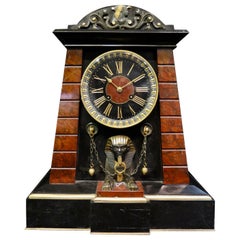
Neo-Egyptian Marble Clock Attributed to G. Servant, France, Circa 1870
Located in PARIS, FR
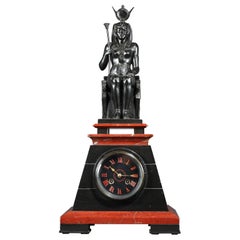
Black and red marble pyramid shaped Egyptian style clock attributed to G. Servant, surmounted by a patinated bronze figure representing the Egyptian goddess Isis sitting on her throne. Wearing the Hathor hairdress (the solar disc surrounded by the sacred cow horns), she holds in her right hand the Ouadj, the goddesses scepter surmounted by a canopy of papyrus, symbolizing health and eternal youth and in her left hand, the cross of life Ankh, symbol of rebirth and eternity. That Egyptian style in fashion since Napoleon the First and his military campaigns in Egypt around 1799 was rediscovered in France in the 1830's and above all in the 1860's. Some renowned French artists, such the sculptors and bronze-casters Guillaume Denière (1815-1903), Emile Hébert (1828-1893) et Georges Servant (1828-1890), presented at the 1867 and 1878 Paris Universal Exhibitions, an a-part section dedicated to their Egyptian style production. Their shows drew then considerable attention from the public and the wealthy collectors. During the 1867 Universal Exhibition, one could admire the Stand realized by the French silversmith-jeweller Gustave Baugrand (1826-1870), where his works executed in most Fine materials took inspiration from the Egyptian Antiques, exhibited then in the Louvre museum. Georges Emile Henri Servant (1828-c.1890), who took over his father in 1855 at their foundry, rue Vieille-du-Temple, in Paris, specialized in the production of neo-Egyptian style clocks, very popular in France since 1860’s, and also the making of Greek style decorative objects. He drew considerable attention to the high quality of his bronzes at the 1855 Paris Universal Exhibition and then at the 1862 London Exhibition. At this time Servant exported up to 40% of his production, principally to the United States, where for instance, his clocks were sold with great success by Louis Tiffany Inc. or Hamann & Roche of New York. But his success came really at the 1867 Paris Universal Exhibition, where he was awarded a gold medal for his neo-Greek and Egyptian works (Les Merveilles...
Category

1870s French Antique Revival Clocks

Materials

Marble, Bronze

Morris and Co, In the style of, An Aesthetic Movement Gilt Marble Mantle Clock
Located in London, GB
Morris and Co, In the style of, An Aesthetic Movement noir belge and red Marble gilded mantle or bracket clock with an important Gay Vicarino & Co French...
Category

Mid-19th Century British Antique Revival Clocks

Materials

Marble, Belgian Black Marble

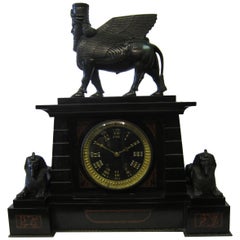
Egyptian Revival Bronze and Marble French Mantle Clock
Located in Bronx, NY
This wonderful 1920s Egyptian Revival clock is surmounted with an Assyrian style lamassau (human headed winged lion) and flanked by a pair of re...
Category

Early 20th Century French Revival Clocks

Materials

Belgian Black Marble

E. F. Caldwell Renaissance Revival Clock
Located in New York, NY
Gilded and Patinated Bronze Mounted Renaissance Revival Mantel Clock with blue enamel detail This highly ornamented clock from the renowned E.F. Caldwell company is an incredible ex...
Category

Early 20th Century American Revival Clocks

Materials

Marble, Bronze, Enamel

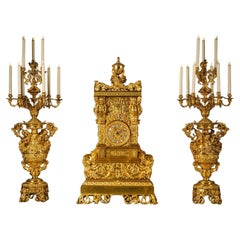
Second Empire Gothic Cathedral Clock and Garniture
By Pierre-François Feuchère
Located in Vancouver, British Columbia
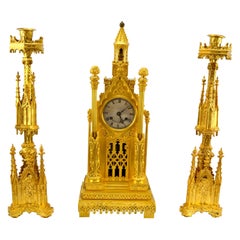
A mid 19 century French Gilt Bronze Gothic style mantel clock and garniture which the French call " A la Cathedrale". The three pieces are of finely chased and gilded bronze; the cl...
Category

Mid-19th Century French Antique Revival Clocks

Materials

Bronze

A Monumental Renaissance Revival Clock Garniture, Attributed to Feuchère
Located in Brighton, West Sussex
A Large and Important Louis Philippe Period Gilt-Bronze Three-Piece Clock Garniture. Attributed to the Feuchère family. The clock movement by Hémon. In the Renaissance revival style. Comprising a clock and a pair of nine-light candelabra. The clock case of architectural out-shape with cherubic term figures supporting a rectangular pediment centred by an urn. The sides of the clock tower cast in relief with strapwork and foliage. The dial inset with enamel Roman numeral chapters. The twin-barrel clock movement with tic-tac escapement, silk suspension and countwheel strike to bell. Pendulum and winding key. The candelabra as twin-handled vases supporting tiered branches with candle nozzles. Modelled en suite with naturalistic scrolls and foliage. Surmounted by finials modelled as an eagle toying with a serpent. The scrolled handles flanked by cherubic figures and serpents. The bodies fronted by bacchic masks and supported on socles bearing angels. France, Circa 1835. The clock movement signed ‘HEMON A PARIS’. The clockmaker Claude Hémon was established at rue de St. Martin circa 1810-1820. Dimensions, the clock: Height : 106 cm 42 inches Width : 58 cm 23 inches Depth : 38 cm 15 inches Weight : 72 kg Dimensions, the candelabra: Height : 104 cm 41 inches Width : 36 cm 14 inches Depth : 36 cm 14 inches Weight : 28 kg (each) This magnificent clock garniture of palatial size is designed in the Renaissance revival style and dates to the Louis Philippe period. Executed in sculptural gilt-bronze with leaves, scrolls, masks and exotic birds, the naturalistic ornament represents an elaborate system of allegories and mythological iconography which recall the influence of Italian Mannerist art in France. The distinctive design reflects a new style which replaced the neoclassism of the French Empire period. With the fall of Napoleon Bonaparte, artists and designers sought a new decorative vocabulary with which to aggrandise the Bourbon restoration. With the French revolution and Louis XVI’s execution still within living memory, it seemed too soon for a revival of the style of the Grand Siècle. Instead they looked further back to the time of François I, whose patronage of Italian artists had brought the Renaissance to France. The idea of a renaissance revival appealed to the new Bourbon monarchs and their patronage ignited great creativity in the arts. The reigns of Louis XVIII and Charles X, who were brothers of the late King, Louis XVI, and later of Louis Philippe I, nicknamed the Citizen King, coincided with the enlightenment and the dawn of the industrial age. Great technical progress was made in metallurgy and casting which raised the art of bronze making to new heights in the hands of great masters such as Pierre-Philippe Thomire (1751-1843) and Pierre- Jean-François Denière (1774-1866). The renaissance provided a rich and varied source book in architecture, furniture and other decorative arts for designers such as Claude Aimé Chenavard (1798-1838) whose Album de l’ornemaniste (1835) became a reference work. Léon Feuchère (1804-1857) also produced drawings of interiors, silver, bronzes and furniture and was a scion of the prominent family of bronze castors established by his grandfather Pierre-François Feuchère (1737-1823) who had worked as a gilder for the bronze caster Pierre Gouthière before setting up a bronze foundry that would become one of the largest in Paris under the management of his son Lucien-François (d. 1841) and grand-son Armand (1797-1866). A number of drawings by Léon Feuchère have recently been discovered by the Rijksmuseum and probably belonged to the collection of Louis-Philippe-Albert, duc d’Orléans, comte de Paris (1838-1894). Louis-Philippe-Albert was the grandson of the French king, Louis-Philippe I (1773-1850), who granted him the title of comte de Paris, and the son of Ferdinand-Philippe, duc d’Orléans (1810-1842). Ferdinand-Philippe was an important collector and sponsored many young artists to create metalwork objets d’art, notably a celebrated surtout de table made by Claude-Aimé Chenavard and Jean-Jacques Feuchère (1807-1852), a cousin of Armand and Léon. Principally remembered as a sculptor, Jean-Jacques Feuchère trained in the family foundry and designed small objects, cigar boxes...
Category

Early 19th Century French Antique Revival Clocks

Materials

Bronze

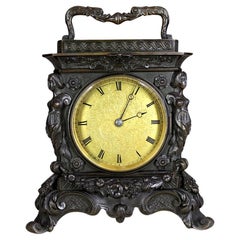
A Unique Twin Fusee English Carriage Clock by James Moore French
Located in Amersham, GB
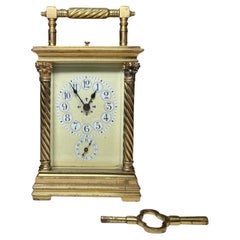
A one of a kind english twin fusee carriage clock by James Moore French. The eight day movement has a large English jewelled level escapement with compensated bimetallic balance. The movement is wound and set through a round glazed door at the back and can be regulated from the outside as the fast/slow arm extends through the back of the case with rack striking the hour and half hour on blued steel gong with trip repeat. The gilt dial is signed as is th back plate of the movement, the centre of the dial is engraved with foliate scroll work with a roman chapter and breguet style moon hands. The unusual case of case bronze in a rococo revival style is finely chased with fluted sides flanked by Cariatids with a swag of fruit and flowers strung between them, th handle is formed of two dolphins. James Moore French was born in 1781 in County Antrim, Ireland. He was the son of Dr Hugh French and Sarah (née Arundel) French who married his father in 1763 and died in 1783, two years after James’s birth. In 1784, the year after Sarah’s death, Dr Hugh French married a widow named Judith Woodward who was to raise the young James French as her own, alongside his own and his half siblings. As a young man, James French moved from Ireland to London, where he worked with a relative, Peter Moore...
Category

19th Century English Antique Revival Clocks

Materials

Brass, Bronze, Steel

Parmigiani Fleurier, Nubia , Extremely Fine, Unique 18k Pink Gold Pocket Watch
Located in London, GB
Parmigiani Fleurier, 'Nubia' - an extremely fine and unique 18K pink gold pocket watch Swiss, Early 21st Century Measures: Height 9cm, width 6.5cm, depth 1.5cm Open: height 9.5cm,...
Category

Early 2000s Swiss Revival Clocks

Materials

Onyx, Gold

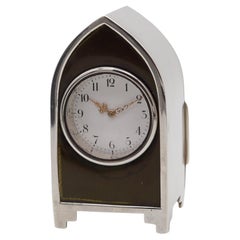
Carriage clock with case. 19th century
Located in Madrid, ES
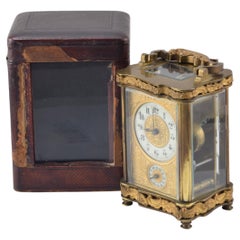
Travel clock with case. Metal, glass, leather, etc. XIX century. Case with lid at the top and front with a transparent glass sheet, upholstered on the inside, containing a travel cl...
Category

19th Century European Antique Revival Clocks

Materials

Metal, Other

Large Antique French Ormolu Bronze Mantel Clock with Musical Design Motif
Located in Madrid, ES
A true museum piece, this beautifully sculptural clock could easily find its home in a traditional environment, or be a functional and explosive counterpoint to a minimalist interior...
Category

19th Century French Antique Revival Clocks

Materials

Metal, Enamel, Ormolu

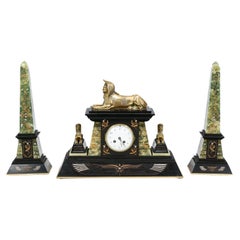
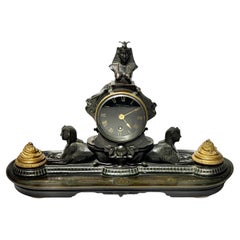
19th Century Egyptian Revival Green Onyx and Bronze Garniture Mantle Clock
Located in Dublin 8, IE
19th Century Egyptian Revival green onyx and bronze garniture mantle clock with two obelisks, with the clock mounted and flanked by ormolu sphinxes and all parts of the set featuring...
Category

19th Century European Antique Revival Clocks

Materials

Onyx, Bronze, Ormolu

Monumental 19th Century Ormolu Mounted Onyx Marble Longcase Grandfather Clock
Located in Los Angeles, CA
A monumental architectural French 19th century neoclassical Revival gilt bronze mounted beige and red onyx longcase grandfather clock. The very impressive clock-case surmounted by a figure of seated Classical male figure...
Category

Early 1900s French Antique Revival Clocks

Materials

Onyx, Marble, Bronze

Antique Gilt Bronze and Champlevé Enamel Clock Set
Located in London, GB
This beautiful clock set, which comprises of a mantel clock and a pair of vases, was designed in France in circa 1870 in a wonderful Renaissance Revival style. The set has been craft...
Category

Late 19th Century French Antique Revival Clocks

Materials

Ormolu, Bronze, Enamel

Gothic Table Clock w. Stunning Antique Pocket Watch Made of Gilt Bronze or Gold
Located in Lisse, NL
Small Gothic table clock with gilt bronze (or possibly golden) pocket watch by John Worboys of London, 1780-1810. We know too little about antique ...
Category

Early 1800s British Antique Revival Clocks

Materials

Metal, Bronze

Egyptian Revival Mantel Clock, 19th Century
Located in SAINT-OUEN-SUR-SEINE, FR
Mantel clock in patinated and gilt bronze, with red and black marble, in the Egyptian Revival style of the 19th century. The composition features a standing female Egyptian figure h...
Category

19th Century French Antique Revival Clocks

Materials

Marble, Bronze

19TH C. Louis XVI Style Gilt Bronze Green Marble Rotary Clock
Located in Swedesboro, NJ
19th C. French Rotary Clock. Ormolu Mounted and Verde Antico marble rotary mantel clock on Pedestal. A fine large Louis XVI style gilt bronze mounted and verde antico marble rotary...
Category

Late 19th Century European Antique Revival Clocks

Materials

Marble, Bronze

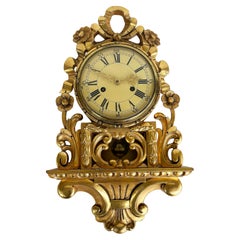
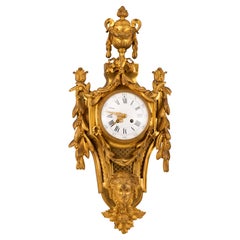
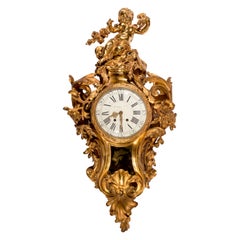
Antique French Ormolu Bronze Cartel Wall Clock, Sculptural Case with Cherub
Located in Madrid, ES
Exhibiting the fine design and craftsmanship of French clockmakers Raingo Frères (Raingo Brothers), this impressively large clock, measuring over 1 meter tall ( 3 feet +), is an example of the “Second Rococo” period beginning circa 1830, when the highly ornate "Cartel" style of the early 18th century came back into fashion. The clock is crowned at top center by the figure of a putto or cherub, holding in one hand a dove and the other a garland of flowers. This allegorical figure can represent innocence or purity, and was a popular subject for sculptors of the 19th century. The term "Cartel clock" comes from the French "Pendule à Cartel" meaning roughly "clock in a frame for the wall" - the word "Cartel" meaning in this context "decorative frame". These clocks were almost always made from gilt bronze (also known as "ormolu") and highly decorated. The clock is complete and includes a winding key, and will be checked by our specialist clockmaker to ensure it is functioning properly before shipping. Established in the early 1800s, Raingo Frères was one of the leading makers of precision clocks...
Category

Mid-19th Century French Antique Revival Clocks

Materials

Ormolu, Bronze, Enamel, Brass

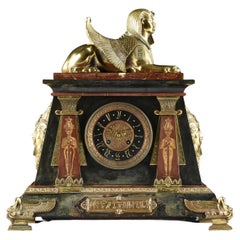
Neo-Egyptian Bronze and Marble Clock Attributed to G.Servant, France, Circa 1870
Located in PARIS, FR
A black and red marble clock in the shape of an Egyptian temple attributed to G. Servant, flanked by double columns inscribed with hieroglyphs and ornated with a winged uraeus, all made in two patina bronze. The clock is surmounted by a patinated bronze sphinx. Resting on four bronze faces wearing the nemes and terminating in lion paw feet. Georges Emile Henri Servant (circa 1828-1890) who took over his father in 1855 at their foundry, rue Vieille-du-Temple, in Paris, specialized in the production of neo-Egyptian style clocks, very popular in France since 1860s, and also the making of Greek style decorative objects. He drew considerable attention to the high quality of his bronzes at the 1855 Paris Universal Exhibition and then at the 1862 London Exhibition. At this time Servant exported up to 40% of his production, principally to the United States, where for instance, his sphinx clocks were sold with great success by Louis Tiffany Inc. or Hamann & Roche of New York (A similar clock is now exposed at the Metropolitan Museum of Art, New York). But his success came really at the 1867 Paris Universal Exhibition, where he was awarded a gold medal for his neo-Greek and Egyptian works (Les Merveilles...
Category

1870s French Antique Revival Clocks

Materials

Marble, Bronze

Large French Figurative Greek Revival Bronze Clock by Auguste Moreau
Located in New York, NY
Large antique (late 19th century) French figurative clock from the Greek Revival period depicting the goddess, Selene, after the original sculpture by Auguste Moreau (French, 1834-19...
Category

Late 19th Century French Antique Revival Clocks

Materials

Bronze

Renaissance Style Gilt Bronze and Enamel Mantel Clock
Located in London, GB
Renaissance style gilt bronze and enamel mantel clock French, late 19th century Measures: Height 53cm, width 28cm, depth 23cm This exquisite mantel clock is crafted in the idios...
Category

Late 19th Century French Antique Revival Clocks

Materials

Ormolu, Bronze, Enamel

Wall clock. Gilt bronze. France, 19th century.
Located in Madrid, ES
Wall clock. Gilt bronze. France, 19th century. Gilt bronze wall clock of the type known as a "cartel" due to its shape, featuring Parisian movement and a white dial with Roman numer...
Category

19th Century French Antique Revival Clocks

Materials

Bronze, Other

Elegant Patinated and Gilt Bronze Portico Clock Circa 1875
Located in Lambertville, NJ
An elegant neoclassical bronze portico clock. The patinated bronze with gilt bronze accents with round white porcelain dial. The four columns on each side with a plinth base at the...
Category

1870s French Antique Revival Clocks

Materials

Bronze

French Porcelain Mantel Clock by Dagoty and Honore
By Edouard Honoré 1, Dagoty
Located in London, GB
This beautiful Gothic Revival style porcelain clock was made by the prestigious French firm Dagoty and Honore, founded by the esteemed porcelain makers Pierre-Louis Dagoty and Edouard Honore...
Category

Early 19th Century French Antique Revival Clocks

Materials

Porcelain

A Novelty Desk Clock By Jaeger LeCoultre
Located in Amersham, GB
A desk clock in the shape of an Egyptian obelisk made by LeCoultre with an 8 day movement in the base, a crisp silvered dial and gilded numerals and batons set beneath a perspex obelisk. The black lacquered base has gilt mounts that continue the theme and repeat on all four sides. This is an extremely handsome small clock ideal as a gift or use as a desk clock, the dial is visible through the obelisk, the fine fully jewelled LeCoultre eight day movement is wound from the base, dating from the 1960's this mid century clock...
Category

1970s Swiss Vintage Revival Clocks

Materials

Steel

Neoclassical Style Carriage/Table Clock
Located in Guaynabo, PR
This is a Neoclassical Style Carriage/Table Clock. It depicts a gilt brass rectangular box case with Greek temple like front adorned with two Corinthian columns with a frieze above i...
Category

Early 20th Century French Revival Clocks

Materials

Brass

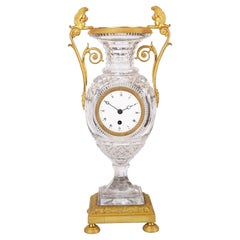
Fine Quality French Empire Baccarat Style Crystal Vase Clock, circa 1860
Located in Brighton, Sussex
A fine quality French Empire style Baccarat hobnail cut lead crystal glass two handled vase clock with ormolu-mounts, having a white enamel clock face with roman numerals and raised ...
Category

19th Century French Antique Revival Clocks

Materials

Ormolu

Tall Case Amsterdam Clock, Signed Pieter Verlaer, circa 1840-1860
Located in INTERLAKEN, NY
Tall case Amsterdam clock. Signed Pieter Verlaer, Dutch, circa 1840-1860. walnut and burled walnut. Clock has an amazing dial with three ships that mov...
Category

19th Century Dutch Antique Revival Clocks

Materials

Walnut

Large French Renaissance Revival Bronze Mounted Carved Walnut Mantel Clock
Located in Tarzana, CA
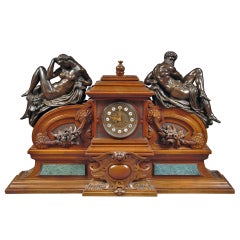
A magnificent 19th century French Renaissance Revival patinated bronze mounted carved walnut "Day and Night" mantel clock.  The dial with Roman numerals flanked by allegorical figures of night and day after Michelangelo. France, circa 1870 Maker: Victor Paillard The movement stamped: Vr. Paillard, Paris. Rodier Paris Stamp & Medaille Dor', 1837 Dimensions: Height 22" (56 cm) Width 37" (94 cm) Depth 9" (22 cm) Victor Paillard (1805-1886) designed and made various bronze decorative and functional objects including chenets, lighting and clocks. He also cast bronzes for some of the most important sculptors of the day including Barye, Carrier-Belleuse and Pradier He opened his first workshop in the 1830s at 105, boulevard Beaumarchais and 6, rue Saint-Claude and by the 1850s was employing around 100 people. His success at numerous international exhibitions including the 1851 Great Exhibition (where he displayed a bronze of the Standing Sappho after Pradier) further enhanced his reputation Day and night by Michelangelo: Though never finished, the tomb of Giuliano de' Medici in the Medici Chapel is the only one of Michelangelo great architectural-sculptural projects to be realized in a form approaching completion. Built between 1520 and 1534, it is widely held to be one of Michelangelo's most stunning achievements. The pose of the central figure on the tomb of Giuliano de' Medici, arms resting at his sides and legs comfortably apart, and its open composition suggest a cheerful Duke, generous in both mind and spirit. In fact, the figure holds in his hand several coins, as if an intended gift. Light plays freely on his beautiful face, yet the figure is lacking in energy and seems to wilt under the burden of the Roman armor...
Category

19th Century French Antique Revival Clocks

Materials

Marble, Bronze

Egyptian Revival Mantle Clock Retailed By Tiffany Company
Located in Essex, MA
A TIFFANY & CO. EGYPTIAN REVIVAL MANTLE CLOCK, AMERICAN, 1880s, a bronze ormolu and marble clock made by L. Marti et Cie for Tiffany & Company, marked on clock face, "Tiffany & Co." ...
Category

1880s French Antique Revival Clocks

Materials

Marble, Bronze, Ormolu

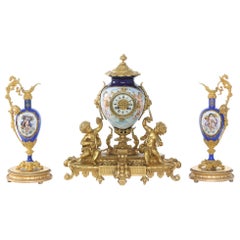
Antique French Gilt Bronze and Sevres Porcelain Clock - Fully Working
Located in Belper, Derbyshire
A highly decorative and beautifully modelled French gilt-bronze mantel clock, of elegant Louis XV Rococo revival design, surmounted by an exceptionally charming putto. Set within the...
Category

19th Century British Antique Revival Clocks

Materials

Bronze

19th Century Egyptian Revival Bronze Mantel Clock
Located in New York, NY
Antique (late 19th century) Egyptian Revival period French empire style mantel clock in bronze with dark brown patina, retailed at Brown and Rogers of Providence, Rhode Island.
Category

Late 19th Century French Antique Revival Clocks

Materials

Bronze

Unique Gothic Revival Gilt Bronze Table or Desk Clock w Rare Porcelain Plaques
By W.H. Tooke
Located in Lisse, NL
Wonderful clock for the collectors of truly stylish Gothic antiques, by W.H.Tooke, Paris. Finding this unique (Germany made) Gothic table clock again felt like a blessing. The overall design is remarkable, but the combination of the craftsmanship of the bronze components and the hand crafted and hand painted Gothic porcelain plaques is what takes this clock to the next level. Whenever you find a piece that is this good then you can rest assure that there is a maker's mark. This late 1800s work of beauty was made and marked by the prolific Parisian clock...
Category

Late 19th Century German Antique Revival Clocks

Materials

Bronze

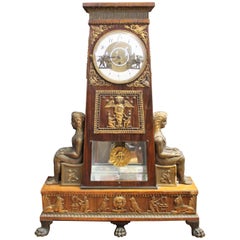
Egyptian Revival Grande Sonnerie Clock from the Biedermeier Period
Located in Hamilton, Ontario
Egyptian Revival Grande Sonnerie clock from the Biedermeier period. It features animated workmen that swing an anvil, pump bellows while making a 'clac...
Category

19th Century Antique Revival Clocks

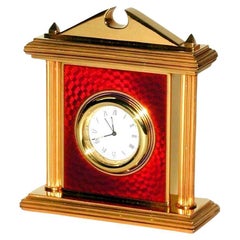
Clock Red fired enamel on guillochè, with columns in Neoclassico Salimbeni
Located in Firenze, FI
Clock Red fired enamel on guillochè, with columns in Neoclassico Salimbeni. Small gold-plated 925/1000 sterling silver table clock with translucent fired enamel on guillochè, with co...
Category

1970s Italian Vintage Revival Clocks

Materials

Sterling Silver, Enamel

Ormolu and Champleve Enamel Antique French Clock by Le Roy Fils
Located in Belper, Derbyshire
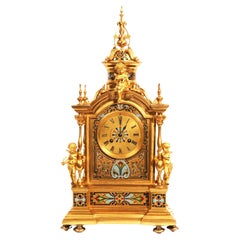
A magnificent Renaissance style clock by the renown Parisian clockmaking firm of Le Roy &Fils. Beautifully modelled in finely gilded bronze and finely decorated with exquisite polychrome champlevé enamel. The case is formed with an arched swan neck pediment surmounted by a turret with elaborate finial. To the sides are charming figures of cherubs clutching the baluster turned pillars. A third cherub is seated above the dial. The dial is also gilded bronze with champlevé enamel and is complete with original finely blued steel hands. The clock is decorated in the round with a frosted glass rear door. Please note that this type of clock does not have a glazed bezel to cover the dial. The French movement is of high quality and is by Vincenti et Cie. It is in excellent clean and running condition having been fully overhauled by our clockmaker. Pendulum is original. It runs for 8 days and strikes the hours and halves on a bell. We have a video of the clock, please ask and we will send you a link. Condition of the case is excellent, the original gilding is particularly good with only minor wear where the clock has been handled and some light marks and discolouration. The rear most bun feet are missing however the clock sits very well without them. Rear frosted glass has some marks. Enamel is very good. Established by Basile Charles Le Roy in 1785, the firm of Le Roy et Fils became a well-established and renowned clockmaker. Basile had been Napoleon's master clockmaker, and along with his son Charles-Louis, he worked for Princess Pauline and the Duke de Bourbon as well. Examples of the firm's work are included in all of the major world collections. The firm was located at the Palais Royale from 1785, the year of its founding, through the death of Charles-Louis at Versailles in 1865. A shop was opened in London, in 1854 at 296 Regent Street under the name of Le Roy and Son. The name was later changed to Le Roy and Fils...
Category

19th Century French Antique Revival Clocks

Materials

Enamel, Ormolu

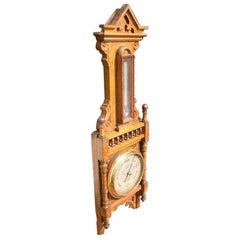
A Large Gothic Revival Carved Oak Barometer with a Rare Snail Tail Thermometer
Located in London, GB
A large Gothic Revival oak barometer with blind trefoil carved pediment, a rare snail tail mercury thermometer flanked by turned and incised uprights with sunflower carvings. A small...
Category

1880s British Antique Revival Clocks

Materials

Oak

Egyptian Revival Marble, Gilt and Patinated Bronze Three-Piece Clock Set
Located in London, GB
Attributed to Emile Herbert, French, 1828-1893. Comprising a central clock and a pair of flanking lidded vases, the clock on a red and black marble base with Pharaoh busts...
Category

19th Century French Antique Revival Clocks

Materials

Marble, Bronze

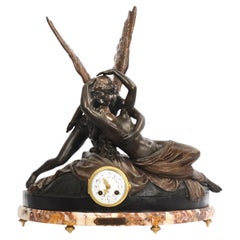
A Fine Antique French Figural Mantel Clock Amour et Psyche-After Antonio Canova
Located in Belper, Derbyshire
~ French - Circa 1890 ~ ~~ Excellent condition, fully overhauled ~~ A superb antique French mantel clock, finely cast and patinated, depicting the iconic embrace of Psyche Revived ...
Category

19th Century Unknown Antique Revival Clocks

Materials

Marble, Metal

Unique French-Style Mantel Clock With Candelabras, Early 20th Century
Located in Opole, PL
Unique French-Style Mantel Clock With Candelabras, Early 20th Century A unique French-style set with a mantel clock and two four-arm bras...
Category

Early 20th Century French Revival Clocks

Materials

Brass

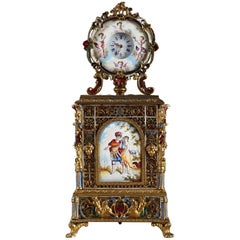
Viennese Enamel and Gilt Brass Table Clock, Mid-19th Century
Located in Paris, FR
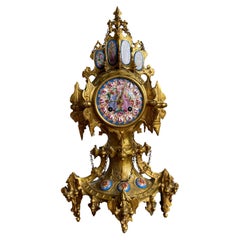
Small table clock in gilt brass richly decorated with openwork scrollwork, acanthus leaves, flowers, and masks in multicolored enamel. The main faces...
Category

1850s Austrian Antique Revival Clocks

Materials

Enamel, Brass

Gilt Bronze Eagle and Marble Ball Clock, France, circa 1900
Located in Buenos Aires, Buenos Aires
Gilt bronze eagle and marble ball clock. France, circa 1900.
Category

Early 20th Century French Revival Clocks

Materials

Marble, Ormolu, Bronze

Three Train Clock By Smith Sons
Located in New Orleans, LA
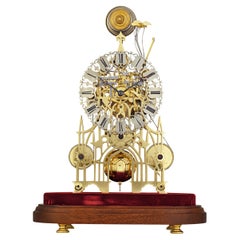
A spectacular feat of engineering and artistry, this 19th-century skeleton clock was created by John Smith & Sons of Clerkenwell. The Clerkenwell Borough of Central London has for al...
Category

19th Century English Antique Revival Clocks

Materials

Steel

20th Century Italian Silver Gothic revival Table Clock. Casting and chisel
Located in VALENZA, IT
Solid silver 800 silver neo-Gothic silver table clock. The clock was made in casting and chiselling. Mechanical mechanism
Category

1980s Italian Vintage Revival Clocks

Materials

Silver

Antique Gothic Revival Porcelain Clock by Dagoty Honoré
Located in London, GB
Antique Gothic Revival porcelain clock by Dagoty & Honoré French, c. 1830 Measures: Height 51cm, width 25.5cm, depth 17cm This beautiful Gothic Revival style porcelain clock was made by the prestigious French firm Dagoty and Honoré, founded by the esteemed porcelain makers Pierre-Louis Dagoty and Edouard Honoré...
Category

Early 19th Century French Antique Revival Clocks

Materials

Porcelain

Revival clocks for sale on 1stDibs.

Find a broad range of unique Revival clocks for sale on 1stDibs. Many of these items were first offered in the 21st Century and Contemporary, but contemporary artisans have continued to produce works inspired by this style. If you’re looking to add vintage clocks created in this style to your space, the works available on 1stDibs include decorative objects, more furniture and collectibles, serveware, ceramics, silver and glass and other home furnishings, frequently crafted with metal, bronze and other materials. If you’re shopping for used Revival clocks made in a specific country, there are Europe, France, and United Kingdom pieces for sale on 1stDibs. While there are many designers and brands associated with original clocks, popular names associated with this style include Raingo Frères, Argenteria Marchetti, Dagoty, and Giorgio Salimbeni. It’s true that these talented designers have at times inspired knockoffs, but our experienced specialists have partnered with only top vetted sellers to offer authentic pieces that come with a buyer protection guarantee. Prices for clocks differ depending upon multiple factors, including designer, materials, construction methods, condition and provenance. On 1stDibs, the price for these items starts at $380 and tops out at $250,000 while the average work can sell for $5,574.

Recently Viewed

View All