Items Similar to A 19th Century French "Pagoda" Japonisme Inkwell
Video Loading
Want more images or videos?
Request additional images or videos from the seller
1 of 18
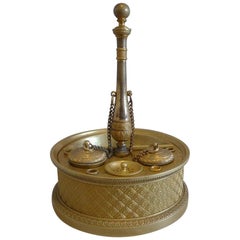
A 19th Century French "Pagoda" Japonisme Inkwell
$4,528.06
£3,372.75
€3,800
CA$6,235.50
A$6,787.19
CHF 3,596.29
MX$81,626.21
NOK 45,725.89
SEK 41,902.72
DKK 28,953.48
About the Item
A 19th Century French “Japonisme” Inkwell
Patinated and gilt bronze, very finely chizeled
Open-worked design in the Chinese Archaïc Taste of fighting dragoons
The penholders simulating fantastic animals
The gilt bronze pagoda, decorated with dragoon’s heads revealing original ink tank
Circa 1875
Numbered 216 and Impressed monogram under the base
In the manner of Édouard Lièvre (1828-1886)
“Japonisme” in the second half of the 19th century, was a craze for everything that came from Japan or imitated its style. The word was first coined in a series of articles published by Philippe Burty, from May 1872 to February 1873, in the French magazine “la Renais-sance littéraire et artistique”. Far from the academic sphere, artists seeking for new ways of expression, appropriated this discovery. Manet and the impressionists led the way to half a century of enthusiasm for Japanese art, and largely contributed to the esthetical revolution Europe experienced between 1860 and the beginning of the twentieth century.
From 1862, The World’s Fairs provoked massive arrivals of fans, kimonos, lacquers, bronz-es, silks, prints and books that launched the real era of Japonisme. With those exhibitions, the demand was boosted, the number of merchants and collectors was multiplied, and artists became passionate about this new esthetic. For them, its “primitivism” was probably its most important quality: artists were fond of the Japanese art’s capacity to be close to nature and to reconcile art and society by representing, with a lot of care, the most trivial objects.
In painting, Edouard Manet, Mary Cassatt, Degas, Van Gogh, Gauguin were among those who were deeply inspired by Japanese art, affected by the lack of perspective and shadow, the flat areas of strong color, the compositional freedom in placing the subject off-center, with mostly low diagonal axes to the background. The Japanese iris, peonies, bamboos, ki-monos, calligraphy, fish, butterflies and other insects, the blackbirds, cranes and wading birds, the cats, tigers, and dragons were endless sources of inspiration, appropriation, and reinterpretation for European artists. The occidental productions were combining styles and artistic conceptions instead of copying Japanese art slavishly. That is what brings to light the comparison between the artworks of Kitagawa Utamaro and Degas, of Katsushika Hoku-sai and Van Gogh
The World’s Fairs of 1851 and 1862 in London, those of 1867, 1878, 1889 and 1900 in Paris, of 1873 in Vienna and of 1904 in Saint Louis presented a number of “Japanese-Chinese” installations with earthenware, bronzes, screens and paintings and attracted the largest amounts of visitors In Vienna, the “Japanese village” particularly drew the atten-tion. These were reinterpretations combining elements from Japan and China, mixing them to a degree one could not differentiate between them. Interior design was equally influenced by oriental art, architects showed a keen interest in Japanese houses and furniture. Charles Rennie Mackintosh, Josef Hoffmann and Gustav Klimt were early propagators of Japonisme.
Several cabinetmakers, mostly Parisians, specialized into Japanese furniture. Gabriel Viar-dot was the leader of those producers, their oldest representative, and the one who had the longest influence.
Another important name would be the one of Edouard Lièvre. The climax of his career cor-responded to his Japanese production. While the time was at the “Neo” and at the pastiche, he stood out because of his great creativity.
The Maison Duvinage was renowned thanks- in part- to its patent of invention for a “combined mosaic”: pieces of ivory, fixed on a wood panel, are used for the background, some metal compartmentalizes them, the motifs in nacre are incrusted into the ivory to figure flowers or birds. One of the prettiest examples of furniture unit realized with this technic is today kept at the Orsay Museum in Paris.
In the field of the objects of art, the boutique Escalier de Cristal, opened at the beginning of the 19th century, had a high production, and enjoyed a great reputation. It collaborated with many craftsmen: bronze makers, cabinetmakers, lacquerware makers and painters who realized numerous decorative objects to adorn the shops.
Art Nouveau in France, Arts and Craft in England, Free Aesthetics in Brussels were all movements that were influenced by the Japanese ideal of unity in art. In the late 19th centu-ry, art dealer Siegfried Bing, being perfectly aware of the importance of the fusion of art and life in Japan, exceeded Japonisme and launched the “Japon Artistique” concept in 1888 - art as indissociable with life.
- Similar to:Edouard Lievre (Designer)Maison Marnyhac 1 (Metalworker)Gabriel Viardot (Designer)
- Dimensions:Height: 3.94 in (10 cm)Width: 11.03 in (28 cm)Depth: 6.3 in (16 cm)
- Style:Japonisme (Of the Period)
- Materials and Techniques:
- Place of Origin:
- Period:
- Date of Manufacture:circa 1875
- Condition:Wear consistent with age and use. Very nice quality and original gilding.
- Seller Location:Saint-Ouen, FR
- Reference Number:Seller: T 51391stDibs: LU2612347207272
About the Seller
4.8
Gold Seller
Premium sellers maintaining a 4.3+ rating and 24-hour response times
1stDibs seller since 2017
73 sales on 1stDibs
Typical response time: 2 hours
- ShippingRetrieving quote...Shipping from: Saint-Ouen, France
- Return Policy
More From This Seller
View All19th Century French Japonisme Inkwell attributed to L
Escalier de Cristal
By L
Escalier de Cristal
Located in Saint-Ouen, FR
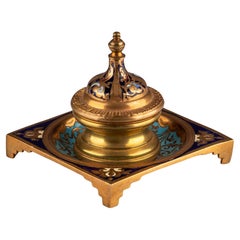
A very nice quality French Japonisme Style inkwell
Attributed to l'Escalier de Cristal, circa 1880
Resting on a diamond-shaped polychromed hand-painted porcelain tray representing l...
Category
Antique Late 19th Century French Japonisme Inkwells
Materials
Ormolu
Albert Marionnet (1852-1910), A Belle Époque Naturalistic Inkwell, circa 1900
By Albert Marionnet
Located in Saint-Ouen, FR
Albert Marionnet (1852-1910),
A Large Belle-Epoque Naturalistic Inkwell, circa 1900
In gilded and chiseled bronze with naturalistic decoration of grapevines, the green marble board ...
Category
Antique 1890s French Belle Époque Inkwells
Materials
Marble, Ormolu
$2,602 Sale Price
22% Off
A 19th Century French Ormolu-Mounted Celadon Porcelain Centerpiece
By Minton
Located in Saint-Ouen, FR
A circular French 19th century ormolu-mounted and polychromed porcelain centerpiece.
Designed and inspired in the Chinese taste with birds, butterflies, foliages and flowers on a bl...
Category
Antique 1880s French Chinoiserie Porcelain
Materials
Ormolu

A Louis XV Style Desk Travelling Cartel Clock circa 1875
By Etienne LeNoir
Located in Saint-Ouen, FR
Desk Travelling Cartel Clock in chiseled and gilded bronze
Rocaille decoration of scrolls, acanthus leaves and lyre
Enamel dial signed Lenoir in Paris
Plate mechanism No. 13287 and w...
Category
Antique 1870s French Louis XV Carriage Clocks and Travel Clocks
Materials
Enamel, Ormolu
$2,478 Sale Price
35% Off
Allegories of Art, French 19th Century Large Jewelry Casket After Clodion
By Claude Michel Clodion
Located in Saint-Ouen, FR
Large Napoleon III Jewelry Casket
In chiseled and silvered bronze, decorated with putti scenes in the style of Claude Michel dit Clodion (...
Category
Antique 1870s French Napoleon III Decorative Boxes
Materials
Bronze
$4,561 Sale Price
34% Off
A 19th Century French Envelope Card Table by Sormani Paris, circa 1880
By Sormani
Located in Saint-Ouen, FR
A fine 19th Century French ormolu-mounted envelope card table by Sormani Paris.
The revolving fold out top enclosing a gilt tooled baize lined interior above a frieze drawer ;
The r...
Category
Antique 1870s French Louis XV Card Tables and Tea Tables
Materials
Ormolu
You May Also Like
Antique Victorian Inkwell with Glass Insert
Located in Stamford, CT
Decorative Victorian brass inkwell with a glass insert a nice size and good conversation piece for any desk. This inkwell could use a good cleaning or po...
Category
Antique Late 19th Century Inkwells
Materials
Brass
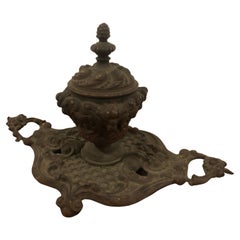
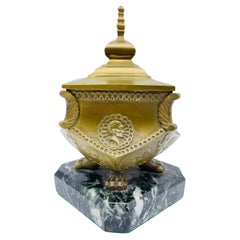
Stately Antique Brass Bronze Inkwell, Around 1880
Located in Berlin, DE
Stately antique brass bronze inkwell around 1880
Solid brass bronze inkwell with lid. Original glass insert.
Inkwell with paw feet standing on...
Category
Antique 1880s German Inkwells
Materials
Marble, Brass, Bronze
$752 Sale Price
20% Off
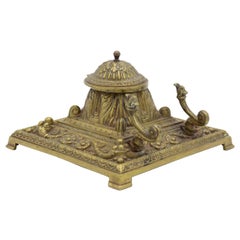
French Victorian Bronze Inkwell
Located in Queens, NY
French Victorian bronze square inkwell with 2 cornucopia pen holders.
Previously broken hinge, inkwell lid is not attached
Category
Antique 19th Century French Victorian Inkwells
Materials
Bronze
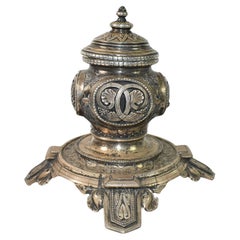
Antique Edwardian Elkington Inkwell, 1890
By Elkington
Co.
Located in Toledo, OH
This antique Edwardian inkwell from 1890 is covered in ornate detailing and was made by Elkington. Elkington was established in 1830's - 1963 in Birmingham, England. This inkwell has...
Category
Antique 1890s Inkwells
Materials
Metal
French Empire Ormolu Inkwell
Located in London, GB
A fine French Empire ormolu desk standish. Set upon a circular base with top and bottom mouldings cast with leaf and dart decoration. The space be...
Category
Antique 1810s French Empire Inkwells
Materials
Ormolu
Late 19th Century Inkwell with Enamel Decoration, France, circa 1870-1890
Located in Greven, DE
Inkwell with Enamel Decoration
Origin: France
Material: Gilt metal with coloured enamel
Date: Circa 1870–1890
Dimensions:
H × W × D: 8 × 9 × 9 cm
Description:
Square inkwell resti...
Category
Antique Late 19th Century French Inkwells
Materials
Brass, Bronze, Enamel