Austrian Decorative Objects

to
367
2,442
253
9
25
466
1,951
262
995
797
75
268
80
243
161
21
304
100
35
21
3
754
470
455
58
45
37
17
16
13
11
10
8
7
5
2
2
1
1
1,716
806
589
548
384
1,693
772
13,597
97,568
27,501
24,950
16,498
Height
to
Width
to
2,704
2,694
2,694
372
168
144
138
90
Place of Origin: Austrian
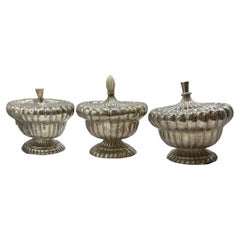
Set of Three Austrian Silver Boxes and Covers, Johann Hoppe, Vienna, 1920s
Located in North Miami, FL
A set of three Austrian silver boxes and covers, Johann Hoppe, Vienna, circa 1925. These are marked on bases and covers in Secessionist style, one ...
Category

19th Century Antique Austrian Decorative Objects

Materials

Silver, Sterling Silver

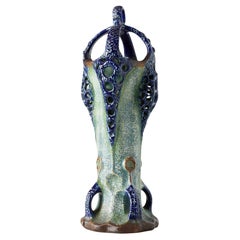
Vase by RStK Pottery
Located in San Francisco, CA
An Art Nouveau porcelain vase marked "Amphora" and "Austria" on the bottom, hallmarks of the Riessner, Stellmacher, and Kessel factory. Design shows evidence of the work Eduard Stell...
Category

Early 1900s Modern Antique Austrian Decorative Objects

Materials

Porcelain

Vase by RStK Pottery
Price Upon Request
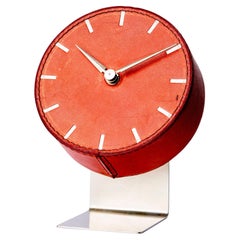
Carl Auböck Table Clock in red leather, Austria 1950s
By Werkstätte Carl Auböck
Located in Berlin, DE
A beautiful leather and stainless steel modernist clock from the 1950s, designed and executed by Carl Auböck in very rare and hard to find red leather, Vienna/Austria. An amazing str...
Category

1950s Mid-Century Modern Vintage Austrian Decorative Objects

Materials

Stainless Steel

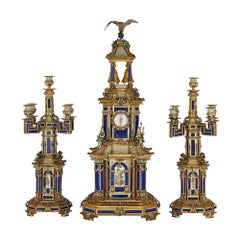
Impressive Antique Austrian Champlevé Enamel, Silver-Gilt and Lapis Lazuli Clock
Located in London, GB
Impressive antique Austrian champlevé enamel, silver-gilt and lapis lazuli clock set Austrian, Late 19th century Clock: Height 91cm, width 37cm, depth 37cm Candelabra: Height 64cm, width 24cm, depth 24cm Clock case: Height 97cm, width 44cm, depth 41cm Candelabra case: 67cm, width 27cm, depth 27cm Crafted in Austria in the late 19th century, this magnificent three-piece clock set was most likely gifted to the Imperial Russian family by the Austro-Hungarian Royal family. Its design is inspired by various cultures and styles, whilst its high quality celebrates some of the best craftsmen of the late 19th century. Of a tiered pagoda shape, the clock is surmounted by an eagle, its wings spread wide landing atop a vibrant lapis lazuli ball. The eagle is most likely a reference to Turul, a mythological animal which is a symbol of Hungary. This bird of prey is also a popular feature within Turkish traditions. Within a canopy, supported on four sturdy lapis lazuli pillars two prominent silver-gilt bells are hanging. These are carved with various motifs such as acanthus leaf design and connect to the clock mechanism below. The bells ring informing its users of the time. All four sides of the piece are inset with a clock, an unusual feature on an object of this type and a testament to its highest quality. The inclusion of clocks on all sides signifies that the antique is aimed to be a centrepiece, admired from all sides. The dial is decorated using the champlevé enamelling technique, whereby ‘parcels’ are carved into the silver gilt and into which enamel is poured. The 12 numbers are coloured in black with a gold outline and are surrounded by a white circular background making them stand out and easy to read. The hour clock dial is cast in the form of a sun, while the minute hand is represented as the moon. The two motifs symbolise one’s bright and gloomy sides of existence. The four corners around the clocks are mounted with three-dimensional female figures dressed in traditional garments from around the world. For example, one figure is dressed in typical Turkish clothing...
Category

Late 19th Century Antique Austrian Decorative Objects

Materials

Lapis Lazuli, Silver, Enamel, Bronze

Recently Viewed

View All