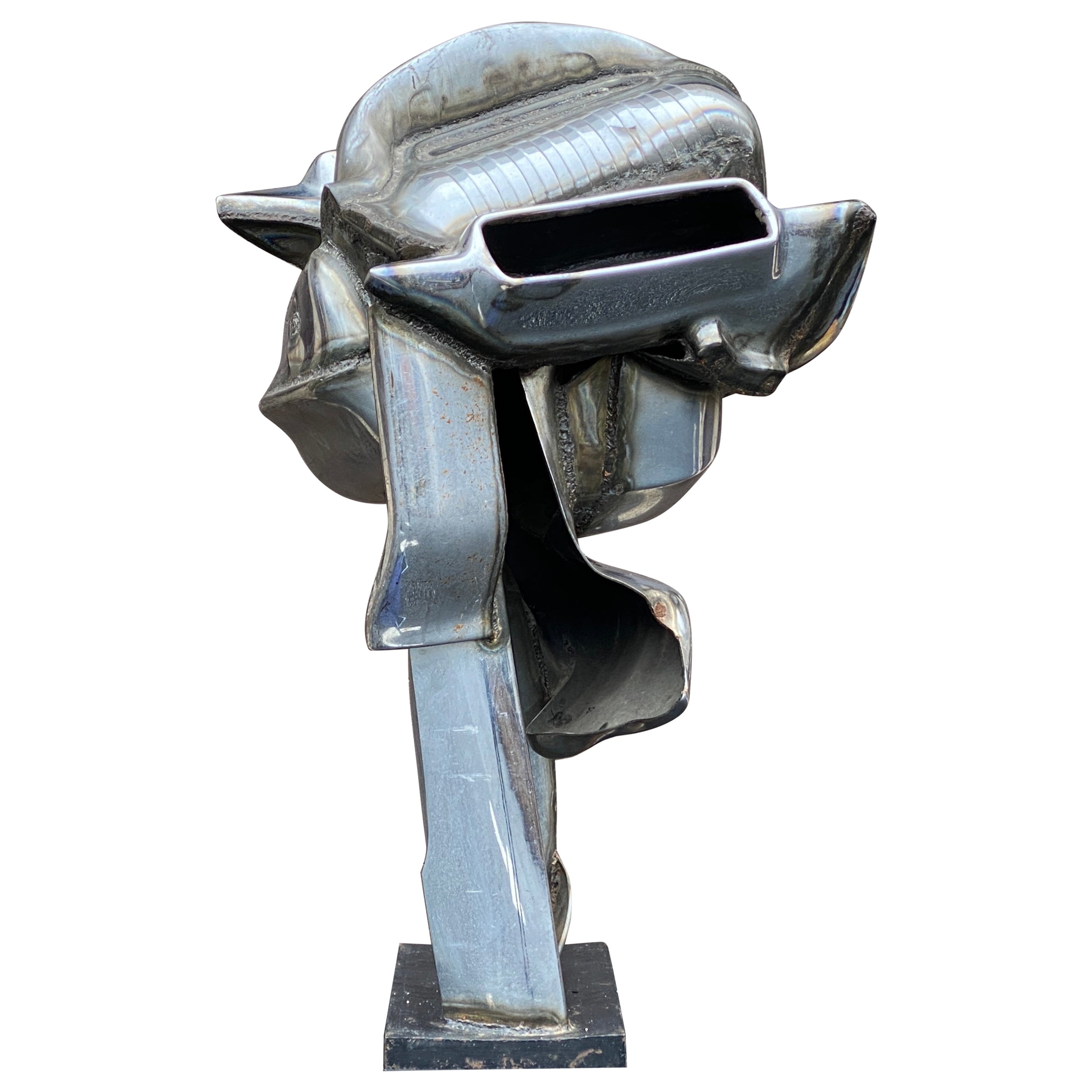
Items Similar to Abstract Brutalist Chrome Sculpture by Jason Seley "Sculptor
s Harp 2" 1966

Want more images or videos?
Request additional images or videos from the seller
1 of 9
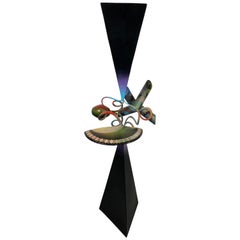
Abstract Brutalist Chrome Sculpture by Jason Seley "Sculptor
s Harp 2" 1966
$2,850
£2,164.33
€2,486.41
CA$4,017.83
A$4,271.78
CHF 2,310.05
MX$50,814.14
NOK 28,936.66
SEK 26,427.78
DKK 18,574.33
About the Item
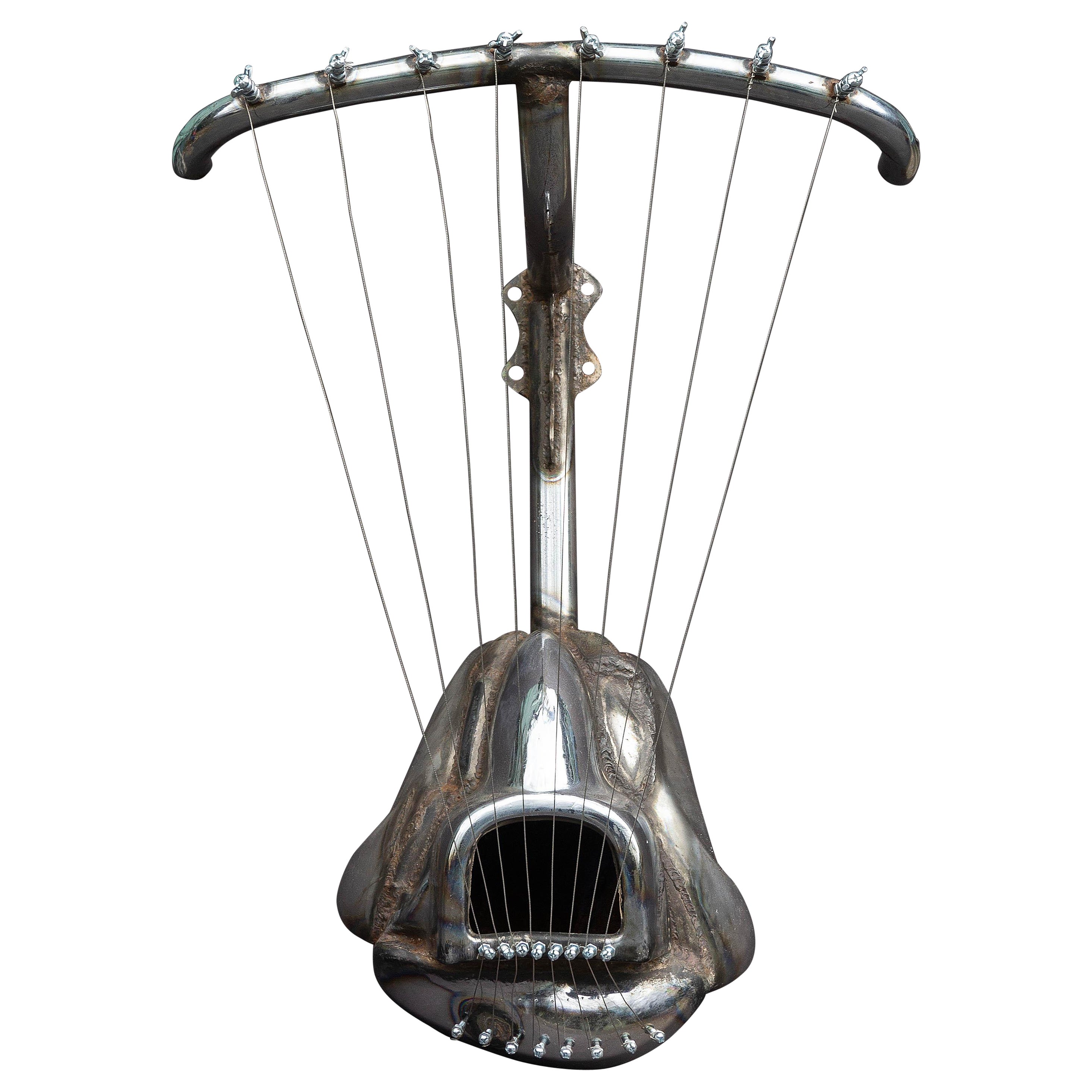
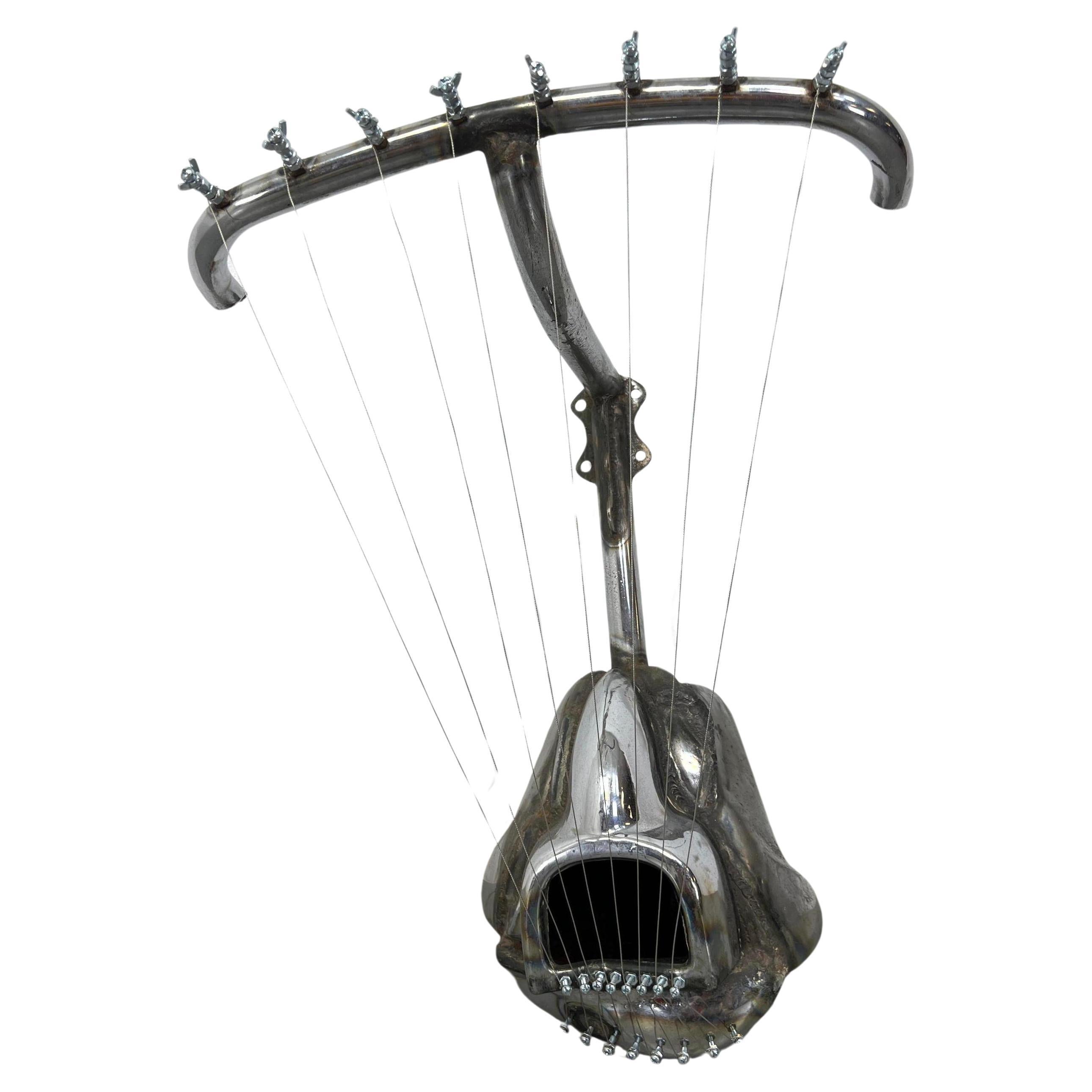
Abstract brutalist welded chrome sculpture by Jason Seley "Sculptor's Harp 2". An abstract deep sea monster. Created 1966. Seley's preferred medium was chrome bumpers. Unsigned.
Jason Seley (1918-1983) American sculptor. He taught at Cornell University for many years and served as dean of the College of Architecture, Art, and Planning.
His works are in the collection of MOMA, Whitney Museum of American Art, Johnson Museum of Art, Cornell University .
- Creator:Jason Seley (Artist)
- Dimensions:Height: 31 in (78.74 cm)Width: 22 in (55.88 cm)Depth: 18 in (45.72 cm)
- Style:Modern (Of the Period)
- Materials and Techniques:
- Place of Origin:
- Period:
- Date of Manufacture:1966
- Condition:Wear consistent with age and use.
- Seller Location:Rochester, NY
- Reference Number:Seller: 690041stDibs: LU1585241583712
About the Seller
5.0
Vetted Professional Seller
Every seller passes strict standards for authenticity and reliability
Established in 1979
1stDibs seller since 2015
550 sales on 1stDibs
Typical response time: 10 hours
- ShippingRetrieving quote...Shipping from: Rochester, NY
- Return Policy
More From This Seller
View AllAbstract Brutalist Chrome Sculpture by Jason Seley "Sculptor
s Harp 2" 1966
By Jason Seley
Located in Rochester, NY
Abstract brutalist welded chrome sculpture by Jason Seley "Sculptor's Harp 2". An abstract deep sea monster. Created 1966. Seley's preferred medium was chrome bumpers. Unsigned.
J...
Category
Mid-20th Century North American Modern Abstract Sculptures
Materials
Chrome
Abstract Sculpture
Located in Rochester, NY
A striking metal sculpture of a fish. Iron with gold gilt decoration. Probably Asian.
Category
Mid-20th Century Mid-Century Modern Animal Sculptures
Materials
Metal, Iron
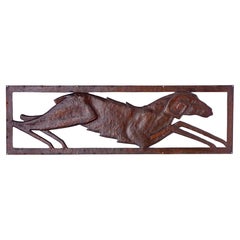
Art Deco Sculpture by Paul Lobel RKO Roxy Theatre Rockefeller Center
By Paul Lobel
Located in Rochester, NY
Bronze art deco ram sculpture by Paul A. Lobel from the RKO Roxy Theater, Rockefeller Center, New York. Hand wrought. Provenance: RKO, Roxy Center Theatre; Mr. Eugene Lee Schoen; M...
Category
Early 20th Century American Animal Sculptures
Materials
Metal, Bronze
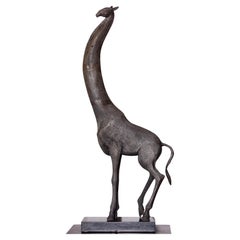
Large Modern Giraffe Sculpture, American, Mid- Century
By Manuel Carbonell
Located in Rochester, NY
A large and early sand cast aluminum Modernist sculpture of a giraffe by Cuban American artist Manuel Carbonell. Pedestal included. Height is 73” with base. Presented by Joseph Da...
Category
Mid-20th Century American Modern Animal Sculptures
Materials
Metal, Aluminum
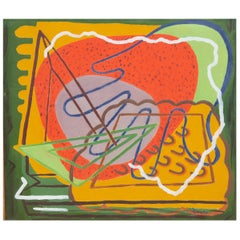
Abstract Composition by Zoute (Leon Salter) Mid Century
Located in Rochester, NY
Abstract Modernist oil painting by Zoute. Oil on canvas mounted on board. Painted in circa 1940's.
Zoute (Born-Leon Salter, 1903-1976) was self-taught and well exhibited during his...
Category
Mid-20th Century American Mid-Century Modern Paintings
Materials
Paint
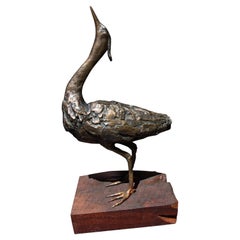
Bronze Heron Sculpture by Wayne F Williams
Located in Rochester, NY
Bronze heron by American sculptor Wayne Williams. Signed and dated 1993. Edition 2/2. Mounted on a walnut base.
From Finger Lakes Magazine 2001:
Art is everywhere in the Finger Lakes. Inspired by the region’s diverse scenery and lifestyles, artists pursue their creativity outdoors, in studios and in workshops. In the many well-established museums and galleries or at the newer fledgling arts organizations, a wide array of artistic styles and talents are represented. Often the artists, like Wayne Williams, share their artistic skill and passion through teaching at local colleges.
Williams, who is retired after a 35-year career at Finger Lakes Community College, found his calling there. “I didn’t want to teach in public schools,” explains Williams of his career choice. “I wanted to be at the college level. CCFL (the Community College of the Finger Lakes, as it was then known) was literally creating a college, right from scratch.” The year was 1968 and Williams was charged with coordinating the new college’s art program.
Rand Darrow, a CCFL student in that first year, remembers attending Williams’ art classes in a commercial building on Main Street just south of the railroad tracks in Canandaigua. Darrow appreciated his instructor’s relaxed manner. “He was a great teacher,” recalls Darrow, “cracking jokes all the time.” Darrow graduated with a major in Liberal Arts and continued on to SUNY Oswego where he earned a BA in fine arts. He taught art to elementary and middle school students for 30 years.
These days Williams and Darrow typically cross paths at the Wayne County Arts Council in Newark where Williams and his wife, Marleen, are heavily involved. Williams offers classes in figure drawing and sculpture and hangs the gallery’s shows, including his former student’s “Slavic Tales of Novgorod” this past August. “I’d like to take a sculpture class from him,” says Darrow.
In 2003 when Williams retired, the college honored him and another retiring art professor, Tom Insalaco, by renaming its art gallery the Williams-Insalaco Art Gallery. It was known formerly as Gallery 34 to recognize its origins at 34 North Main Street in Canandaigua. Williams held professor’s rank from 1976 and served as director of the art gallery beginning with its opening in 1983.
Williams, who was born and raised in Newark, New York, says he began doing art at about age 8. By the time he was in junior high school his career direction seemed clear. He received local and national awards for his art and a scholarship to Syracuse University, from which he graduated in 1958 with a Bachelor of Fine Arts in sculpture. He continued with graduate work at Syracuse, receiving an MFA in sculpture in 1962. He worked full time as a sculptor until he began teaching.
At one point Williams admits he wanted to be a painter, but didn’t want to adopt the abstract expressionist style in vogue in the 1950s, preferring to pursue the realist tradition. He advises any would-be artist to “do what you do because you love it.”
After graduation he traveled abroad, spending time in Belgium, the land of his ancestors. “My family’s name was originally Willems,” explains the 73-year old who still relishes the time spent in the Flemish countryside. Williams speaks excitedly about art, referencing the lives of great artists. He acknowledges that American artists do not have the same stature as those in Europe, where Old Masters like Brueghel and Rembrandt are national heroes.
These days the energetic Williams, known primarily as a sculptor, is active at the Phelps Arts Center where he is on the board of directors. In mid-September when a group of visitors on a motor coach tour explored artworks displayed in the beautiful church-turned- gallery, they were treated to a large number of Williams’ bronze and metal sculptures, along with his charcoal drawings. “I’ve always loved his work because he deals with things, people, and animals you understand,” says the center’s Director Emeritus Marion Donnelly, who has known him for many years.
Outside the Phelps Community Historical Society, Williams’ life-size figure of a farmer raises his pitchfork above a colorful flower garden on the front lawn. Inspired by the peasants working the fields in Europe, the metal figure is shown with wooden shoes. This is Williams’ largest copper piece, loaned to the Phelps museum in connection with Artistry in Sculpture, a community exhibition in 2009. Williams added a new base using a metal wagon...
Category
20th Century American Animal Sculptures
Materials
Bronze
You May Also Like
Abstract Brutalist Chrome Sculpture by Jason Seley "Sculptor
s Harp 2" 1966
Located in Rochester, NY
Abstract brutalist chrome sculpture by Jason Seley "Sculptor's Harp 2". An abstract deep sea monster. Created 1966. Seley's preferred medium was chrome bumpers. Unsigned.
Jason Se...
Category
Mid-20th Century Abstract Abstract Sculptures
Materials
Metal
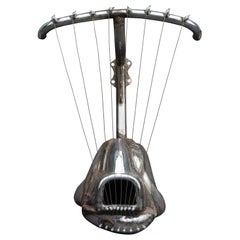
1960s Brutalist Steel Abstract Sculpture
Located in Raleigh, NC
Heavily textured and expressive vintage sculpture. Has tons of movement and a wonderful patina.
Category
Mid-20th Century American Brutalist Abstract Sculptures
Materials
Cut Steel
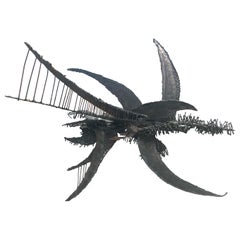
Claude Viseux, Abstract Sculpture, 1970s, Stainless Steel
By Claude Viseux
Located in SAINT-SEVER, FR
Claude Viseux est un peintre, sculpteur et graveur aquafortiste et lithographe français né le 3 juillet 1927 à Champagne-sur-Oise et mort le 9 novembre 2008 à Anglet.
'est dans les années 1959-1960 que la sculpture de Claude Viseux, qualifiée de « protéiforme, onirique, fantastique » — ami de Max Ernst, Man Ray, Francis Ponge et Henri Michaux, il ne désavoue pas une parenté avec le Surréalisme9 — se substitue à la peinture, ses premières réalisations étant les objets trouvés en bord de mer qu'il pétrifie dans la cire10 d'une part, les empreintes de pierres et d'algues coulées en bronze d'autre part.
En 1960, il signe le Manifeste des 121 titré « Déclaration sur le droit à l’insoumission dans la guerre d’Algérie ».
En 1961, ses expérimentations s'orientent vers les corps organiques, notamment avec sa série Ostéales constituée d'assemblages d'os fossilisés qu'il patine ou au contraire décape, qu'il visse, scie, assemble et plastifie. Les Concrétudes ou Coulées directes qui suivent en 1961-1962 sont obtenues à partir de coulées de métal en fusion dans le sable, générant des reliefs qu'il soude sur des plaques d'acier. Il va cependant adopter rapidement l'acier inoxydable — qu'il est avec Pol Bury parmi les premiers à employer en sculpture — comme matériau de prédilection. « Il assemble divers rebus industriels — tuyaux, écrous, boulons, cuves… — pour créer des sculptures à mi-chemin du mécanique et du biologique » restitue ainsi Sophie Serra11. Claude Viseux, qui fréquente alors Jean Tinguely, Piotr Kowalski, Michel Guino, Takis et César, confirme : « Ma récupération de l'élément industriel s'élargit vers les aciers spéciaux, avec un essai de vocabulaire formel : des barres, des profilés, des sphères, des rotules, des fonds de cuves, des chambres à combustion de Boeing, des tubulures, des soupapes de navire »9.
« L'artiste entre au cœur de la réalité industrielle, prospecte dans les chaînes de montage de Renault et rôde dans les terrains vaques autour des usines », restitue donc l'encyclopédie Les Muses : « il récupère ferrailles, pièces détachées, débris de voitures, vieux châssis, toute une série d'éléments devenus inutiles. Ils les assemblent, tels quels, sans les modifier. Des créatures agressives ou pathétiques vont surgir de ce combat physique et dialectique que l'artiste livre avec la matière et entrer dans le domaine d'une poétique étrange, surnaturelle5 ». Dans les années 1967-1970, Les « structures actives » en acier inoxydable procèdent ainsi de la production industrielle de série. Elles se répartissent en familles de formes combinatoires composées par addition, soustraction, multiplication, division. Il confirme : « le monde industriel est ma nature, mon bouillon de culture, où je cherche des corps, des familles de corps, des genres, des espèces, dans un aller-retour de l'artificiel au naturel pour confondre les règnes, pour en inventer d'autres selon une géométrie organique qui féconde les différents types de structures, qui aménage la forme concernée par la forme à venir »9. En 1968, Claude Viseux s'installe à la villa Baudran à Arcueil, atelier qu'il conservera jusqu'en 1992.
Si des corps imaginaires naissent ainsi des pièces mécaniques que Claude Viseux emprunte à l'automobile, à l'avion et au bateau, en 1972, « la symétrie de ces formes pures en inox », constate Lydia Harambourg, « l'amène à s'interroger sur la notion d'équilibre instable »12. Ses Instables sont de la sorte exposés à la Biennale de Venise en 1972 où, rappelle encore Lydia Harambourg, une salle entière est consacrée « aux dessins qui reprennent son vocabulaire mécanique identitaire de sphères, toupies, hélices, anneaux, astrolabes et balanciers »12. Les Instables sont de même, en 1973, présentés à la galerie Le Point cardinal à Paris où Claude Viseux avait déjà exposé en 1968 avec Henri Michaux et Joaquin Ferrer...
Category
Vintage 1970s Unknown Sculptures and Carvings
Materials
Stainless Steel
$1,812 Sale Price
20% Off
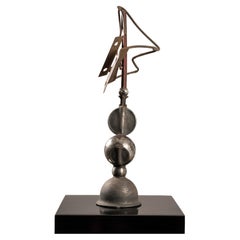
Welded Chrome Automobile Bumper Abstract Sculpture by Jason Seley,
1919-1983
By Jason Seley
Located in West Chester, PA
Large scale welded chromium-plated steel salvaged car parts sculpture by artist Jason Seley (1919-1983). Signed by the artist.
Rectangular base measures roughly 18" x 10".
Category
Vintage 1960s American Brutalist Abstract Sculptures
Materials
Steel, Chrome
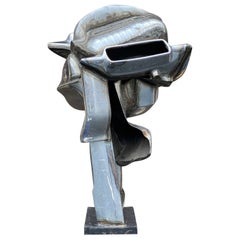
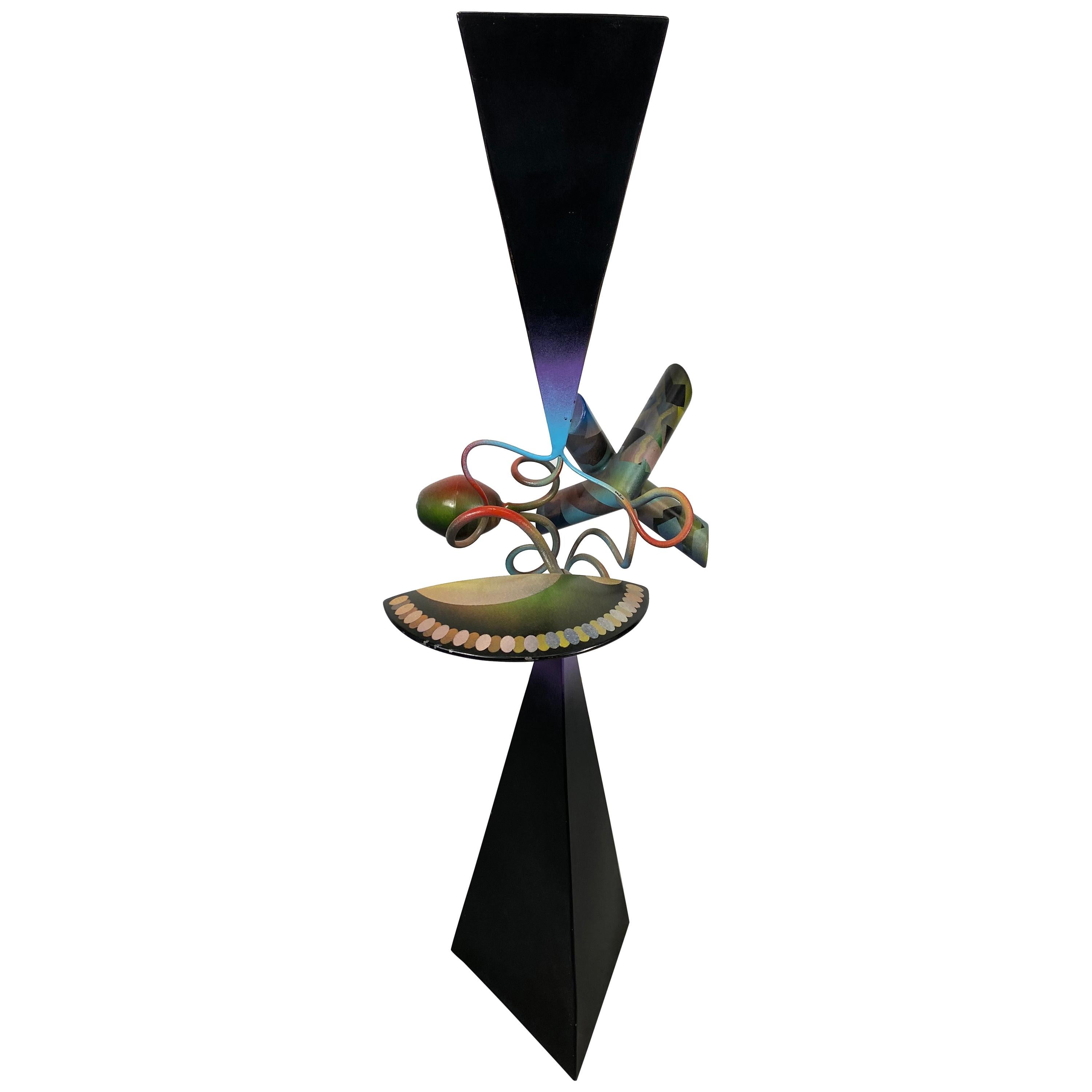
Memphis Style Abstract Free-Standing Welded Steel Sculpture by Jerry Dodd
By Mike Dodd
Located in Buffalo, NY
Memphis style abstract free-standing Welded steel sculpture by Jerry Dodd, his sculptural pieces are painted with enamels and are suitable for display indoors or protected areas outd...
Category
Vintage 1970s American Folk Art Abstract Sculptures
Materials
Steel
Steel Sculpture by Nicolas Vlavianos, 1970
By Nicolas Vlavianos
Located in Rio De Janeiro, RJ
Steel sculpture signed and dated Vlavianos in perfect conditions.
Category
Vintage 1970s Greek International Style Abstract Sculptures
Materials
Steel