Want more images or videos?
Request additional images or videos from the seller
1 of 12
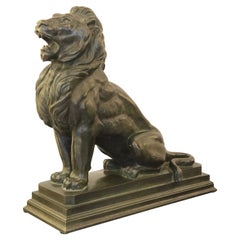
Art Deco Bronze Sculpture of a Lion Kabuki Shumei Japan 1940
$4,798.99List Price
About the Item
- Creator:Kabuki Shumei (Sculptor)
- Dimensions:Height: 7.29 in (18.5 cm)Width: 12.01 in (30.5 cm)Depth: 3.15 in (8 cm)
- Style:Art Deco (Of the Period)
- Materials and Techniques:Bronze,Patinated
- Place of Origin:
- Period:
- Date of Manufacture:1940
- Condition:Very good condition.
- Seller Location:Antwerp, BE
- Reference Number:1stDibs: LU931010608263
About the Seller
5.0
Platinum Seller
Premium sellers with a 4.7+ rating and 24-hour response times
Established in 1988
1stDibs seller since 2012
503 sales on 1stDibs
Typical response time: 1 hour
Associations
International Confederation of Art and Antique Dealers
AssociationsLAPADA - The Association of Arts
Antiques Dealers
Authenticity Guarantee
In the unlikely event there’s an issue with an item’s authenticity, contact us within 1 year for a full refund. DetailsMoney-Back Guarantee
If your item is not as described, is damaged in transit, or does not arrive, contact us within 7 days for a full refund. Details24-Hour Cancellation
You have a 24-hour grace period in which to reconsider your purchase, with no questions asked.Vetted Professional Sellers
Our world-class sellers must adhere to strict standards for service and quality, maintaining the integrity of our listings.Price-Match Guarantee
If you find that a seller listed the same item for a lower price elsewhere, we’ll match it.Trusted Global Delivery
Our best-in-class carrier network provides specialized shipping options worldwide, including custom delivery.You May Also Like
Art Deco Bronze Animal Lion Sculpture
Located in IT
Art Deco bronze animal lion sculpture
Size: W 38 cm, D 14 cm, H 38 cm
Original patina.
A video of the item Is available upon request...
Category
Early 20th Century French Art Deco Animal Sculptures
Materials
Bronze
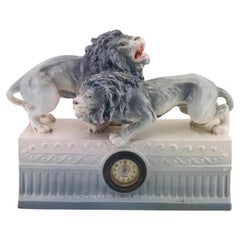
Italian Large Art Deco 1940s Ceramic Lions Sculpture Table Clock, 1940s
Located in Byron Bay, NSW
Impressive Italian Art Deco 1940s large table clock in ceramic, white and light blue ceramic in good condition.
Category
Vintage 1940s Italian Art Deco Animal Sculptures
Materials
Ceramic
$3,000
H 14.57 in W 14.57 in D 4.73 in
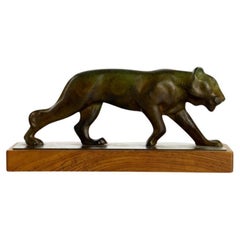
Swedish Art Deco Sculpture of a Female Lion
Located in Brooklyn, NY
1940s, Sweden. Art Deco sculpture featuring a female lion crafted in patinated bronze, mounted on a wooden base. The artist is anonymous.
Category
Vintage 1940s Swedish Art Deco Animal Sculptures
Materials
Bronze
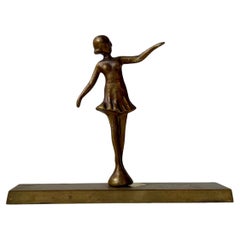
Art Deco Desk Ballerina Sculpture in Bronze, 1940s
Located in Esbjerg, DK
A small desk sculpture or paperweight executed in patinated bronze. Given as a 40 year anniversary gift in 1949 (dated 1909-49). Danish made. Mea...
Category
Vintage 1940s European Art Deco Figurative Sculptures
Materials
Bronze
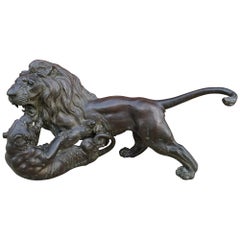
Antique Japanese Bronze Sculpture of Roaring Lion vs. Tiger
Located in Chicago, IL
Antique Japanese Bronze Sculpture of Roaring Lion vs. Tiger
This stunning antique depicts a lion and tiger locked in conflict. The ...
Category
Early 20th Century Other Animal Sculptures
Materials
Bronze
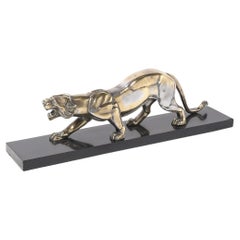
Art Deco Silvered Bronze Lion Sculpture on Black Marble Base
Located in New York, NY
This striking Art Deco sculpture, crafted in France circa 1930, depicts a powerful lion in silvered bronze, embodying the bold and dynamic energy characteristic of the Art Deco movem...
Category
Vintage 1930s French Art Deco Animal Sculptures
Materials
Marble, Bronze
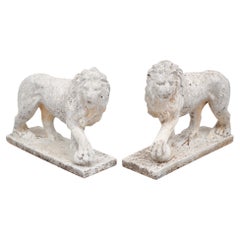
French Art Deco Period Lion Sculptures
Located in Austin, TX
Pair of sculptures from the Art Deco period in France. Each is sculpted into the shape of a lion, featuring one outstretched paw on a ball and supported by a base. These sculptures a...
Category
Vintage 1940s French Art Deco Animal Sculptures
Materials
Stone
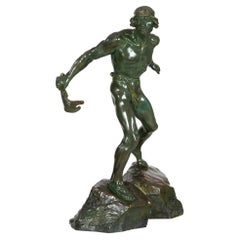
French Art Deco Bronze Sculpture of a Warrior by Ernest Diosi, circa 1940
Located in Shippensburg, PA
An incredibly powerful Art Deco figure of a Standing Warrior poised for battle, he is a picture of sheer determination and will. Wind blows his hair behind him as every muscle in his...
Category
20th Century French Art Deco Figurative Sculptures
Materials
Bronze
$5,900
H 30 in W 20 in D 10.5 in
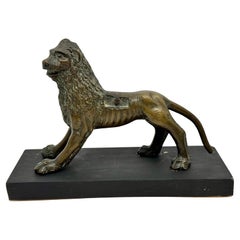
Medieval Bronze Sculpture of a Lion
Located in Palm Springs, CA
A cast bronze lion figure mounted on a black rectangular base, depicted in a dynamic stance with stylized detailing, including a ribbed torso, deeply incised mane, and expressive fac...
Category
Antique 15th Century and Earlier Animal Sculptures
Materials
Bronze
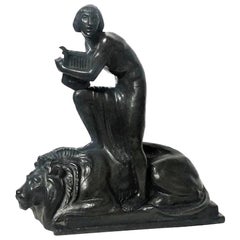
Ernst Seger, David and Lion, German Art Deco Patinated Bronze Sculpture, c. 1920
By Ernst Seger
Located in New York, NY
Signed “E. Seger”.
Black patina.
Dimensions
Height: 8 inches (20cm)
Width: 7.5 inches (18.75cm)
Depth: 8.5 inches (21.25cm)
THE BIBLE STORY
Samuel 17:34-36
Originally, Saul would not allow David to fight Goliath (17:33). Saul’s reason was simply that Goliath would be stronger than David. David was young and he did not have the experience to fight such a capable enemy as Goliath. David was likely to die, and his death would benefit nobody.
Often people wrongly imagine that they are acting in faith (in other words, that they are trusting God). Really, they are acting in a foolish manner, as if the danger is not real. They are not trusting in God, but in their own thoughts, hopes and desires.
David’s reply to Saul shows us his attitudes. This reply explains clearly why David had offered to fight Goliath. In other words, it shows how David considered himself able to defeat Goliath.
Like many boys and young men in Israel, David had worked as a shepherd. That is, he looked after sheep. He was responsible to look after those sheep in every way. In particular, he had to protect them from wild animals.
Lions and bears are some of the fiercest large wild animals. They were common in Israel at the time of the Bible. They are much stronger than a man (see for example 1 Kings 13:24 and 2 Kings 2:24). Only the bravest and strongest men were able to kill a lion (Judges 14:5-6; 2 Samuel 23:20). However, David had killed both a lion and a bear. He had killed animals that were stronger than him.
David did not believe that the strongest man would win the fight. David had a close relationship with God; he was trusting God to rescue him (17:37). David was not pretending that there was no danger. However, God’s Holy Spirit was active in David’s life (16:13). By the power of his Holy Spirit, God had given David the faith (trust in God) to fight Goliath. Because David really was trusting God, there was no reason for him to be afraid of Goliath.
THE ARTIST
Ernst Seger (1865 1939), born in Neurode (Nowa Ruda, now Poland), studied sculpturing from 1884 at the Kunstschule in Breslau under Robert Härtel. From 1886 he worked in the Atelier of Christian Behrens, where he created the Eichendorff-Memorial for the Silezian City of Neisse. From 1893 to 1894 Seger stayed in Paris where he worked in the atelier of Auguste Rodin. However, Seger finally chose a ‘Jugenstill’ and a more ‘naturalistic’ or ‘Neuklassizismus’ style. His sculptures, modelled like the Greek antiques, were later greatly admired by the National Socialists.
At the end of 1894 Ernst Seger went back to Berlin, founded his own atelier and created the Kaiser Wilhelm I memorial for the Silesian City of Glatz. In 1897 Seger created the sculpture ‘Jugend’ (‘Youth’), which was displayed at the ‘Große Berliner Kunstausstellung’ in 1898, at the ‘Große Berliner Kunstausstellung’ in 1899, at the ‘Münchener Glaspalast Ausstellung’ in 1899 and at the ‘Münchener Glaspalast Ausstellung’ in 1908. As a sculptor Seger regarded this as his first relevant work, his breakthrough. A copy of the sculpture in bronze, 1.60 metres high, was placed in the ‘Scheitniger Park’ in Breslau (now Wroclaw). In 1898 Segers ‘Diana’, the Roman Goddess of the Hunt, the Moon and Childbirth, was unvealed in Park Szczytnicki, Breslau, Polen (earlier ‘Schneitniger Park’). Until 1945 the sculpture stayed in the Schneitniger Park, Breslau. This part of the park is still called ’Dianagarten’.
After the turn of the century the elegant female dancers and nudes by Seger gained great popularity. In 1905 Ernst Seger created -together with the sculptor Bernhard Sehring- the ‘Bismarck Brunnen’ (‘Bismarck Fountain’) in Breslau. This memorial-fountain (which still exists) represents the allegories ‘Kampf’ and ‘Sieg’ (‘Battle and Victory’). Seger’s ‘Verwundete Amazone’ (‘Wounded Amazon’), displayed at the Grosse Münchner Kunstausstellung in the Glaspalast in 1908, was placed in the garden of the ‘Kaufhauses Wertheim’ in Berlin. In the same year he was appointed as a professor. Seger’s marble sculpture ‘Kypris’, created in 1916, was placed in the Alten Nationalgalerie in Berlin. In 1925 the City of Berlin acquired his sculpture ‘Anbetung’ and placed it at the Johannaplatz. ‘Storchenbrunnen’ (‘Stork-fountain’), was placed in 1931 at the Adolf-Scheidt-Platz in Berlin. In 1935 the American newspaper publisher William Randolph Hearst bought Seger’s sleeping ‘Ganymede’.
During the Third Reich Ernst Seger was commissioned numerous Hitler busts...
Category
Vintage 1920s German Art Deco Figurative Sculptures
Materials
Bronze
$5,800
H 8 in W 7.5 in D 8.5 in
More From This Seller
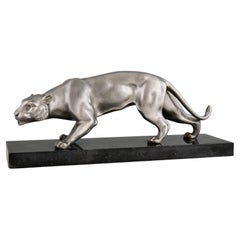
View AllArt Deco bronze panther sculpture signed J. Brault
By Brault
Located in Antwerp, BE
Art Deco bronze panther sculpture signed by J. Brault.
Bronze, silver patina on a Black marble base.
France 1930.
Category
Vintage 1930s French Art Deco Animal Sculptures
Materials
Belgian Black Marble, Bronze
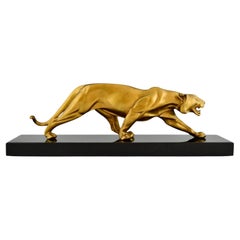
Art Deco bronze sculpture of a panther by Rulas France 1930
By Rulas
Located in Antwerp, BE
Art Deco bronze sculpture of a panther signed Rulas.
Bronze gold patina, on a Belgian Black base.
Signed and marked Bronze.
Ca. 1930
Category
Vintage 1930s French Art Deco Figurative Sculptures
Materials
Belgian Black Marble, Bronze
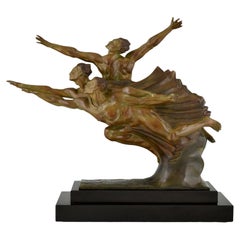
Art Deco bronze sculpture of 3 athletes ALLEGORY OF SPEED by Robert Delandre
By Robert T. Delandre
Located in Antwerp, BE
Art Deco bronze sculpture of 3 athletes, Allegory of speed by Robert Delandre.
La Vitesse. Patinated bronze on a Belgian Black marble base.
With foun...
Category
Vintage 1930s French Art Deco Figurative Sculptures
Materials
Belgian Black Marble, Bronze
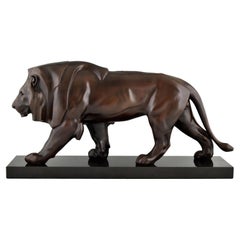
Art Deco Style Sculpture of a Walking Lion by Max Le Verrier original, France
By Max Le Verrier
Located in Antwerp, BE
Very impressive Art Deco style sculpture of a walking lion by the famous French sculptor Max Le Verrier.
Art metal with beautiful dark brown patina on a black marble base.
Contempo...
Category
2010s French Art Deco Animal Sculptures
Materials
Belgian Black Marble, Metal
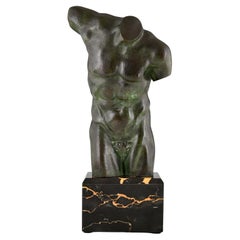
Art Deco bronze sculpture male torso France 1930
Located in Antwerp, BE
Art Deco bronze sculpture male torso.
Bronze, dark green patina on a Portor marble base.
France 1930.
Category
Vintage 1930s Art Deco Figurative Sculptures
Materials
Marble, Bronze
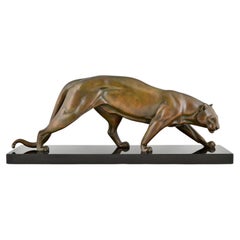
Art Deco Bronze Sculpture of a Panther by Irenee Rochard France 1930
By Irénée Rochard
Located in Antwerp, BE
Art Deco bronze panther sculpture signed by Irenee Rochard, France 1930.
The bronze has a rich brown patina and stands on a Belgian Black marble base.
Irenee Rochard.
Literature:
...
Category
Vintage 1930s French Art Deco Animal Sculptures
Materials
Marble, Bronze
Still Thinking About These?
All Recently ViewedMore Ways To Browse
Bronze Animal Sculpture Japan
Japanese Lion
Japanese Lion Sculpture
Bronze Lion Japan
Mid Century Modern Fish
Vintage Brass Animals
Animals Figurines
Horse Sculpture Vintage
Small Sculpture Vintage
Animal Head
Monkey Furniture
Lion Sculptures
Hand Blown Glass Sculpture
Hand Carved Wood Animal Sculpture
Marble Sculpture Animals
Wood Carved Animals
Vintage Wood Sculpture
Owl Furniture