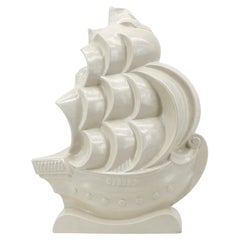
Want more images or videos?
Request additional images or videos from the seller
1 of 10
CH FRANCE French Art Deco Ceramic Pigeon, 1920s
Price:$990
$1,200List Price
About the Item
- Dimensions:Height: 5.71 in (14.5 cm)Width: 8.27 in (21 cm)Depth: 4.93 in (12.5 cm)
- Style:Art Deco (Of the Period)
- Materials and Techniques:
- Place of Origin:
- Period:
- Date of Manufacture:1920s
- Condition:
- Seller Location:Saint-Amans-des-Cots, FR
- Reference Number:1stDibs: LU2312324846912
About the Seller
5.0
Platinum Seller
Premium sellers with a 4.7+ rating and 24-hour response times
Established in 2003
1stDibs seller since 2016
518 sales on 1stDibs
Authenticity Guarantee
In the unlikely event there’s an issue with an item’s authenticity, contact us within 1 year for a full refund. DetailsMoney-Back Guarantee
If your item is not as described, is damaged in transit, or does not arrive, contact us within 7 days for a full refund. Details24-Hour Cancellation
You have a 24-hour grace period in which to reconsider your purchase, with no questions asked.Vetted Professional Sellers
Our world-class sellers must adhere to strict standards for service and quality, maintaining the integrity of our listings.Price-Match Guarantee
If you find that a seller listed the same item for a lower price elsewhere, we’ll match it.Trusted Global Delivery
Our best-in-class carrier network provides specialized shipping options worldwide, including custom delivery.You May Also Like
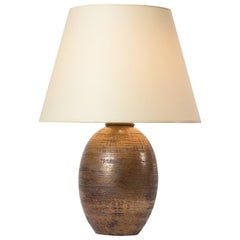
French Ceramic Art Deco Kaza Table Lamp, France 1920s
By Kaza
Located in Paris, FR
Ceramic very stylish table lamp by famous French studio KAZA from 1920s.
Marked under the base "KAZA France".
Category
Vintage 1920s French Art Deco Table Lamps
Materials
Ceramic
Art Déco Figurine
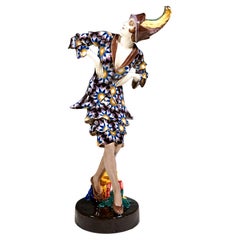
Dance Of Vanity
by Josef Kostial, Goldscheider Vienna, 1920s
By Goldscheider Manufactory of Vienna
Located in Vienna, AT
Rare Art Ceramics Model by Goldscheider from the 1920s:
Portrayal of the dancer Lucie Kieselhausen in an exotic costume consisting of a jacket and knee-length skirt with star decoration in brown, blue and yellow, sleeves and skirt part with tiered flounces with a wavy hem, the waisted jacket on the side and on the back with three peaks similar to a bellflower, jagged headgear with long colored feathers curved upwards, floral decorative element on the side of the posing figure at her feet.
The figure is based on a black, round base with the artist's signature 'Kostial' on the top next to the figure.
The dancer and actress Lucy Kieselhausen (1897 - 1926) was a student of Grete Wiesenthal and was a successful German dancer at the beginning of the 20th century. Lucy Kieselhausen appeared in three silent films: 'Thousand and one Woman' (18), 'The Seventh Great Power' and 'Earth Spirit'. In addition to her dancing activities, Lucy Kieselhausen also wrote the dance drama 'Salambo', which was set to music by Heinz Tiessen. In 1926, Lucy Kieselhausen died in a tragic accident caused by a petrol explosion with a burning jet of flame in her bathroom. Source: Cyranos ch
Designed by Josef KOSTIAL...
Category
Vintage 1920s Austrian Art Deco Ceramics
Materials
Ceramic
$5,741
H 17.92 in W 9.06 in D 7.88 in
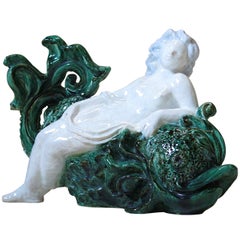
French Art Deco Glazed Ceramic Woman and Dolphin Sculpture
Located in Isle Sur La Sorgue, Vaucluse
Lovely glazed ceramic representation of a nude woman reclining on a dolphin's back. Craquelure finish on the woman. Signed and dated "GN, 1946."
Category
Mid-20th Century French Art Deco Ceramics
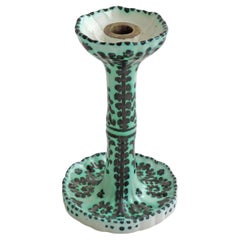
Italian Art Deco Matricardi Ceramic Candle Holder, Italy 1920s
Located in Milan, IT
Italian Art Deco Matricardi Ascoli Piceno Ceramic Candle Holder, Italy 1920s.
The company was founded in 1923 and closed in 1934.
Category
Vintage 1920s Italian Art Deco Ceramics
Materials
Ceramic
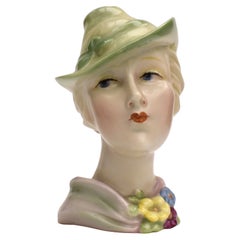
Art Deco Ceramic Bust Figurine, C1930
Located in Devon, England
For your consideration is this petite and very skillfully painted Art Deco ceramic head marked underneath foreign . Measuring just 8 cm in height...
Category
Mid-20th Century European Art Deco Busts
Materials
Ceramic
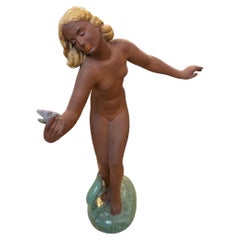
Ceramic Red and Black, Style, Art Deco
Located in Ciudad Autónoma Buenos Aires, C
Ceramic
Sign:
Made in Austria Keramos
2051
19/M
Wiener
Keramos, later Keramos AG or Keramos KG , was a Viennese ceramics manufacturer that made a name for itself especially in the interwar period . In addition to their own designs, designs from the dissolved Wiener Werkstätte were also produced from 1932 onwards. In over 60 years of company history, around 3000 model designs have been produced by around 60 ceramists.
Keramos also carried out commissions from the Wiener Werkstätte, such as vases by Dagobert Peche .
History
The origins of the Keramos company lie in two companies with the same name. The company Keramos – Invalid Society for Viennese Art Ceramics was founded at the end of 1919 on the initiative of the three ceramists Rudolf Wolf, Heinrich Wolf and Ludwig Rys, who had become invalids in World War I. Production started in September 1920. Art-ceramic lamps, figures, vases and boxes were produced.
The company Keramos – Viennese art ceramics and porcelain manufactory was founded in 1920. Josef Hoffmann was a shareholder of Keramos for a long time, as was the sculptor Rudolf Podany, who was engaged from the start and created a large number of designs. From 1921 Anton Klieber was employed, who was also responsible for most of the models.
Around 1924 both companies were merged and converted into an AG, commercial director became Otto Köller, the technical directors were the brothers Rudolf and Heinrich Wolf.
"Some war invalid ceramists founded a workshop with the help of some artists, which was subsequently financed by the state and later enlarged with its participation and converted into a joint-stock company."
The company's headquarters were in the Hofburg , Schwarze-Adler-Stiege, the factory in the 10th district of Vienna, Schleiergasse 17. Artistic collaborators at that time were Eduard Klablena , Otto Prutscher , Karl Perl , Karin Jarl-Sakellarios , IDA Schwetz- Lehmann and Grete Fucik-Fischmeister. On February 23, 1928, the triangular mark was entered in the trademark register. It was now also produced for the Wiener Werkstätte.
Difficulties for the company arose from the Great Depression . Around 1932, 50 people were employed and a large number of models from Eduard Klabena and the dissolved Wiener Werkstätte were taken over. The works created by Keramos were labeled with their company brands until after 1941. From 1939 the economic situation of the company was better managed by taking over the production of ceramic winter welfare organization badges, the so-called WHW badges.
Before 1941 the company is converted into a KG named Keramos, Wiener Kunstkeramik und Porzellanmanufaktur Brüder Wolf KG . Otto Köller was no longer active from this point on.
After the end of World War II, Robert Obsieger recommended Robert Mathis as the new head of Keramos, who took over the management of the ceramics manufactory in 1945. In 1949 Mathis introduced a new company logo, which was used alongside the existing triangle mark, the so-called coat of arms mark.
Anton Klieber and Rudolf Podany continued to work as ceramists, and new artists such as Josef Lorenzl and Stephan Dakon , both of whom had previously worked for Goldscheider , as well as Rudolf Chocholka, Karl Grössl and Ina Eisenbeisser were engaged. New models such as dancers, children's figures, animals and nudes were created, as well as the well-known wall masks, young people and poodles from the mid-1950s, which corresponded to the trend at the time. In addition, however, traditional designs such as Madonna statues and busts, saints and angels were still made.
Utility ceramics such as crockery, vases, lamp bases, candle holders and flower pots also became an important branch of production, and cooperation with the German manufacturer Carstens at the beginning of the 1960s was just as lucrative.
In the course of the 1960s, the sales markets for figurative ceramics became increasingly difficult. So until 1982, production was increasingly shifted to everyday ceramics, since ceramic figures were no longer modern due to changing tastes and the spirit of the times. Ultimately, the economic situation at Keramos became more and more difficult and Klaus Mathis, the son of Robert Mathis and then director, who succeeded his father at the helm of the company at the beginning of the 1970s, initiated the liquidation of the company at the end of 1982 .
Staff
The following artistic collaborators have worked for Keramos over the years: Hans Adametz , Franz Barwig the Elder , Franz Barwig the Younger , Andreas Beck, Hans Bolek, Angelo Bortolotti, Hertha Bucher , Rudolf Chocholka, Stephan Dakon , Ferdinand Doblinger, Eckstein, Franz Eggenberger , Ina Eisenbeisser, English, Stephan Erdös, Alois Feichtinger, Feyslitz, Hans Friedberger, Grete Fucik-Fischmeister, Kurt Goebel, Anton Grath, Karl Grössl, M. Günther, Otto Hafenrichter, Arnold Hartig , Friedrich Herkner, Trude Hillinger, Leopold Hohl, Hostasch, Karl Jamök, Karin Jarl-Sakellarios , Eduard Klablena, Klar, Anton Klieber, Maria Klinger, Josef Kostial, Josef Lorenzl , Wilhelm Otto Lugerth, Viktor Matula, Gusty Mundt-Amman, Novotny, Carl Perl, Rudolf Podany, Friedrich Pollak, Hugo Postl, Adolf Prischl, Otto Prutscher , Max Rieder , Elisabeth Rieger-Hofmann, Walter Ritter , Willibald Russ, Karl Sailer, Schönberg, Schwarz, Ida Schwetz-Lehmann , Sult, Robert Ullmann , Otto Weigand, IDA Weiss-Moricz, Rudolf Wolf.
Exhibitions
• Jubilee exhibition of the Wiener Kunstgewerbeverein, Austrian Museum , Vienna 1924.
• Arts and Crafts Exhibition, Paris, 1925.
• Exhibition of Austrian arts and crafts...
Category
Vintage 1930s Austrian Art Deco Figurative Sculptures
Materials
Ceramic
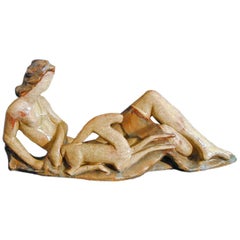
"Diana with Stag, " Art Deco ceramic sculpture
Located in Philadelphia, PA
Strikingly stylized and abstracted, yet sumptuously finished in lustrous glazes in tones of tan and ruddy brown, this long, lean sculpture is the perfect embodiment of Art Deco desig...
Category
Vintage 1930s American Art Deco Figurative Sculptures
Materials
Ceramic
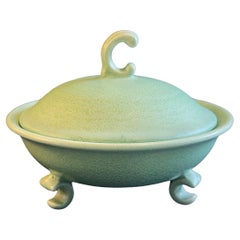
1920s Art Deco Bowl, Pastel Mint Green Glazed Tripod, Korean Vibe, Art Ceramic
Located in Andernach, DE
Gorgeous art deco lidded bowl in a mildly sprinkled, pastel mint green, matte glaze.
An elegantly shaped wave-like handle and Korean or Chinese inspired tripod feet give this piece
i...
Category
Early 20th Century German Art Deco Ceramics
Materials
Ceramic
$170 Sale Price
50% Off
H 4.73 in Dm 5.91 in
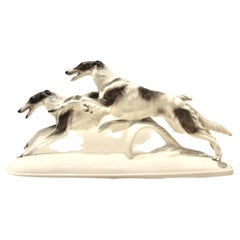
Stunning Goldscheider Vienna Art Deco Ceramic Barzoi Sculpture, signed
By Goldscheider Manufactory of Vienna, GOLDSCHEIDERSCHE PORZELLAN-MANUFACTUR UND MAJOLICA-FABRIK (1885-1953)
Located in Voorburg, NL
A Stunning and beautiful Hand Painted ceramic Barzoi sculpture made in Austria by Goldscheider in the 1930s. This very decorative ceramic barzoi figurine by the renowned company of Friedrich Goldscheider in Vienna - Austria. The manufactory of Goldscheider, one of the most successful companies in European ceramic history, was founded 1885 and is world famous for their outstanding figurines and amazing shaped busts. This beautiful crafted early 20th century prowling ceramic barzoi dogs impresses with its realistic depiction. The timeless beauty and quality of this Goldscheider dogs sculpture makes...
Category
Early 20th Century Austrian Art Deco Ceramics
Materials
Ceramic
$4,136
H 8.27 in W 16.54 in D 3.94 in
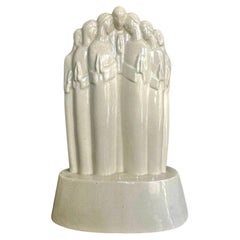
"Supplication, " Art Deco Sculpture from Archipenko
s Ceramic School, Woodstock
By Lu Duble
Located in Philadelphia, PA
One of the rarest and most important sculptures eminating from the ARKO ceramic school established by Alexander Archipenko in Woodstock, New York, this stylized group of praying figu...
Category
Vintage 1920s American Art Deco Figurative Sculptures
Materials
Ceramic
$4,500
H 13 in W 9 in D 3.5 in
More From This Seller
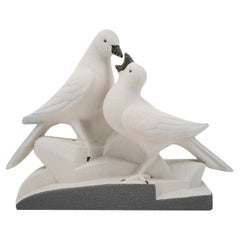
View AllCharles LEMANCEAU Sainte-Radegonde French Art Deco Ceramic Pigeons 1920
By Sainte Radegonde, Charles Lemanceau
Located in Saint-Amans-des-Cots, FR
French Art Deco antelope couple sculpture by Charles LEMANCEAU at Sainte-Radegonde, France, ca.10. Illustrated in the Sainte-Radegonde catalogue, page #8 (see photo). Measures: Width...
Category
Vintage 1920s French Art Deco Animal Sculptures
Materials
Ceramic
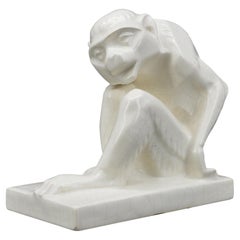
ODYV French Art Deco Ceramic Monkey, 1920
By ODYV
Located in Saint-Amans-des-Cots, FR
This French Art Deco crackle glaze ceramic sculpture by BERLOT-MUSSIER, created in the 1920s in Vierzon, France, features a monkey in a playful and stylized pose. The sculpture stand...
Category
Vintage 1920s French Art Deco Animal Sculptures
Materials
Ceramic
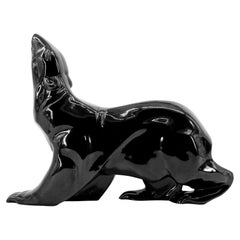
Desbarbieux French Art Deco Ceramic Bear at Saint-Clément, 1920
Located in Saint-Amans-des-Cots, FR
French Art Deco ceramic sculpture of a black bear by Desbarbieux and produced at Saint-Clément, France, 1920s. This piece captures the iconic style of the era, featuring intricate de...
Category
Vintage 1920s French Art Deco Animal Sculptures
Materials
Ceramic
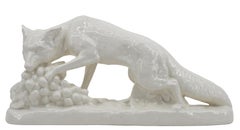
French Art Deco Ceramic Fox by Gustave Gillot for Odyv, 1920
By ODYV, Gustave Gillot
Located in Saint-Amans-des-Cots, FR
French Art Deco ceramic fox sculpture by Gustave Gillot (1888-1965) for Berlot-Mussier), France, 1920s. Illustration of the fable "The Fox and the Grape" by Jean de La Fontaine. Heig...
Category
Vintage 1920s French Art Deco Animal Sculptures
Materials
Ceramic
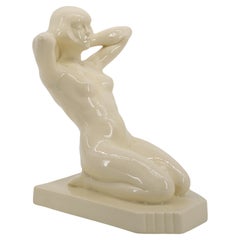
Sarreguemines Art Deco Crackle Glaze Ceramic Lady, 1920
By Faienceries Sarreguemines
Located in Saint-Amans-des-Cots, FR
French Art Deco Crackle Glaze Ceramic Lady Sculpture, France, 1920s. This exquisite French Art Deco ceramic lady features a beautiful cr...
Category
Vintage 1920s French Art Deco Figurative Sculptures
Materials
Ceramic
Lejan Art Deco Crackle Glaze Ceramic Ship Sculpture at Orchies
s, France, 1920
By LEJAN
Located in Saint-Amans-des-Cots, FR
Crackle Glaze Ceramic Sculpture "BOUNTY" by Lejan, Orchies, France, 1920s – Rare Large Art Deco Masterpiece. This exceptional crackle glaze ceramic sculpture titled "BOUNTY" was craf...
Category
Vintage 1920s French Art Deco Figurative Sculptures
Materials
Ceramic