Items Similar to Early 20th Century Bronze Sculpture entitled "Standing Terrier" by Edith Parsons
Want more images or videos?
Request additional images or videos from the seller
1 of 14
Early 20th Century Bronze Sculpture entitled "Standing Terrier" by Edith Parsons
$3,098.28
£2,250
€2,629.38
CA$4,238.34
A$4,619.58
CHF 2,442.33
MX$55,610.93
NOK 30,999.24
SEK 28,419.97
DKK 19,641.56
About the Item
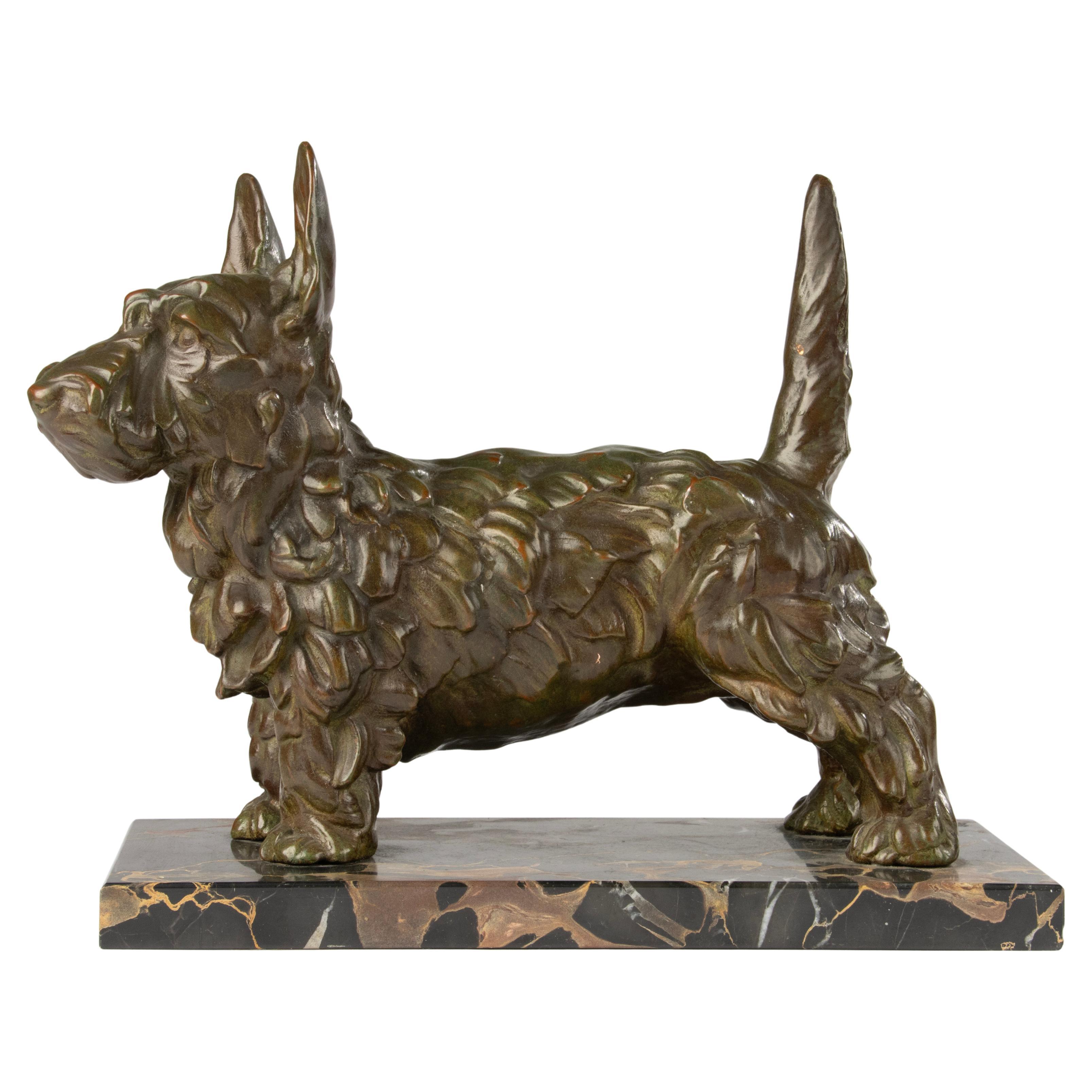
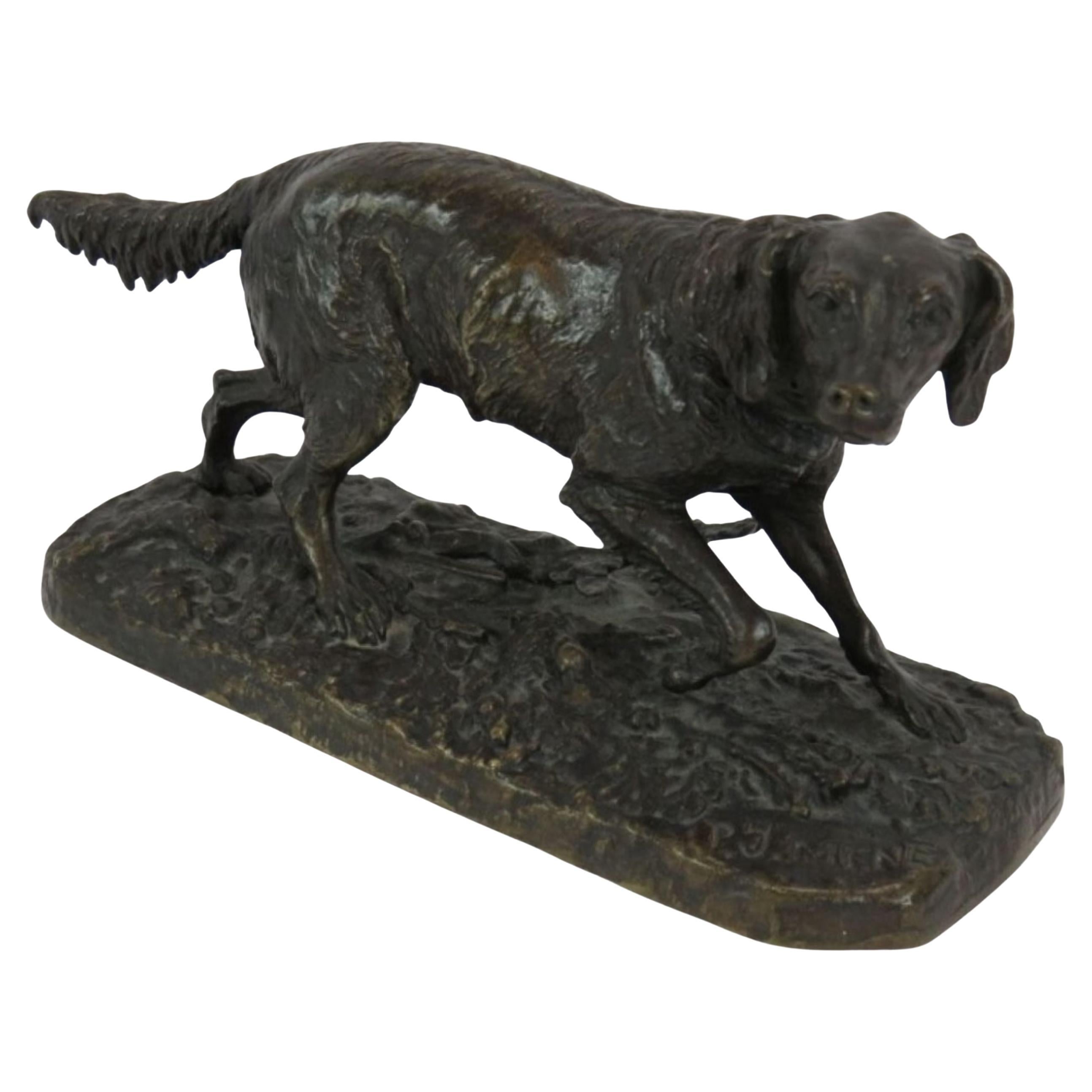
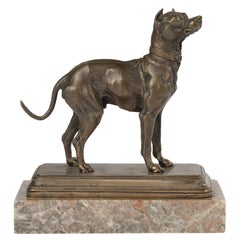
An endearing early 20th Century patinated bronze study of a standing terrier with excellent textured surface detail and colour, raised on a bronze base and signed PB Parsons
ADDITIONAL INFORMATION
Height: 13 cm
Condition: Excellent Original Condition
Circa: 1910
Materials: Bronze
SKU: 9374
ABOUT
Edith Parsons (1878–1956) was an American sculptor renowned for her charming and expressive portrayals of children and animals. Born in Houston, Ohio, she studied at the Art Students League of New York under Daniel Chester French and other prominent artists. Parsons gained early recognition for her playful and tender works, often capturing joyful childhood moments in bronze. Her sculpture Duck Baby (1915) became especially popular, symbolizing innocence and delight. She exhibited widely, including at the 1915 Panama-Pacific International Exposition. Parsons' work remains celebrated for its warmth, vitality, and sensitive observation of her youthful subjects.
- Dimensions:Height: 5.12 in (13 cm)Width: 6.7 in (17 cm)Depth: 1.97 in (5 cm)
- Style:Art Nouveau (Of the Period)
- Materials and Techniques:
- Place of Origin:
- Period:
- Date of Manufacture:1910
- Condition:Wear consistent with age and use.
- Seller Location:London, GB
- Reference Number:Seller: 93741stDibs: LU3216345296572
About the Seller
5.0
Vetted Professional Seller
Every seller passes strict standards for authenticity and reliability
Established in 1936
1stDibs seller since 2017
87 sales on 1stDibs
- ShippingRetrieving quote...Shipping from: London, United Kingdom
- Return Policy
More From This Seller
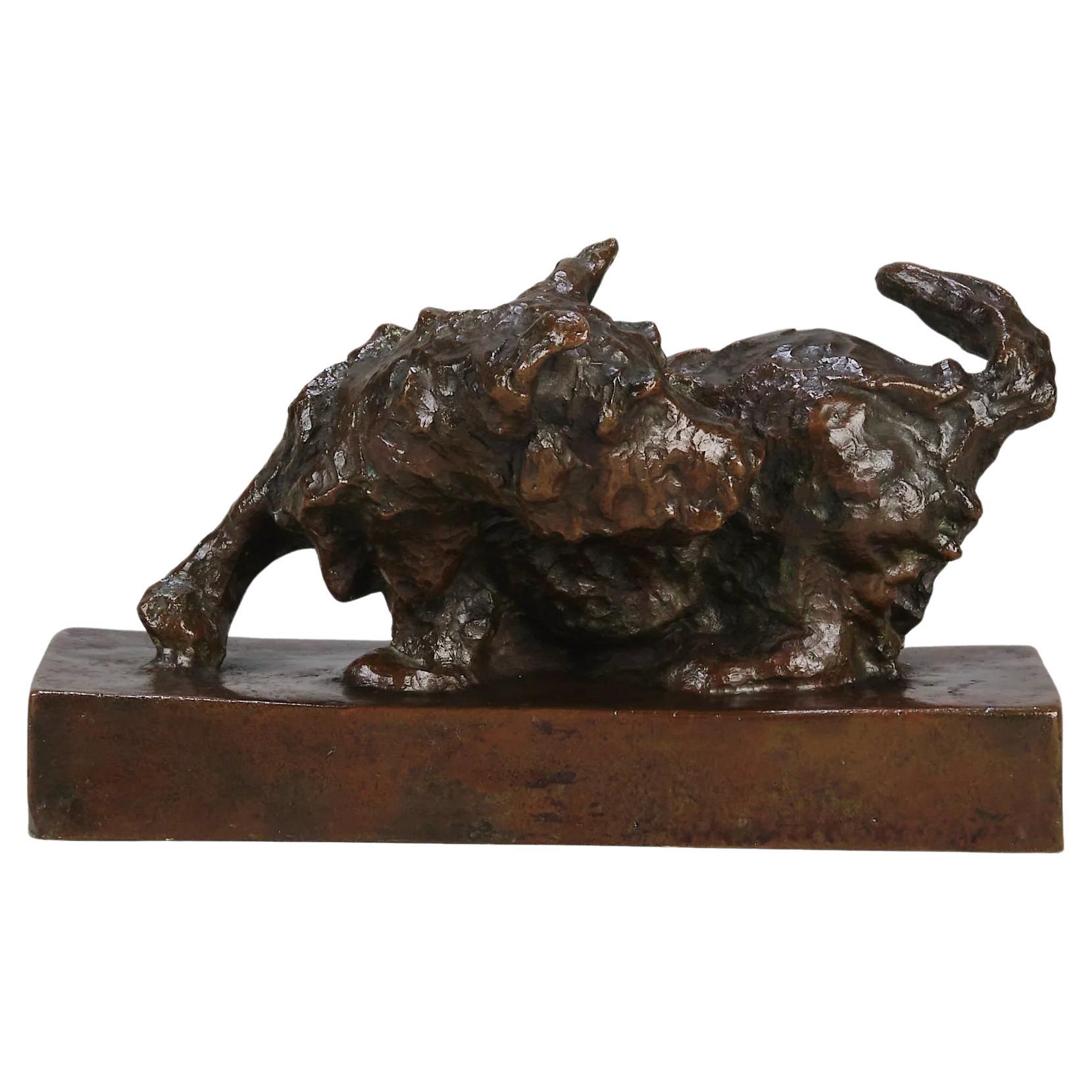
View AllEarly 20th Century Animalier Bronze Sculpture "Turning Terrier" by Edith Parsons
Located in London, GB
A charming early 20th Century patinated bronze study of a turning terrier with excellent textured surface detail and colour, raised on a bronze base and signed E B Parsons...
Category
Early 20th Century North American Art Nouveau Animal Sculptures
Materials
Bronze
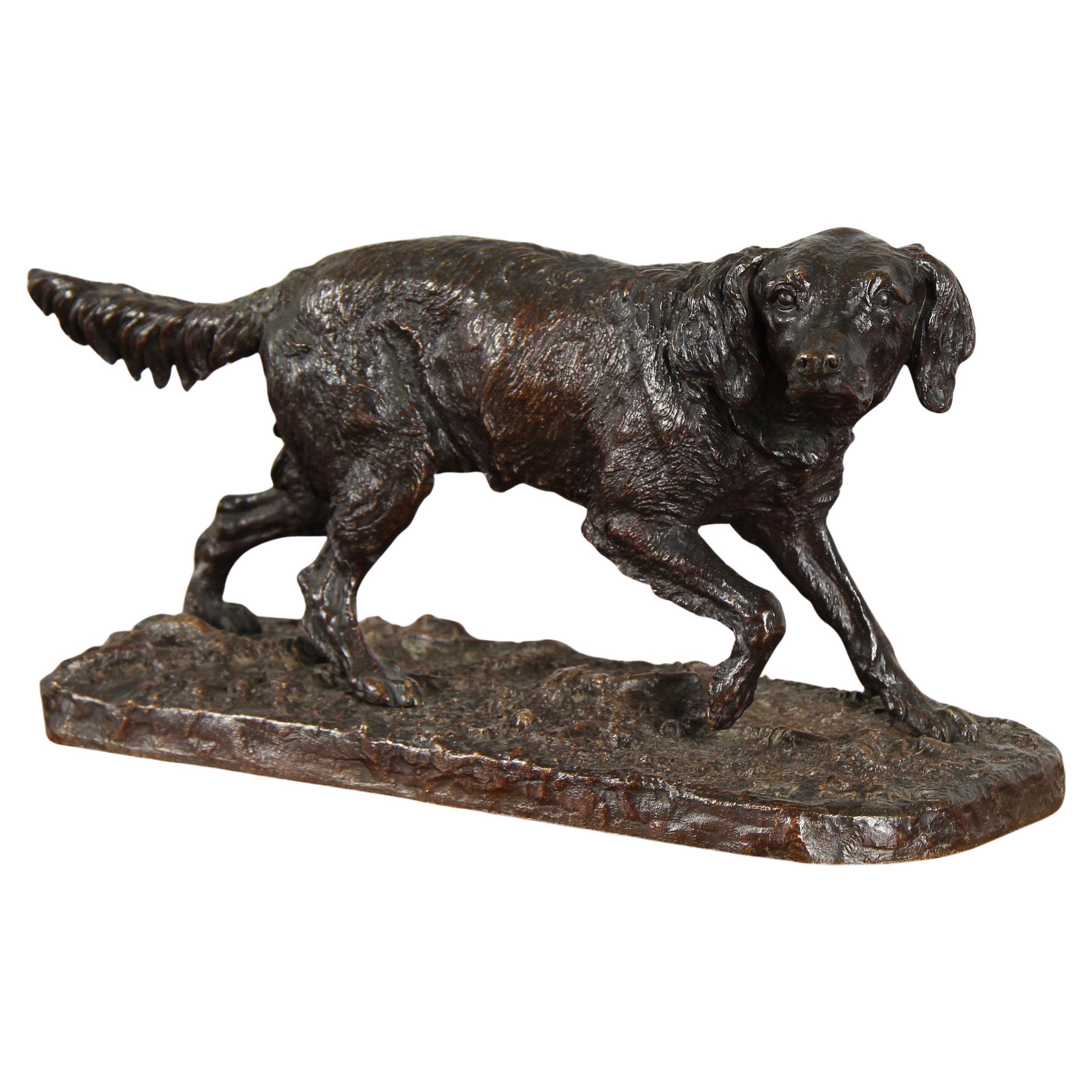
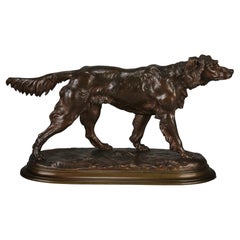
“Standing Setter” French Animaliers Bronze by Jules Moigniez, circa 1870
Located in London, GB
Very fine mid-19th century French Animalier bronze study of a standing Setter with excellent hand chased surface detail and rich brown patination. Raised on a stepped naturalistic base, signed J Moigniez.
Additional information:
Height: 19 cm
Width: 34 cm
Condition: excellent original condition
Circa: 1870
Materials: bronze
Book reference: Les Animaliers by Jane Horswell
Page no. 237
About
Jules Moigniez (French, 1835 ~ 1894) Moigniez was a French animalier sculptor of the 19th century. He worked primarily in bronze and frequently exhibited his sculptures at the Paris salon. He was best known for his bronzes depicting birds, although his skill and versatility enabled him to produce quality horse sculptures (primarily racehorses), dog sculptures and hunting scenes. His bird sculptures were among the finest ever created in his time. Moigniez was born at Senlis, Oise, France in 1835, the son of a metal gilder. Moigniez’s father bought a foundry to cast his sculptures, which was of great benefit to Moigniez as he didn’t have the added foundry costs that most of his contemporaries had to pay. Moigniez studied sculpture under the tutelage of Paul Comoléra (a student of François Rude) in Paris. It is quite likely that Moigniez’s attraction to bird sculpture was a direct result of his education under Comoléra, who was himself a bird specialist. Over the course of his 40-year sculpting career Moigniez exhibited thirty works at the Salon between 1855–92. His first submission in a major art exhibition was his plaster, Pointer Stopping at a Pheasant, at the Exposition Universelle of 1855.[1][2] Moigniez was known for the fine detail and chiseling of his sculptures. His bronzes—usually cast using the lost wax method—were always immaculately chased and patinated, and were especially popular in England and Scotland.[2] More than half of his output during his lifetime was sold in the United Kingdom. By the end of the 19th century, his sculpture had become popular in the United States as well. In contrast with other animaliers of the period such are P.J. Mêne and Antoine-Louis Barye, Moigniez’s bird sculptures often incorporated highly detailed bases complete with bushes, extensive foliage and undergrowth. His castings were generally of excellent quality with a variety of patinas, the gilded and silvered patinas being the most desirable and sought after by collectors. His bronzes could be reproached for an excess of detail, a result of overly-finicky, over-worked chiseling. Moigniez received redemption, however, by portraying in his sculpture a certain “elegance of attitudes”. His Chien braque...
Category
Antique 19th Century Animal Sculptures
Materials
Bronze
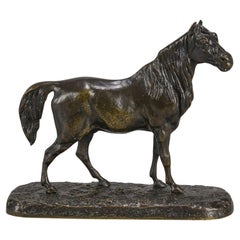
Late 19th Century Animalier Bronze Sculpture "Cheval Arabe No.3" by Pierre Jules
By Pierre Jules Mêne
Located in London, GB
"Cheval Arabe No.3" by Pierre Jules Mene
An attractive late 19th Century Animalier bronze study of an arab stallion. The bronze exhibiting excellent hand chased surface detail and g...
Category
Antique 19th Century French Art Nouveau Animal Sculptures
Materials
Bronze
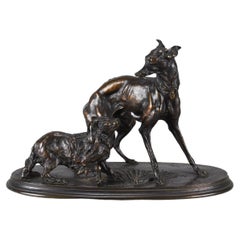
Anamilier Bronze Entitled "Greyhound and King Charles Spaniel" by P J Mêne
By Pierre Jules Mêne
Located in London, GB
Delightful mid 19th Century French Animaliers bronze study of a playful Greyhound and King Charles Spaniel, with rich brown rubbed to a golden colour and fine hand chased surface det...
Category
Antique 1870s Art Nouveau Animal Sculptures
Materials
Bronze
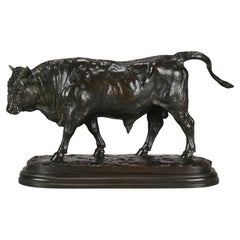
19th Century Animalier French Bronze Entitled "Taureau Debout" by Rosa Bonheur
By Rosa Bonheur
Located in London, GB
"Taureau Debout" by Rosa Bonheur.
An excellent late 19th Century French animalier bronze study of a standing bull with fine hand chased surface that accentuates the muscle definition of the subject, signed Rosa B.
ADDITIONAL INFORMATION
Measures: Width: 32 cm
Height: 18 cm
Depth: 11cm
Condition: Excellent Original Condition
Circa: 1870
Materials: Bronze
Book reference: Animals in Bronze by Christopher Payne
Page no. 174
DESCRIPTION
Bonheur, Rosa (1822-1899)
The most popular artist of nineteenth-century France, Rosa Bonheur was also one of the first renowned painters of animals and the first woman awarded the Grand Cross by the French Legion of Honor. A professional artist with a successful career, Bonheur lived in two consecutive committed relationships with women.
Born on March 16, 1822 in Bordeaux, Marie Rosalie Bonheur was the oldest of the four children of Raimond Oscar Bonheur (1796-1849) and Sophie Marquis. Bonheur's father was an art teacher who came from a poor family, while her mother, a musician, had descended from a middle-class family and had been her husband's art student.
Bonheur's father, who taught drawing and landscape painting, was an ardent member of the utopian Saint Simeon society.
The group held idealistic beliefs about the reform of work, property, marriage, and the role of women in society. Most importantly, for the artist's future, the Saint Simeons questioned traditional gender norms and firmly believed in the equality of women. While teaching artistic techniques to his oldest daughter, Raimond Bonheur also encouraged her independence and taught her to consider art as a career.
In 1828 Raimond Bonheur joined the Saint Simeons at their retreat outside Paris. Sophie and the children joined him in Paris the following year. Four years later, however, Raimond abandoned his family to live in isolation with his fellow Saint Simeons.
Sophie Bonheur died in 1833 at the age of thirty-six. Rosa was only eleven years old when her mother died, but she was aware of the heavy price her mother paid for married life with a man who was more dedicated to his own ideals than to meeting his family's needs. Rosa also saw that her mother's marriage led to poverty and her death from exhaustion.
After her mother's death, Bonheur was taken in by the Micas family who resided nearby. Mme Micas and Bonheur's mother had been friends. When Mme Bonheur died, the Micas family paid Raimond Bonheur's debts and cared for Rosa. Their daughther, Nathalie, who would later become an amateur inventor and unschooled veterinarian, and Rosa became enamored with each other.
When Rosa Bonheur began her career as a professional artist, she had already been trained by her father who had allowed her to study in all male classes. Rosa also learned by sketching masterworks at the Louvre from the age of fourteen, and later, by studying with Léon Cogniet.
From the very beginning, Bonheur's favorite subject was animals. She learned their anatomy completely by dissecting them in local slaughterhouses. She also visited the horse market two times a week. Study of animals by direct observation led to the formation of the realist style in which Bonheur worked.
It was for such work that Bonheur obtained written permission from the French government to wear men's slacks. Her working attire also consisted of a loose smock and heavy boots that protected her feet from the dangerous environment in which she painted. The style of dress that the artist adopted for work and home may well have been influenced by her father's attire, which was based on St. Simeonian clothing experiments. Bonheur also cropped her hair, perhaps to facilitate her work. She did, however, always wear dresses for social occasions because she knew that appropriate dress would further her career.
Bonheur earned a successful living as a painter of animals. She exhibited at the annual Paris Salon regularly from the age of nineteen in 1841 through 1853, when she was thirty-one. She won the salon's gold medal at the age of twenty-six in 1848 and was commissioned by the French government to paint Plowing on the Nivernais in 1849. In the same year Bonheur and her sister Juliette became directors of l'École gratuite de dessin pour les jeunes filles, a post their father had once held.
Bonheur completed her most renowned work, The Horse Fair, in 1855. The successful representation of percherons (a breed native to Normandy) was purchased by Ernest Gambart, a London art dealer whose gallery specialized in work by French artists. He exhibited The Horse Fair in London where Bonheur visited with Nathalie. Queen Victoria requested a private viewing of the painting at Windsor Castle. It would later be purchased in 1887 by Cornelius Vanderbilt and donated to the new Metropolitan Museum of Art in New York City.
Bonheur's trip to England allowed her to meet Charles Eastlake, then President of the Royal Academy, John Ruskin, the English writer and critic, and Edwin Landseer, the British animalier. She also toured the English and Scottish countrysides and executed some paintings based on her observations of new breeds of animals found there.
Gambart made engravings of Bonheur's work, including The Horse Fair, and sold them in England, Europe, and the United States. Bonheur became one of the most renowned painters of the time. Little girls, such as Anna Klumpke in the United States, even had dolls in her likeness, much as American girls played with Shirley Temple dolls...
Category
Antique 19th Century French Art Nouveau Animal Sculptures
Materials
Bronze
Animalier Bronze Sculpture Entitled "Bear and Rabbit" by Charles Paillet
By Charles Paillet
Located in London, GB
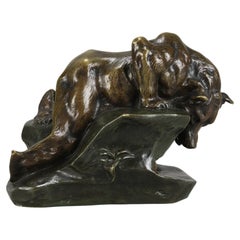
An amusing early 20th Century bronze group of a bear peering over the edge of a rock at a rabbit quietly hiding under a ledge, with excellent rich brown patina and fine hand chased surface detail. Signed Paillet
ADditional information
Measures: Height: 18 cm.
Condition: Excellent Original Condition.
circa: 1910.
Materials: Patinated Bronze.
ABOUT
Charles Paillet
Charles Paillet (French, 1871 ~ 1937) Paillet studied sculpture under Georges Gardet. Paillet’s first exhibit was in the Salon of 1897 and he exhibited regularly until 1921. Most of his works were cast by the foundry Thiebault Freres both in lost wax and by the sand-cast method. A few of his works have been recorded bearing the F. Barbedienne foundry mark also. Charles Paillet, Georges Gardet, Rene Paris...
Category
Early 20th Century French Art Deco Animal Sculptures
Materials
Bronze
You May Also Like
Late 19th Century French Bronze Dog, Pierre-Jules Mène, circa 1870
Located in Greven, DE
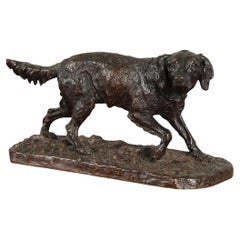
Pierre-Jules Mène - Pointing dog
France
Bronze
around 1870
Dimensions: H x W x D: 16 x 33 x 12 cm
Description:
This animal bronze by Pierre-Jules Mène shows a long-haired hunting ...
Category
Antique Late 19th Century French Animal Sculptures
Materials
Bronze
Antique Bronze Sculpture of a Scottie Dog - Early 20th Century
Located in Casteren, Noord-Brabant
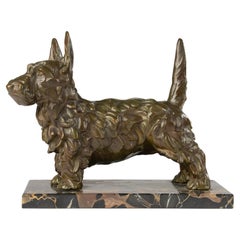
A lovely bronze animal sculpture. This charming bronze sculpture depicts a characterful terrier, most likely a Scottish Terrier, captured in an alert and proud stance.
Crafted in the...
Category
Vintage 1920s French Art Deco Animal Sculptures
Materials
Marble, Bronze
19th century bronze dog , setter , after p j mene
Located in York, GB
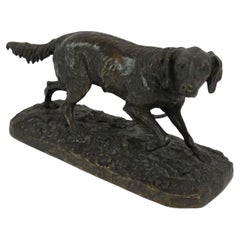
A fine bronze Animalier sculpture of a setter dog after the renowned French sculptor p j mene
from a private collector
Height: 11cm. Length: 21.5cm base 7 cm
Signed in excellent cond...
Category
Antique 19th Century French Animal Sculptures
Materials
Bronze
19th Century Bronze Sculpture of a Terrier Dog - made by Alfred Dubucand
By Alfred Dubucand
Located in Casteren, Noord-Brabant
A beautiful small bronze sculpture by the French Animalier / artist Alfred Dubucand.
It is a terrier dog, very refined bronze with beautiful details.
Alfred Dubucand (1828-1894) is a...
Category
Antique Mid-19th Century French Napoleon III Animal Sculptures
Materials
Marble, Bronze
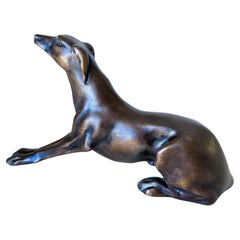
Antique Bronze Sculpture of a Dog in brown Patina, Austria, ca. 1920
Located in Auribeau sur Siagne, FR
bronze of a Dog antique figure.
Offered is a Viennese bronze figure of a Dat dating to the early 20th century. He shows an antique patina .
Category
Antique Early 1900s Austrian Animal Sculptures
Materials
Bronze
$432 Sale Price
20% Off
French Antique Bronze Dog Sculpture Signed
Located in Tampa, FL
An antique bronze dog on a rouge marble base. Signed P.J. Mene. France, circa 1890s.
Category
Antique 1890s French Animal Sculptures
Materials
Marble, Bronze