Items Similar to Greyhound - Shaped Glass Sculpture, Flavio Poli, I.V.A.M. Murano, Circa 1930
Video Loading
Want more images or videos?
Request additional images or videos from the seller
1 of 18
Greyhound - Shaped Glass Sculpture, Flavio Poli, I.V.A.M. Murano, Circa 1930
$4,826.23
£3,537
€4,000
CA$6,624.24
A$6,999.61
CHF 3,764.43
MX$83,798.35
NOK 47,163.87
SEK 43,195.26
DKK 30,472.83
About the Item
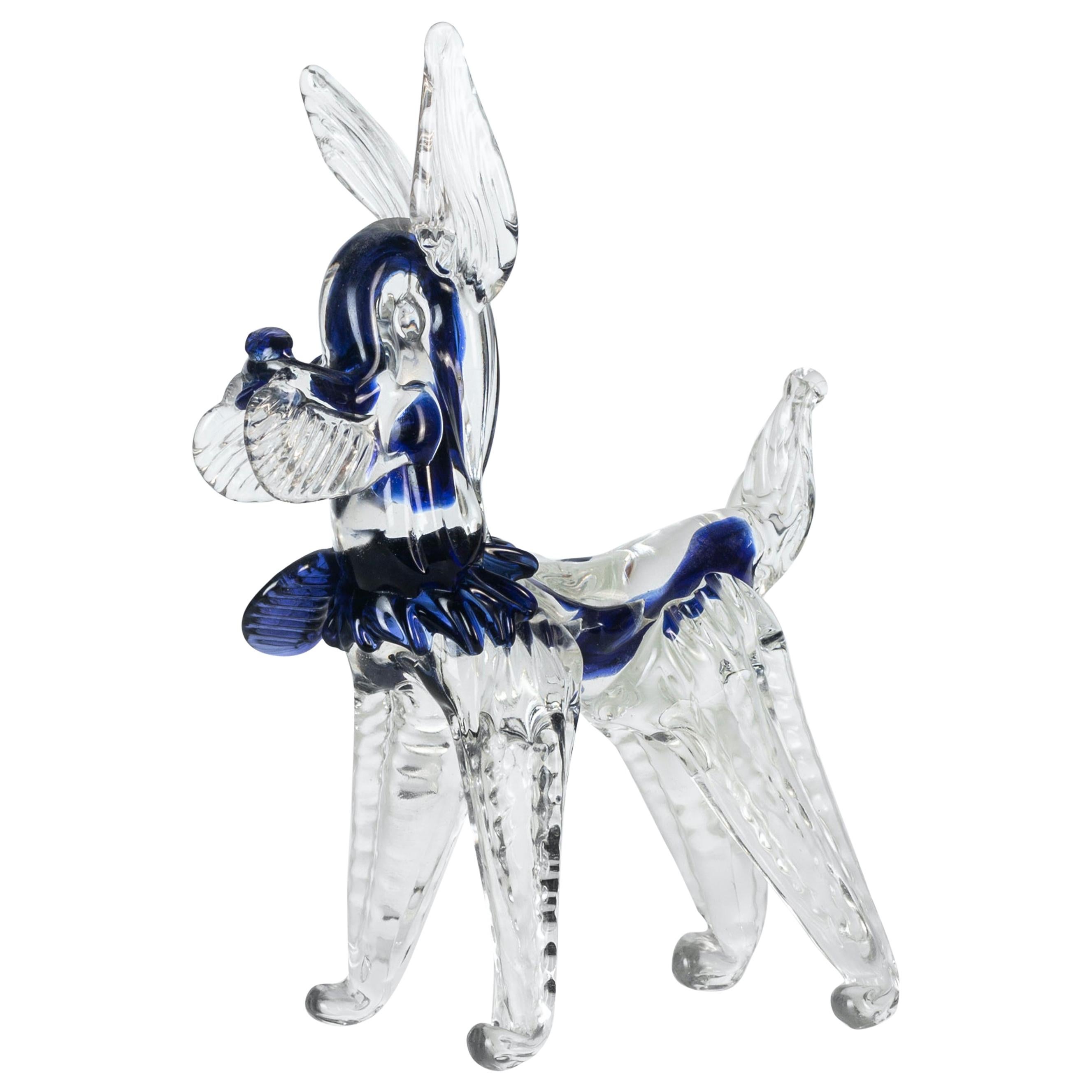
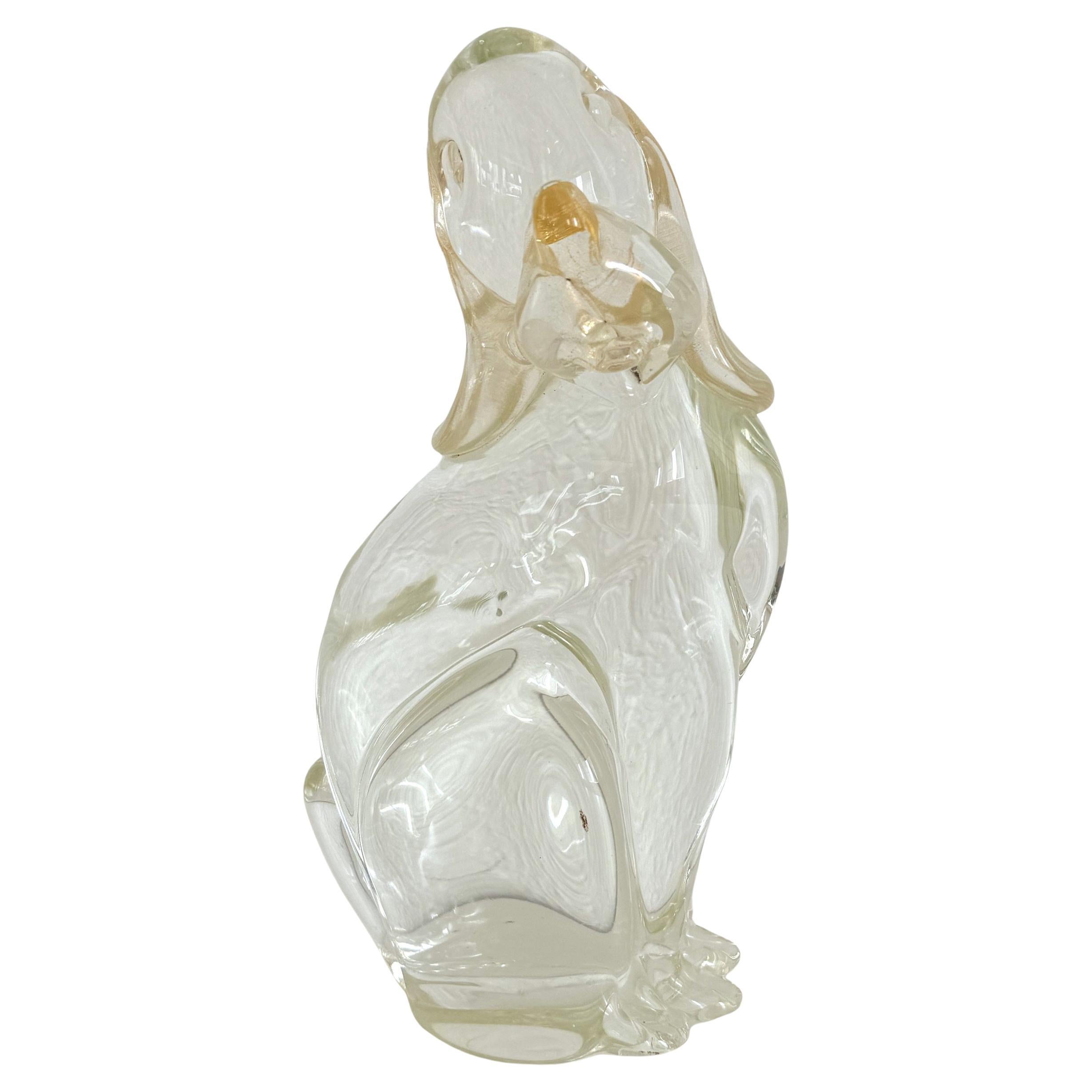
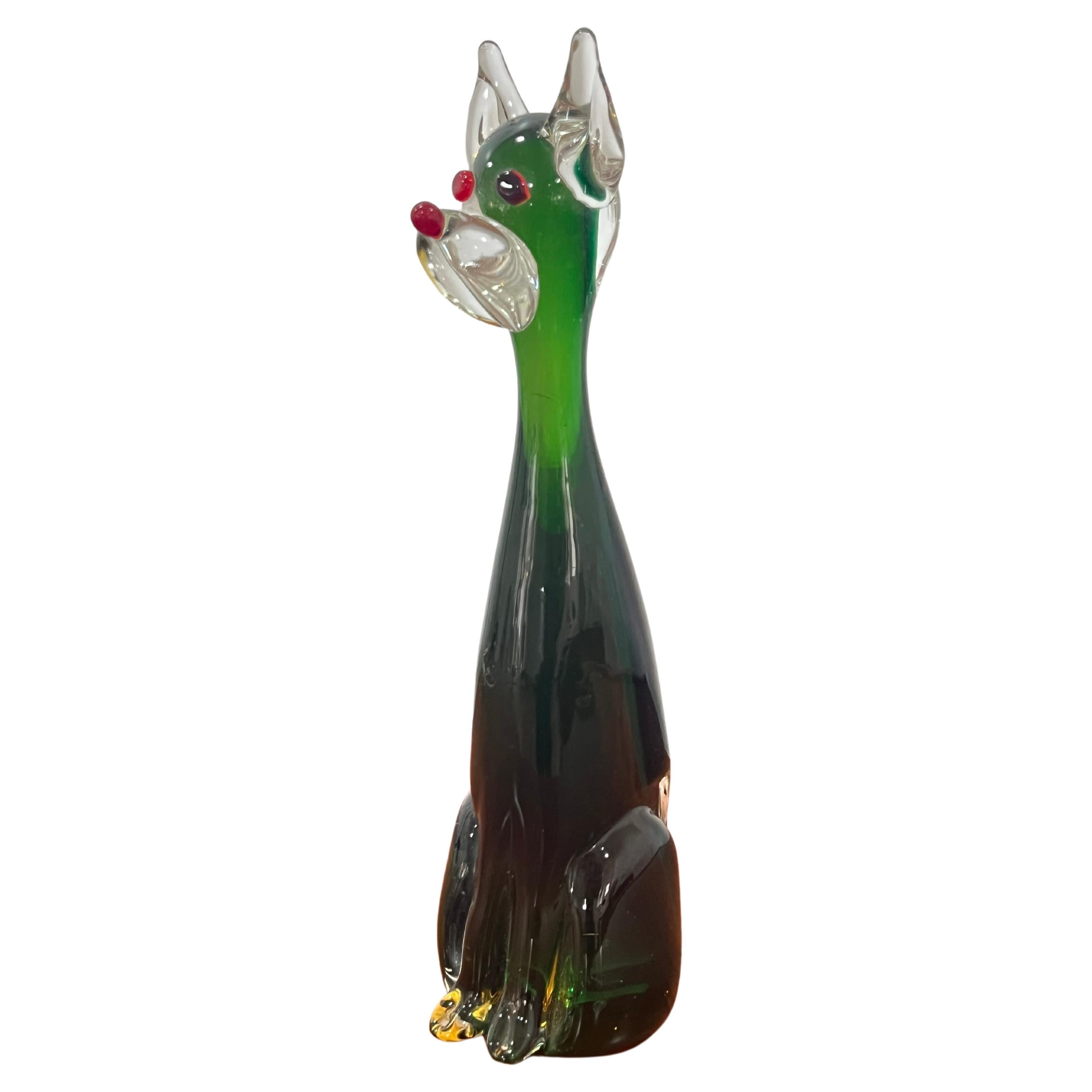
Greyhound - shaped glass sculpture
Flavio Poli
I.V.A.M. Murano, circa 1930
It measures 4.72 in in height x 12.59 x 3.74 (12 cm x 32 x 9.5)
It weighs 2.42 lb (1.1 kg)
State of conservation: intact
The solid amber-colored glass sculpture with black and white glass paste eyes is the work of Flavio Poli and depicts a greyhound dog. It is datable to about 1930 and was probably made by master glassmaker Otello Nason using the author's original design (Rosa Barovier Mentasti in Cristina Beltrami and Giordana Naccari, eds., L'Arca di Vetro, La collezione di animali di Pierre Rosenberg, Milan, 2021, p. 43).
The figure is modeled to represent the playful attitude of a greyhound. Its front legs have been brought forward, its torso is down, and its rear is up. Its tail is high and curled, with the whole figure seemingly ready to run at a snap. Its muzzle rests on its paws, with mouth closed and ears upright. The use of solid amber-colored glass made on the grinding wheel, with hot-applied parts, makes the fairly large sculpture unusual and rich in color. Flavio Poli designed this sculpture probably around the 1930s when he was active in the I.V.A.M. glassworks in Murano.
A similar specimen, with non-intact tail, was displayed at the exhibition L'arca di Vetro held on the island of San Giorgio from April 26 to November 2, 2021, and was published in the related catalog (Cristina Beltrami and Giordana Naccari, op. cit., p. 94 n. 033).
Another example is a greyhound from the Bersellini collection, displayed in Milan in the exhibition on glass animals at the Museo di Storia naturale and attributed in the catalogue to the production of S.A.I.A.R.- Ferro Toso in the 1930s. (R. Chiesa, S. Ciappi, S. Pezzoli, eds, Gli animali di Murano, Opere in vetro dalla collezione Bersellini 1920-2015, Marsilio Editori, Venice, 2016, fig. no. 2).
Flavio Poli (Chioggia, 1900 - Venice, 1984) had a background related to ceramic art and collaborated in the early 1930s with the ceramic workshops of I.C.A.M. in Murano, of which Libero Vitali was a member. Vitali himself had at the same time also founded I.V.A.M. (Industria Vetraria Artistica Muranese) and encouraged Flavio Poli to engage with glass art as well. His animals and nude figures were a critical success, moving from blown to solid glass specimens (Rosa Barovier Mentasti in Cristina Beltrami and Giordana Naccari, eds., op. cit., p. 43).
In 1934, after I.V.A.M. went bankrupt and was taken over by the Zecchin glassworks. Flavio Poli became art director of Barovier Seguso
Ferro, becoming a partner in 1937. With that qualification he began the production of what were considered his most original and successful creations: the "sommersi" vases, specimens blown in such a way as to emphasize the different layers of glass without adding any surface decoration.
Between 1950 and 1960 Poli won numerous awards including the Compasso d'Oro and the Grand Prix at the Milan Triennale.
Bibliography:
Cristina Beltrami and Giordana Naccari, eds, The Glass Ark, The Animal Collection of Pierre Rosenberg, Milan, 2021.
- Attributed to:Flavio Poli (Artist)
- Dimensions:Height: 4.73 in (12 cm)Width: 12.6 in (32 cm)Depth: 3.75 in (9.5 cm)
- Style:Modern (Of the Period)
- Materials and Techniques:
- Place of Origin:
- Period:
- Date of Manufacture:Circa 1930
- Condition:Intact.
- Seller Location:Milano, IT
- Reference Number:1stDibs: LU4352242584952
About the Seller
4.4
Vetted Professional Seller
Every seller passes strict standards for authenticity and reliability
Established in 1860
1stDibs seller since 2018
23 sales on 1stDibs
Typical response time: 5 hours
Associations
International Confederation of Art and Antique Dealers
Associations
- ShippingRetrieving quote...Shipping from: Milano, Italy
- Return Policy
More From This Seller
View AllGlass Parrot-Shaped Sculpture, Dino Martens, Venice, Aureliano Toso, 1953-1956
By Dino Martens
Located in Milano, IT
Parrot-shaped sculpture Psitaccus
Dino Martens (1894 - 1970)
Vetreria Artistica Rag. Aureliano Toso, 1953-1956
It measures 9.055 inches in height x 4.13 in x 5.90 in (23 cm, 10.5 cm x 15 cm)
It weighs 1.997 lb (906 g)
State of conservation: intact.
The small glass sculpture...
Category
Vintage 1950s Italian Modern Glass
Materials
Blown Glass
Pair of glass sculptures, Cats, Archimede Seguso, Murano, circa 1960-1970
By Archimede Seguso
Located in Milano, IT
Pair of glass sculptures Cats
Archimede Seguso (attr.)
Seguso Vetri d’arte
Murano, circa 1960-1970
Dimensions:
achrome cat: height 9.45 in x 4.49 in x 5.24 (24 cm x 11.4 x 13.3); ...
Category
Vintage 1960s Italian Other Animal Sculptures
Materials
Murano Glass
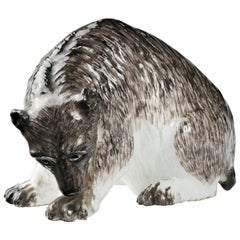
Meissen Porcelain Bear, Johann Gottlieb Kirchner, Johan Joachim Kaendler, 1735
By J.J. Kaendler
Located in Milano, IT
Hard porcelain bear modeled and painted in gray-brown and black
Manufacture of Meissen, by Johann Gottlieb Kirchner and Johan Joachim Kaendler, 1735
It...
Category
Antique 1730s German Baroque Porcelain
Materials
Porcelain
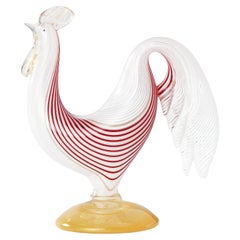
Murano Glass Rooster-Shaped Sculpture, Dino Martens, Venice Aureliano Toso, 1954
By Dino Martens
Located in Milano, IT
Rooster- shaped sculpture Galletto
Dino Martens (1894 - 1970)
Vetreria Artistica Rag. Aureliano Toso, 1954
It measures 9.25 inches in height x 8.18 in x 4.4 in (23.5 cm x 20.8 cm x 11.4 cm)
It weighs 2.57 lb (1.169 g)
State of conservation: intact.
The small glass sculpture...
Category
Vintage 1950s Italian Modern Animal Sculptures
Materials
Glass
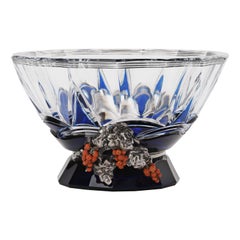
Italian 1940s Crystal Bowl, Milan, circa 1940
By Eliseo Mangili
Located in Milano, IT
Crystal bowl with silver and coral decorative elements
Eliseo Mangili (1890-1977)
Milan, circa 1940
It measures 4.8 in high x Ø 8.26 in; foot Ø 4.33 in (12.2 x Ø 21 cm; Ø foot 11 cm)
5.51 lb (2.55 kg)
The rounded bowl narrows and rests on a flared foot with a polygonal section in blue crystal. The bowl itself is crafted in transparent crystal and continues the polygonal motif. The base of the bowl is decorated with a series of engraved blue arches which somewhat overlap creating a corolla and with five vertical cusps of the same colour. The rim is accented with a triple cut line around the entire circumference.
A silver band representing a currant branch wraps the “waist” where the foot joins the bowl with currants made of orange coral.
The bowl features the following marks along the silver band which defines its narrowing towards the foot. These help us date the work:
1) a lozenge with the abbreviation of the province (MI); Roman fasces; the number 08. This was the mark in force after the promulgation of the law of 5 February 1934 n. 305, which provided for the use of a uniform mark for the identification of the silversmith and of the province. In this case it is the Milanese smith Eliseo Mangili during the period 1935-1944.
2) 800 without a border. Title in thousandths of silver.
Eliseo Mangili was one of the most talented goldsmiths flanking Alfredo Ravasco...
Category
Vintage 1930s Italian Other Decorative Bowls
Materials
Coral, Crystal, Silver
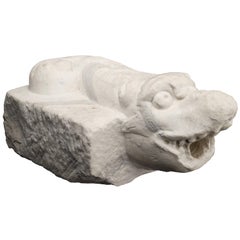
Italian Ancient Marble Sculpture Fountain, Late 16th Century
Located in Milano, IT
Sea monster
Carrara marble mouth fountain
Italy, late 16th century
It measures 13.8 x 31.5 x 18.9 in (35 x 80 x 48 cm)
State of conservation: some small evident gaps and widespread signs of wear due to outdoor exposure. The gray marks crossing it do not come from restoration, but are rather the natural veins of the marble.
This work has some morphological characteristics typically associated with the iconography of the sea monster: an elongated muzzle, sharp teeth, protruding eyes, elongated ears, and a coiled serpent's tail.
An in-depth series of studies on artistic depictions of the sea monster attempted to verify how this symbol evolved in antiquity in the European and Mediterranean contexts and how it gradually changed its image and function over time. The iconography itself is mutable and imaginative and its history is rich with cultural and artistic exchange, as well as the overlapping of ideas. This occurred so much that it is difficult to accurately pinpoint the "types" that satisfactorily represent its various developments.
However, we can try to summarize the main figures, starting from the biblical Leviathan and the marine creature that swallowed Jonah (in the Christian version, this figure was to become a whale or a "big fish", the “ketos mega”, translation of the Hebrew “dag gadol”). Other specimens ranged from the dragons mentioned in the Iliad (which were winged and had legs) to "ketos” (also from Greek mythology), the terrifying being from whose Latinized name (“cetus”) derives the word "cetacean". See J. Boardman, “Very Like a Whale” - Classical Sea Monsters, in Monsters and Demons in the Ancient and Medieval Worlds, in Papers presented in Honor of Edith Porada, Mainz am Rhein 1987, pp. 73-84).
In Italy the monster underwent yet further variations: it can be found in Etruscan art on the front of some sarcophagi representing the companion of souls, while among the Romans we find the “Pistrice” (cited by Plinio in Naturalis Historia PLIN., Nat., II 9, 8 and by Virgilio in Eneide: VERG., Aen., III, 427), which appeared in the shape of a stylized hippocampus or a very large monstrous cetacean and evolved into a hideous being with a dragon's head and long webbed fins.
During the Middle Ages, the sea monster was the object of new transformations: at this time, it is often winged, the head is stretched like a crocodile, the front legs are often very sharp fins - sometimes real paws - until the image merges with dragons, the typical figures of medieval visionary spirituality widely found throughout Europe (on this topic and much more, see: Baltrušaitis, J., Il Medioevo fantastico. Antichità ed esotismi nell’arte gotica, Gli Adelphi 1997).
In Italy during the 15th and 16th centuries, the revival of classicism - representative of the humanistic and Renaissance periods - led to a different reading of these "creatures". Indeed, the sea monster was also to find widespread use as an isolated decorative motif, especially in numerous fountains and sculptures where dolphins or sea monsters were used as a characterizing element linked to water (on this theme see: Chet Van Duzer, Sea Monsters on Medieval and Renaissance Maps, London, The British library, 2013).
From the morphological point of view, the "sea monsters" of this period are mostly depicted as hybrid figures, in which the body of a mythological or real being (a hippocampus, a sea snake, a dolphin), is joined to a head with a rather indistinct appearance. It was usually characterized by large upright ears, an elongated snout, sharp teeth and globular, protruding eyes; a complex and indefinite figure, both from the symbolic point of view and from that of its genesis.
The work we are examining is placed as a cross between the medieval sea serpent and the Renaissance dolphin, with stylistic features which recall the snake as often used in heraldry (such as the "snake" depicted in the coat of arms of the Visconti - the lords and then dukes of Milan between 1277 and 1447 - and which, for some, may be derived from the representations of the “Pistrice” that swallowed Jonah).
In the search for sources, Renaissance cartography and in particular woodcuts should not be neglected. See for example the monsters of Olaus Magnus, from the editions of the “Historia de gentibus septentrionalibus” (“History of the peoples of the north”) and the natural histories of Conrad Gesner, Ulisse...
Category
Antique 16th Century Italian Renaissance Animal Sculptures
Materials
Carrara Marble
You May Also Like
Vintage Murano Glass Dog, 1980s
Located in Roma, IT
Murano glass dog is a beautiful glass decorative object, realized by Murano manufacture during the 1980s.
This object belongs to the exclusive and...
Category
Vintage 1980s Italian Animal Sculptures
Materials
Murano Glass
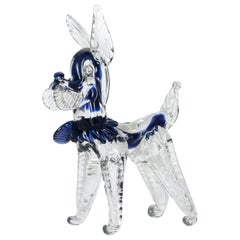
Silvano Signoretto Murano Glass Sculpture of Dog, 1990s
By Silvano Signoretto
Located in Morazzone, Varese
Beautiful glass sculpture made by Italian Murano Glass Master Silvano Signoretto (born 1948) during the 1990s.
The sculpture shows a sitting dog, hand crafted of transparent Murano ...
Category
Late 20th Century Italian Mid-Century Modern Figurative Sculptures
Materials
Murano Glass
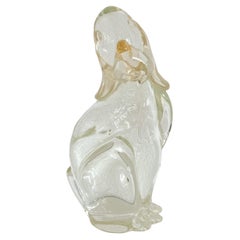
Italian Green Murano Glass Dog Sculpture, 1960s
Located in Byron Bay, NSW
Art Glass from murano island Italy, sculpture in green glass 1960s.
Category
Vintage 1960s Italian Mid-Century Modern Animal Sculptures
Materials
Murano Glass
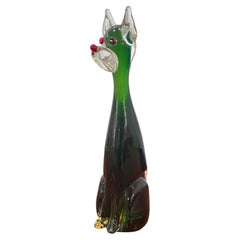
Italian Green Murano Glass Dog Sculpture, 1960s
Located in Byron Bay, NSW
Art Glass from murano island Italy, sculpture in green glass 1960s.
Category
Vintage 1960s Italian Mid-Century Modern Animal Sculptures
Materials
Murano Glass
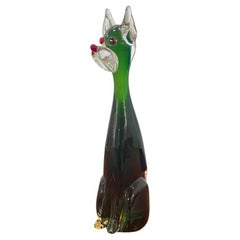
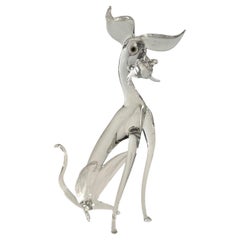
Murano Glass Dog - Italy
Located in Beuzevillette, FR
Murano glass dog.
Magnificent Murano glass dog, hand-blown with pliers.
Beautifully crafted, fine, and delicate, the glass is beautifully colored.
A superb collector's item.
Three o...
Category
20th Century Italian Animal Sculptures
Materials
Murano Glass
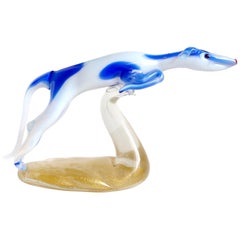
Murano Opal White Blue Gold Italian Art Glass Whippet Greyhound Dog Sculpture
By Cenedese, Venini
Located in Kissimmee, FL
Beautiful and rare, vintage Murano hand blown opalescent white and cobalt blue spots Italian art glass leaping whippet or greyhound dog sculpture, on gold flecks base. The piece is v...
Category
Mid-20th Century Italian Art Deco Animal Sculptures
Materials
Gold Leaf
$1,675 Sale Price
33% Off
More Ways To Browse
Flavio Poli Murano Art Glass
White Ceramic Hands Sculpture Italian
Barovier E Toso Murano Vase
1950s Murano Vase Barovier And Toso
Specimen Vase
Pierre Rosenberg
Greyhound Glass
Terracotta Bird
Vintage Stone Figurine
Vintage Swordfish
Vintage Wooden Elephants
White Dog Ceramic
Wood Carousel Animals
Wood Chinese Horses
Antique Terracotta Dog
Art Deco Bronze Panther
Art Deco Dolphin
Art Deco Parrot