Want more images or videos?
Request additional images or videos from the seller
1 of 21
Pair of 16th Century Italian Renaissance Carved Wooden Lion Supports
$2,200List Priceper set
About the Item
- Dimensions:Height: 15.5 in (39.37 cm)Width: 8 in (20.32 cm)Depth: 8.25 in (20.96 cm)
- Sold As:Set of 2
- Style:Renaissance (Of the Period)
- Materials and Techniques:
- Place of Origin:
- Period:
- Date of Manufacture:1500s
- Condition:Wear consistent with age and use. Minor losses. Good antique condition. Commensurate losses, not including small chips to the affixing blocks. Minor nicks and age separations. Light traces of old woodworm damage.
- Seller Location:Dallas, TX
- Reference Number:Seller: 424-112D1stDibs: LU906341882962
About the Seller
5.0
Vetted Professional Seller
Every seller passes strict standards for authenticity and reliability
Established in 1983
1stDibs seller since 2011
883 sales on 1stDibs
Authenticity Guarantee
In the unlikely event there’s an issue with an item’s authenticity, contact us within 1 year for a full refund. DetailsMoney-Back Guarantee
If your item is not as described, is damaged in transit, or does not arrive, contact us within 7 days for a full refund. Details24-Hour Cancellation
You have a 24-hour grace period in which to reconsider your purchase, with no questions asked.Vetted Professional Sellers
Our world-class sellers must adhere to strict standards for service and quality, maintaining the integrity of our listings.Price-Match Guarantee
If you find that a seller listed the same item for a lower price elsewhere, we’ll match it.Trusted Global Delivery
Our best-in-class carrier network provides specialized shipping options worldwide, including custom delivery.You May Also Like
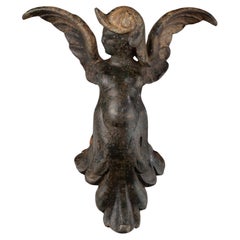
Renaissance Harpy - Italy, 16th century
Located in Bruxelles, BE
Renaissance Harpy
bronze
Italy, 16th century
15 x 12 x 5,5 cm
This expressive bronze figure represents a harpy, a mythological creature with the body of a bird and the head and tor...
Category
Antique 16th Century Italian Renaissance Figurative Sculptures
Materials
Bronze
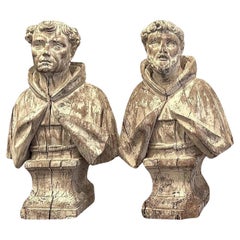
Pair of 16th Century Italian Wooden Busts
Located in Los Angeles, CA
A pair of hand carved and parcel painted carved busts.
Category
Antique 16th Century Busts
Materials
Wood, Paint
Pair of 16th Century Italian Wooden Busts
Located in Los Angeles, CA
A pair of hand carved and parcel painted carved busts.
Category
Antique 16th Century Italian Busts
Materials
Wood, Paint

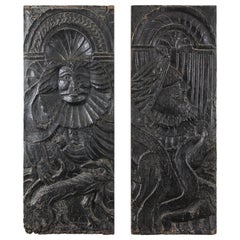
Renaissance Period Hand Carved Oak Panels, 16th Century
Located in Beuzevillette, FR
Set of two 16th century oak panels, one representing a character accompanied by a dog, the other a character in flames, probably saints.
These ...
Category
Antique 16th Century French Renaissance Figurative Sculptures
Materials
Oak
$1,234 Sale Price / set
20% Off
H 20.28 in W 8.27 in D 0.99 in
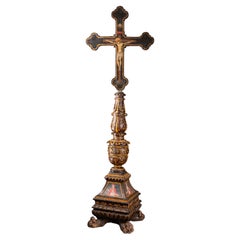
renaissance wooden candelabrum and painted cross - Umbria, 16th century
Located in Bruxelles, BE
Base of a carved wooden candelabrum, polychrome and gilded; cross painted on both sides.
Umbria or Tuscany, 16th century
136 x 43,5 x 30 cm
(The cross and the base of the candelabrum were later assembled)
The base of the candelabrum is intricately carved and adorned with polychrome and gilded finishes. The shafts take on the shape of balusters reminiscent of ancient columns, feature ornate foliage decorations, garlands and winged cherub faces. The feet are crafted in the likeness of lion paws. The base is further embellished with depictions of four saint martyrs, among them Saint Barbara and Saint Catherine of Alexandria. The plasticity of the figures, outlined with strong contour lines, the clear and vibrant colors, are stylistic elements linked to the Umbrian tradition of the sixteenth century.The precisely defined and elegant drawing, along with the clear color palette applied with refined chiaroscuro modulations, became the signature of a style that would leave a lasting mark on the era to come. This is exemplified by a preference for vibrant, multicolored images, accentuated in this case by the use of red and pink in the saint's attire.
A notable addition, introduced later, is a polylobed cross painted on both sides. On one side, the Crucifixion is vividly portrayed:The treatment of the corpus itself is in line with High Medieval practice, emphasizing pathos by showing Jesus dead, his arms sagging from the weight of the body. The upper section displaying a pelican pecks at her breast to feed her young with her own blood; a symbol of the sacrifice of Christ on the cross whose body and blood similarly nourishes the celebrant during Mass.
The lower part depicts Golgotha. On the reverse side, the Resurrection is artistically presented in a Renaissance iconography, reminiscent of the renowned composition painted by Piero della Francesca, now housed in the Civic Museum of Sansepolcro. In terms of composition, with the frontal depiction of Christ holding the banner, this motif became particularly widespread in central Italy, spanning from Tuscany to Umbria throughout the 16th century..
The double-sided construction suggests that it may also have been carried in liturgical processions. In Umbria from the 14th century, the use of portable crosses painted on both sides had become a widespread practice, aimed at satisfying the monastic clientele that had significantly increased following the establishment of new religious communities.
The earliest surviving Tuscan painted crucifix represent Christ as Christus Triumphans, or the “Triumphant Christ” with his head up and eyes open. This form was supplanted in the 13th century with the Christus Patiens, or “Suffering Christ” type who is shown often with his head fallen on his shoulder and his eyes closed, as In our cross. The iconography of the suffering Christ appears to have developed out of a new interest in Christ’s human nature, the development of the feast of Corpus Christi and with increased importance given to the Eucharist. The process of humanizing the figure of Christ reaches its peak with the abandonment of all the previous expressive conventions in favor of more realistic details we can observe in this Crucifix, such as the swollen belly, the arms stretched to the limit of muscle tearing, the body falling heavily forward, the abundant blood on
the wounds, and the cross firmly embedded in the rock of Calvary.
It's worth noting that Renaissance candelabra...
Category
Antique 16th Century Italian Renaissance Figurative Sculptures
Materials
Wood, Giltwood
$23,731
H 53.55 in W 17.13 in D 11.82 in
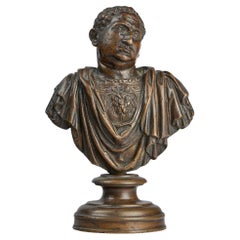
Italian Renaissance 16th Century Bronze Bust of Emperor Vitellius
Located in London, GB
North Italian, 16th century
Bust of the emperor Vitellius
Bronze, on later bronze socle, lead support to reverse
18 cm. / 7 ins (the bust), 23 cm. / 9 ins overall
This small yet attractive all’antica bust of a Roman emperor is inspired by a bust in Venice thought to depict Vitellius (15-69 AD), who ruled Rome for only eight months in 69 AD before he was overthrown by Vespasian.
The Vitellio Grimani, also known as the pseudo-Vitellius, was discovered in Rome in 1505 during excavations on the Quirinale on land owned by the Venetian cardinal Domenico Grimani (1461-1523). On the death of Grimani the Vitellius was sent to Venice and bequeathed to the Republic of Venice, where it was displayed at the Palazzo Ducale from 1525 to 1593. It is now in the Museo arceologico nazionale di Venezia (inv. 20) and regarded as a portrait of an unknown Roman from the first half of the second century AD.
The present small bust, with its rough, waxy surface and imaginative adaptation of the antique model on which it is based, bears all the hallmarks of Renaissance bronze modelling in the north of Italy. Indeed, the vigorous modelling is reminiscent of the works by Andrea Briosco, called Il Riccio (1470-1532), who worked in Padua in the Veneto and specialised in small bronzes based on antique subjects. See, for example, his head of Bacchus (private collection, offered at Sotheby’s London in 2021), which has a similarly waxy treatment of the hair.
The fantastical lion-mask on the breastplate, with its stylised face and unusual braids of hair, is also typical of the imaginative re-working of antique motifs by Renaissance artists. This indicates that the present bust is probably by a follower of Riccio working in Padua or another centre of classicism in the Veneto.
RELATED LITERATURE:
L. Planiscig, 'Andrea Riccio...
Category
Antique 16th Century Italian Renaissance Busts
Materials
Bronze
$7,385 Sale Price
20% Off
H 9.06 in W 6.5 in D 2.37 in
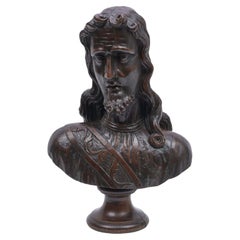
A Monumental 16th Century Renaissance Carved Oak Bust of Jesus Christ
Located in Queens, NY
Magnificent and Monumental 16th Century Renaissance Carved Oak Bust of Christ, Flemish Netherlandish, C. 1550
A powerful and deeply expressive Renaissance carved oak bust of Jesus C...
Category
Antique 16th Century Dutch Renaissance Busts
Materials
Oak
$34,700
H 24 in W 17.5 in D 9.5 in
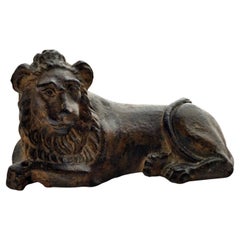
Lion of Forge, Spain, 16th Century
Located in Madrid, ES
Lion of Forge, Spain, 16th century
In forging, measurements: 10 x 17 x 5 cm
Good condition
Spanish private collection.
Category
Antique 16th Century Spanish Baroque Animal Sculptures
Materials
Iron
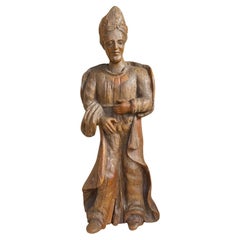
16th-century Flemish Female Wooden Sculpture
By A. Manzoni
Located in Villa Verucchio, Emilia-Romagna
Prologue: An Ancient Mastery the Wooden Sculpture
We begin our journey through Gothic art by presenting a magnificent Late Gothic Female Wooden Sculpture from the Flemish 500s. This ...
Category
Antique 16th Century Belgian Renaissance Figurative Sculptures
Materials
Wood
A 16th century carved marble sculpture of poseidon
Located in London, GB
This fine and imposing sculpture is an excellent example of 16th century Italian craftsmanship. The figure is stood on a raised, shaped rectangular base with a carved "dolphin" at th...
Category
Antique 16th Century Italian Renaissance Figurative Sculptures
Materials
Marble
More From This Seller
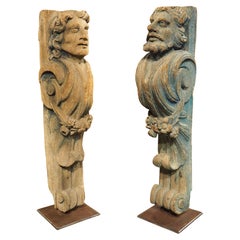
View AllPair of 16th Century Carved Wooden Terms or Beam Supports from Northern Europe
Located in Dallas, TX
A fascinating bit of history, this pair of carved wooden terms dates to the High Renaissance during the 1500s. A term is a beam support in the form of a human head where the bust con...
Category
Antique 16th Century European Renaissance Busts
Materials
Metal, Iron
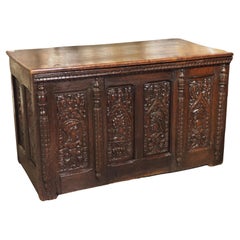
16th Century French Renaissance Chest in Carved Oak
Located in Dallas, TX
Whereas many pieces of furniture during the Italian Renaissance were heavily painted or inlaid with decorative motifs, French examples utilized hand-sculpted elements as the predomin...
Category
Antique 16th Century French Renaissance Blanket Chests
Materials
Wood, Oak
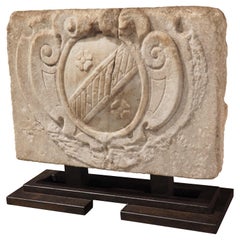
Carved and Mounted Marble Stemma Cartouche from Tuscany, Italy, 16th Century
Located in Dallas, TX
The carvings of this marble stemma cartouche dates to the 1500’s. Hand-carved in Tuscany, Italy, the marble was mounted onto a geometrically shaped iron stand within the last century...
Category
Antique 16th Century Italian Mounted Objects
Materials
Marble
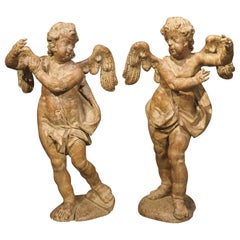
Pair of 18th Century Carved Wooden Winged Cherubs from Italy
Located in Dallas, TX
Originally from 18th-century Italy, this pair of winged cherubs were hand-carved from wood as reflections of each other, meaning that their bodies are orientated as mirror images. Bo...
Category
Antique 18th Century Italian Figurative Sculptures
Materials
Wood, Paint
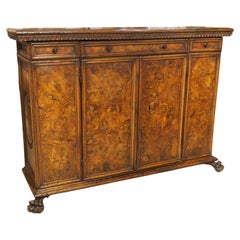
16th Century Italian Renaissance Walnut and Burr Walnut Intarsia Credenza
Located in Dallas, TX
A beautiful piece of Italian furniture, dating to the High Renaissance of the 1500s, this walnut credenza has a fascinating intarsia burr façade. The front, which consists of three b...
Category
Antique 16th Century Italian Renaissance Credenzas
Materials
Wood, Walnut, Burl
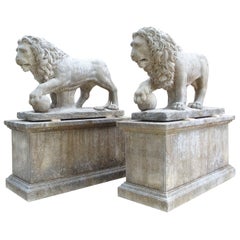
The Lions of Florence, Monumental Pair of Italian Carved Limestone Medici Lions
Located in Dallas, TX
The monumental size of this pair of hand-carved limestone lions is quite impressive, and their stature has been embellished by positioning them on classic, rectangular pedestals. Florence, Italy, is known for its artistic depictions of lions, ranging from the city’s coat of arms to the famous Marzocco lion that is currently part of Piazza della Signoria, and of course, the Medici lions, which inspired this pair.
Just like the original Medici, these lions mirror...
Category
21st Century and Contemporary Italian Neoclassical Animal Sculptures
Materials
Stone, Limestone
Still Thinking About These?
All Recently ViewedMore Ways To Browse
Renaissance Wood Carved
Antique 1500s
16th France Renaissance
French Wood Carved Animals
Renaissance Cassone
Lion Sculpture Pair French
Sculpture Renaissance Lion
16th Century Wooden Sculpture
Elephant Skin
Horse And Roman
Horse On Stand
Horse Polychrome
Italy Ronzan
Lions Of Foo
Mid Century 3 Birds Ceramic
Murano Sommerso Fish
Royal Elephant
Seguso Bird