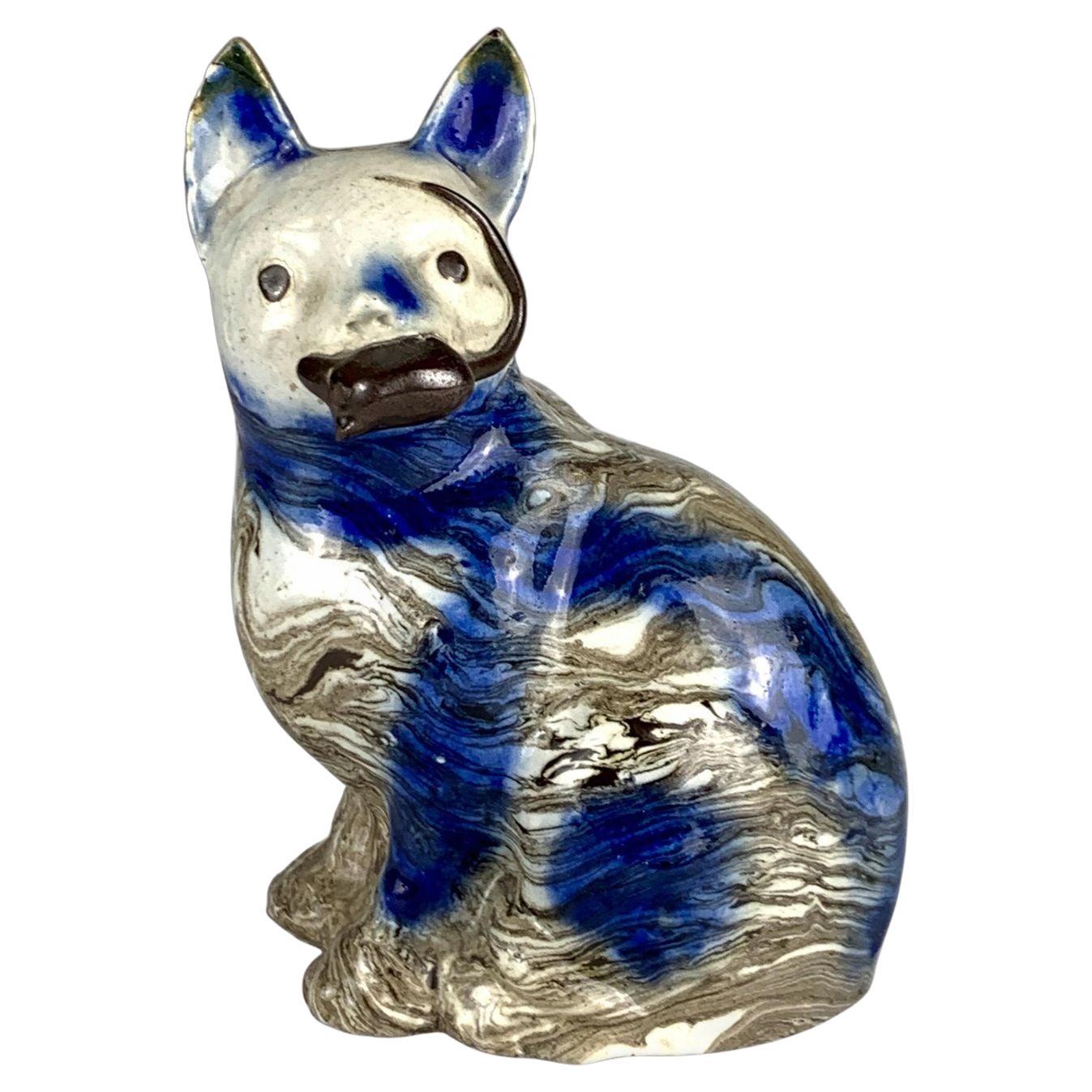
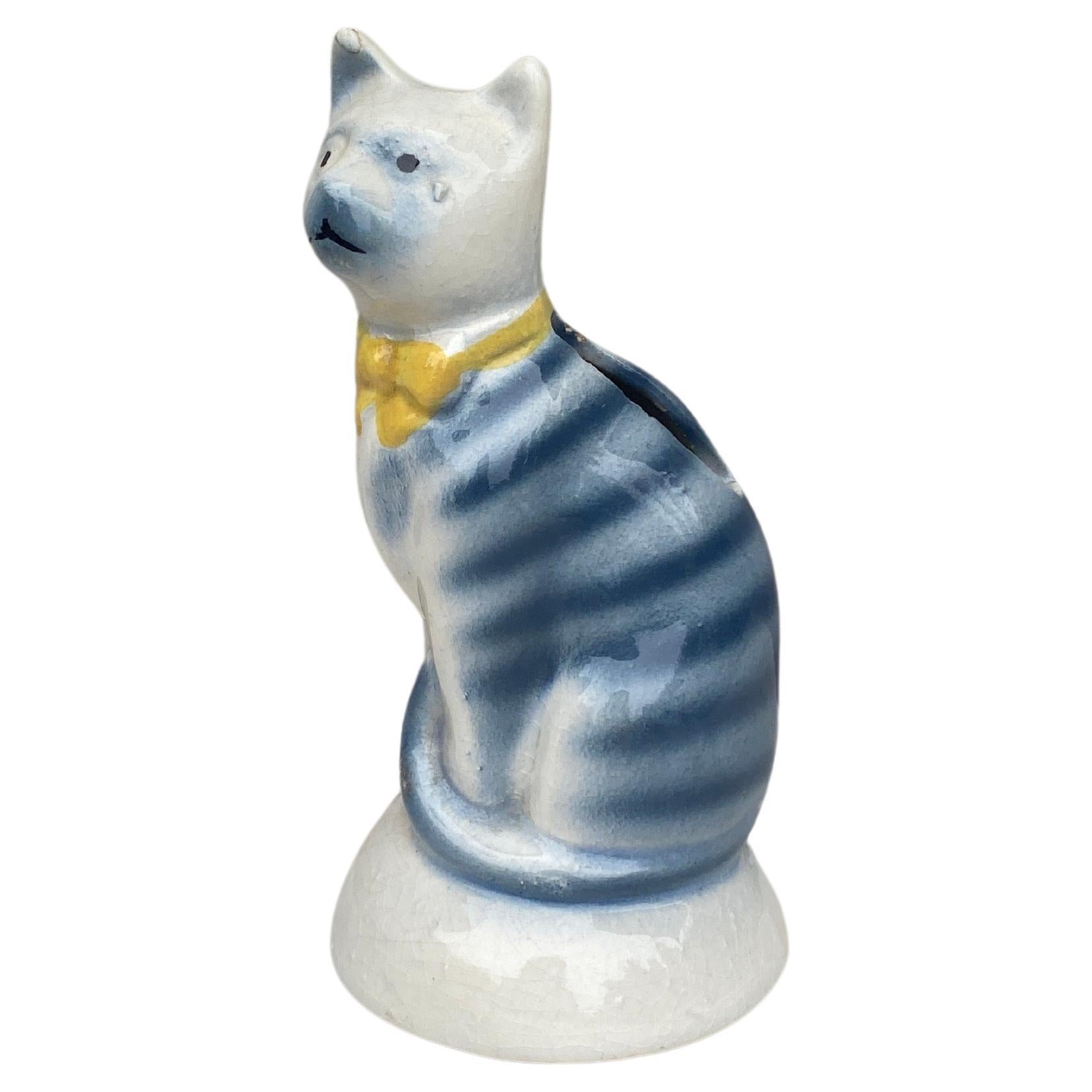
Salt-Glazed Solid Agateware Cat with Candle Holder, Staffordshire, Mid-18th C.
About the Item
- Creator:Staffordshire (Manufacturer)
- Dimensions:Height: 5.5 in (13.97 cm)Width: 2.5 in (6.35 cm)Depth: 3 in (7.62 cm)
- Style:Folk Art (Of the Period)
- Materials and Techniques:Stoneware,Molded
- Place of Origin:
- Period:
- Date of Manufacture:Circa 1745-1760
- Condition:
- Seller Location:Katonah, NY
- Reference Number:Seller: SKU000012461stDibs: LU866544797532
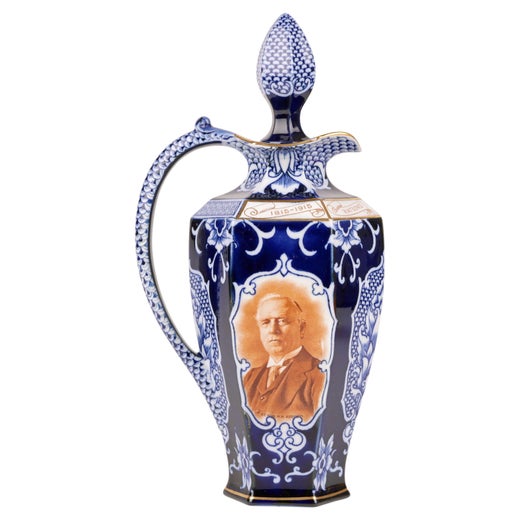
Staffordshire
Thanks to its reserves of clay, lead, salt and coal, Staffordshire, England, has been a center for ceramics since the early 17th century. The county was home at one time to hundreds of pottery workshops and as many as 4,000 bottle-shaped kilns that operated year-round. The term “Staffordshire Potteries” refers to the industrial area of Stoke-on-Trent — comprising the towns Burslem, Fenton, Hanley, Longton, Stoke and Tunstall — where most of the production was concentrated.
In 1720, potter John Astbury discovered that he could make what would later be called creamware by adding ground flint powder to the local red clay. Because resources were so plentiful in Staffordshire, local potters could afford to experiment, working to refine their techniques and designs. One such innovator was Thomas Whieldon, an important 18th-century potter known today for his tortoiseshell ware, whose brilliant glazed surface of caramel, yellow and green hues was made with copper and manganese compounds.
Whieldon operated the Fenton Low workshop, making coffee- and teapots, dinner services and even ornamental knife hafts. He was an influential figure: Josiah Spode apprenticed at the workshop prior to opening his company in 1770, and Josiah Wedgwood partnered with Whieldon for five years before establishing his eponymous firm in 1759.
Wedgwood is perhaps the best known of the Staffordshire potters. The firm produced a line of light-colored earthenware for Queen Charlotte, who liked it so much that she granted permission to market it under the moniker Queen’s Ware, which despite the name, was designed for everyday use.
In the same regal vein, in 1773, Wedgwood created the 954-piece Frog service for Catherine the Great, of Russia. The company is also known for its black stoneware, Black Basalt, which imitates the color and shapes of Etruscan vases; Jasperware, with its classical reliefs applied on the unglazed body; and pearlware.
By the end of the 18th century, Staffordshire was the primary producer of ceramics for the American colonies, even creating patriotic wares celebrating independence for this market. The imagery on Staffordshire ceramics became more standardized during the mid-18th century with the advent of transferware, in which a design etched on a copper plate is printed on tissue paper, which is then used to transfer the wet ink onto the ceramic surface. This technique enabled artisans to decorate their wares with complex scenes that wrapped around an object’s surface and make several copies of popular patterns.
The Staffordshire potters also produced decorative figurines, such as this charming pair of cows dating from the 19th century. Particularly popular in Great Britain were pieces with hunting imagery, such as this George IV porcelain stirrup cup in the shape of a fox head wearing a gilt collar inscribed with the word “Tallyho.” Among the many whimsical vessels produced is this mid-19th-century frog mug. The exterior is painted with a charming scene of people picking fruit on one side and ladies on a garden swing on the other side, while inside a molded frog’s head at the bottom of the mug makes a gurgling sound when the beverage has been almost completely consumed.
On 1stDibs, find a range of antique ceramics from the Staffordshire Potteries including decorative objects, tea sets, dinner plates and other items.
- ShippingRetrieving quote...Shipping from: Katonah, NY
- Return Policy
More From This Seller
View AllAntique Mid-19th Century English Country Animal Sculptures
Pottery
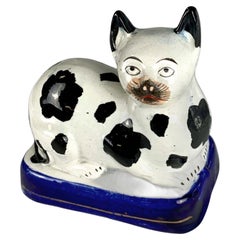
Antique Mid-18th Century English Folk Art Animal Sculptures
Stoneware
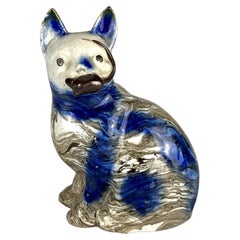
Antique 1830s English Animal Sculptures
Porcelain
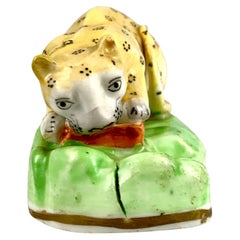
Antique Late 18th Century French Rococo Delft and Faience
Faience
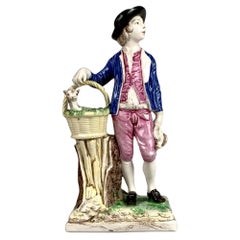
Antique Late 18th Century Delft and Faience
Delft
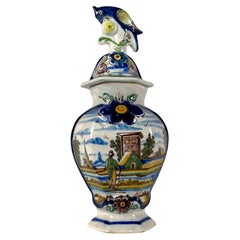
Antique Early 19th Century English Folk Art Animal Sculptures
Creamware
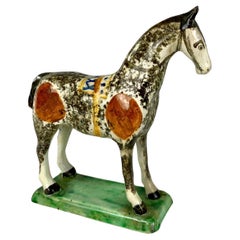
You May Also Like
Vintage 1970s English Animal Sculptures
Ceramic
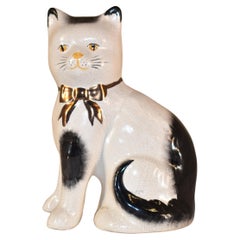
Antique Early 1900s French Country Decorative Boxes
Ceramic
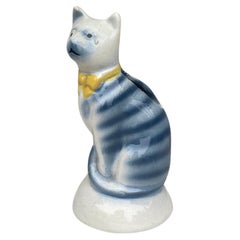
Mid-20th Century Italian Mid-Century Modern Animal Sculptures
Ceramic, Majolica, Pottery
20th Century Danish Animal Sculptures
Porcelain
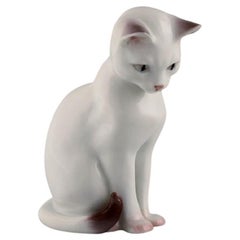
Vintage 1950s German Animal Sculptures
Porcelain
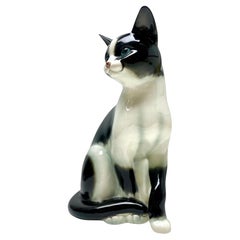
20th Century Finnish Scandinavian Modern Animal Sculptures
Porcelain