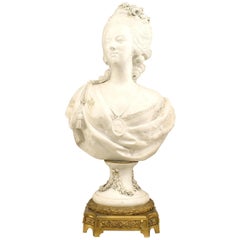
Items Similar to Antique Sevres Bisque Porcelain Bust Marie Antoinette 19th Century
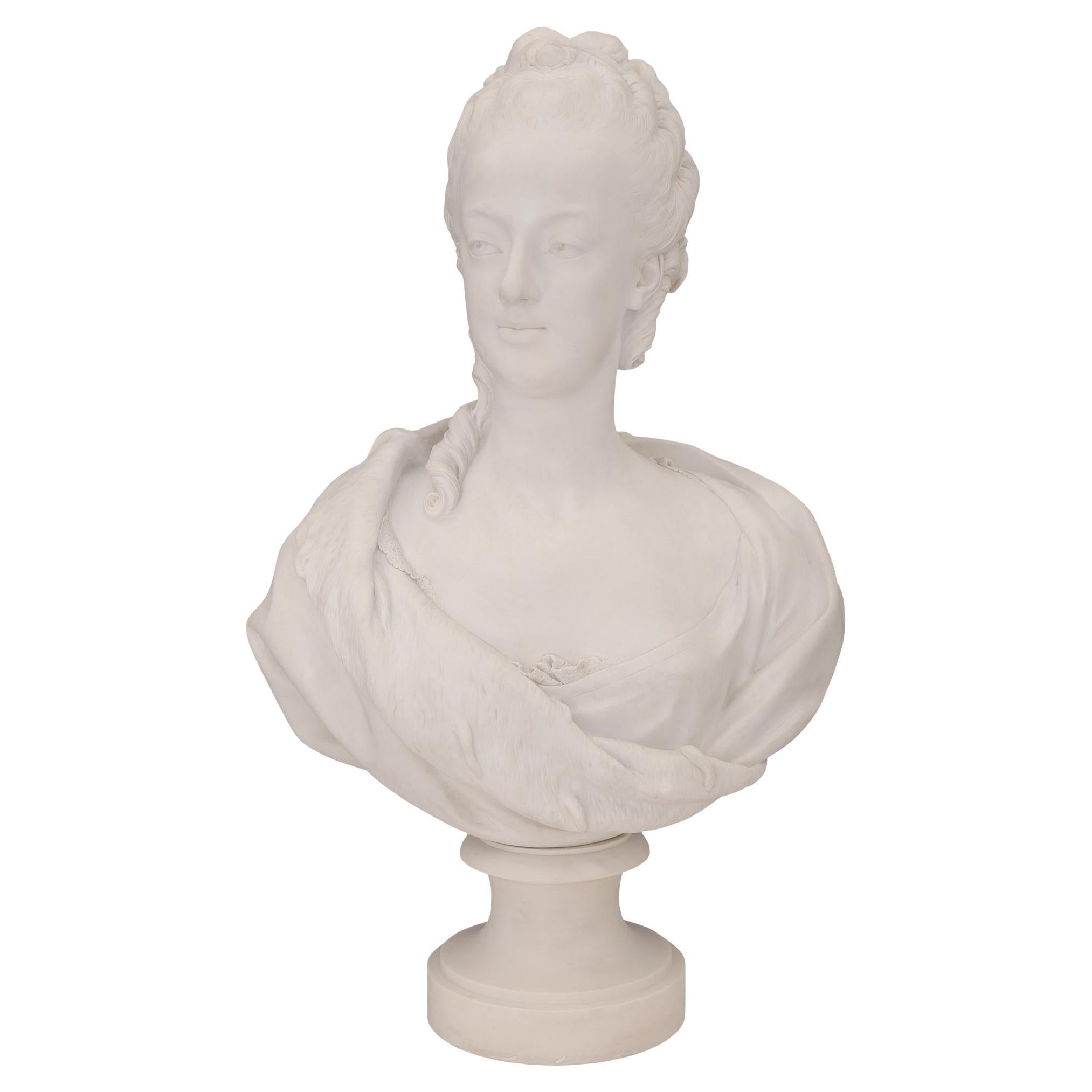
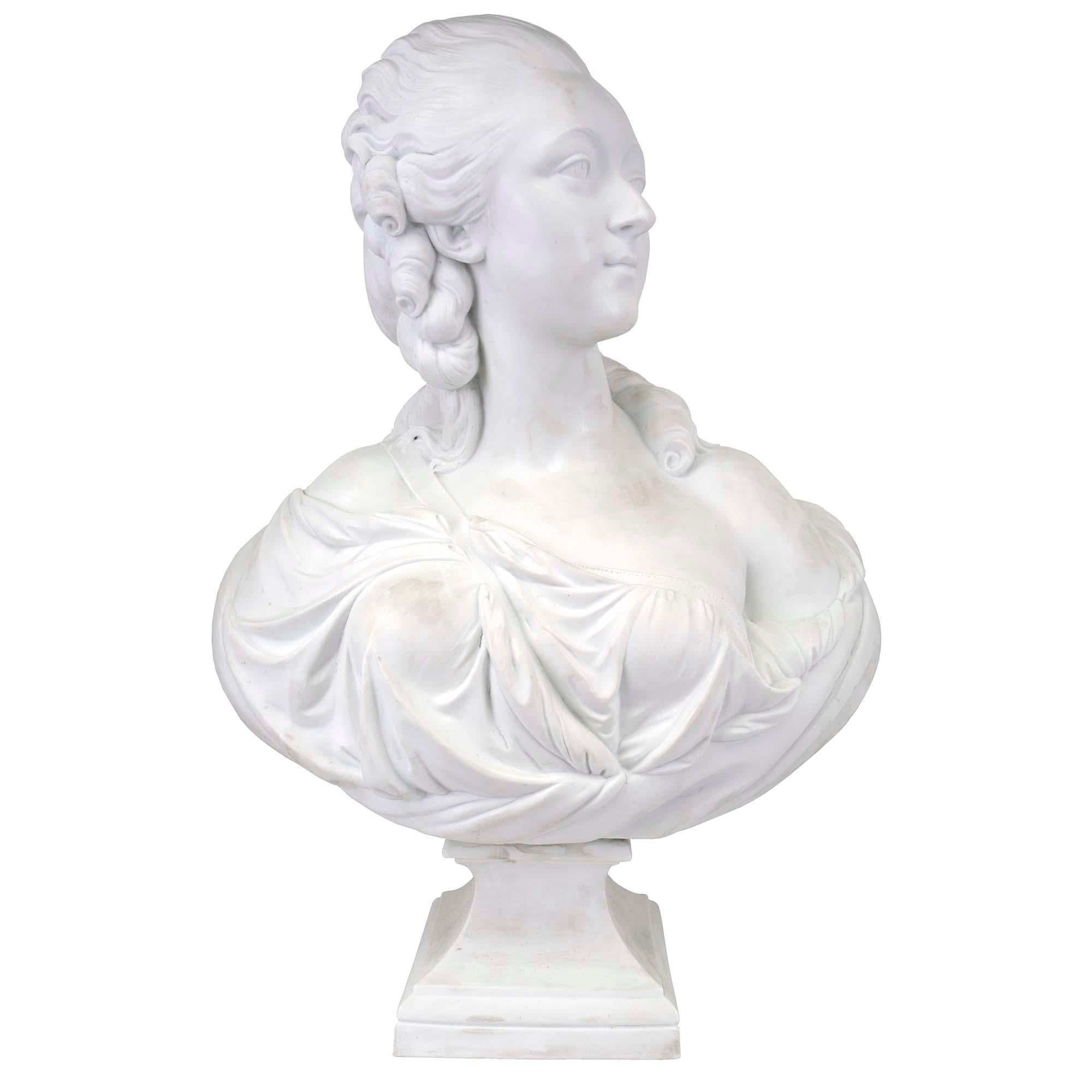
Want more images or videos?
Request additional images or videos from the seller
1 of 16
Antique Sevres Bisque Porcelain Bust Marie Antoinette 19th Century
$1,854.41
£1,350
€1,581.44
CA$2,547.68
A$2,769.84
CHF 1,468.57
MX$33,203.32
NOK 18,664.78
SEK 17,099.47
DKK 11,819.24
About the Item
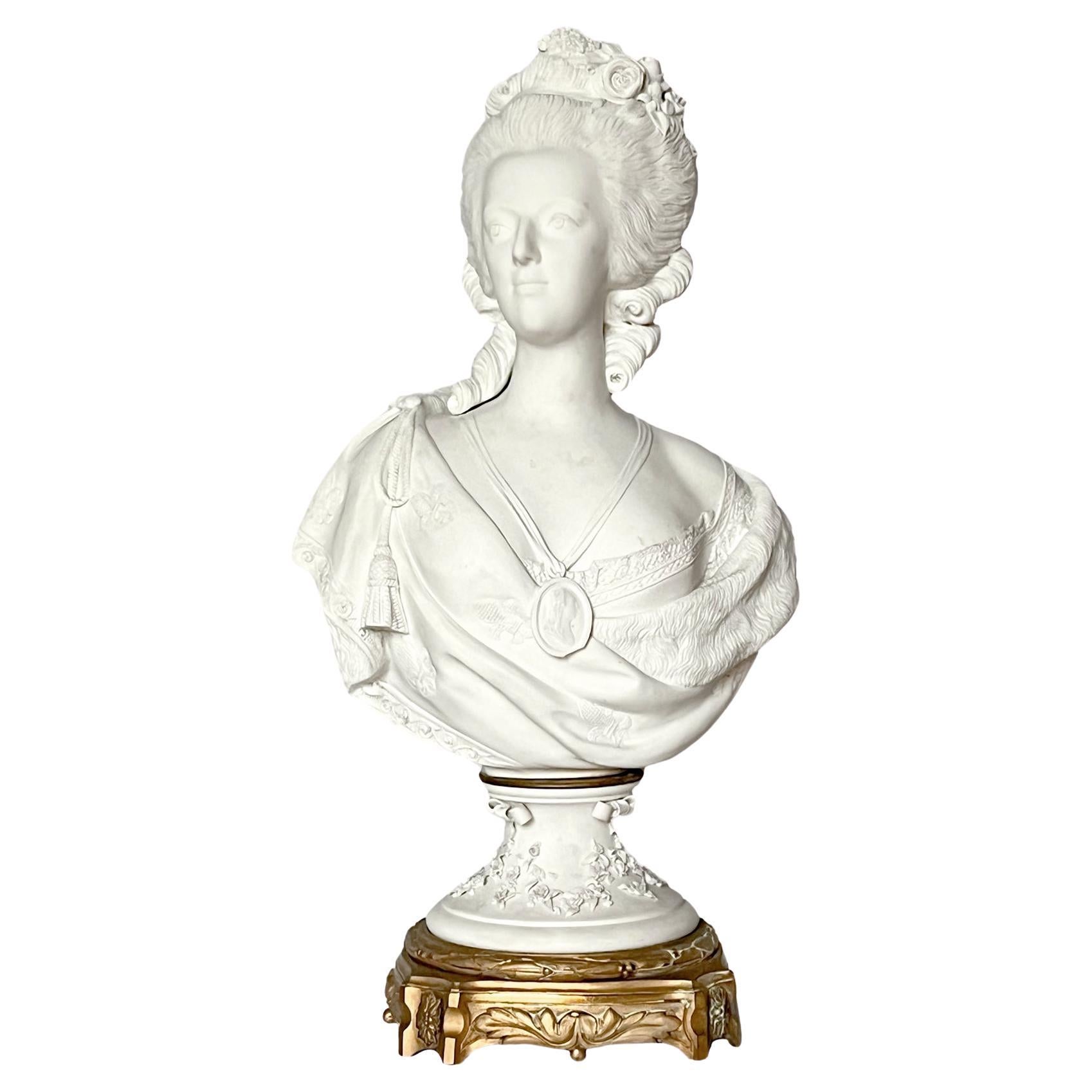
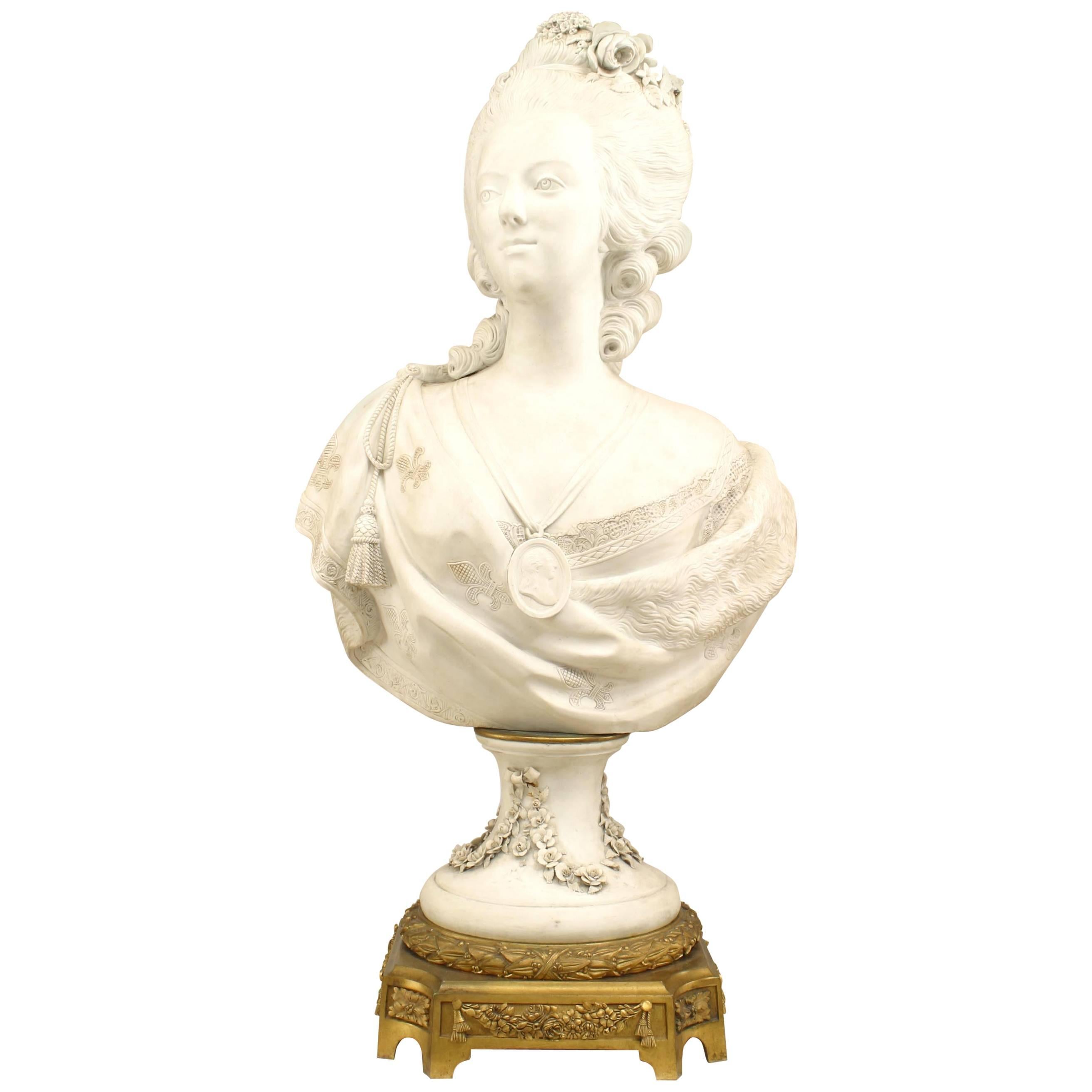
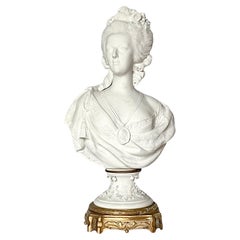
This is a fabulous decorative antique Sevres bisque porcelain bust of Marie Antoinette dating from early 19th Century and bearing the blue painted interlaced L's Sevres royal cipher with an M inside the classic two interlaced-Ls.
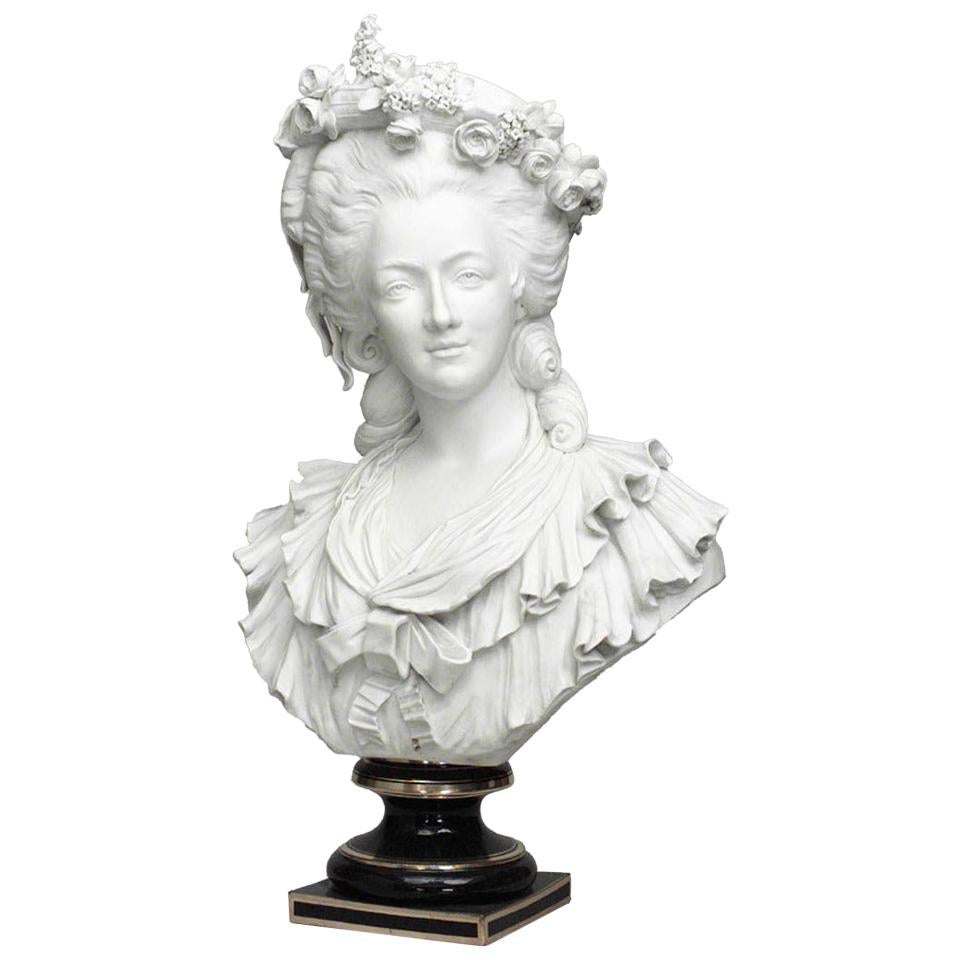
This is an elegant bust of Marie Antoinette, Queen of France and the wife of Louis XVI. The bust in white bisque porcelain contrasts beautifully with the glazed cobalt blue and gilt pedestal.
Marie Antoinette was a prominent victim of the Reign of Terror, executed by guillotine in October 1793 after being found guilty of treason by the Revolutionary Tribunal. Her execution followed that of her husband, King Louis XVI, and was the culmination of her unpopularity due to her perceived extravagance, and her perceived role in undermining the French Revolution. Busts of her were very popular in France and the Sevres factory made many.
Marie Antoinette is pictured with ribbons woven into her hair wearing a Fleur de Lys crown.
Bisque porcelain busts of Louis XVI and Marie Antoinette were highly fashionable during their reign, and continued to be produced in the 19th Century.
This bust depicts one of the most important figures in French history, and will make an elegant addition to any home.
Provenance: from a private Worcestershire collection.
Condition:
In excellent condition, with no chips, cracks or repairs, please see photos for confirmation.
Dimensions in cm:
Height 35 cm x Width 18 cm x Depth 14 cm
Dimensions in inches:
Height 1 foot, 2 inches x Width 7 inches x Depth 5 inches
Marie Antoinette
was the last queen of France prior to the French Revolution. She was born an archduchess of Austria, and was the penultimate child and youngest daughter of Empress Maria Theresa and Emperor Francis I.
Bisque,
French for 'biscuit', is a technique where the porcelain is left unglazed. In its pristine white state, the moulded porcelain resembles pure marble. This style of porcelain was invented by the Sèvres factory, who used it to create small sculptures to replace the white sugar figurines that were used to decorate dining room tables in the 18th Century.
Sevres Porcelain
traces its roots in France to early craftsmen who had small manufacturing operations in such places as Lille, Rouen. St. Cloud, and most notably Chantilly. It is from Chantilly that a cadre of workers migrated to the Chateau de Vincennes near Paris to form a larger porcelain manufactory in 1738.
French King Louis XV, perhaps inspired by his rumoured relationship with mistress Madame de Pompadour, took an intense interest in porcelain and moved the operation in 1756 to even larger quarters in the Paris suburb of Sevres. Sevres was also conveniently near the home of Madame de Pompadour and the King's own Palace at Versailles.
From the outset the king's clear aim was to produce Sevres Porcelain that surpassed the established Saxony works of Meissen and Dresden. Though the French lacked an ample supply of kaolin, a required ingredient for hard-paste porcelain (pate dure), their soft-paste porcelain (pate tendre) was fired at a lower temperature and was thus compatible with a wider variety of colours and glazes that in many cases were also richer and more vivid. Unglazed white Sevres Porcelain "biscuit" figurines were also a great success. However, soft-paste Sevres Porcelain was more easily broken. Therefore, early pieces of Sevres Porcelain that remain intact have become rare indeed.
The Sevres Porcelain manufactory always seemed to be in dire financial straits despite the incredibly fine works it produced. In fact, the king's insistence that only the finest items be created may have contributed to the difficulties. Only a limited number of European nobility could afford the extravagant prices demanded for such works. King Louis XV and eventually his heir, the ill-fated Louis XVI, were obliged to invest heavily in the enterprise. Ultimately, the Sevres Porcelain Factory produced items under the name of "Royal" and thus the well-known Sevres mark was born. King Louis XV even mandated laws that severely restricted other porcelain production in France so as to retain a near monopoly for his Sevres Porcelain. The king even willingly became chief salesman for the finest of his products, hosting an annual New Year's Day showing for French nobility in his private quarters at Versailles. He eagerly circulated among potential buyers, pitching the merits of ownership and policing the occasional light-fingered guest.
Sevres Porcelain may have indeed given the makers of Meissen and Dresden a run for their money by the end of the 18th Century but for the French Revolution. By 1800, the Sevres Porcelain Works were practically out of business due to the economic devastation of the new French Republic.
About the time when Napoleon Bonaparte named himself Emperor of France (1804), a new director was named for the Sevres Porcelain Manufactory. Alexandre Brongniart, highly educated in many fields, resurrected Sevres Porcelain. Soft-paste porcelain was eliminated altogether thanks to the earlier discovery of kaolin near Limoges. For four decades until his death, Brongniart presided over monumental progress for Sevres Porcelain, catering not only to Napoleon himself, but at last to include the more financially profitable mid-priced market in the emerging middle class.
Our reference: A3639a
- Dimensions:Height: 13.78 in (35 cm)Width: 7.09 in (18 cm)Depth: 5.52 in (14 cm)
- Materials and Techniques:
- Place of Origin:
- Period:
- Date of Manufacture:Early 19th Century
- Condition:
- Seller Location:London, GB
- Reference Number:Seller: A3639a1stDibs: LU950647790752
About the Seller
5.0
Platinum Seller
Premium sellers with a 4.7+ rating and 24-hour response times
Established in 1983
1stDibs seller since 2012
1,445 sales on 1stDibs
Typical response time: <1 hour
Associations
LAPADA - The Association of Arts
Antiques Dealers
- ShippingRetrieving quote...Shipping from: London, United Kingdom
- Return Policy
More From This Seller
View AllVintage Sculpted Composite Marble Bust of Marie Antoinette late 20th Century
Located in London, GB
This is a beautifully sculpted composite marble bust of Marie Antoinette, late 20th century in date.
This attractive sculpture features the Queen of France facing to dexter, wearing...
Category
Late 20th Century Figurative Sculptures
Materials
Marble
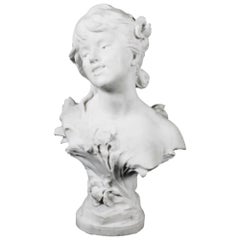
Antique Carrara Marble Portrait Bust by Auguste Moreau, 19th Century
By Auguste Moreau
Located in London, GB
This is beautiful antique French marble shoulder length bust of a beautiful maiden, signed Auguste Moreau, circa 1890 in date.
The face and body has been sensitively modelled in Carrara marble with her head tilted to the right, her loose hair falling on her bare shoulders.
There is no mistaking its unique design and superb quality, which is certain to attract attention and make it a talking point in any room of your home.
Condition:
In excellent condition, please see photos for confirmation.
Dimensions in cm:
Height 53 x Width 33 x Depth 23
Dimensions in inches:
Height 20.9 x Width 13.0 x Depth 9.1
Louis Auguste Moreau, 1855-1919,
was a French sculptor best known for his bronze-cast figurines. His allegorical Art Nouveau works often depicted women, children, cherubs, and historical figures adorned with floral motifs and ornaments, and were influential to other artists working at the time. Born in Dijon, France in 1855 to a celebrated family of sculptors, including his father Auguste Moreau, he went on to regularly exhibit his work at the Paris Salon from 1861 on. The artist died in 1919 in France.
Carrara marble - is a type of white or blue-grey marble popular for use in sculpture and building decor. It is quarried at the city of Carrara in the province of Massa-Carrara (Tuscany, Italy).
Carrara marble has been used since the time of Ancient Rome; the Pantheon and Trajan's Column in Rome are constructed of it. Many sculptures of the Renaissance, such as Michelangelo's David, were carved from Carrara marble. For Michelangelo at least, Carrara marble was valued above all other stone, except perhaps that of his own quarry in Pietrasanta. The Marble Arch in London and the Duomo di Siena are also made from this stone, as are the interiors of Manila Cathedral, the cold-white marbles of the Sheikh Zayed Mosque and the campus of Harvard Medical...
Category
Antique 1890s French Busts
Materials
Marble
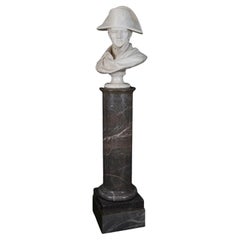
Fine Antique Napoleon Bonaparte Marble Bust
Pedestal Early 19th Century
Located in London, GB
An exceptionally fine Carrara marble bust of Napoleon Bonaparte on an equally fine marble columnar pedestal, Circa 1810 in date.
The sculpture depicts a young Napoleon wearing his...
Category
Antique Early 19th Century Busts
Materials
Marble, Carrara Marble
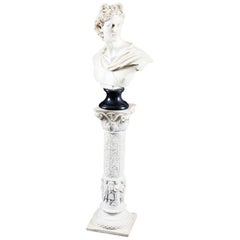
Vintage Composition Marble Bust of Apollo on a Pedestal, 20th Century
Located in London, GB
A beautifully sculpted marble bust of the famous Greek god Apollo, on it's original fabulous decorative pedestal, dating from the mid-20th century.
The attention to detail throughout the piece is second to none and the figure is extremely lifelike.
This high quality bust and pedestal...
Category
Vintage 1950s Busts
Materials
Marble
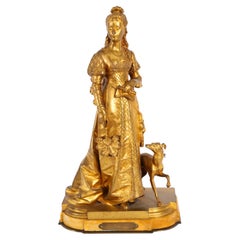
Antique Gilt Bronze Sculpture of Reine Isabella by Eurotrope Bouret 19th Century
By Eutrope Bouret
Located in London, GB
This is a superb antique gilt bronze and sienna mable sculpture of Reine Isabella, the Queen of Spain, by Eutrope Bouret (1833 - 1906) , and circa 1870 in date.
This exceptionally e...
Category
Antique Late 19th Century French Figurative Sculptures
Materials
Siena Marble, Bronze, Ormolu
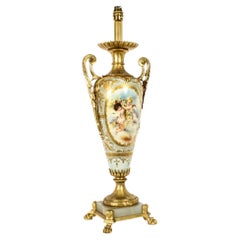
Antique Bleu Celeste Sevres Porcelain Ormolu Table Lamp 19th Century
Located in London, GB
This is a stunning large antique French Sevres hand-painted porcelain and ormolu mounted vase circa 1870 in date, later converted into a lamp.
The ovoid porcelain body is painted...
Category
Antique 1870s French Table Lamps
Materials
Onyx, Ormolu
You May Also Like
French 19th Century Louis XVI St. Porcelain Bust of Marie Antoinette
Located in West Palm Beach, FL
An elegant and high quality French 19th century Louis XVI st. Biscuit de Sèvres porcelain bust of Marie Antoinette. The bust is raised by a circu...
Category
Antique 19th Century French Louis XVI Figurative Sculptures
Materials
Porcelain
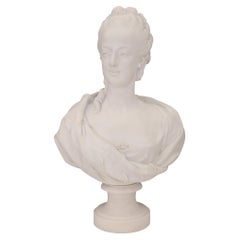
French 19th Century Louis XVI Style Biscuit de Sevres Porcelain Bust
Located in West Palm Beach, FL
A large-scale French 19th century Louis XVI st. Biscuit de Sèvres Porcelain bust of Madame La Contesse Du Bary in the manner of the sculptor Pajo...
Category
Antique 19th Century French Louis XVI Figurative Sculptures
Materials
Porcelain

French Louis XVI Porcelain Bust
Located in Queens, NY
French Louis XVI style life sized Sevres biscuit porcelain bust of Marie-Therese Louise Di Savoia-Carignano on a gilt decorated blue glazed so...
Category
Antique 19th Century French Louis XVI Busts
Materials
Gold Leaf
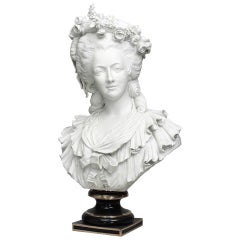
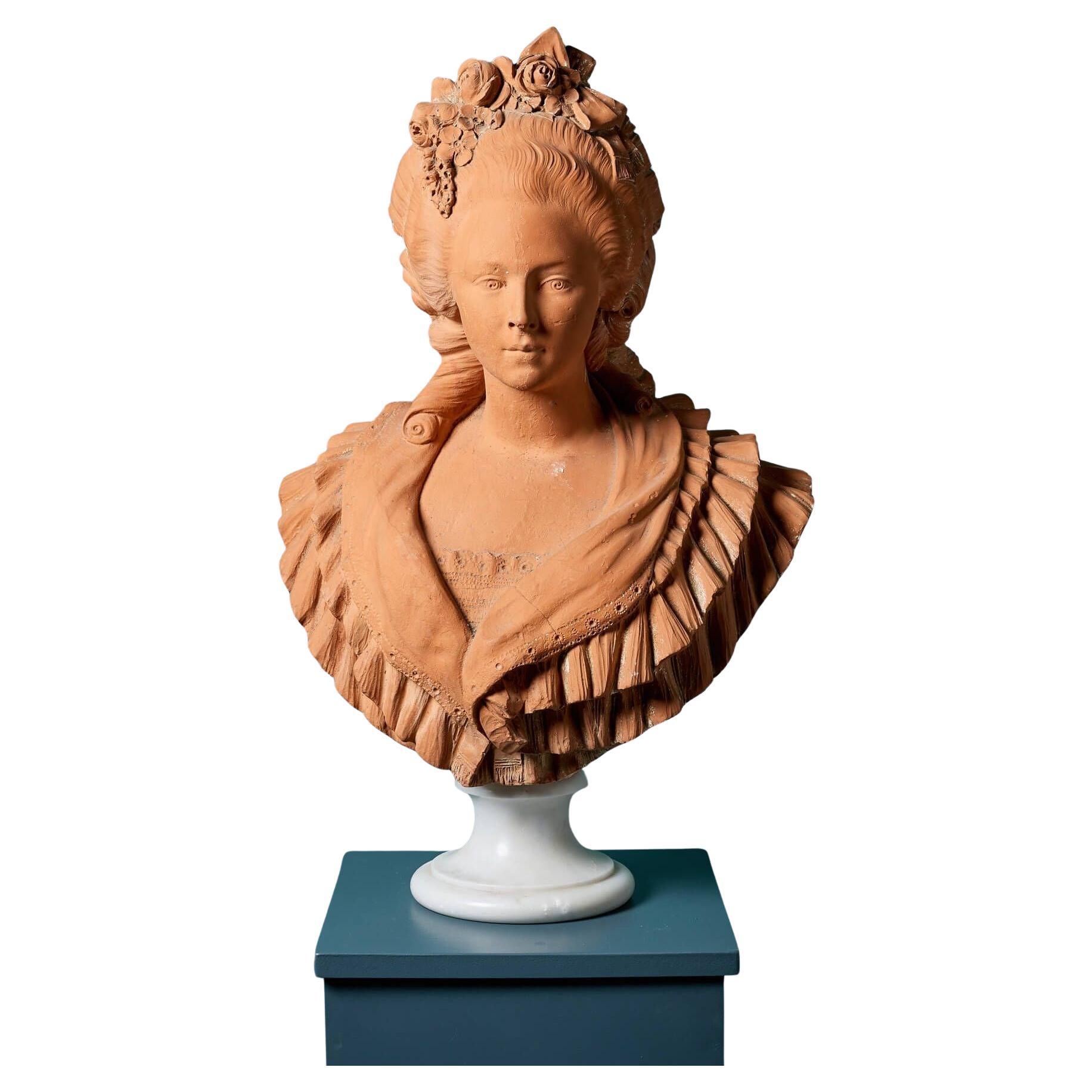
Antique French Terracotta Bust of Marie Antoinette
Located in Wormelow, Herefordshire
An early 20th century antique French terracotta bust of Marie Antoinette, Queen Consort of France (1775-1792), on an associated white marble socle. This beautiful sculpture exudes el...
Category
Early 20th Century French Busts
Materials
Marble
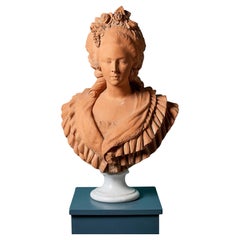
Bust of Marie-Antoinette in Biscuit from the Royal Manufacture of Sèvres
By Manufacture Nationale de Sèvres
Located in Paris, FR
Bust of Marie-Antoinette in biscuit (hard porcelain) from the Royal Manufacture of Sèvres mounted on an ornamented bronze stand.
Signed and Stamped Felix Lecomte (later).
Slight accident in the back.
Felix Lecomte (1737-1817) sculpted Marie-Antoinette, then aged 28, in 1783. Only 2 sculptors had the right to portray the Queen: Boizot and Lecomte.
This sculpture is therefore the official relief portrait of the Queen...
Category
Antique 19th Century French Louis XVI Busts
Materials
Bronze
French Louis XVI Parium Marie Antoinette Bust
Located in Queens, NY
"French Louis XVI style (19th Cent) parian marble bust of Marie Antoinette wearing a robe and mounted on a festooned pedestal and resting on a bronze base (signed with Sevre mark)
V...
Category
Antique 19th Century French Louis XVI Busts
Materials
Bronze