Items Similar to Judy Brady Sculpted Ceramic Head
Want more images or videos?
Request additional images or videos from the seller
1 of 15
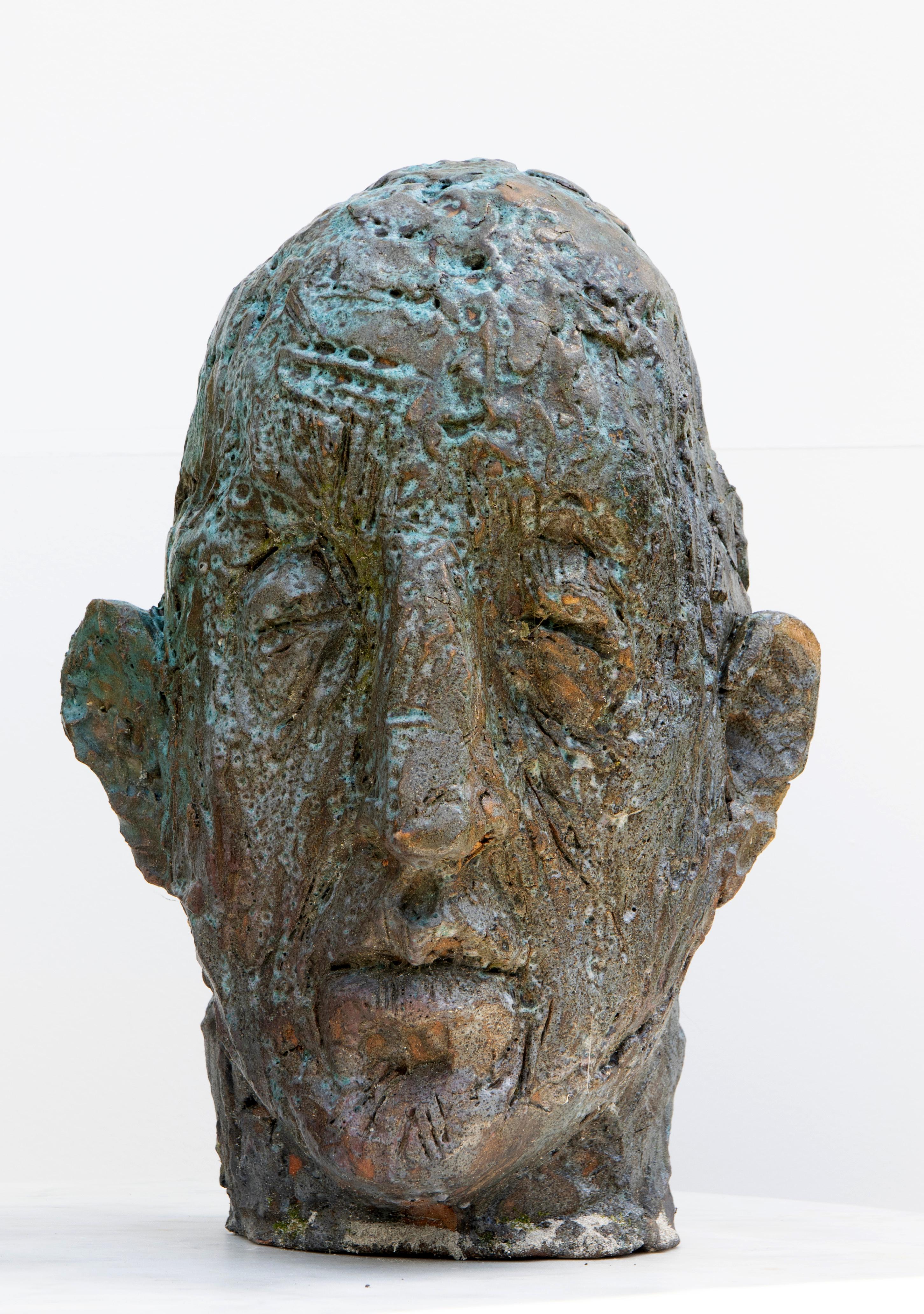
Judy Brady Sculpted Ceramic Head
$3,500
£2,659.14
€3,055.91
CA$4,916.18
A$5,351.14
CHF 2,835.38
MX$64,355.52
NOK 36,051.08
SEK 33,036.83
DKK 22,827.43
About the Item
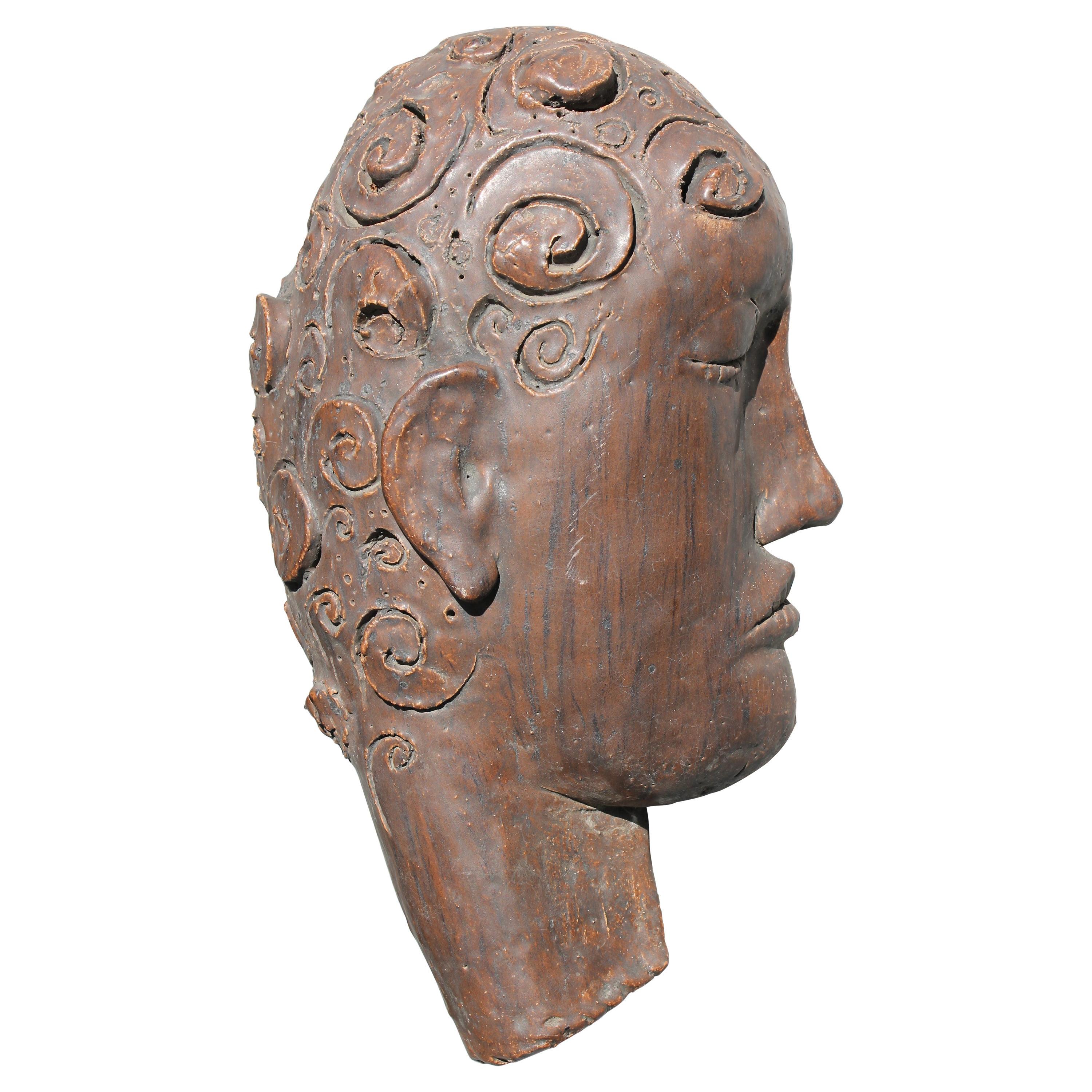
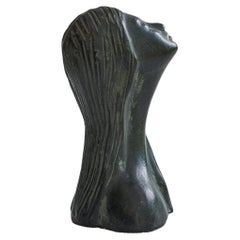
The UNTITLED portrait sculpture has a quiet yet powerful and commanding aura. The viewer cannot be around or near it without feeling its presence. It has a very classical approach in the large straight bridge of the nose and the head of curly hair that is reminiscent of ancient Roman busts. The face is not, however, Classical in that the nose is a bit twisted and one eye is smaller than the other. There is a very soulful look on the face enhanced by the downcast eyes and raised eyebrows. A hint of Giacometti's famous walking figures rests in its large size and tall lean look despite the fact that Giacometti had smaller heads in order to suggest great visual distancing and isolation from the viewer whereas this sculpture absorbs and embraces the viewer.
- Dimensions:Height: 32 in (81.28 cm)Width: 15 in (38.1 cm)Depth: 10 in (25.4 cm)
- Style:Expressionist (In the Style Of)
- Materials and Techniques:
- Place of Origin:
- Period:
- Date of Manufacture:1970
- Condition:
- Seller Location:Bloomfield Hills, MI
- Reference Number:1stDibs: LU7781233542992
About the Seller
5.0
Vetted Professional Seller
Every seller passes strict standards for authenticity and reliability
1stDibs seller since 2022
21 sales on 1stDibs
- ShippingRetrieving quote...Shipping from: Detroit, MI
- Return Policy
More From This Seller
View AllRobert Bielat Sculpture Cast Bi-Metal Stone Wood "TRUE EAST"
Located in Bloomfield Hills, MI
SALE ONE WEEK ONLY
"Robert Bielat was an artist’s artist, a sobriquet applied to those whose work is brilliant but idiosyncratic, deeply compelling in a way that is obvious to those who can see it, but not necessarily so to the market or to the arbiters...
Category
21st Century and Contemporary American Expressionist Abstract Sculptures
Materials
Stone, Cast Stone, Metal, Aluminum
Edgardo Simone Nude Figurative Sculpture "THE KISS"
By Edgardo Simone
Located in Bloomfield Hills, MI
SALE ONE WEEK ONLY
Edgardo Simone (Italian/American, 1890-1948) The Kiss patinated plaster casting sculpture for kissing nudes fountain sculpture signed to top of base.
Classically trained in Italy at the Beaux Arts Academy in Rome from 1906 to 1913, Edgardo Simone became a famous sculptor in Italy and the United States using mediums of terracotta, ceramic, bronze, and plaster. He earned a Doctorate of Design and Sculpture at the Academy and then emigrated to the United States where he worked in New York, Chicago and southern California.
His style was influenced by Art Nouveau, Art Deco and other modernist influences. In Italy he had received three times the Croix de Guerre and was decorated by King Victor Emmanuel II and Queen Margherita. Before moving to America, he had much recognition in Italy. He had created war, funeral and city monuments in twenty-six Italian cities. When he arrived in New York City, one of the newspapers carried a headline: "Italy's greatest Sculptor Arrives in New York."
In New York, Simone became prominent in society and did many portrait busts including of Thomas Edison, John J. Pershing, Henry Ford and Louis Brandeis...
Category
Early 20th Century North American Art Nouveau Figurative Sculptures
Materials
Plaster

Tony Rosenthal Abstract Sculpture Blackened Steel Red Blushes
By Tony Rosenthal
Located in Bloomfield Hills, MI
SALE ONE WEEK ONLY
UNTITLED is an abstract blackened steel sculpture that has a continuous lively movement. The positioning of the heavy metal is suggestive of dance. There are similarities to the sculptors, Robert Sestok and Tony Smith, who both worked in bronze and painted steel with similar cut out pieces and abstract designs. Untitled has a joyous aura and its small size makes it a charming intimate piece. It might have been a maquette for a much larger piece. The design works in this 14" height as it would in a 14' height. There is a Letter of Certification that will accompany the sculpture.
Tony Rosenthal (1914 - 2009) is best known for creating a staggering list of monumental public art sculptures. For over seven decades Tony Rosenthal created an arc of sculpture in a variety of sizes, styles and media, including wood, steel, bronze, brass, cement and aluminum. Every day millions see, enjoy and interact with art created by Rosenthal in cities around the world. In New York City alone, five Rosenthal public art sculptures have been beloved and visible 24/7 for over four decades, yet Rosenthal is not a household name. Art dealer Joseph K. Levene, told The New York Times, Tony Rosenthal "reminds me of a character actor. You know the face but not the name. With him, you know the art."
Tony Rosenthal dedicated his life to creating art and actively created sculpture everyday in his Southampton, New York studio until he passed away at the age of 94, July 28, 2009. At nine Rosenthal learned the fundamentals of carving sculpture when his mother, an opera singer enrolled him in children's classes at the Art Institute of Chicago where he learned how to carve sculptures in soap. In 1936 Rosenthal earned a B.F.A. from the University of Michigan, and in 1952 became the first instructor of sculpture at the University of California, Los Angeles. In 1950 Rosenthal was recipient of the San Francisco Museum of Modern Art’s sculpture award; in 1967, Rosenthal received the outstanding achievement award from the University of Michigan and in 1963 a Ford Foundation Grant.
After graduating from the University of Michigan, Rosenthal became studio assistant to Alexander Archipenko, the figurative master sculptor, casting bronzes in exchange for sculpture lessons; at night, Rosenthal taught evening classes in drawing and sculpture. In 1939, Rosenthal enrolled at Cranbrook Academy of Art, studying with Carl Milles, Cranbrook's sculptor in residence; there, Rosenthal forged friendships with husband and wife designers Charles Eames and Ray Eames and the sculptor Lilian Swann Saarinen the wife of architect, Eero Saarinen.
Decades later Rosenthal acknowledged his gratitude to Cranbrook by donating his archives to them. The Cranbrook Cube, 1984, a 90" painted aluminum cube is in the Cranbrook Museum collection. In 1942, Rosenthal was drafted into the U.S. Army; while stationed in Paris Rosenthal forged friendships with George Braque, Andre Derain, Le Corbusier and Constantin Brancusi, routinely organizing and accompanying groups of soldiers on studio visits. Through multiple visits to Brancusi's Paris studio, Rosenthal learned to create and forge metal sculpture...
Category
Late 20th Century American Modern Abstract Sculptures
Materials
Steel
Ruben Nakian Bronze Figurine "Leda and the Swan" Limited Edition
By Reuben Nakian
Located in Bloomfield Hills, MI
SALE ONE WEEK ONLY
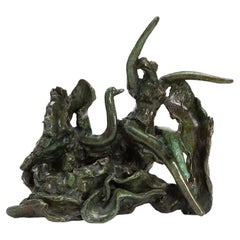
“Leda and the Swan” is by Reuben Nakian (1897 - 1986). He was an American sculptor and teacher of Armenian extraction. His works’ recurring themes are from Greek and Roman mythology. Nakian’s small bronzes achieve majesty and power which are not dependent on size and amplitude. With characteristic freshness, he has reinterpreted the classical subject of Leda and the Swan refining it in the Classical-Renaissance-Baroque tradition in a contemporary way. Dr. Robert P. Metzger gives us his aesthetic interpretation of this work which retells the myth in classical hedonism and freedom of expression showing Leda and the Swann prior to her being ravaged and during their first meeting. “The young virgin is fascinated with her new found friend and accepts him in a spirit of playfulness, contentment and wonder. She is dreamily available and shyly seductive as the deceptively tame swan snuggles up to her with its phallic-like neck.” Leda appears composed, placid yet open and available as compared to her more intense and passionate states in other of Nakian’s depictions on the same theme. This was cast at the "Renaissance Art Foundry" in 1978 and is so marked on the base being #5 of 7.
It is believed that “no other sculptor of the twentieth century matched Rueben’s heroic renditions with the grand themes of Western Art. His erotic mythological figures exude a joyous energy of gesture and movement which place them among seminal sculptural achievements of the past one hundred years.”
Nakian studied at the Independent School of Art in New York City previously known as the Robert Henri School … with Homer Boss...
Category
Vintage 1970s American Figurative Sculptures
Materials
Bronze
John Glick Plum Street Pottery Signed Monumental Ceramic Charger
By John Glick
Located in Bloomfield Hills, MI
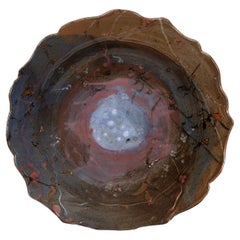
The ceramic charger with scalloped edge is an example of the kind of work by which John Glick became so famous. He was seduced by the effects of the reduction kiln, which decreased the levels of oxygen during firing, inducing the flame to pull oxygen out of the clay and glazes changing the colors of the glazes depending on their iron and copper content. In this way he achieved the rich gradients of ochre and umber and variations in stippling and opacity. It is signed on verso.
John was an American Abstract Expressionist ceramicist born in Detroit, MI. Though open to artistic experimentation, Glick was most influenced by the styles and aesthetics of Asian pottery—an inspiration that shows in his use of decorative patterns and glaze choices. He has said that he is attracted to simplicity, as well as complexity: my work continually reflects my re-examination that these two poles can coexist… or not, in a given series. Glick also took influences from master potters of Japan, notably Shoji Hamada and Kanjrio Kawai, blending their gestural embellishments of simple forms with attitudes of Abstract Expressionism. He was particularly drown to the work of Helen Frankenthaler whose soak-stain style resonated with Glick’s multi-layered glaze surfaces, which juxtaposed veils of atmospheric color with gestural marks and pattern. He spent countless hours developing and making his own tools in order to achieve previously unseen results in his work with clay and glaze.
Glick’s “Plum Tree Pottery” (now a designated historic landmark in Farmington Hills, Michigan) studio opened around 1965 and closed in the summer of 2016. It was a private studio space for John and a number of his students and assistants. He believed his shapes evolved guided by forces apparently outside his control. This was instinctual, intellectual and due to his openness to change, fusing into what he thought was the most positive force behind a potter’s approach: evolution and growth. Some have called it inspiration.
John was not only a major figure in the Detroit creative community, but in the ceramics world at large. According to Shelley Selim in her book on John, “John Glick: A Legacy in Clay” John remains: “one of the most recognizable names in the field of studio pottery – known for lecturing, publishing, and offering workshops widely – and his work has been featured in well over a hundred local, national and international exhibitions since he was a college student in the late 1950s.” Along with this John has mentored over thirty studio apprentices over five and a half decades, received numerous grants and awards for his work, and has been prolific, with an estimated 300,000 ceramic wares throughout the world.
He received his Masters from Cranbrook Academy of Art in Bloomfield Hills, Michigan, working with Maija Grotell, a legendary and influential teacher. Grotell was noted for her deep interest in the human connection to nature’s rhythms and patters. These ideas often grounded her dialog with her students including Glick, affecting, a profund and lasting influence on his future work. This famous Art Academy was designed by architect and faculty member, Eliel Saarinen who collaborated with Charles and Ray Eames on chair and furniture design. Numerous creative artists who are alumni of Cranbrook include: Harry Bertoia, Florence Knoll, Jack Lenor Larsen, Donald Lipski, Duane Hanson, Nick Cave, Hani Rashid, George Nelson, Urban Jupena (Nationally recognized fiber artist), Artis Lane (the first African-American artist to have her sculpture, "Sojourner Truth," commissioned for the Emancipation Hall in the Capital Visitor Center in Washington DC), Cory Puhlman (televised Pastry Chef extraordinaire), Thom O’Connor (Lithographs), Paul Evans (Brutalist-inspired sculpted metal furnishings), Eugene Caples (small bronze images/abstract), Morris Brose (Bronze Sculptures), Herb Babcock (blown glass), Larry Butcher (mixed media) and Lauren Anais Hussey...
Category
1990s American Expressionist Decorative Dishes and Vide-Poche
Materials
Ceramic
John Glick Plum Street Pottery Ceramic Charger Monumental
By John Glick
Located in Bloomfield Hills, MI
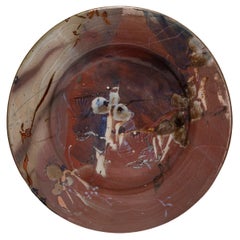
The ceramic charger is an example of the kind of work by which John Glick became so famous. He was seduced by the effects of the reduction kiln, which decreased the levels of oxygen during firing, inducing the flame to pull oxygen out of the clay and glazes changing the colors of the glazes depending on their iron and copper content. In this way he achieved the rich gradients of ochre and umber and variations in stippling and opacity. It is signed by the artist and stamped with Plum Street Pottery on the verso.
John was an American Abstract Expressionist ceramicist born in Detroit, MI. Though open to artistic experimentation, Glick was most influenced by the styles and aesthetics of Asian pottery—an inspiration that shows in his use of decorative patterns and glaze choices. He has said that he is attracted to simplicity, as well as complexity: my work continually reflects my re-examination that these two poles can coexist… or not, in a given series. Glick also took influences from master potters of Japan, notably Shoji Hamada and Kanjrio Kawai, blending their gestural embellishments of simple forms with attitudes of Abstract Expressionism. He was particularly drown to the work of Helen Frankenthaler whose soak-stain style resonated with Glick’s multi-layered glaze surfaces, which juxtaposed veils of atmospheric color with gestural marks and pattern. He spent countless hours developing and making his own tools in order to achieve previously unseen results in his work with clay and glaze.
Glick’s “Plum Tree Pottery” (now a designated historic landmark in Farmington Hills, Michigan) studio opened around 1965 and closed in the summer of 2016. It was a private studio space for John and a number of his students and assistants. He believed his shapes evolved guided by forces apparently outside his control. This was instinctual, intellectual and due to his openness to change, fusing into what he thought was the most positive force behind a potter’s approach: evolution and growth. Some have called it inspiration.
John was not only a major figure in the Detroit creative community, but in the ceramics world at large. According to Shelley Selim in her book on John, “John Glick: A Legacy in Clay” John remains: “one of the most recognizable names in the field of studio pottery – known for lecturing, publishing, and offering workshops widely – and his work has been featured in well over a hundred local, national and international exhibitions since he was a college student in the late 1950s.” Along with this John has mentored over thirty studio apprentices over five and a half decades, received numerous grants and awards for his work, and has been prolific, with an estimated 300,000 ceramic wares throughout the world.
He received his Masters from Cranbrook Academy of Art in Bloomfield Hills, Michigan, working with Maija Grotell, a legendary and influential teacher. Grotell was noted for her deep interest in the human connection to nature’s rhythms and patters. These ideas often grounded her dialog with her students including Glick, affecting, a profund and lasting influence on his future work. This famous Art Academy was designed by architect and faculty member, Eliel Saarinen who collaborated with Charles and Ray Eames on chair and furniture design. Numerous creative artists who are alumni of Cranbrook include: Harry Bertoia, Florence Knoll, Jack Lenor Larsen, Donald Lipski, Duane Hanson, Nick Cave, Hani Rashid, George Nelson, Urban Jupena (Nationally recognized fiber artist), Artis Lane (the first African-American artist to have her sculpture, "Sojourner Truth," commissioned for the Emancipation Hall in the Capital Visitor Center in Washington DC), Cory Puhlman (televised Pastry Chef extraordinaire), Thom O’Connor (Lithographs), Paul Evans (Brutalist-inspired sculpted metal furnishings), Eugene Caples (small bronze images/abstract), Morris Brose (Bronze Sculptures), Herb Babcock (blown glass), Larry Butcher (mixed media) and Lauren Anais Hussey...
Category
1990s American Expressionist Decorative Dishes and Vide-Poche
Materials
Ceramic
You May Also Like
Expressionist Cast Bronze Bust
Located in Kilmarnock, VA
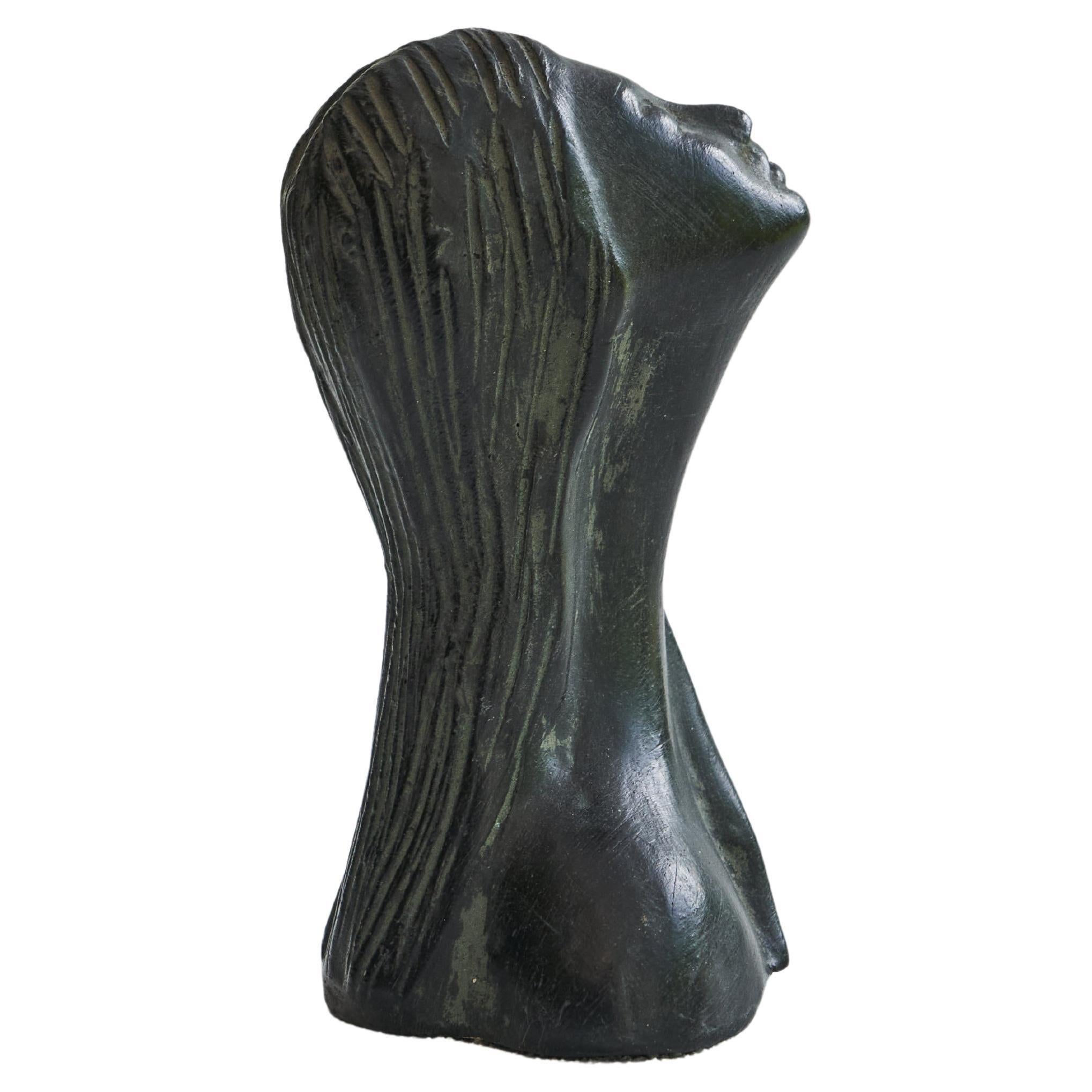
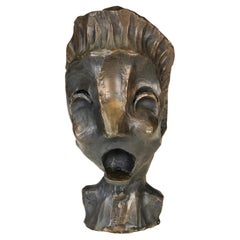
A powerful 20th-century cast bronze Expressionist bust, imbued with raw psychological energy and sculptural immediacy. Evocative of The Scream by Edvard Munch, the distorted features...
Category
20th Century Unknown Expressionist Busts
Materials
Bronze
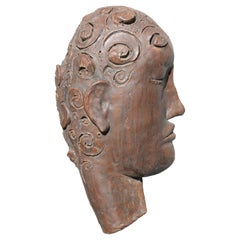
Sculpted Stoneware Face Sculpture by James Kouretas
Located in Palm Springs, CA
Beautiful hand carved stoneware face sculpture by James Kouretas. Sculpture has 2 holes in the back most likely for hanging on the wall or could be dis...
Category
Vintage 1970s American Modern Figurative Sculptures
Materials
Stoneware
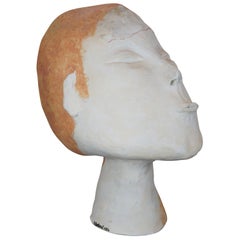
1986 Deborah Ballard "Stress" Ceramic Figural Art Sculpture Head Bust
Located in Dayton, OH
1986 Deborah Ballard "Stress" Ceramic Figural Art Sculpture
Made from fired white clay by Deborah Ballard (b.1951). Deborah is a Native American who was born in Dallas. She had a ...
Category
Vintage 1980s American Expressionist Figurative Sculptures
Materials
Clay
$1,400 Sale Price
30% Off
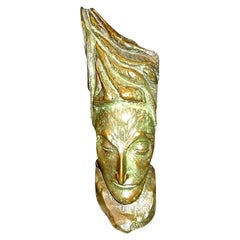
Mid-Century Modern Bronze Bust by J.D. Murillo
By Rene Brancusi, Amedeo Modigliani, Alberto Giacometti
Located in Houston, TX
Mid-Century Modern bronze bust by J.D. Murillo.
Interesting Mid-Century Modern Brancusi inspired patinated bronze bust or head sculpture signed J.D....
Category
20th Century Unknown Mid-Century Modern Busts
Materials
Bronze
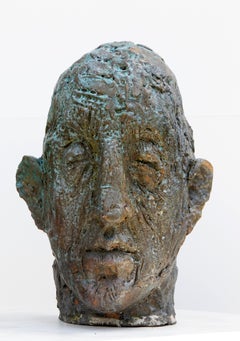
Ceramic Expressionist Head in Refractory Stoneware with Copper Glaze Testa nº 11
By Óscar Aldonza Torres
Located in FISTERRA, ES
Ceramic expressionist head sculpture created in refractory stoneware with a semi-transparent copper glaze. This ceramic head belongs to the Testas series, a body of work composed of ...
Category
2010s Expressionist Figurative Sculptures
Materials
Clay, Glaze
Bucchero
Ceramic Bust Italian, 1950s
By Gio Ponti
Located in Meer, VAN
'Bucchero' female head / bust attributed to Giò Ponti and Carlo Alberto Rossi. Mid 20th century, Italy.
This is a rare and marvelous little mid century ceramic head / bust by Carlo Alberto Rossi after a design attributed to Giò Ponti. Very stylistic and elegant.
The ceramic gets its characteristic black color through a special process in which the oxygen is removed from the red clay. So no paint or varnish is used. This is a technique that dates back to the Etruscans. Many works by Carlo Alberto Rossi and his brother – with whom he collaborated – have the characteristic black color.
The Rossi brothers collaborated with the famous architect and designer Gio Ponti. Several of his designs – including this head – were executed in the Rossi’s studio. The collaboration was a great success. Some of the works were also shown at the IX Triennale of Milan in 1951.
Please note we have a selection of 'Bucchero' pieces by Gubbio artists C. A. Rossi, Sebastiani and Elio Cerbella...
Category
Mid-20th Century Italian Mid-Century Modern Figurative Sculptures
Materials
Ceramic
More Ways To Browse
Ceramic Head
Ancient Bust
Curly Hair Vintage
Giacometti Walking
Bust Plinth
Plaster Cast Busts
Bust Of Boy
Chinese Head Sculpture
Marble David Sculpture
Augustus Caesar
Large Marble Bust
Sculpture Plaster 1940
Antique Bronze Head
Bronze Bust Man
Roman Medallion
Septimius Severus
Apollo Belvedere
Art Deco Plaster Bust