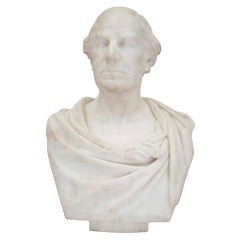
Items Similar to A Marble Bust on Pedestal of Richard Cobden by Neville Northey Burnard 1865
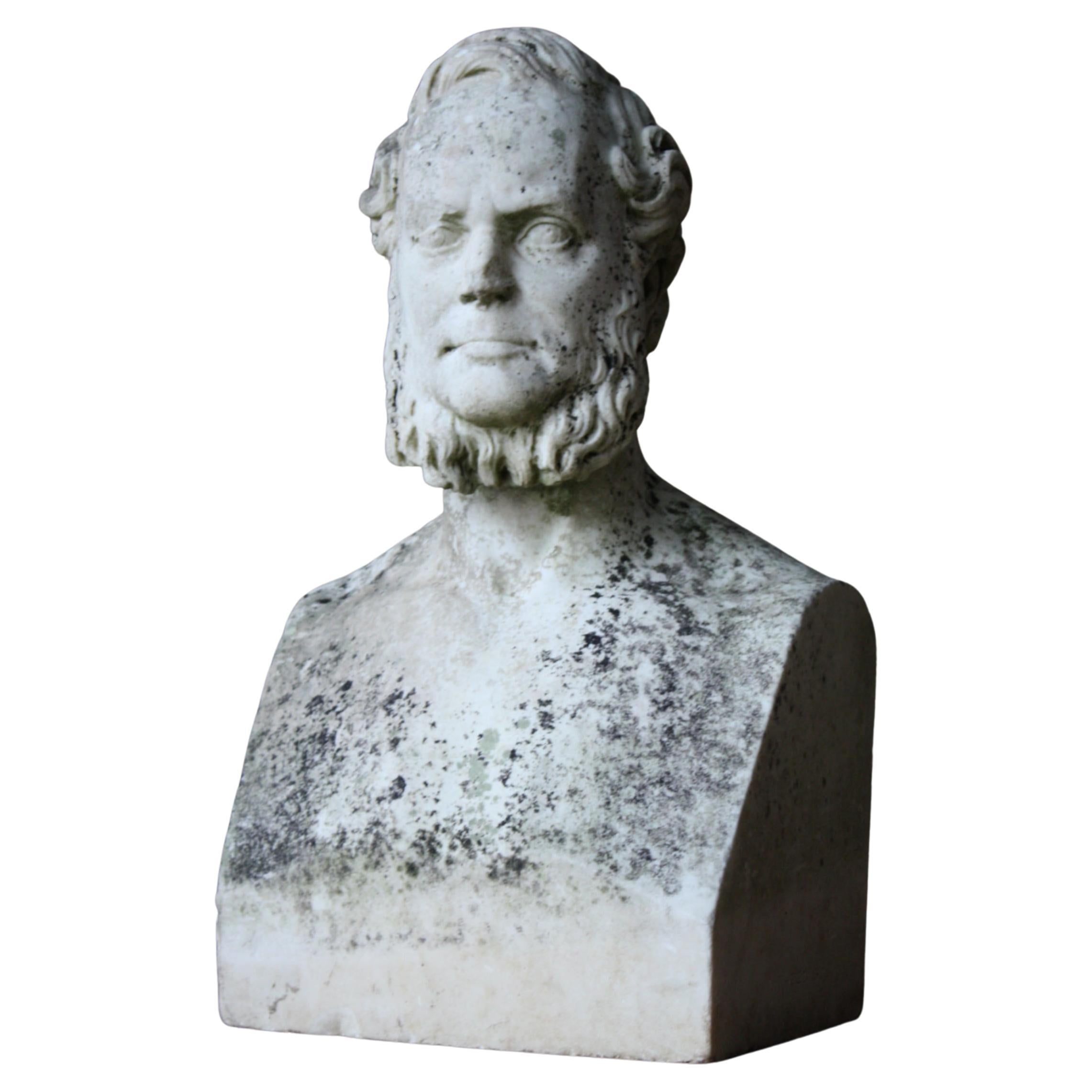
Want more images or videos?
Request additional images or videos from the seller
1 of 12
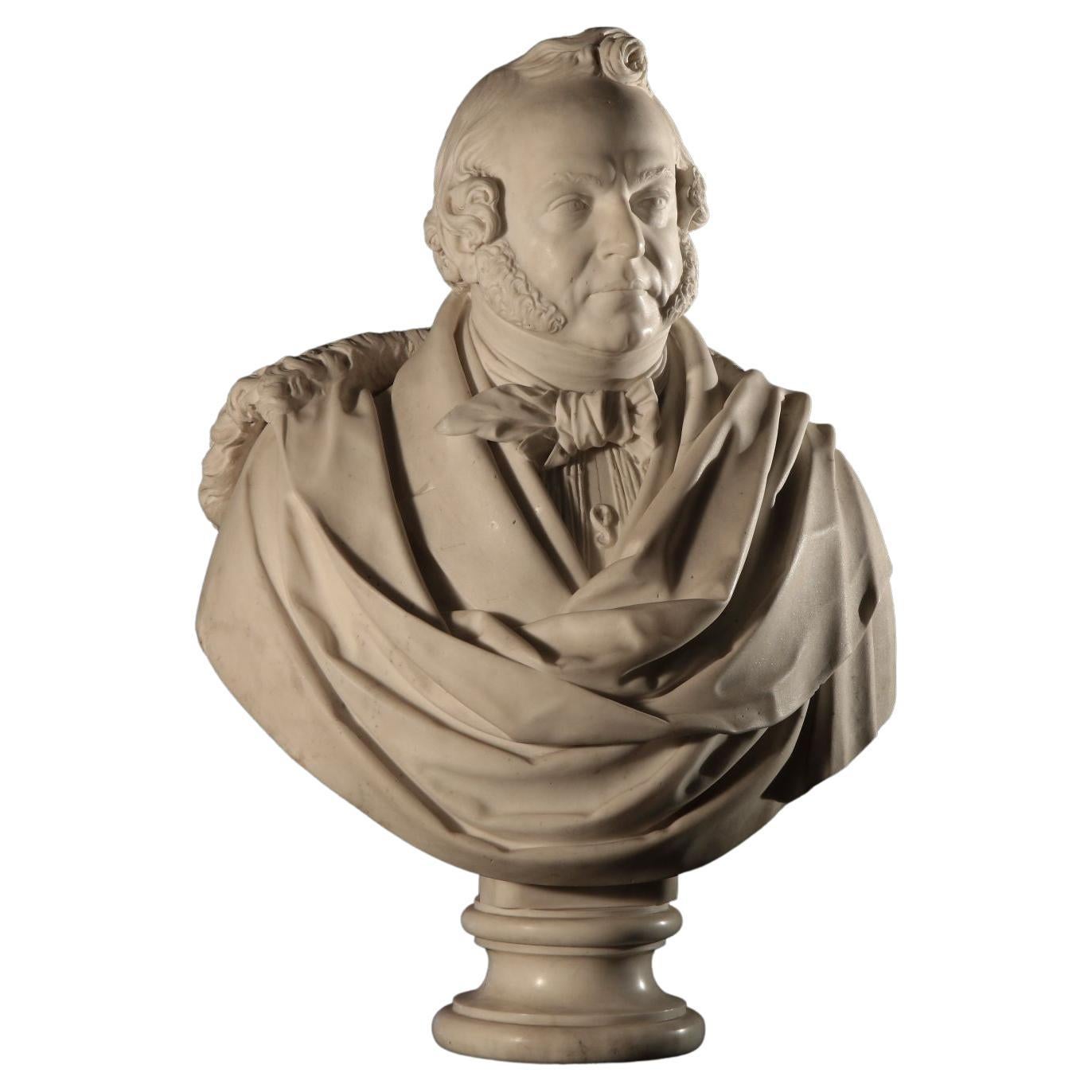
A Marble Bust on Pedestal of Richard Cobden by Neville Northey Burnard 1865
$18,178.63
£13,200
€15,440.29
CA$24,867.45
A$27,063.43
CHF 14,346.30
MX$325,593.75
NOK 181,957.15
SEK 166,478.05
DKK 115,350.66
About the Item
A fine and important Marble Bust on Pedestal of Richard Cobden by Neville Northey Burnard, 1865, Exhibited at the Royal Scottish Academy in 1866 and Presented to the Edinburgh Chamber of Commerce
This white marble bust is very finely carved and set on a turned socle and square section pedestal. The Bust is in very good original condition, however the pedestal requires work.
Provenance
Commissioned by a group of subscribers to commemorate the late Richard Cobden in the Edinburgh Chamber of Commerce, Melbourne Place, in 1865.
Exhibition History
Exhibited at the Royal Scottish Academy, 1867.
Of Carrara marble, this fine bust depicts the MP and free trade activist Richard Cobden wearing a cravat, double breasted waistcoat and suit coat. The trademark whiskers and wispy hair are beautifully recreated in marble. The bust stands on a finely turned socle and is signed and dated on the reverse. The piece also retains its original pedestal, lettered with the name of the sitter and his dates of birth and death. The pedestal has beautifully executed guilloche carving to the top and a selection of fine mouldings to the base.
This bust was made from casts taken by the artist from the sitter’s body, as implied by a newspaper report of 1865 in the Sun newspaper (London) on the 29th of April that year. The report stated:
‘BUST OF COBDEN—A very excellent bust of the late Richard Cobden is in course of execution by Mr Burnard, the well-known Cornish sculptor, whose busts of Ebenezer Elliott, Thackeray, and others have been so much admired, the model having been already completed. The sculptor has had every facility for taking the necessary casts from the head of the illustrious free-trader, and the likeness is very faithful. The bust will, doubtless, be most welcome to a large number of Cobden’s admirers.’
Further information as to the piece’s history is revealed in a fascinating report in the Caledonian Mercury, dated the 16th of November 1866.
PRESENTATION OF A BUST OF COBDEN TO THE CHAMBER OF COMMERCE.
On the invitation of the chairman of the Chamber of Commerce, a conversazione was held last evening in the Museum of Science and Art, the lecture hall of which was brought into use for the first time. An interesting part of the proceedings was the presentation of a bust of the late Richard Cobden to the Chamber. The presentation was made by Mr T. J. Boyd on behalf of the subscribers. The bust is the work of Mr Burnard, of London, a fine work of art, and an excellent likeness. The chairman suitably acknowledged the presentation. May we express a hope that the bust may be allowed to remain in the museum for a few days before its removal to the hall of the Chamber in Melbourne Place.’
Having become the property of the Edinburgh Chamber of Commerce, the bust was then exhibited at the Royal Scottish Academy in 1867. A report in The Kentish Chronicle, 23rd of February 1867, records that amongst the exhibits at the 41st exhibition of the Academy that year was:
‘Mr Burnard’s excellent bust of Cobden, belonging to the Edinburgh Chamber of Commerce’.
Reproduced here is a photograph of Cobden taken around the end of his life, illustrating just how good a likeness the present bust provides to the viewer.
Richard Cobden MP (1804–1865)
Born in West Sussex, Cobden spent much of his life as MP for constituencies in the north of England, at Stockport, West Riding and finally Rochdale.
He was a pioneering free trader and free thinker, opposing the Peel government’s corn laws and other protectionist mechanisms and earning the respect of liberal economists as a result. He was clearly a popular man and several busts of him were made as a result, the present example being particularly fine and, as we have seen, widely praised in the press at the time.
Neville Northey Burnard (1818–1878)
Born in Cornwall as the son of a stonemason, working with tools and stone carving were clearly in his blood. His first known work is a relief of John Wesley executed for the Wesleyan chapel next door to his childhood home when he was only 16. His talent was spotted by the MP Sir Charles Lemon who took him to London in the 1830s where he was able to study with Francis Chantrey, the leading sculptor of the period, and he exhibited at the Royal Academy in London many times between 1848 and 1873. Burnard completed many public commissions and was introduced to the Queen but, sadly, his life took a tragic turn after the premature death of his daughter. He became alcoholic, leading to the end of his marriage, the loss of his clients and his career. He became homeless and eventually returned to Cornwall as a tramp, constantly on the move from place to place. He died in a workhouse and was buried in a pauper’s grave. A very unfitting end for such an extraordinarily talented artist. In 1954 his previously unmarked grave was given a fitting headstone by virtue of the support of the Old Cornwall Society of Cambourne.
Many of Burnard’s public commissions were for Devon and Cornwall and works by him may still be seen in such places as the Plymouth Library (a bust of Thackeray), Truro Town Hall and Lander’s Monument, also in Truro. There is also a bust by the artist in the Natural History Museum in London.
Overall Height 75 inches Width 21 inches
Column 14 ¼ sq inches
- Dimensions:Height: 75 in (190.5 cm)Width: 21 in (53.34 cm)Depth: 14.25 in (36.2 cm)
- Materials and Techniques:
- Place of Origin:
- Period:
- Date of Manufacture:1865
- Condition:Wear consistent with age and use.
- Seller Location:Lymington, GB
- Reference Number:1stDibs: LU973046878342
About the Seller
5.0
Recognized Seller
These prestigious sellers are industry leaders and represent the highest echelon for item quality and design.
Established in 1982
1stDibs seller since 2013
140 sales on 1stDibs
Typical response time: <1 hour
Associations
LAPADA - The Association of Arts
Antiques Dealers
- ShippingRetrieving quote...Shipping from: Lymington, United Kingdom
- Return Policy
More From This Seller
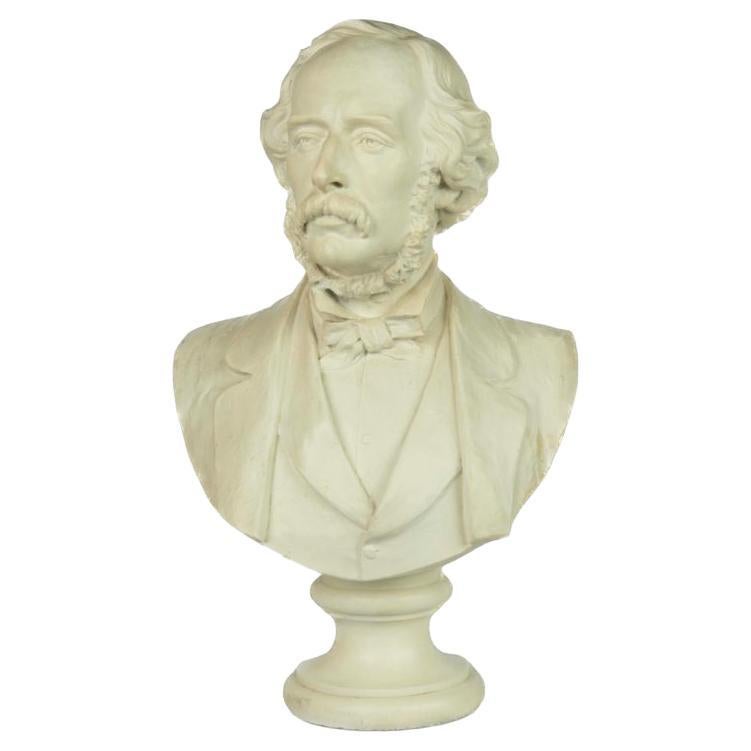
View AllA plaster bust of a Victorian gentleman by Boehm
Located in Lymington, Hampshire
A plaster bust of a Victorian gentleman by Boehm, this white plaster bust shows an authoritative gentleman with a moustache and whiskers wearing a high collar and bow tie with a wais...
Category
Antique 1830s English Busts
Materials
Plaster
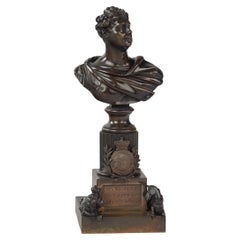
A Rare Bronze Bust of King George IV, Retailed by Rundell, Bridge and Rundell
By Rundell, Bridge
Rundell
Located in Lymington, Hampshire
A Rare Bronze Bust of King George IV, Retailed by Rundell, Bridge and Rundell c.1821
Literature
Bronze busts of this model are discussed by Christopher Hartop in Royal Goldsmiths:...
Category
Antique Early 19th Century English Busts
Materials
Bronze
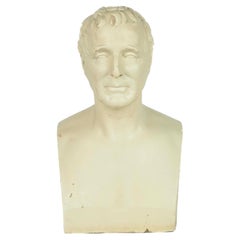
A painted plaster herm bust of the Duke of Wellington by George Gammon Adams
Located in Lymington, Hampshire
This plaster bust of Arthur Wellesley, 1st Duke of Wellington is a replica of the original marble portrait bust, commissioned, in 1852, by the Duke’s heir for Stratfield Saye, Hampsh...
Category
Antique 19th Century English Busts
Materials
Plaster
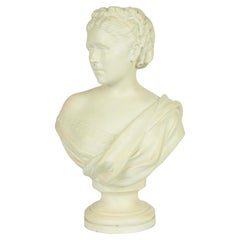
Victorian White Painted Terracotta Bust of a Young Woman
Located in Lymington, Hampshire
A Victorian white painted terracotta bust of a young woman, wearing a draped shawl over a bodice with a lace trim, her hair elaborately coiffed with a broad plait and multiple ringle...
Category
Antique 1860s English Victorian Busts
Materials
Terracotta
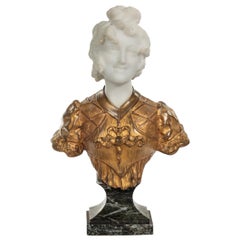
Marble and Ormolu Bust by Marionnet
Located in Lymington, Hampshire
A marble and Ormolu bust by Marionnet, showing the white marble head and shoulders of a girl with her hair in a bun and ringlets framing her face, wi...
Category
Antique 1890s French Busts
Materials
Marble, Ormolu
The Duke of Wellington after the Lawrence Gahagan commission for Stratfield Saye
Located in Lymington, Hampshire
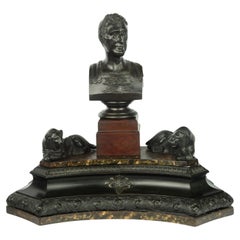
This impressive bronze table bust of the Duke of Wellington is in the form of a classical tribute. He is portrayed wearing Roman leather armour, the breastplate with a central lion’s mask radiating lightning bolts. This is set on a turned socle and square plinth which in turn is raised on a curved simulated marble pedestal, with two recumbent lions above superb quality borders of classical motifs and flowerhead arabesques. The reverse states ‘Wellington L. Gahagan Fecit & Pub’d June 12. 1811’.
Height: 22in (56 cm) Width: 25in (63 cm) Depth: 11in (28cm)
Provenance: Major Hon Denis Gomer Berry and Lady Pamela Wellesley Berry
Richard Gomer Berry, 3rd Viscount Kemsley
Lawrence Gahagan (1735-1820) was born in Dublin to a family of talented stone masons and sculptors. He was based in London from around 1757 and exhibited regularly at the Royal Academy between 1798 and 1817. He was involved in a major project to help update the interiors of Castle Howard from 1801 to 1811 but he is most famous for his portrait busts. In addition to the Wellington busts...
Category
Antique 1810s English Busts
Materials
Bronze
You May Also Like
William Theed the Younger 1804-91 Marble Bust of William Ewart Gladstone 1868
Located in Lowestoft, GB
A very finely carved marble bust of William Ewart Gladstone dated 1868 and signed W.Theed SC
William Theed was born in Staffordshire, his father, William Theed the elder being a sculptor and a craftsman at Wedgwood, known for his major work, Hercules and the Thracian Horses for one frontage of the Buckingham Palace complex. The younger Theed studied at the Royal Academy Schools, then worked for the sculptor E. H. Baily. Five years on, in 1826, he went to Rome, where he was to stay a total of 22 years, during that time working in the studios of Thorwaldson and John Gibson.
Returning to London in 1848, Theed enjoyed a good reputation, being a favoured sculptor of Queen Victoria, and was commissioned to produce many portrait statues, busts, and large monuments. He showed work in the 1851 Great Exhibition, and among other high points were a group for the Albert Memorial, and five standing figures on the Inland Revenue side of Somerset House, representing Manchester, Edinburgh, Glasgow, Belfast and Dublin.
Theed's statues may be seen in St Paul's (Henry Hallam), Manchester (Monument to Chetham in the Cathedral, Gladstone and Thomas Bright for the Town Hall, and James Watt in Piccadilly Gardens), Huddersfield (Robert Peel), Winchester (David Williams monument in the Cathedral), and Prince Albert statues for Grimsby, and in Australia in Macquairie Street, Sydney. He was also responsible for three of the portrait statues (Bacon, Locke, Adam Smith...
Category
Antique 1860s English Victorian Busts
Materials
Marble
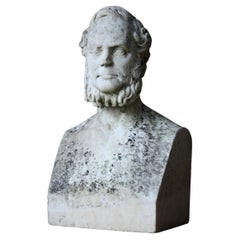
A White Marble Bust of a Gentleman by John Warrington Wood
By John Warrington Wood
Located in Sheffield, MA
John Warrington Wood
English, 1839-1886
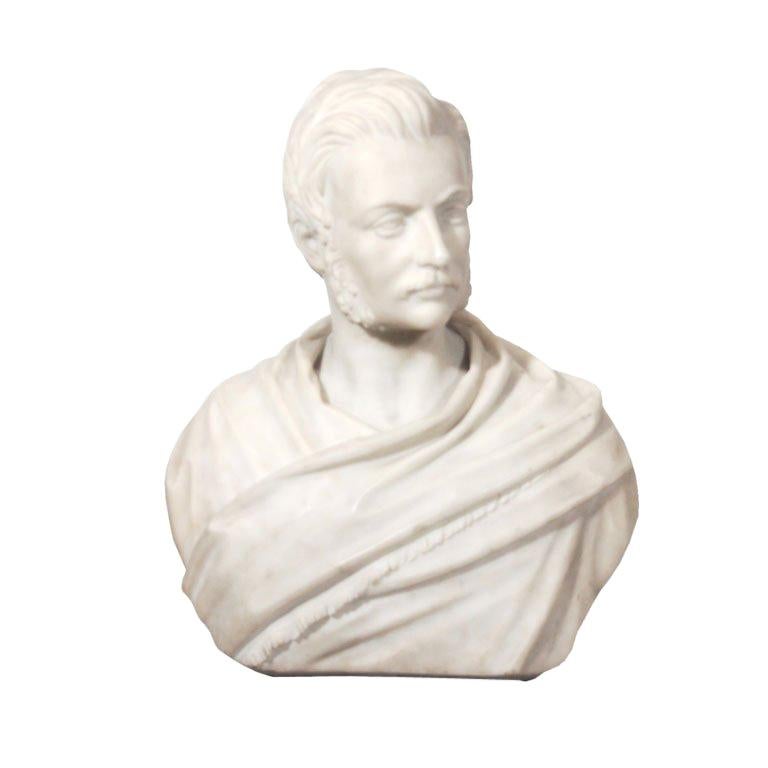
The gentleman wearing a moustache and sideburns
Signed on verso of truncated shoulders
J.Warrington Wood, Sculpt.Rome 1874
Category
Antique 19th Century English Busts
Materials
Marble
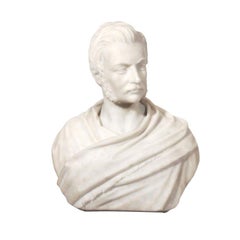
Male Bust Marble Italy 1838
Located in Milano, IT
Male bust in white marble, signed and dated “G. EMANUELI F. / 1838 \". The sculpture depicts a man with a voluminous ring-shaped tuft above his high forehead...
Category
Antique 19th Century Italian Other Busts
Materials
Marble
$18,013
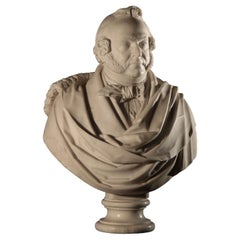
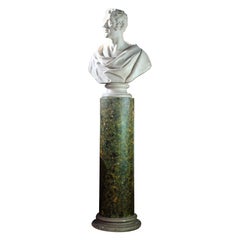
19thC Plaster Bust on Faux Porphyry Marble Column of Architect Matthew Habershon
Located in Lowestoft, GB
A fine plaster bust of the English architect Matthew Habershon (1789-1852). The bust sits on a faux painted porphyry marble column (plaster).
The bust taken from the original marbl...
Category
Antique 19th Century English Busts
Materials
Plaster
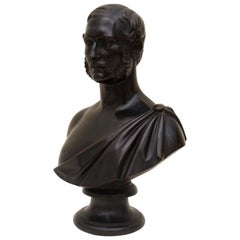
Bust of Prince Albert
Located in New York, NY
In centuries past, lucky artists were ennobled after mastering their craft and achieving renown, but Baron Marochetti had been born into the noblility before he proved his mettle as ...
Category
Antique 1850s Italian Victorian Busts
Materials
Bronze
$8,000
English 19th Century White Carrara Marble Bust by Sir William Hamo Thornycroft
By William Hamo Thornycroft
Located in West Palm Beach, FL
A detailed and wonderfully executed English 19th century white Carrara marble bust of a classical nobleman by famous English sculptor Sir William Hamo Thornycroft. The noble with an ...
Category
Antique 19th Century English Figurative Sculptures
Materials
Carrara Marble