Want more images or videos?
Request additional images or videos from the seller
1 of 18
16th Century Stone classical Torso Sculpture
$40,603.34List Price
About the Item
- Dimensions:Height: 35.44 in (90 cm)Width: 13.78 in (35 cm)Depth: 13.39 in (34 cm)
- Style:Renaissance (Of the Period)
- Materials and Techniques:
- Place of Origin:
- Period:
- Date of Manufacture:1520
- Condition:Wear consistent with age and use.
- Seller Location:Vosselaar, BE
- Reference Number:1stDibs: LU2023316704261
About the Seller
5.0
Vetted Professional Seller
Every seller passes strict standards for authenticity and reliability
Established in 1972
1stDibs seller since 2016
286 sales on 1stDibs
Typical response time: 8 hours
Authenticity Guarantee
In the unlikely event there’s an issue with an item’s authenticity, contact us within 1 year for a full refund. DetailsMoney-Back Guarantee
If your item is not as described, is damaged in transit, or does not arrive, contact us within 7 days for a full refund. Details24-Hour Cancellation
You have a 24-hour grace period in which to reconsider your purchase, with no questions asked.Vetted Professional Sellers
Our world-class sellers must adhere to strict standards for service and quality, maintaining the integrity of our listings.Price-Match Guarantee
If you find that a seller listed the same item for a lower price elsewhere, we’ll match it.Trusted Global Delivery
Our best-in-class carrier network provides specialized shipping options worldwide, including custom delivery.You May Also Like
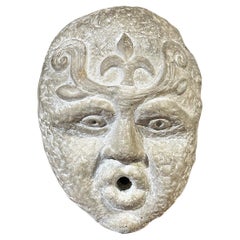
16th CENTURY FOUNTAIN MASK SCULPTURE
Located in Firenze, FI
Unique and precious sculpture in carved white marble, likely depicting Aeolus, the god of the wind. The sculpture originated as a fountain mask, as evidenced by the opening in the mo...
Category
Antique 16th Century Italian Renaissance Figurative Sculptures
Materials
Marble
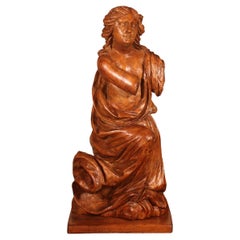
16th Century Walnut Sculptures from Germany
Located in Brussels, Brussels
Very elegant sculpture reprenting a Putti (angel) from the German renaissance period -16 century
Rare sculpture in walnut of great quality with a very beau...
Category
Antique 16th Century German Renaissance Figurative Sculptures
Materials
Walnut
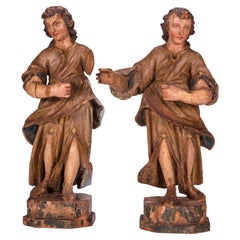
Angelic Carved Wood Sculptures, 16th Century
Located in North Miami, FL
Pair of 16th Century Italian carved polychromed angelic sculptures.
Category
Antique 16th Century Italian Renaissance Figurative Sculptures
Materials
Gold Leaf
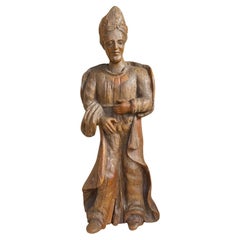
16th-century Flemish Female Wooden Sculpture
By A. Manzoni
Located in Villa Verucchio, Emilia-Romagna
Prologue: An Ancient Mastery the Wooden Sculpture
We begin our journey through Gothic art by presenting a magnificent Late Gothic Female Wooden Sculpture from the Flemish 500s. This ...
Category
Antique 16th Century Belgian Renaissance Figurative Sculptures
Materials
Wood
Sculpture of John The Baptist, 16th Century
Located in North Miami, FL
Early 16th Century Spanish gold gilded and polychromed carved wood sculpture of John The Baptist.
Category
Antique 16th Century Spanish Renaissance Figurative Sculptures
Materials
Gold Leaf

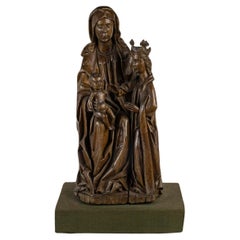
Oak Sculpture of Saint Anne, 16th Century.
Located in Saint-Ouen, FR
Oak sculpture of Saint Anne, 16th century.
Large oak sculpture of Saint Anne. Work from the Upper Rhine, Basel region. First third of the 16th century.
An arm is missing from the i...
Category
Antique 16th Century French Renaissance Figurative Sculptures
Materials
Oak
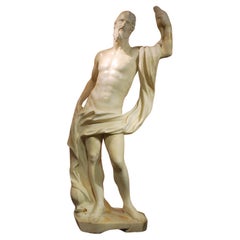
A 16th century carved marble sculpture of poseidon
Located in London, GB
This fine and imposing sculpture is an excellent example of 16th century Italian craftsmanship. The figure is stood on a raised, shaped rectangular base with a carved "dolphin" at th...
Category
Antique 16th Century Italian Renaissance Figurative Sculptures
Materials
Marble
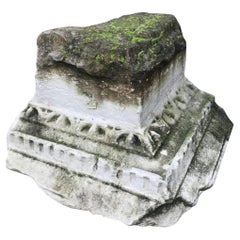
16th C. Hand Carved Capital Stone Base Architectural Element Sculpture Pedestal
Located in West Hollywood, CA
16th C. Hand Carved Capital Stone Base Architectural Element Sculpture Pedestal. Very rare 16th Century Renaissance corner Capital . Hand carved limestone Chapiteau Capital from a Cloister in France . From an ornamental point of view , it is the coronation , the upper part of a post or a column or pilaster pillar . A beautiful Architectural element garden ornament .
It can used as a Base for a coffee glass table , or as a side table for drinks or to mount books. A stunning Fragments to be used as stand for a sculpture . Use it as a pedestal or as a mounted decorative object. In an entryway a bathroom a living room , in an office , it will create an incredible focal point . It can make a beautiful base for a floor lamp by a leather reading chair...
Category
Antique 16th Century French Renaissance Garden Ornaments
Materials
Stone, Limestone
$9,800
H 16 in W 21 in D 21 in
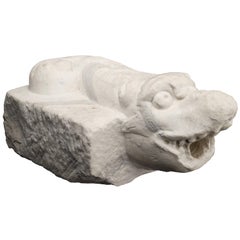
Italian Ancient Marble Sculpture Fountain, Late 16th Century
Located in Milano, IT
Sea monster
Carrara marble mouth fountain
Italy, late 16th century
It measures 13.8 x 31.5 x 18.9 in (35 x 80 x 48 cm)
State of conservation: some small evident gaps and widespread signs of wear due to outdoor exposure. The gray marks crossing it do not come from restoration, but are rather the natural veins of the marble.
This work has some morphological characteristics typically associated with the iconography of the sea monster: an elongated muzzle, sharp teeth, protruding eyes, elongated ears, and a coiled serpent's tail.
An in-depth series of studies on artistic depictions of the sea monster attempted to verify how this symbol evolved in antiquity in the European and Mediterranean contexts and how it gradually changed its image and function over time. The iconography itself is mutable and imaginative and its history is rich with cultural and artistic exchange, as well as the overlapping of ideas. This occurred so much that it is difficult to accurately pinpoint the "types" that satisfactorily represent its various developments.
However, we can try to summarize the main figures, starting from the biblical Leviathan and the marine creature that swallowed Jonah (in the Christian version, this figure was to become a whale or a "big fish", the “ketos mega”, translation of the Hebrew “dag gadol”). Other specimens ranged from the dragons mentioned in the Iliad (which were winged and had legs) to "ketos” (also from Greek mythology), the terrifying being from whose Latinized name (“cetus”) derives the word "cetacean". See J. Boardman, “Very Like a Whale” - Classical Sea Monsters, in Monsters and Demons in the Ancient and Medieval Worlds, in Papers presented in Honor of Edith Porada, Mainz am Rhein 1987, pp. 73-84).
In Italy the monster underwent yet further variations: it can be found in Etruscan art on the front of some sarcophagi representing the companion of souls, while among the Romans we find the “Pistrice” (cited by Plinio in Naturalis Historia PLIN., Nat., II 9, 8 and by Virgilio in Eneide: VERG., Aen., III, 427), which appeared in the shape of a stylized hippocampus or a very large monstrous cetacean and evolved into a hideous being with a dragon's head and long webbed fins.
During the Middle Ages, the sea monster was the object of new transformations: at this time, it is often winged, the head is stretched like a crocodile, the front legs are often very sharp fins - sometimes real paws - until the image merges with dragons, the typical figures of medieval visionary spirituality widely found throughout Europe (on this topic and much more, see: Baltrušaitis, J., Il Medioevo fantastico. Antichità ed esotismi nell’arte gotica, Gli Adelphi 1997).
In Italy during the 15th and 16th centuries, the revival of classicism - representative of the humanistic and Renaissance periods - led to a different reading of these "creatures". Indeed, the sea monster was also to find widespread use as an isolated decorative motif, especially in numerous fountains and sculptures where dolphins or sea monsters were used as a characterizing element linked to water (on this theme see: Chet Van Duzer, Sea Monsters on Medieval and Renaissance Maps, London, The British library, 2013).
From the morphological point of view, the "sea monsters" of this period are mostly depicted as hybrid figures, in which the body of a mythological or real being (a hippocampus, a sea snake, a dolphin), is joined to a head with a rather indistinct appearance. It was usually characterized by large upright ears, an elongated snout, sharp teeth and globular, protruding eyes; a complex and indefinite figure, both from the symbolic point of view and from that of its genesis.
The work we are examining is placed as a cross between the medieval sea serpent and the Renaissance dolphin, with stylistic features which recall the snake as often used in heraldry (such as the "snake" depicted in the coat of arms of the Visconti - the lords and then dukes of Milan between 1277 and 1447 - and which, for some, may be derived from the representations of the “Pistrice” that swallowed Jonah).
In the search for sources, Renaissance cartography and in particular woodcuts should not be neglected. See for example the monsters of Olaus Magnus, from the editions of the “Historia de gentibus septentrionalibus” (“History of the peoples of the north”) and the natural histories of Conrad Gesner, Ulisse...
Category
Antique 16th Century Italian Renaissance Animal Sculptures
Materials
Carrara Marble
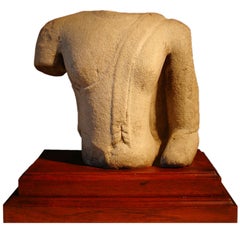
16th Century Thai Ayutthaya Sandstone Torso of the Buddha
Located in Austin, TX
A lovely carved sandstone torso of the Buddha, Ayutthaya period (1350-1767), Thailand.
Wonderfully simplistic, the only ornamentation this torso displays...
Category
Antique 16th Century Thai Sculptures
Materials
Sandstone
More From This Seller
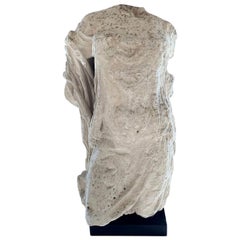
View All16th Century Stone Classical Roman Style Torso
Located in Vosselaar, BE
A wonderful 16th century draped female torso in classical style. Made in France under Italian Renaissance influence this female torso is finely sculpted with great detail to the stol...
Category
Antique 16th Century French Renaissance Figurative Sculptures
Materials
Sandstone
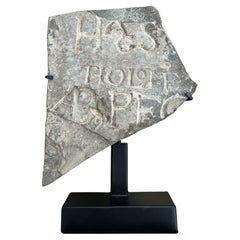
16th century stone architectural fragment
Located in Vosselaar, BE
A 16th century Spanish slate stone architectural fragment. Probably part of a commerative plaque. The Latin inscription only partly present but most likely being a religious referenc...
Category
Antique 16th Century Spanish Medieval Antiquities
Materials
Slate
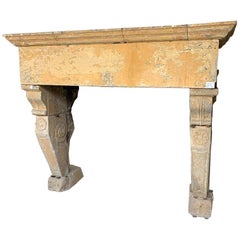
16th Century French Fireplace Mantel
Located in Vosselaar, BE
A monumental 16th century sandstone Renaissance fireplace mantel. Finely sculpted with a moulded beam and colomn supports. Decorated with flower motives, guirlandes and cirkels.
Lov...
Category
Antique 16th Century French Renaissance Fireplaces and Mantels
Materials
Sandstone
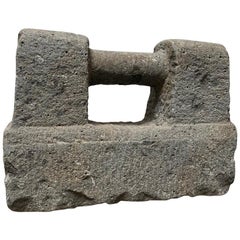
18th Century Chinese Stone Artefact
Located in Vosselaar, BE
This double sided hitching post was used to stall horses for short period of times. They are found throughout China and made during centuries. This hardstone example dates from the 1...
Category
Antique Early 18th Century Chinese Sculptures and Carvings
Materials
Stone
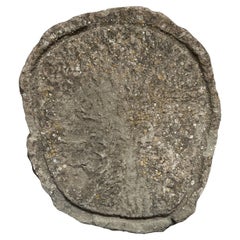
18th century round stone ornament
Located in Vosselaar, BE
Interesting round stone object. Most likely a element of a stone wine- or cheese press. On its own it has the feeling of a intriguing ancient disc with the weathered surface almost l...
Category
Antique Late 18th Century Spanish Mounted Objects
Materials
Stone
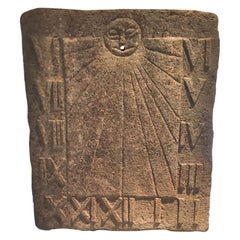
18th Century French Stone Sundial
Located in Vosselaar, BE
A impressive late 18th century French sandstone sundial mounted on a custom lade iron stand. The Latin numerals finely carved at both sides an...
Category
Antique Late 18th Century French Neoclassical Sundials
Materials
Sandstone
Still Thinking About These?
All Recently ViewedMore Ways To Browse
Waterford Nativity
Lalique Victoire
Papua Totem
Vintage Ceramic Snow White And Seven Dwarfs
Vintage Hat Display Heads
African Bronze Head Benin
Art Deco Figure Attributed To Lorenzl
Dior Mannequin
Goldscheider Man
Karl Grossl
Thomas Holland Sculpture
Vintage 3 Wise Men
Dresden Angels
Grant Speed
Green Lucite Buddha
Hannah Carving
Herend Wrestlers
Hermes Bologna