Items Similar to 19th Century Gilt Bronze Sculpture of Aurora


Want more images or videos?
Request additional images or videos from the seller
1 of 16
19th Century Gilt Bronze Sculpture of Aurora
$2,138.38
£1,604.18
€1,800
CA$2,960.75
A$3,217.82
CHF 1,724.46
MX$39,070.10
NOK 21,649.55
SEK 20,076.66
DKK 13,712.66
About the Item
A fire-gilt bronze sculpture of Aurora, also known as Eos in Greek mythology, created in France during the Empire period around 1810. She rises lightly onto one foot, poised atop a gleaming sphere that symbolizes the dawn ascending over the world. Beneath this celestial globe rests a crisp white marble disk, itself supported by a block of deep black marble, giving the composition a striking architectural clarity.
Aurora is rendered in the pure, idealized manner favoured by early nineteenth-century neoclassicism—her figure slender, elongated, and animated by a subtle forward motion. Above her head she holds a flowing veil, shaped by the wind into a graceful arch, as if she were unfolding the first light of morning across the sky. The drapery, though delicate, introduces a dramatic counter-movement, sweeping behind and around her with a sense of celestial breeze.
Between her raised foot and the sphere lies a pillar-like cascade of cloud, flame, or stylized waves—an effect sometimes used by Empire sculptors to “lift” the figure visually and to create equilibrium when the goddess balances upon a single point. This vertical plume gives the composition an ethereal buoyancy, allowing Aurora to appear both anchored to the world and rising away from it.
In mythology, Aurora (Eos) is the bringer of dawn, opening the gates of heaven each morning to let the sun rise. Empire-period artists were drawn to her as a symbol of renewal, purity, and celestial order. In this sculpture, those themes are distilled into a single gesture—her arched veil, her lifted heel, her luminous ascent above the world. The fire gilding enhances this effect, giving her surface a soft radiance that echoes her divine role as the herald of light.
The contrasting marbles beneath her form a deliberate visual foundation: the black marble evokes the night she dispels, while the white marble plate represents the first pale glow of day. Together they complete the allegory, allowing Aurora to emerge with the serenity and quiet drama characteristic of early nineteenth-century French bronzework.
- Dimensions:Height: 8.27 in (21 cm)Width: 4.34 in (11 cm)Depth: 4.34 in (11 cm)
- Style:Empire (Of the Period)
- Materials and Techniques:
- Place of Origin:
- Period:
- Date of Manufacture:ca.1810
- Condition:Wear consistent with age and use. A few minor insignificant chips on the marble. See photos.
- Seller Location:Stockholm, SE
- Reference Number:1stDibs: LU1006847642212
About the Seller
4.9
Recognized Seller
These prestigious sellers are industry leaders and represent the highest echelon for item quality and design.
Established in 1989
1stDibs seller since 2013
108 sales on 1stDibs
Typical response time: <1 hour
- ShippingRetrieving quote...Shipping from: Stockholm, Sweden
- Return Policy
More From This Seller
View All18th century Venus de’ Medici Bronze Bust
Located in Stockholm, SE
An 18th century Venus de’ Medici bronze bust, mounted on a later 19th century marble base. It has a beautiful rich slightly worn dark brown patina. Venus...
Category
Antique 18th Century Italian Classical Roman Busts
Materials
Marble, Bronze
$2,471 Sale Price
42% Off
Art Deco Sculpture of a Polynesian Woman
Located in Stockholm, SE
An art deco terracotta-painted plaster sculpture of a partly nude odalisque walking holding a tray, signed and dated "KA (19)15" by Swedish sculptor Knut Andersson (1884–1954). This ...
Category
Vintage 1910s Swedish Art Deco Figurative Sculptures
Materials
Plaster
Early 20th Century Swedish Plaster Sculpture, Art Deco, signed Strindberg
By Tore Strindberg
Located in Stockholm, SE
This is a study for one of the figures that is part of Tore Strindbergs large sculpture "The five continents" placed in Gothenburg, Sweden. This one represents Asia.
The sculpture ...
Category
Vintage 1920s Swedish Busts
Materials
Plaster
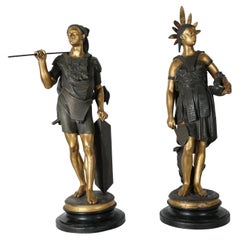
"Guerrier des Amériques". Pair of sculptures signed J J Salmson (1823-1902)
By Jean-Jules Salmson
Located in Stockholm, SE
This pair of sculptures, titled "Guerrier des Amériques" by French sculptor J.J. Salmson (1823-1902), depict two American Indian warriors in a striking and detailed manner. Both figu...
Category
Antique Late 19th Century French Figurative Sculptures
Materials
Bronze
$2,518 Sale Price / set
20% Off
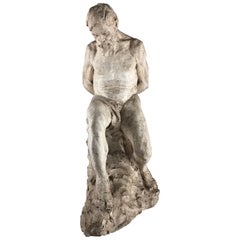
Sculpture of Plaster, signed Gallé and dated -93 (1893)
Located in Stockholm, SE
A plaster sculpture by André Vauthier-Galle (1818–1899). A seated male figure with his hands behind his back. Executed in a very realistic way. The sculpture very much reminds of Auguste Rodins "The Thinker" in its pose.
The sculpture has a great patina.
The sculpture comes from the workshop of the Swedish painter and sculptor Jonas Åkesson...
Category
Antique 1890s French Figurative Sculptures
Materials
Plaster
$3,991 Sale Price
20% Off
Grand Tour sculpture of Narcissus, 19th c
Located in Stockholm, SE
This elegant 19th-century Grand Tour bronze sculpture represents Narcissus, the character from Greek mythology known for his beauty and self-admiration. Standing 65 cm high, the figu...
Category
Antique Mid-19th Century Italian Figurative Sculptures
Materials
Bronze

You May Also Like
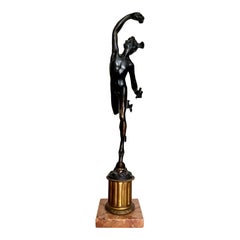
19th Century Grand Tour Bronze Sculpture Mercury
Located in Madrid, ES
Bronze sculpture of the god Mercury
Representation of the god Mercury standing on Aeolus, the god of the wind (according to Gianbologna), on a marble base from which a fluted column ...
Category
Antique Early 19th Century Italian Grand Tour Figurative Sculptures
Materials
Marble, Brass, Bronze
Large Antique Gilt Bronze Sculpture/ Roman Goddess Fortuna, After Giambologna
Located in Tarry Town, NY
Introducing an extraordinary 19th-century gilt bronze sculpture of Fortuna, masterfully created after the famed Italian Renaissance sculptor Giambologna (1529-1608). This impressive piece embodies the grace and elegance of Fortuna, the Roman goddess of luck and fortune.
The sculpture is intricately cast and gilded, reflecting the high level of craftsmanship inspired by Giambologna's iconic works. Fortuna is depicted in a dynamic pose, raised on a beautifully mottled antique marble plinth...
Category
Antique 19th Century Figurative Sculptures
Materials
Marble, Bronze

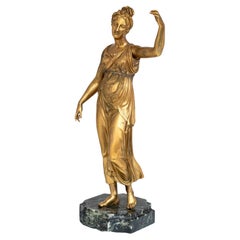
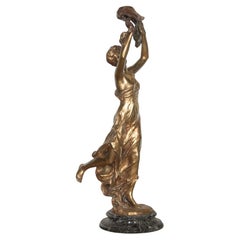
French Gilt Bronze Figural Sculpture
Located in Astoria, NY
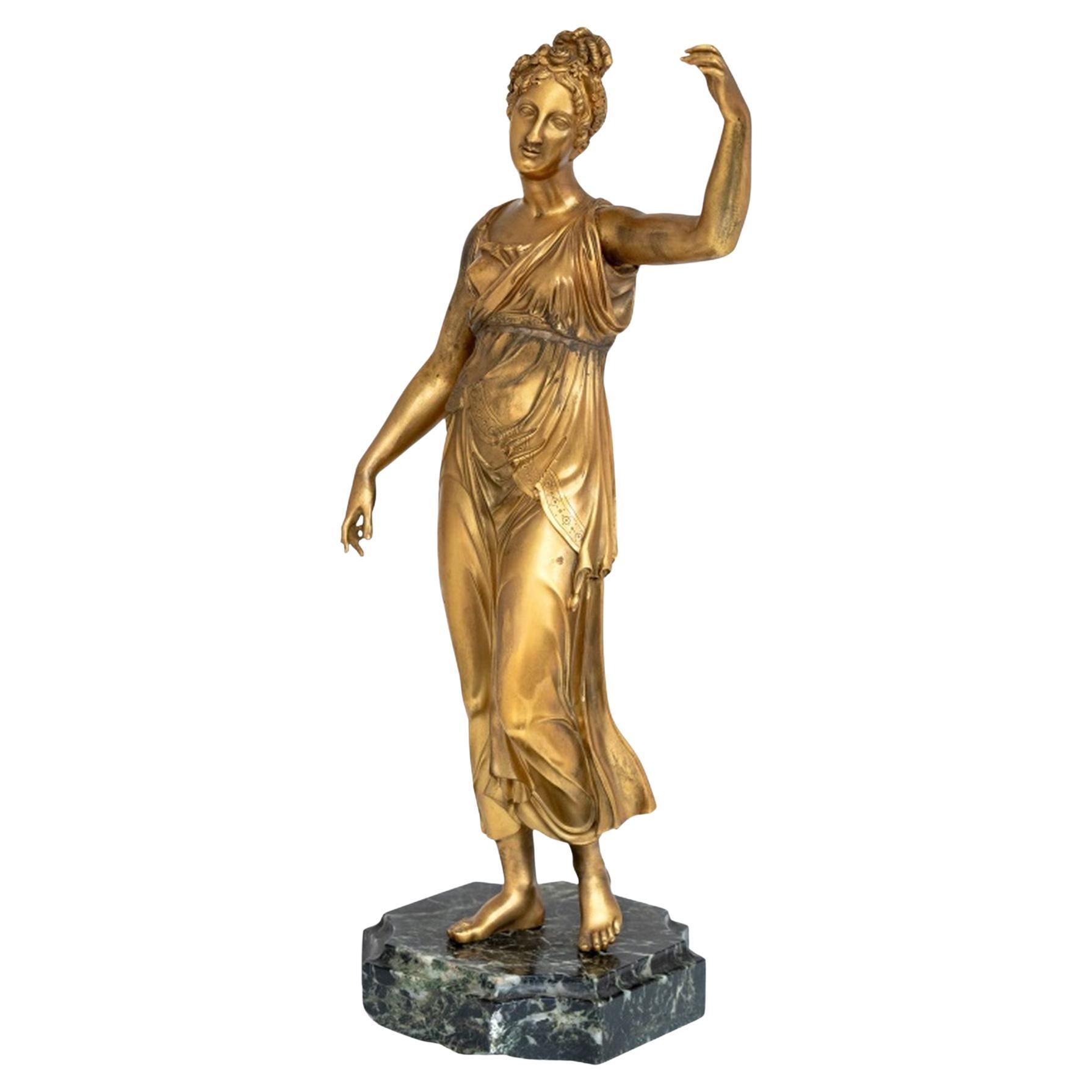
French Gilt Bronze Figural Sculpture, 19th century, depicting a classically draped standing female with raised arm, on a green marble base. 15.25" H x 7" W x 4.75" D.
Category
Antique 19th Century French Neoclassical Figurative Sculptures
Materials
Marble, Bronze
19th Century Gilt Bronze Female Figure
Located in Gloucestershire, GB
19th Century English, high quality and attractive bronze figure of a female.
This beautiful piece is signed 'Roberte du Bois' and stands out from the crowds with its quality gilt fin...
Category
Antique Mid-19th Century English Figurative Sculptures
Materials
Bronze
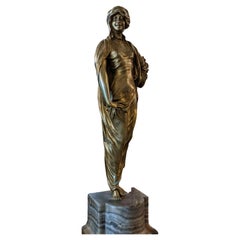
19th Century Bronze Sculpture from France
Located in Dallas, TX
This bronze sculpture origins from France, circa 1880.
Category
Antique Late 19th Century French Figurative Sculptures
Materials
Bronze
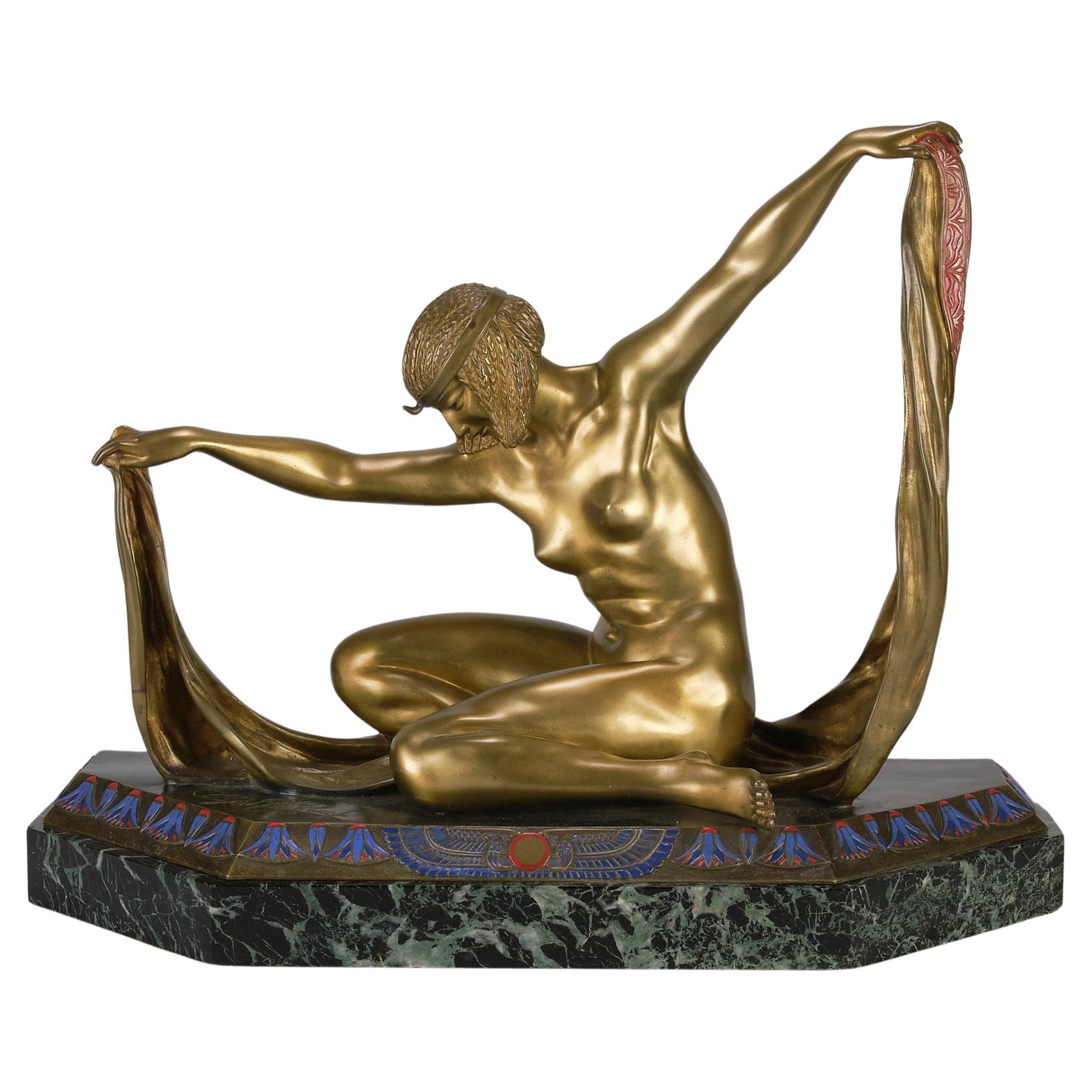
Early 20th Century Art Deco Gilt Bronze Sculpture "Isis" by Claire Colinet
By Claire Colinet
Located in London, GB
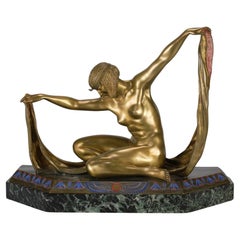
An exquisite early 20th Century French Art Deco gilt bronze figure of a young female dancer seated upon a shawl that she is lifting either side of her. The surface decorated with enamel painted ancient Egyptian design, exhibiting excellent colour and detail. Raised on a marble base and signed Cl.J.R.Colinet
ADDITIONAL INFORMATION
Height: 42 cm
Width: 56 cm
Depth: 21 cm
Condition: Excellent Original Condition
Circa: 1925
Materials: Bronze & Marble
Book Ref: Art Deco & Other Figures by Bryan Catley
Page: 117
SKU: 9176
ABOUT
Colinet
Claire Jeanne Roberte Colinet (1880–1950) was French sculptor of Belgian birth who worked during the early-to-mid 20th century. The subject matter of her best known work was primarily Arab female dancers. The majority of her career output in sculpture can be classified as being of the Art Deco style.
Colinet was a frequent exhibitor at the Salon des Artistes Francais and Salon des Independents art exhibitions in Paris. Her sculptures, most of which depicted beautifully figured, energized, and dramatic female forms, were exhibited posthumously at the Paris Salon for nearly 30 years.
Early Life
Colinet was born in Brussels, Belgium, in 1880. Little is known about her life other than the artwork she produced during a successful career that spanned more than 40 years. As a woman, she was in the minority in her chosen field of sculpture during the era in which she worked and lived.
Career
At an undetermined date – probably around 1910 – Colinet emigrated to Paris, France, where she studied sculpture under the watchful eye of Jef Lambeaux and exhibited for the first time at the Salon des Artistes Francais in 1913 and became a permanent member of the organization in 1929. From 1937 to 1940, she exhibited at the Salon des Independents in Paris and joined the Union of Women Painters and Sculptors. Colinet's work is primarily done in the Art Deco style, and her models included odalisques, exotic dancers, jugglers and artists of cabaret.
A number of her female dancer pieces were influenced by a revival of the Orientalism movement which had been popular in Europe from about 1860 to 1880. Her preferred casting material was bronze; however, a number of her most distinguished sculptures are chryselephantine, being a combination of both bronze and ivory.
Colinet's sculpture has become highly desirable to collectors and, increasingly, is selling for exorbitant sums. At a Christie's sale on 4 May 2007, her Ankara Dancer...
Category
Early 20th Century French Art Deco Figurative Sculptures
Materials
Bronze