Items Similar to Amazing "Our Lady of Sorrows" attributed to Salzillo 18th-century
Want more images or videos?
Request additional images or videos from the seller
1 of 10
Amazing "Our Lady of Sorrows" attributed to Salzillo 18th-century
$89,440.42
£66,590.54
€75,000
CA$123,617.57
A$131,431
CHF 71,073.92
MX$1,563,411.81
NOK 890,301.82
SEK 813,110.45
DKK 571,481.34
About the Item
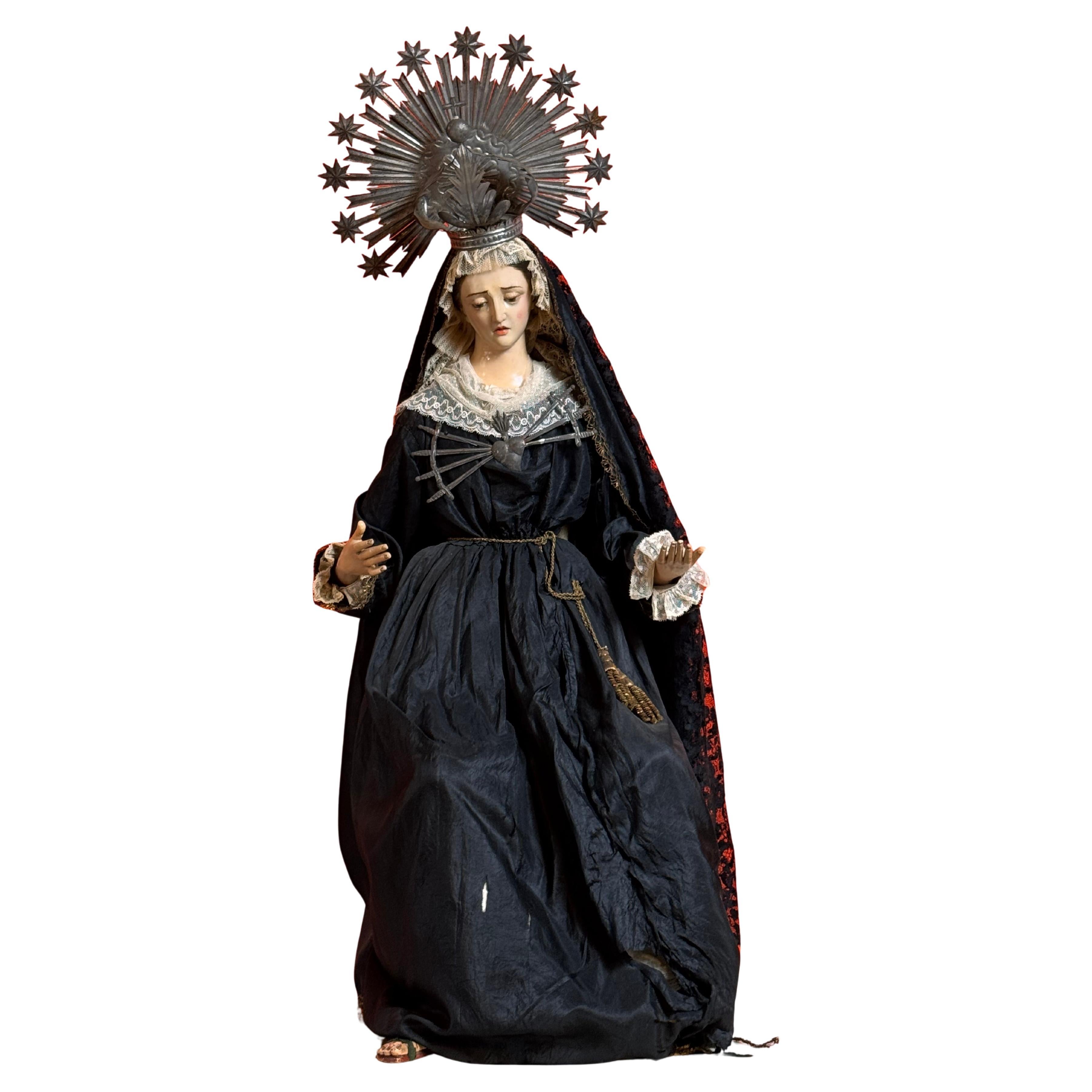
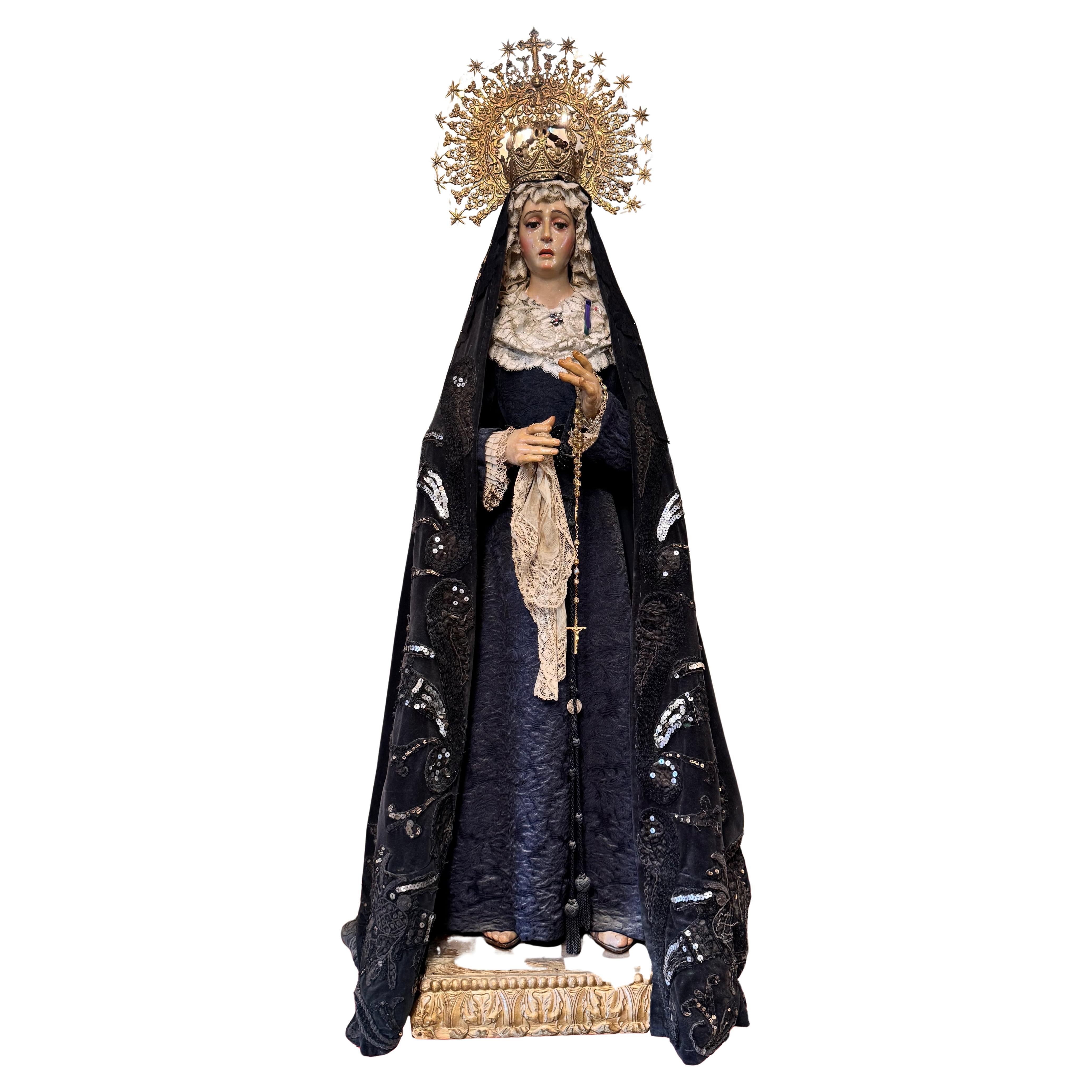
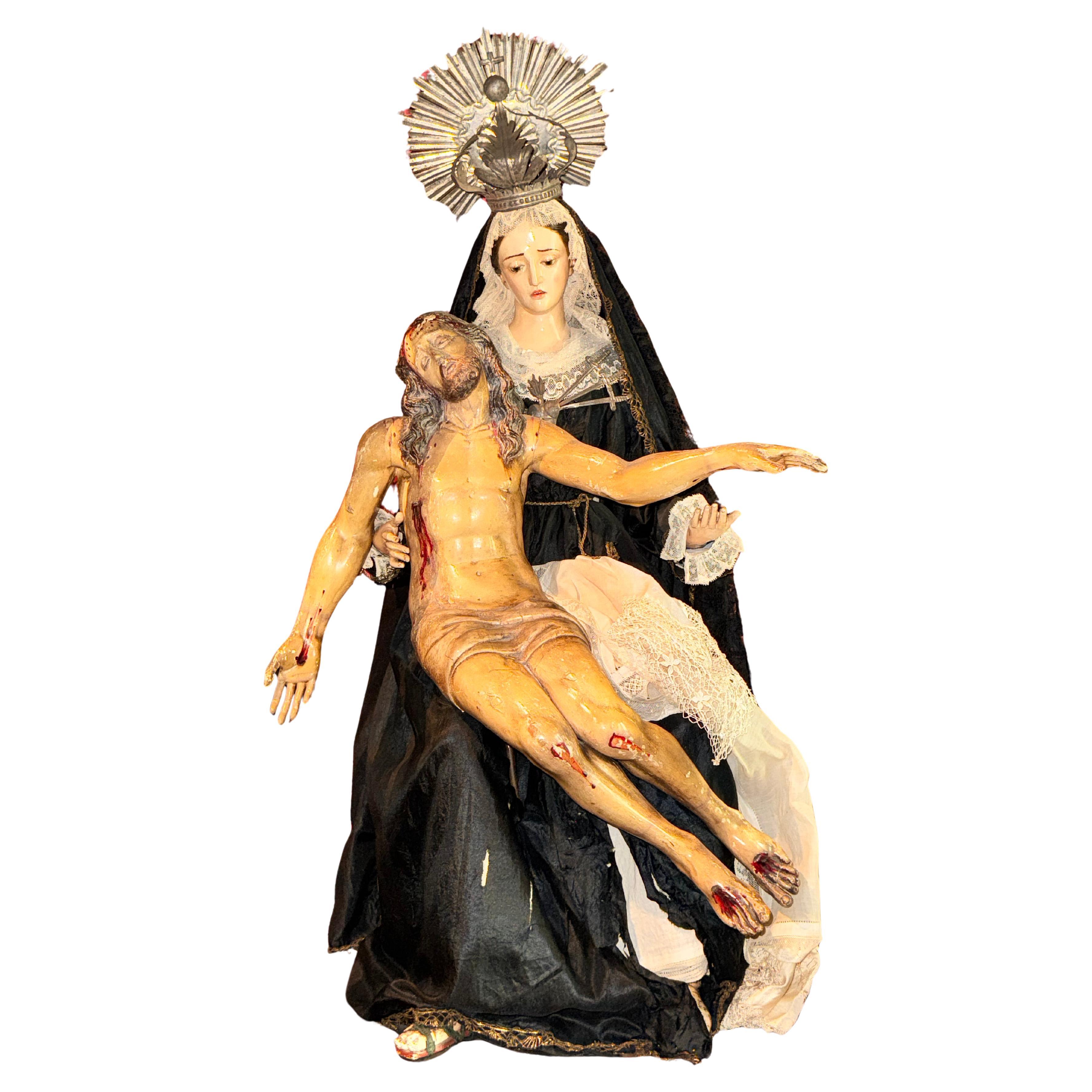
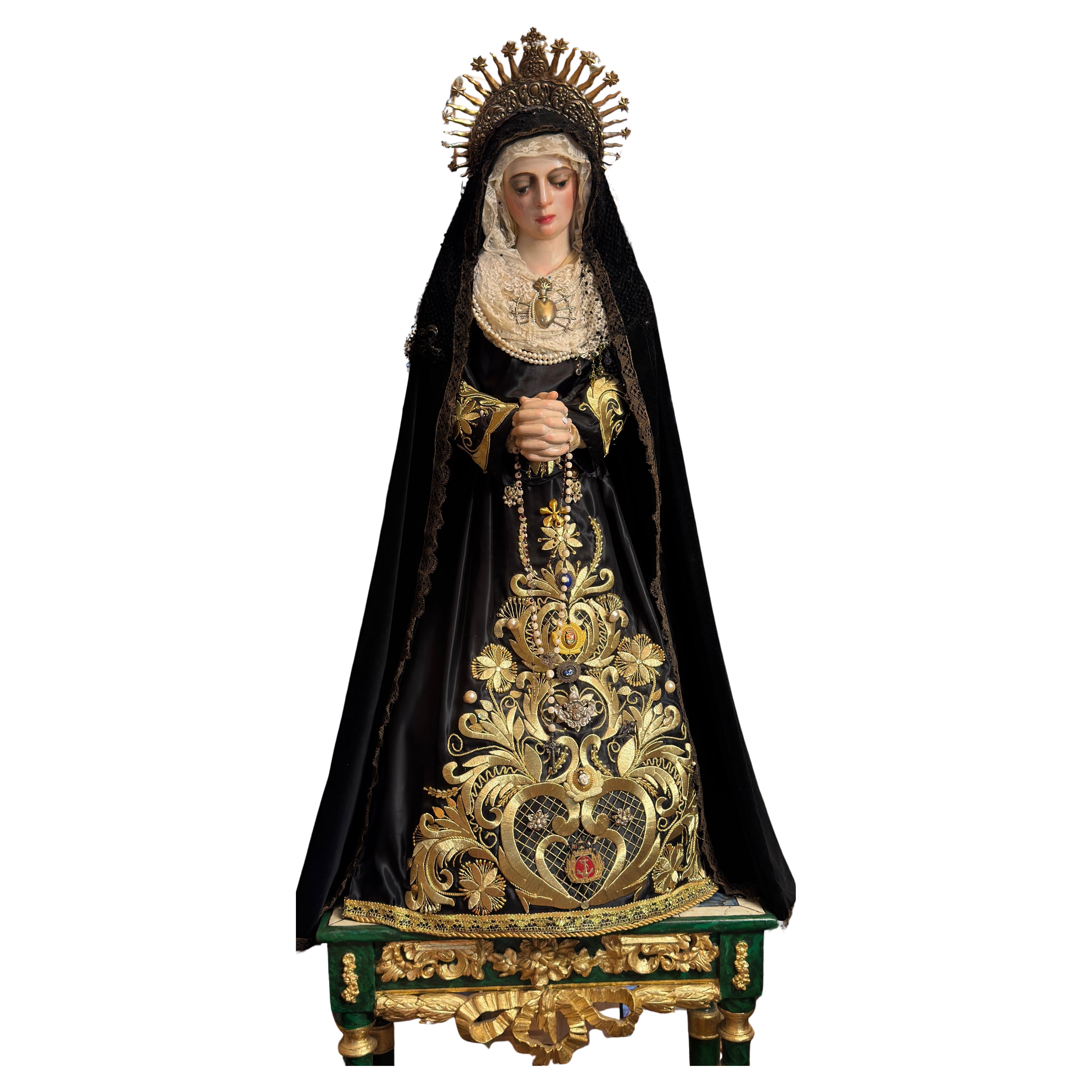
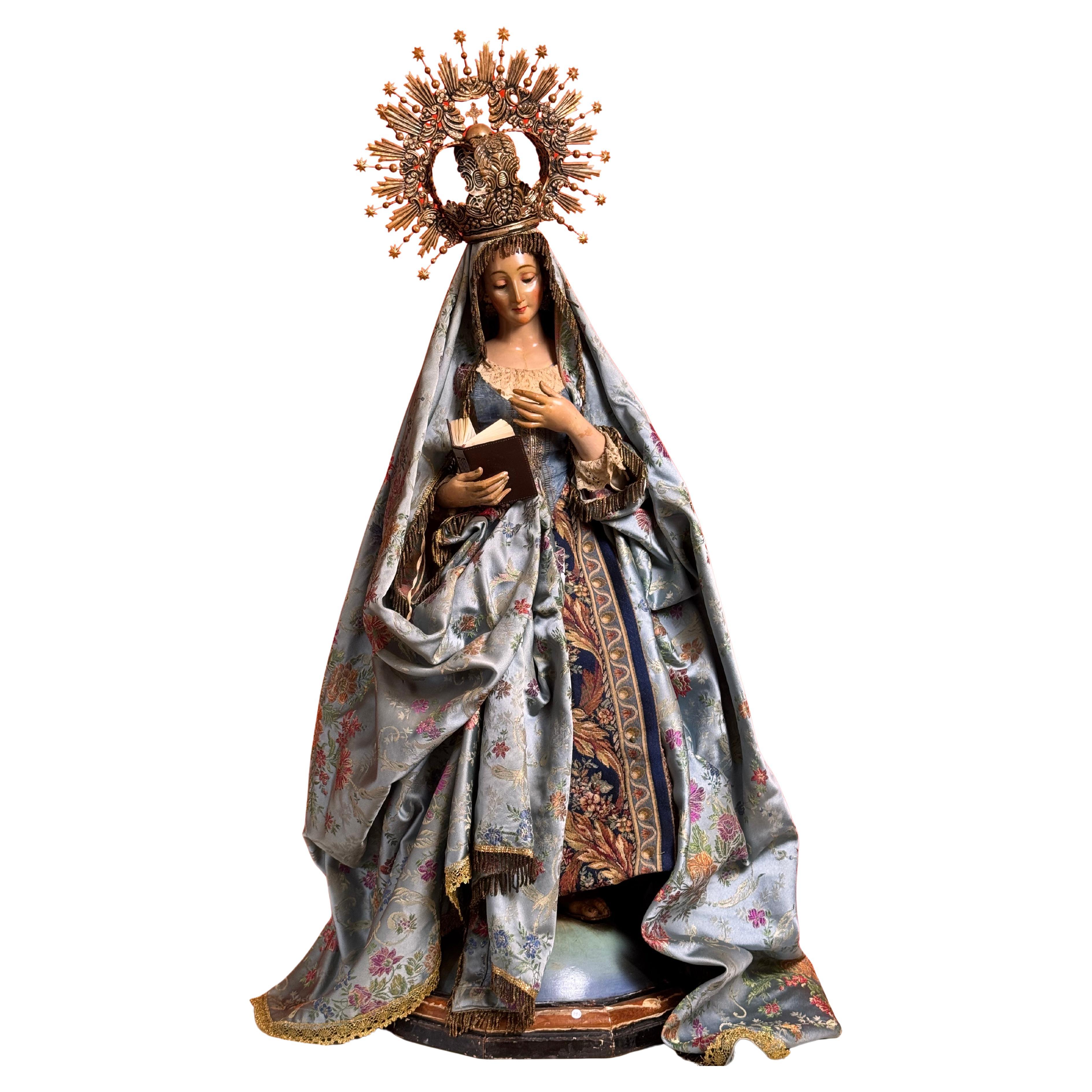
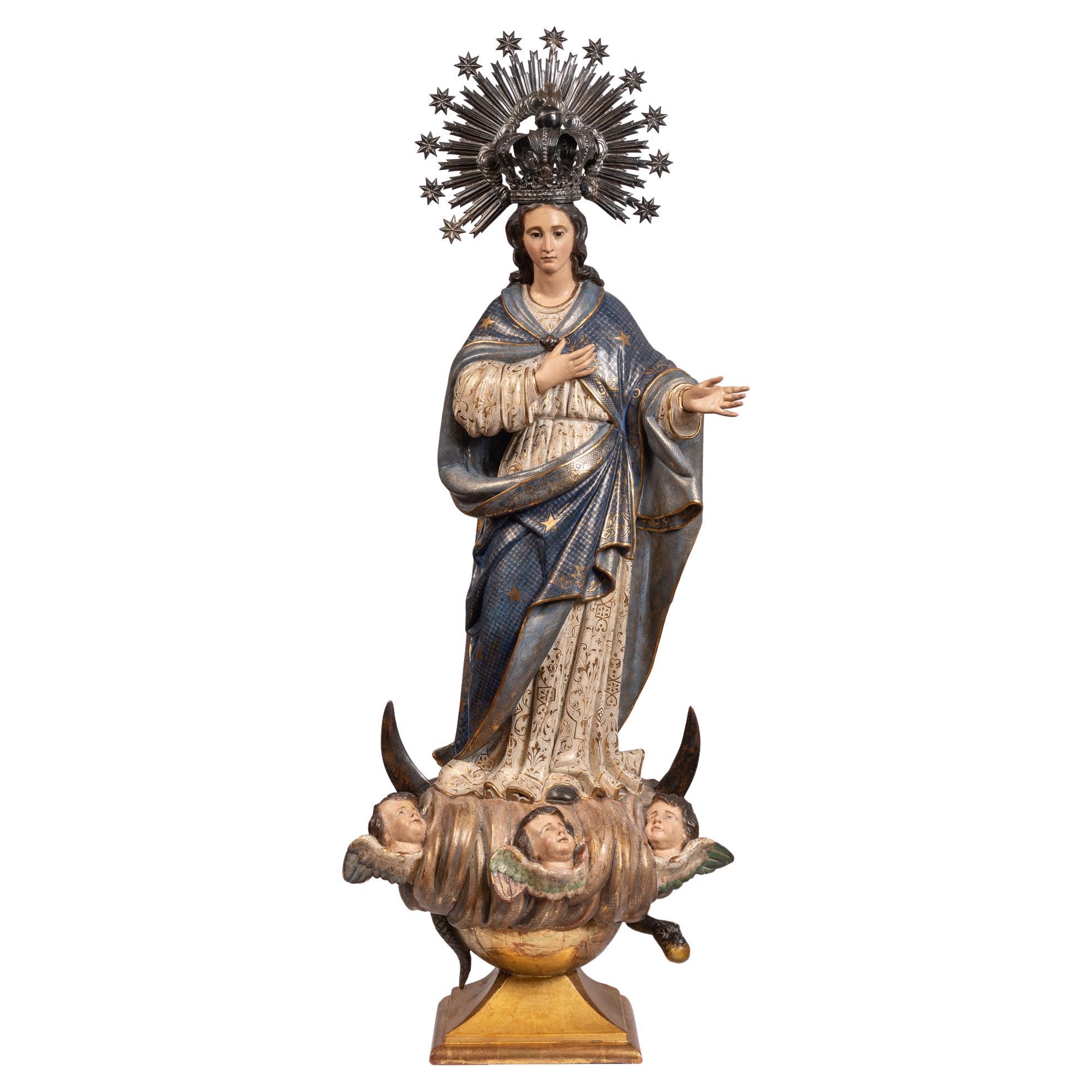
Our Lady of Sorrows, attributed to Salzillo, polychrome wood with 18th-century silver crown and display case
An extraordinary sculpture of Our Lady of Sorrows, attributed to Francisco Salzillo (Murcia, 1707–1783), carved and polychromed in the 18th century. The image presents a face of intense, yet restrained, drama, with carved and polychromed eyes, tears, and a slightly open mouth, reflecting the sensibility of the Murcian master. She wears antique textiles with lace, accompanied by rosaries in silver and jet. She is crowned with a magnificent original 18th-century silver crown, a piece of goldsmithing that further elevates its stature. The entire piece is preserved in its original mahogany display case, constituting a work of exceptional historical, devotional, and artistic value. An outstanding example of Spanish Baroque sculpture, it is of great interest to international collectors and galleries.
60x44 + Headband 22x31 total virgin 72cm Display case - 119 high, 83 wide, 49 deep, console: 95 high, 100 wide, 52 deep
Francisco Salzillo y Alcaraz (Murcia, May 12, 1707 – Murcia, March 2, 1783) was a Spanish Baroque sculptor, considered the most representative religious image maker of the 18th century in Spain and one of the greatest of the Baroque period. Salzillo dedicated himself exclusively to religious themes and masterfully incorporated the changes that occurred during the 18th century into his style. This is reflected in a sculpture that marked a transition between Rococo and Neoclassicism, as well as in various changes that took place in the workshop he inherited from his father, the sculptor and religious image maker Nicolás Salzillo.
His life was spent entirely in Murcia. Today, the city boasts a museum dedicated to his work, the Salzillo Museum, which houses some of his most characteristic pieces, such as the Nativity scene and the eight floats that are carried in procession on Good Friday in what is known as the Salzillo Procession.
Francisco Salzillo was born in Murcia on May 12, 1707. His father, Nicolás Salzillo, was an Italian sculptor from Santa Maria Capua Vetere who had settled in Murcia a few years earlier. After beginning his studies in Literature with the Jesuits, he appears to have entered the Dominican Order as a novice. Upon his father's death in 1727, when Francisco was only twenty years old, he had to take over his sculpture workshop.
He was the second of seven children, some of whom worked in the family workshop, specifically José Antonio and Patricio, born in 1710 and 1722 respectively, and possibly Inés, who was in charge of the gilding and polychrome decoration of the sculptures made in the family workshop. [3] In 1746, he married Juana Vallejo y Taibilla, and they had two children: Nicolás, born in 1750 and who died the following year, and María Fulgencia.
Francisco Salzillo circa 1780, graphite pencil drawing by Joaquín Campos to illustrate the Historical Dictionary by Juan Agustín Ceán Bermúdez. National Library of Spain.
Francisco Salzillo spent his entire life in Murcia, where he earned a name and fame that transcended the purely artistic realm. Only one trip outside the city of Murcia is documented: his journey to Cartagena in 1755 to deliver the images of the Four Saints. He declined the Count of Floridablanca's invitation to move to Madrid, which would have allowed him to gain recognition at Court.
Over the years, his work acquired fame, and he received numerous commissions from churches and convents in Murcia and the neighboring provinces of Alicante, Albacete, and Almería. In 1755, he was appointed Official Sculptor of the City Council of Murcia and inspector of painting and sculpture.
After his wife's death in 1763, Salzillo's meetings with other artists and intellectuals from Murcia became more frequent. In 1777, they founded the Royal Economic Society of Friends of the Country of Murcia, which led to the creation of the Patriotic School of Drawing in 1779, with Salzillo as its first director. He died in Murcia on March 2, 1783. He was buried in the now-demolished Capuchin Convent of Murcia, where his sister, Francisca de Paula, had taken her vows.
The most outstanding works from his early period, when he took over his father's workshop, were the Dolorosa in the parish church of Santa Catalina, the Saint Joseph in Santa Clara, the Holy Family in San Miguel, and the Immaculate Conception in the Convent of Verónicas, all of which are located in the city of Murcia.
From 1740 onward, his personal and well-defined style began to be more clearly appreciated. It was in this year that he achieved fame with the Pietà for the Servite Confraternity of the parish of San Bartolomé in Murcia, a model he repeated for Lorca, Dolores in Alicante, and Yecla. This was his first foray into Passion iconography, of which he would become a great master. Other important works that followed were the Saint Anthony for the hermitage of San Antón (1746), the Saint Augustine for the Convent of the Augustinian Nuns of Corpus Christi, and the medallion of the Virgin of the Milk for Murcia Cathedral. Italian influence is evident in works from this period, such as the images of Saint Francis and Saint Clare for the Capuchin convent. The movement and expression of their hands make them some of the principal Baroque works in the realm of spirituality and mysticism.
From 1765 onward, with Roque López, his principal disciple, working in his workshop, his production became more industrialized. Characteristic of this period are the Virgin of Sorrows in Yecla, the Virgin of the Dawn in Aledo, the Washing of the Feet of Christ the Prince of the Apostles in the Royal Salesian Convent of Orihuela,[7] and the Holy Family in the Church of Santiago in Orihuela. Also noteworthy is the Christ of the Isabelas, or of the Good Death, or Recumbent Christ of the Poor Clares in Orihuela (1774), the only sculpture in his entire oeuvre on this theme. The Dominican saints in the Church are also significant.
- Attributed to:Francisco Salzillo (Artist)
- Dimensions:Height: 46.86 in (119 cm)Width: 32.68 in (83 cm)Depth: 19.3 in (49 cm)
- Style:Baroque (Of the Period)
- Materials and Techniques:
- Place of Origin:
- Period:
- Date of Manufacture:18th Century
- Condition:Wear consistent with age and use. Original condition.
- Seller Location:Madrid, ES
- Reference Number:1stDibs: LU5779247461952
About the Seller
4.8
Gold Seller
Premium sellers maintaining a 4.3+ rating and 24-hour response times
Established in 2005
1stDibs seller since 2021
396 sales on 1stDibs
Typical response time: 1 hour
- ShippingRetrieving quote...Shipping from: Madrid, Spain
- Return Policy
More From This Seller
View AllOur Lady of Sorrows, dressed in robes, 19th century.
Located in Madrid, ES
Our Lady of Sorrows, dressed in robes, 19th century.
This polychrome and gilded wooden sculpture features a delicately executed face, crystal tears, and glass eyes that accentuate ...
Category
Antique 19th Century Spanish Baroque Figurative Sculptures
Materials
Silver
Spanish Virgin of Sorrows in Polychrome Wood with Silver Crown, 19th Century
By Spanish Manufactory
Located in Madrid, ES
Spanish Virgin of Sorrows in Polychrome Wood with Silver Crown, 19th Century
Magnificent dressed Virgin of Sorrows, from the 19th-century Spanish school, carved in polychrome wood (...
Category
Antique 19th Century Spanish Baroque Figurative Sculptures
Materials
Silver
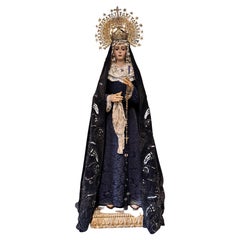
Reliquary Set: Recumbent Christ (17th Century) and Our Lady of Sorrows (19th Cen
Located in Madrid, ES
Reliquary Set: Recumbent Christ (17th Century) and Our Lady of Sorrows (19th Century)
A devotional reliquary with a damask lining and glass houses a 17th-century Baroque Christ and a...
Category
Antique 17th Century Spanish Baroque Figurative Sculptures
Materials
Silver
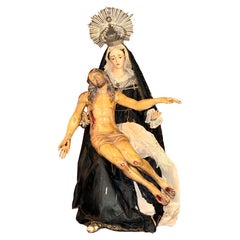
Amazing 16th Cent. Castilian Virgin of Sorrows with an 18th-century Silver Crown
Located in Madrid, ES
Amazing 16th Century Castilian Virgin of Sorrows with an 18th-century Silver Crown, Virgin of Peñaranda
Exceptional 16th-century Castilian school Virgin of Sorrows of Peñaranda, car...
Category
Antique 16th Century Spanish Spanish Colonial Figurative Sculptures
Materials
Wood
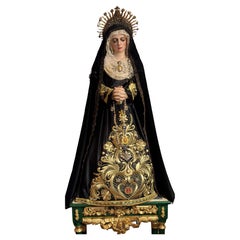
Our Lady of Sorrows “Head and Legs” with Silver Crown Period: 19th Century
Located in Madrid, ES
Our Lady of Sorrows “Head and Legs” with Silver Crown
Period: 19th Century
Origin: Spanish School (probably Andalusian or Castilian).
Dimensions: Approximately 1 meter in height.
...
Category
Antique 19th Century Spanish Baroque Figurative Sculptures
Materials
Silver
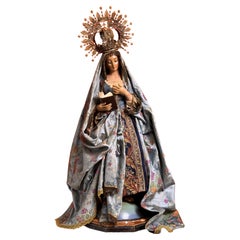
Our Lady of Portillo of Arévalo (Our Lady of Mount Carmel) 17th Century
Located in Madrid, ES
Our Lady of Portillo of Arévalo (Our Lady of Mount Carmel), polychrome wood carving, Spanish school, 17th century
📝 Description
Devotional carving in polychrome and gilded wood
repr...
Category
Antique 17th Century Spanish Baroque Figurative Sculptures
Materials
Wood
You May Also Like
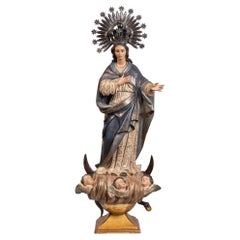
18th Century Spanish Virgin Mary of Immaculate Conception, Handcrafted Sculpture
Located in Madrid, ES
Completely hand-crafted in 18th century Spain, this sculpture of the Virgin stands 1.5 meters / 5 feet tall and was most certainly created for devotional purposes, to be displayed in a church or chapel.
Besides its impressive size this sculpture is an excellent, museum-quality example of the Spanish “Estofado” polychrome technique, developed during the Gothic period to imitate rich brocade fabrics. The finely carved “fabric” areas of the sculpture would be first covered in gesso, and then a layer of gold leaf would be applied. The gold leaf would then be painted over with various colors of tempera paints. Once dry, the painted surface would be incised or scratched away in patterns, revealing the gold beneath.
The sculpture was professionally restored in 2022 by a firm that is often hired by the Spanish government to work on historic building interiors and museum pieces. The virgin was carefully cleaned, repaired and its condition stabilized. A complete and fully-illustrated restoration report will be included with purchase.
Often confused with the virgin birth of Jesus, the belief that the Blessed Virgin Mary herself was conceived “immaculately” without original sin has been variously defended and debated within the Catholic Church since the pre-Middle Ages. For centuries, artists struggled to create an acceptable visual representation of this highly abstract concept, in part taking inspiration from the Book of Revelation and other scriptural sources.
We see the Virgin standing on a half moon (biblically inspired, though also an ancient symbol of chastity) with her long natural hair loose down her back, another indication of purity. Both her white tunic and flowing blue mantle...
Category
Antique 18th Century Spanish Baroque Figurative Sculptures
Materials
Silver, Gold Leaf
$30,529 Sale Price
20% Off
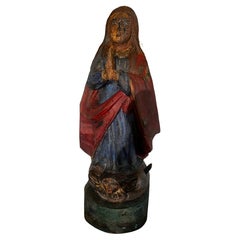
18th Century Italian Carved Wood Polychrome Virgin Mary Sculpture
Located in Doha, QA
This is an outstanding Italian 18th century carved wood polychromed sculpture of Virgin Mary. The Sculpture is hand painted with some remains of a gold gilt in few places and originated until lately in a private Villa in Tuscany (Italy). The colors are typical red, blue and green are spectacular on this large figure. The Virgin's hands are joined together in a prayer, while standing on a pedestal on the both sides of which are devil's horns (bottom left side horn missing ) symbolising Holly Mary defeating the Evil, protected by the Holly Ghost and an Angel. A story tells the pose of the Virgin Mary sculpture...
Category
Antique 18th Century Italian Baroque Figurative Sculptures
Materials
Wood, Pine
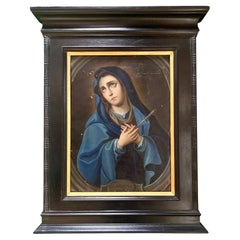
18th Century Spanish Colonial Mater Dolorosa (Our Lady of Sorrows) Oil Painting
Located in London, GB
18th Century Mater Dolorosa Religious Oil Painting, Antique Spanish Colonial Religious Oil Painting, Our Lady of Sorrows Painting, Antique Religious Oil Painting...
Category
Antique Late 18th Century Mexican Spanish Colonial Paintings
Materials
Copper
Antique Spanish Colonial Statue Santo Madonna
Located in Atlanta, GA
A most spectacular antique Spanish Colonial figure of Madonna, Mexico circa 19th century possibly earlier. Constructed in plaster with carved and gilt wood accent. Realistic in style...
Category
Antique 19th Century Mexican Spanish Colonial Figurative Sculptures
Materials
Metal
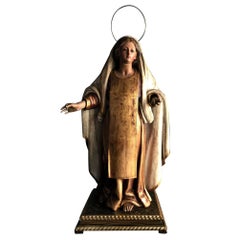
Sculpture of Maria Magdalena, ca. 1600
Located in
S-HERTOGENBOSCH, NL
Sculpture of Maria Magdalena in fruitwood, ca. 1600.
Probably The Netherlands or German. Remains of polychromy.
In the past the underside has been affected by moisture and wood rot....
Category
Antique Early 17th Century Dutch Renaissance Figurative Sculptures
Materials
Fruitwood
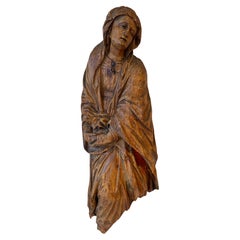
Baroque Sculpture of the Virgin Mary, Immaculate Conception, Olot School, Ca
By Spainhour Furniture Company
Located in Valladolid, ES
Amazing Sculpture of the Virgin Mary Immaculate Conception, Olot School, 20th century – Girona, Catalonia
Material: Wood pulp
School: Olot School
Period: Early 20th century
Count...
Category
Antique Early 1900s Spanish Baroque Religious Items
Materials
Fabric, Plaster, Wood