Items Similar to Antique French Bronze Sculpture of Philosopher “Zeno of Elea” by Eugene Laurent
Want more images or videos?
Request additional images or videos from the seller
1 of 21
Antique French Bronze Sculpture of Philosopher “Zeno of Elea” by Eugene Laurent
$6,800
£5,181.73
€5,975.96
CA$9,658.03
A$10,377.02
CHF 5,567.25
MX$122,253.24
About the Item
EUGENE LAURENT
French, 1832-1898
"Zeno of Elea"
Patinated bronze raised on contemporary Nero Portero marble base
Signed to side "Laurent sculp"
6 1/2” W x 5 7/8” D x 12 1/2” H
ref. 510BLE23A
Exquisitely chiseled and detailed throughout, this fine cabinet bronze depicts philosopher Zeno of Elea, famous for his nine paradoxes. The figure is seated with robes flowing over a classical throne while his face is pensive and lost in thought. A tablet is clasped in his hand where his elbow is also prone. The sculpture is raised on a modern solid block of Nero Portero marble over a patinated bronze rim.
Born in Gray, France in April of 1832, Eugene Laurent studied under Coinchon and exhibited regularly at Salon between 1861 and 1893. He was commissioned for the monument of Jacques Callot in Nancy and the François Boucher statue in the Paris city hall.
Zeno of Elea
Greek philosopher active in the early 5th century BCE, associated with the Eleatic school founded by Parmenides. Zeno is known almost entirely through later writers, primarily Aristotle, who preserved his arguments. He wrote in prose and is regarded as the first philosopher to use systematic argumentation designed to expose contradictions in an opponent’s position.
Zeno’s intellectual project was narrow and rigorous. He defended the doctrine that reality is one, indivisible, and unchanging. Rather than assert this directly, he developed paradoxes intended to show that the common sense belief in plurality, motion, and change leads to logical contradiction. His work stands at the origin of dialectical reasoning and anticipates later developments in logic, mathematics, and the philosophy of time.
For a modern viewer, Zeno represents disciplined skepticism toward appearances. His thought is concerned less with metaphysics as abstraction and more with the limits of perception, intuition, and language. He is a figure associated with intellectual austerity, precision, and the willingness to accept unsettling conclusions if reason demands them.
The Paradoxes of Zeno
The Dichotomy: Motion is impossible because one must first traverse half a distance, then half of the remainder, and so on without end. An infinite number of steps cannot be completed.
Achilles and the Tortoise: A faster runner can never overtake a slower one if the slower has a head start, since the pursuer must always reach the point the other has already left.
The Arrow: An arrow in flight is motionless at each instant of time. If time is composed of instants, motion cannot occur.
The Stadium: Relative motion produces contradictory conclusions about time and speed, suggesting incoherence in the idea of motion itself.
Paradoxes of Plurality
5. The Argument from Divisibility: If things are many, they must be both infinitely small and infinitely large, which is impossible.
6. The Argument from Size: Objects must have size to exist, but if composed of parts without size, size cannot emerge.
7. The Argument from Number: Plurality implies an infinite regress of parts, undermining the coherence of discrete objects.
Paradoxes of Place and Perception
8. Place: If everything that exists is in a place, then place itself must be in a place, leading to infinite regress.
9. The Millet Seed: A single millet seed makes no sound when dropped, yet many seeds do. This challenges the reliability of sensory evidence.
Zeno’s paradoxes were not puzzles to be solved but tools meant to destabilize unexamined assumptions. They force a confrontation between intuition and reason and remain relevant in discussions of infinity, continuity, and the structure of time. Later mathematical solutions do not negate Zeno’s importance; they confirm the depth of the problems he identified.
As a philosophical subject, Zeno embodies intellectual restraint and tension. He is not a teacher of doctrines but a challenger of certainty. His presence suggests an engagement with fundamental questions that resist resolution, favoring clarity of reasoning over comfort of conclusion.
Literature:
Bronzes of the Nineteenth Century: Dictionary of Sculptors, Kjellberg, 1994, p. 416
E. Benezit Dictionary of Artists, vol. VIII, Grund, 2006, p. 536
Condition Report:
Light rubbing wear to patina of relief and raised areas. Cleaned and polished, in overall outstanding condition.
About silla antiques
art
Established in 2009, we have available in our 9000 square foot brick-and-mortar gallery an ever-changing selection of carefully curated and catalogued furniture, decorative arts, paintings, sculpture and estate jewelry. Our company has long specialized in sculpture circa 1860 through 1930 and as such the gallery always has a very large collection of exceptional European and American sculpture available on display.
The gallery is located at 117 W Burd Street in Shippensburg, Pennsylvania and is open by appointment only. We welcome your visit and would love to meet with you at the shop. For clients located outside of the area, we are always available to discuss items by video conferencing or by phone.
- Dimensions:Height: 12.5 in (31.75 cm)Width: 6.5 in (16.51 cm)Depth: 5.88 in (14.94 cm)
- Style:Romantic (Of the Period)
- Materials and Techniques:
- Place of Origin:
- Period:
- Date of Manufacture:1880
- Condition:Replacements made: Modern marble base. Light rubbing wear to patina of relief and raised areas. Cleaned and polished, in overall outstanding condition.
- Seller Location:Shippensburg, PA
- Reference Number:Seller: 510BLE23A1stDibs: LU1059048368022
About the Seller
4.9
Recognized Seller
These prestigious sellers are industry leaders and represent the highest echelon for item quality and design.
Platinum Seller
Premium sellers with a 4.7+ rating and 24-hour response times
Established in 2009
1stDibs seller since 2014
524 sales on 1stDibs
Typical response time: 2 hours
- ShippingRetrieving quote...Shipping from: Shippensburg, PA
- Return Policy
More From This Seller
View AllItalian Grand Tour Bronze Sculpture of Ludovisi Mars Ares after Antiquity
Located in Shippensburg, PA
GRAND TOUR
Italian, circa mid-to-late 19th century
Ludovisi Mars, After the Antique
Patinated bronze raised on an original marble plinth
13 1/2" H x 6 3/8" D x 4 3/4" W (total in...
Category
Antique 19th Century Italian Grand Tour Figurative Sculptures
Materials
Marble, Bronze
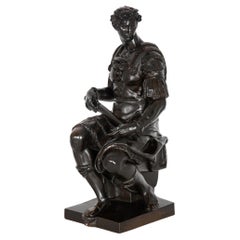
Grand Tour Bronze Sculpture Giuliano de Medici after the Antique, 19th century
Located in Shippensburg, PA
AFTER MICHELANGELO OF ANTIQUITY
Grand Tour Model of Giuliano de Medici from the Medici Chapel in Florence
Patinated sand-cast bronze numbered on the back corner "5505", otherwise u...
Category
Early 20th Century European Grand Tour Figurative Sculptures
Materials
Bronze
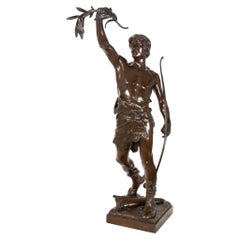
Large 36” French Bronze Sculpture of Warrior “Vainqueur” by Eugene Marioton
By Eugene Marioton
Located in Shippensburg, PA
EUGENE MARIOTON
French, 1857-1933
"Vainqueur"
Dark-brown patinated bronze signed "E. Marioton", foundry cachet for Siot-Decauville, cold-stamped D718 cast circa 1910
stock ref. ...
Category
20th Century French Romantic Figurative Sculptures
Materials
Bronze
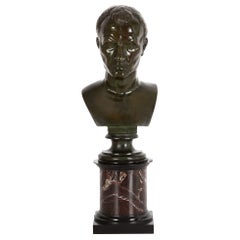
Italian Grand Tour Antique Bronze Sculpture, Bust of Julius Caesar
Located in Shippensburg, PA
A finely cast and beautifully patinated bust of Julius Caesar, it likely originates from Rome circa the third quarter of the 19th century and rests over its original violet breché ma...
Category
Antique 19th Century Italian Grand Tour Busts
Materials
Marble, Bronze
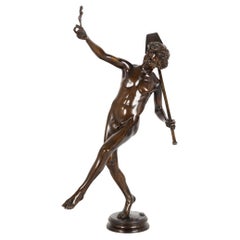
1880s French Antique Bronze Sculpture “Find in Pompeii!” by Hippolyte Moulin
By Thiebaut Freres
Located in Shippensburg, PA
HIPPOLYTE ALEXANDRE JULIEN MOULIN
French, 1832-1884
"Une Trouvaille à Pompéi" (A Find in Pompeii)
Sand-cast and patinated bronze Signed on base "Moulin", sealed with foundry cache...
Category
Antique 19th Century French Romantic Figurative Sculptures
Materials
Bronze
French Art Deco Modernist Bronze Sculpture, Bust of Young Man, Alfredo Pina
By Alfredo Pina
Located in Shippensburg, PA
ALFREDO PINA
French, 1883-1966
Bust of a Young Man
Lost-wax cast medium-brown patinated bronze over solid verde marble plinth signed in cast "A. Pina" and sealed with cachet "cire...
Category
20th Century French Art Deco Busts
Materials
Marble, Bronze
You May Also Like
A Patinated Bronze Statue of a Seated Classical Scholar Signed Doriot
By Theodore Doriot
Located in Vancouver, British Columbia
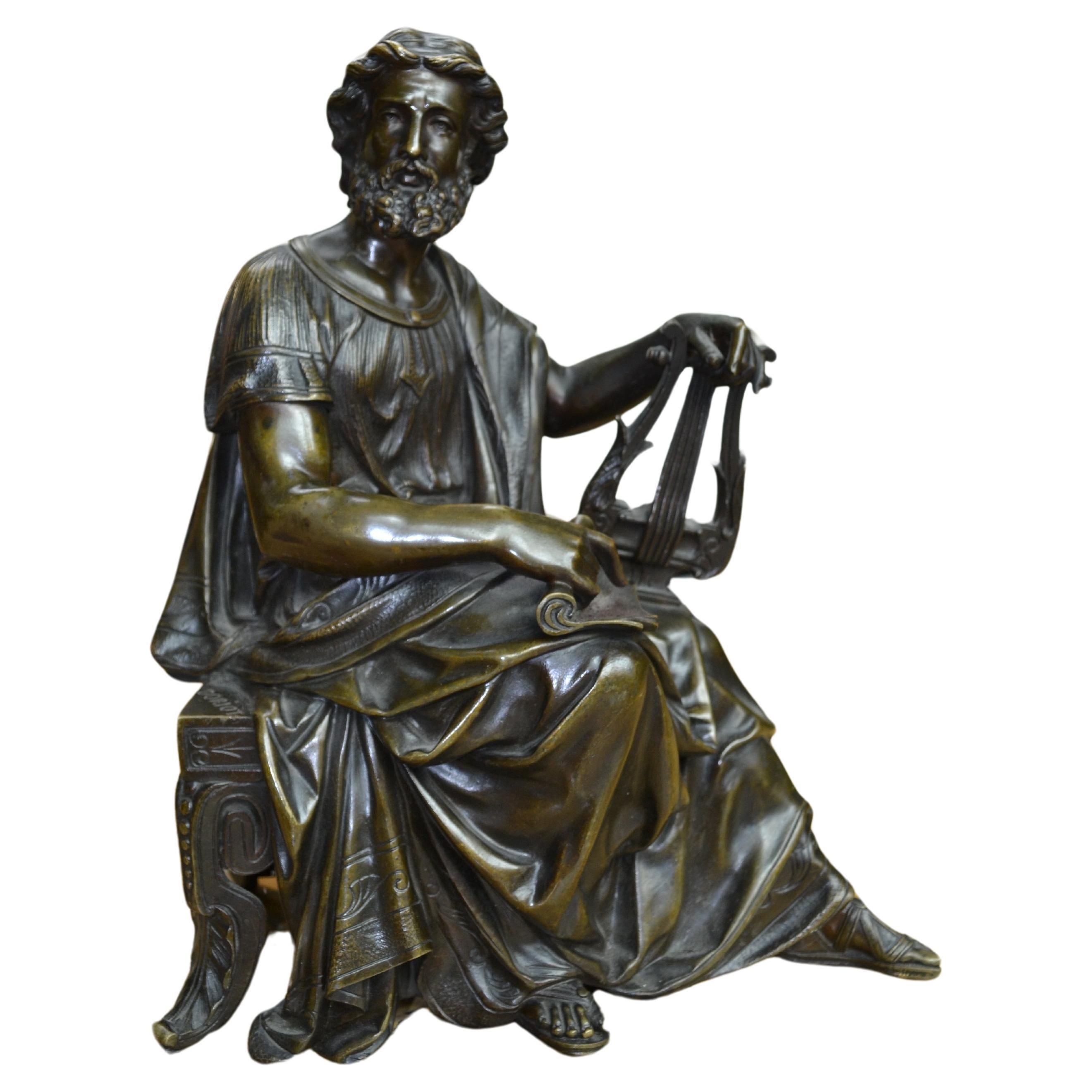
A finely cast bronze sculpture of an expressive classically draped Greek scholar seated on a curule chair holding a lyre in one hand and an an open scroll in the other, both symb...
Category
Antique Late 19th Century French Neoclassical Revival Figurative Sculptures
Materials
Bronze
Amazing 20th Century Gilt Bronze Sculpture of a Meditating King, Italy, 1940
Located in Catania, IT
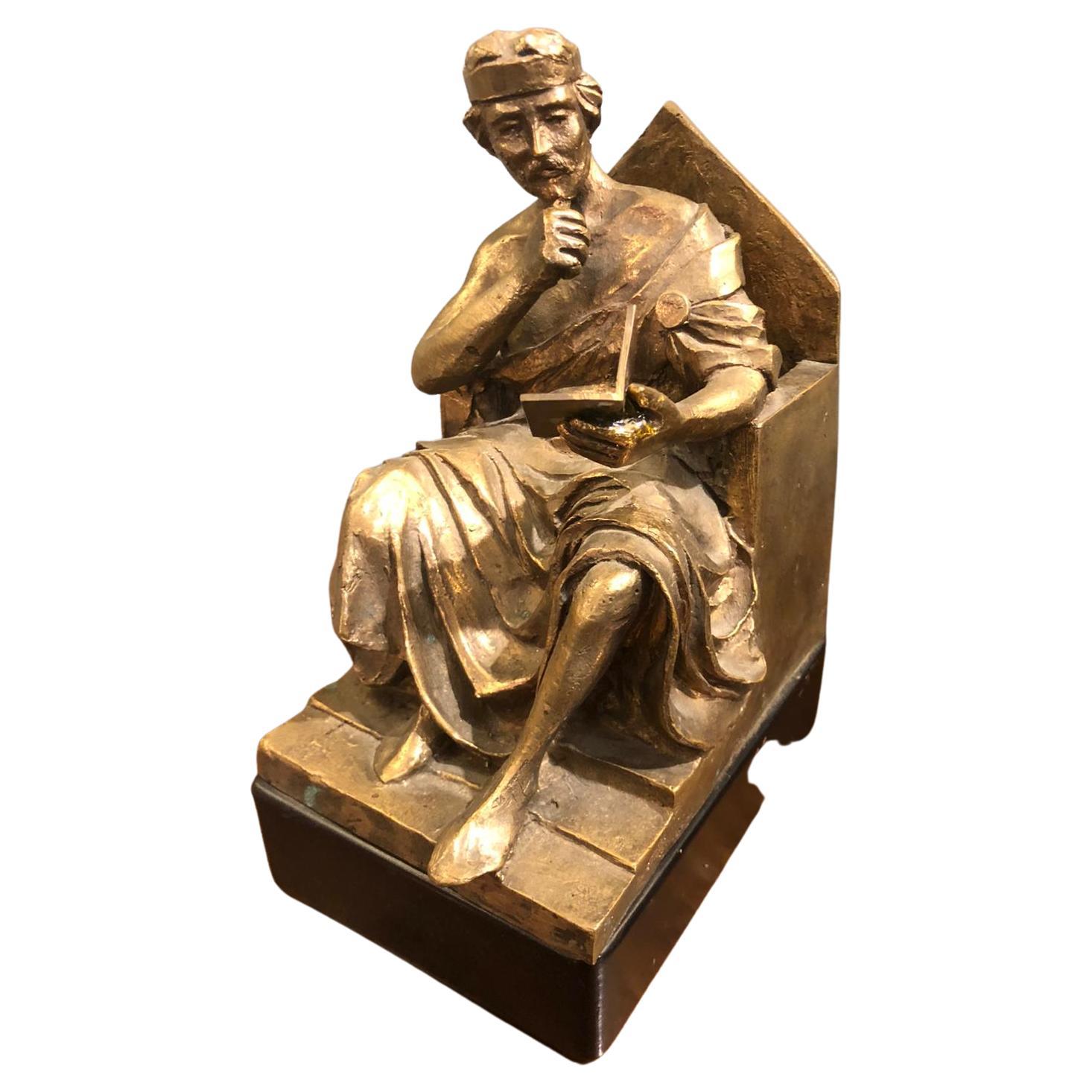
The gilded bronze sculpture of this King seated on his throne, wearing his crown, while he is absorbed in reading a book is very rare and particular. The figure stands elegantly, and...
Category
Vintage 1940s Italian Classical Greek Figurative Sculptures
Materials
Bronze
$2,746 Sale Price
20% Off
19th Century Demosthenes Bronze Sculpture by Barbedienne Foundry
By F. Barbedienne Foundry
Located in 263-0031, JP
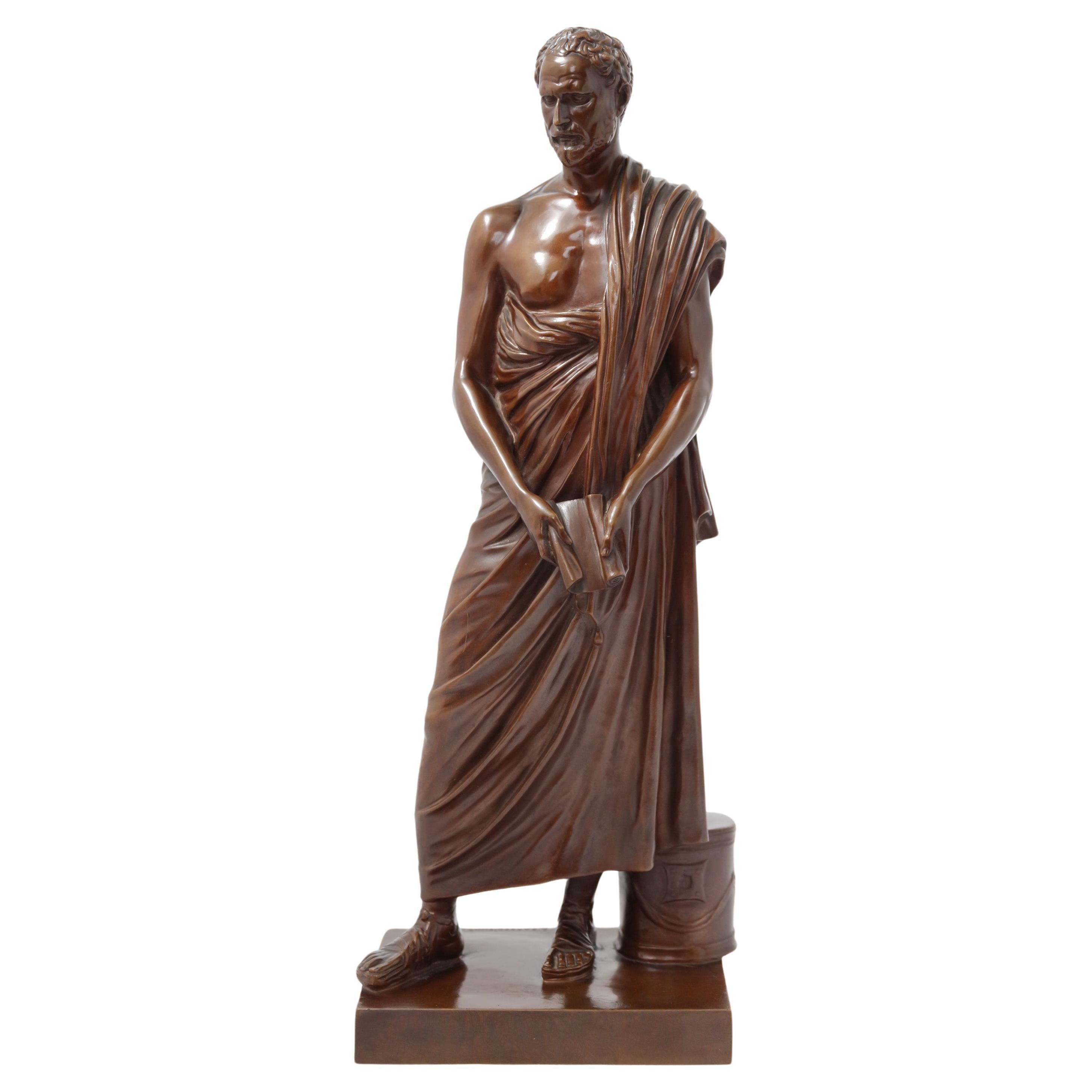
A bronze figure representing Demosthenes (384-322 BC), a Greek statesman and orator. The sculpture is based on a Roman copy of an original Greek statue. The chocolate-brown patina of...
Category
Antique 19th Century French Neoclassical Figurative Sculptures
Materials
Bronze
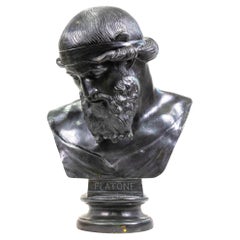
Bronze Plato, bronze bust
Located in Rome, IT
Bust of Plato in chiseled bronze. ADDITIONAL PHOTOS, INFORMATION OF THE LOT AND SHIPPING INFORMATION CAN BE REQUEST BY SENDING AN EMAIL
Tags: Platone in bronzo. Platón de bronce. Pl...
Category
20th Century Figurative Sculptures
Materials
Bronze
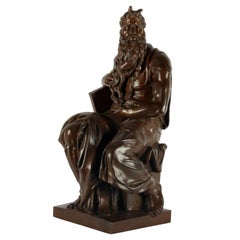
19th Century Bronze Statue
Located in Esbeek, NL
19th century bronze sculpture depicting mozes (michel Angelo).
Category
Antique Late 19th Century European Figurative Sculptures
Materials
Bronze
Bronze Bust of Menelaus, Italian Grand Tour
Located in Bradenton, FL
Italian Grand Tour Bronze Bust of Menelaus on a stepped wooden plinth. Menelaus was the legendary King of Sparta from Greek mythology. This sculpture depicts the bearded warrior wear...
Category
Antique 19th Century Italian Grand Tour Busts
Materials
Bronze