Items Similar to Beautiful German Pieta known as "Vesperbild"
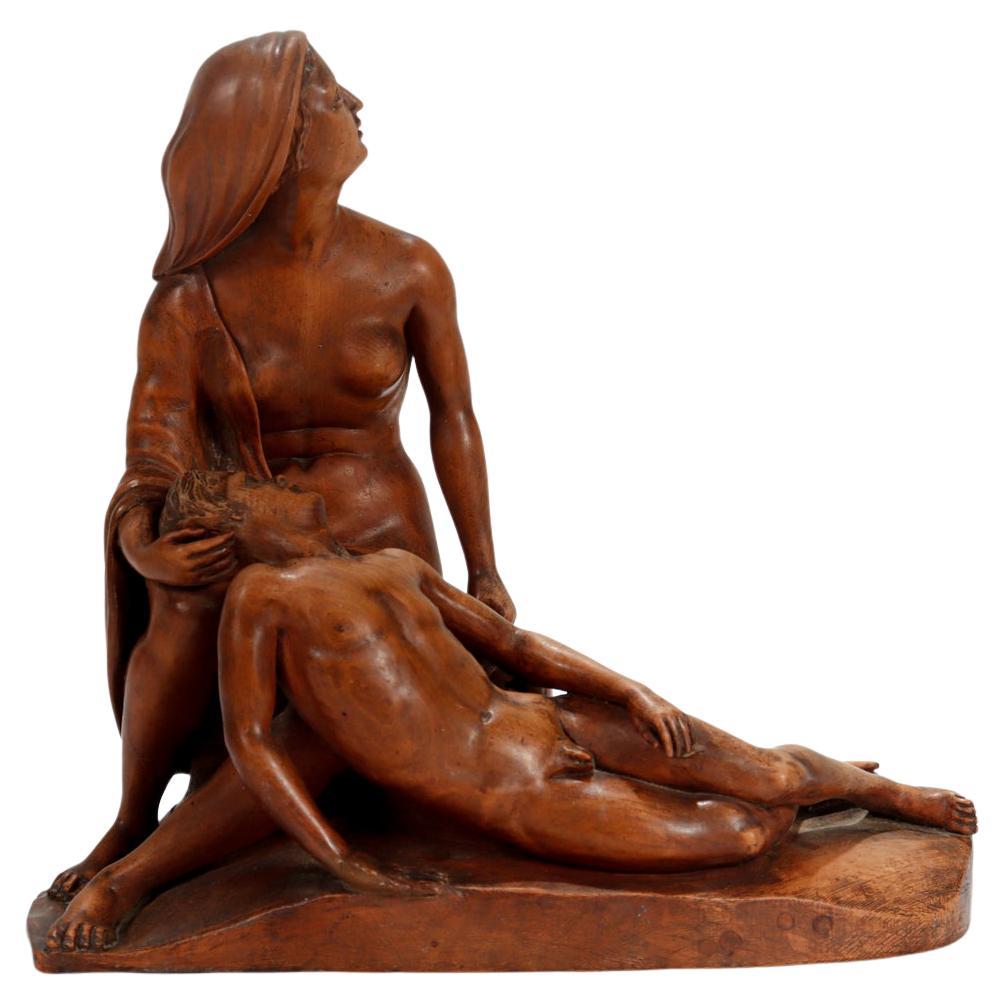
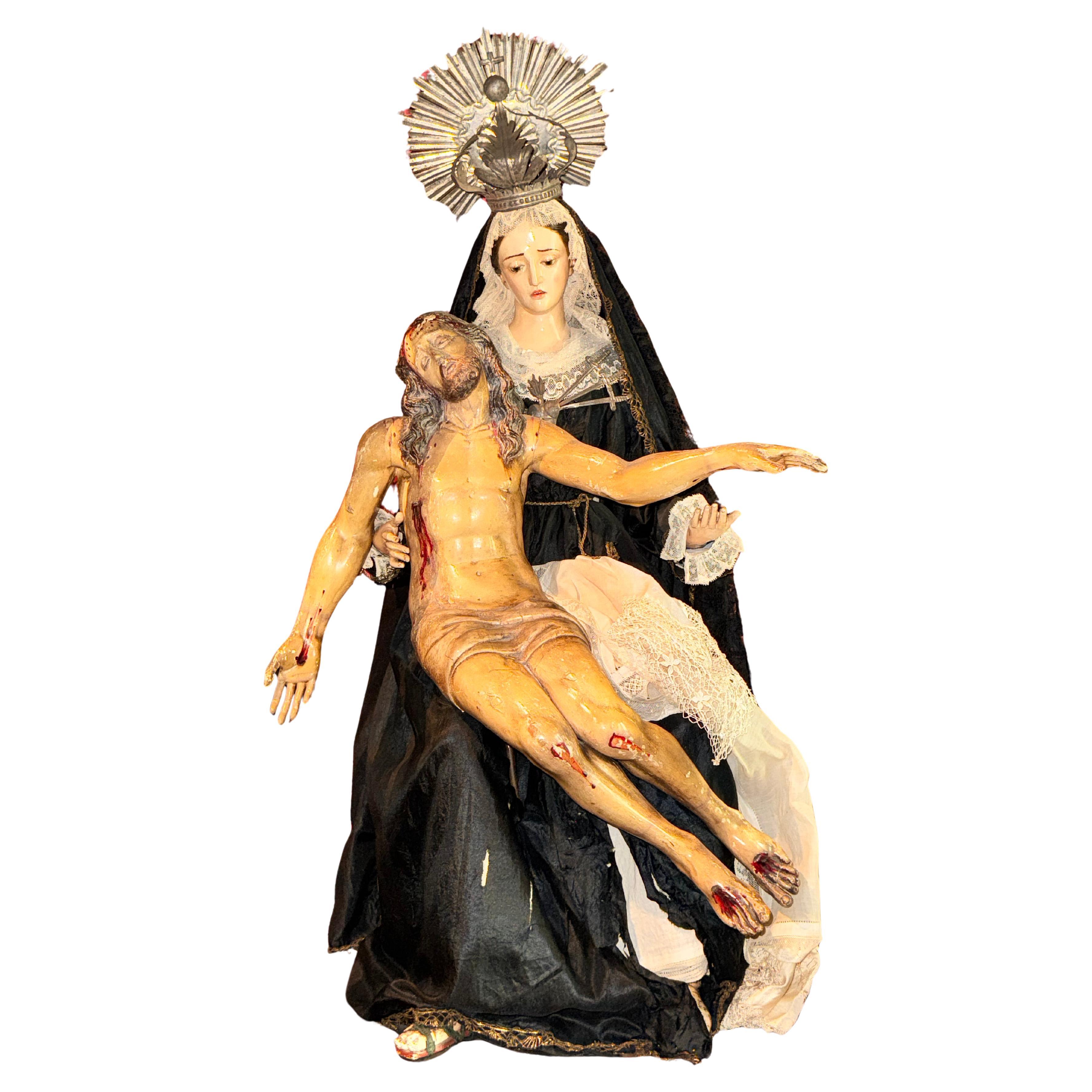
Want more images or videos?
Request additional images or videos from the seller
1 of 11
Beautiful German Pieta known as "Vesperbild"
$54,124.74
£40,051.55
€45,000
CA$74,063.65
A$80,685.75
CHF 42,610.46
MX$968,612.15
NOK 542,906.07
SEK 496,195.77
DKK 342,867.41
About the Item
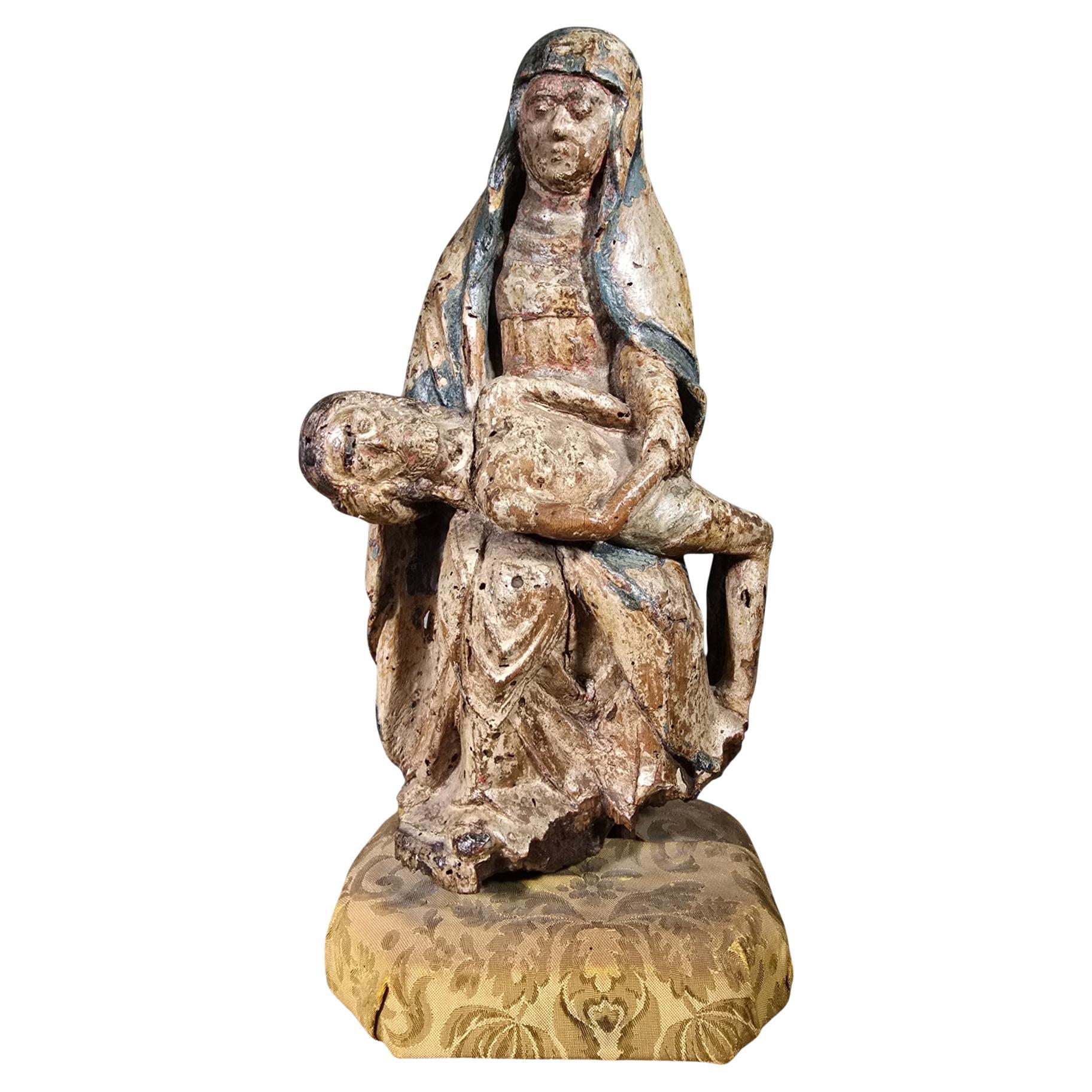
BEAUTIFUL GERMAN PIETA KNOWN AS “VESPERBILD”
ORIGIN : GERMANY
PERIOD : 15th CENTURUY
Height : 74 cm
Width : 43 cm
Depth : 22,5 cm
Good condition
Oak wood
This beautiful 15th-century carved and polychrome wooden Pieta, with a hollowed back, originates from Germany, is commonly known as a Vesperbild. "Vesperbild" literally translates to "evening image" in French. These sculptures traditionally depict the Virgin Mary holding the body of Jesus after his crucifixion. They are often associated with private devotion and were frequently used in evening prayers, hence their name.
This scene, commonly represented in Christian iconography from the 14th century onwards, where Mary cradles her dead son on her lap after the crucifixion, is a creation of Mystical Thought, which emerged in the Rhine Valley around 1320.
The Virgin Mary holds her son lying on her lap, with the legs of Christ falling vertically. The overall appearance, very natural, pyramidal, and well composed, offers a powerful and rigorous composition, pleasing to the eye.
The peaceful and very graceful face of the Virgin, leaning over her son, with delicate and regular features, with her eyes half-closed, is framed by the veil and the guimpe. The beautiful gothic drapery, with its broken and ample folds of the veil, forms her mantle.
Christ, with a well-defined beard and hair, wears his broad crown of intertwined thorns. He surrenders in the greatest simplicity into the arms of the Virgin.
This Pieta, with its perfect harmony, is imbued with restrained grace and serenity, as revealed in the delicate expressions of the faces.
- Dimensions:Height: 29.14 in (74 cm)Width: 16.93 in (43 cm)Depth: 8.86 in (22.5 cm)
- Style:Gothic (Of the Period)
- Materials and Techniques:
- Place of Origin:
- Period:
- Date of Manufacture:1400-1500
- Condition:Wear consistent with age and use.
- Seller Location:Saint-Ouen, FR
- Reference Number:Seller: 3051stDibs: LU3115341317492
About the Seller
5.0
Vetted Professional Seller
Every seller passes strict standards for authenticity and reliability
Established in 2016
1stDibs seller since 2017
210 sales on 1stDibs
Typical response time: 1 hour
- ShippingRetrieving quote...Shipping from: Paris, France
- Return Policy
More From This Seller
View AllImportant German Pietà from the, 14th Century
Located in Saint-Ouen, FR
IMPORTANT GERMAN PIETÀ FROM THE 14th CENTURY
ORIGIN: GERMANY, REGION DE COLOGNE
PERIOD: BEGINNING IF THE 14th CENTURY, ca. 1330
Height: 98 cm
Length: 45 cm
Depth: 33 cm
Polychromed linden wood
Good condition of conservation
Provenance : particular Alsatian collection
The theme of the Pietà or Vesperbild appears in Germany at the end of the 13th century, reflecting the mysticism of the late Middle Ages. Although the theme does not exist in the Gospels, it was often mentioned in contemporary devotional literature. Indeed, during the first half of the 14th century, mystical thought and devotional practices changed under the impulse of a number of religious, among them Heinrich Suso and St Bridget. In his writings, Suso placed important emphasis on contemplation and meditation in the footsteps of Christ's martyrdom.
This will have great impact in the field of art, especially in Germany and later in France. The emphasis will from now on be on grief, death is shown in a straightforward way. The wounds of Christ are gaping and bloody. The suffering of Christ and the seven sorrows of the Virgin Mary are meditated upon.
This piece demonstrates the interest of the faithful in these representations where pathos reigns.
The virgin is represented seated in a frontal position. The bust is very elongated. She is wearing a red dress with a simple neckline and a blue mantel...
Category
Antique 15th Century and Earlier Figurative Sculptures
Materials
Wood
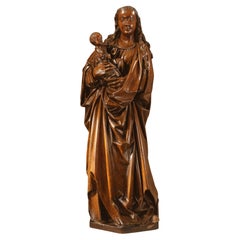
Gothic Virgin and Child from Flanders
Located in Saint-Ouen, FR
Exhibition
Museum Cantini, 1952, The art of the Middle Ages in the Marseille collections, n°101
Provenance
Former collection Louis Bresset (before 1952)
Former collection Profe...
Category
Antique 15th Century and Earlier Dutch Gothic Figurative Sculptures
Materials
Oak
Exceptional Virgin with Child in the Style of Salzburg
s Madonnas
Located in Saint-Ouen, FR
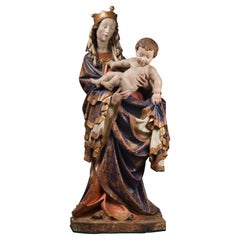
Exceptionnal polychrome wood virgin with child in the style of Salzburg’s Madonnas
Origin : Central Europe
Era : 19th century
Measures: height : 123...
Category
Antique 19th Century Figurative Sculptures
Materials
Wood
Rare Nursing Virgin from the 14th century
Located in Saint-Ouen, FR
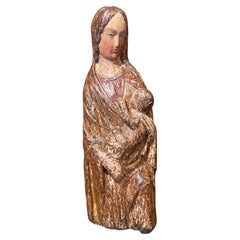
RARE NURSING VIRGIN FROM THE 14TH CENTURY
ORIGIN : ITALY
PERIOD : 14TH CENTURY
Height : 60 cm
Width : 20,5 cm
Depth : 11 cm
Wood
Seated and in a very maternal position, Mary is wearing a red dress with a long, flowing cloak covering her narrow shoulders and falling down her body, with one side hugging her bust.
Her hair, half hidden under a veil, frames an oval face featuring a high forehead, a long and thin nose, a small mouth with thin lips and half-closed eyes.
Mary is carrying her son, the infant Jesus, who is wrapped in a cloak, in her lap. Jesus is being nursed by his mother, held by her left hand.
This remarkable depiction, imbued with such gentleness, is directly inspired by the iconographic theme of the Virgin and Child in Majesty. It breaks with the hieratic, impassive style of the models from the 12th and 13th centuries, adding a touch of realism. From Virgin Queen, Mary became Virgin Mother.
Linked to the development of the Marian cult, this type of representation, sometimes known as Virgo lactans, Virgin of Milk or Nurturing Virgin, remains extremely rare. This image of the Virgin Mary and the Infant Jesus is an extremely delicate representation of the intimate bond formed...
Category
Antique 15th Century and Earlier Italian Gothic Figurative Sculptures
Materials
Wood
Saint Afre of Augsburg
Located in Saint-Ouen, FR
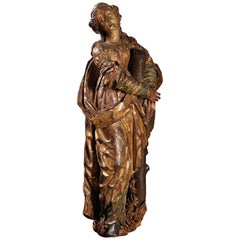
SAINT AFRE OF AUGSBURG
ORIGIN : SOUTHERN GERMANY
PERIOD : 16th CENTURY
Height : 119 cm
Width : 50 cm
Depth : 28 cm
Limewood
Good state of conservation
Patron Saint of the city and the diocese of Augsburg, the oldest traces of her worship date back to the 6th century.
There are several versions of his legend. She is sometimes identified as the daughter of a king of Cyprus whose violent and unexpected death forced her and her mother, Hilaria, to flee. They went to Augsburg via Rome. Others see her origins in Africa instead, her name meaning African in Latin.
Settled in Augsburg, they became the owners of a notorious inn where they traded in their charms.
Bishop Narcissus of Girona, accompanied by his deacon Felix, found refuge there one day, fleeing the persecution of Emperor Diocletian. As the two men prayed devoutly, Afre was touched by grace and asked to be baptized. She then left her old life and embraced the Christian faith.
When the Roman authorities learned of his new vocation, they exhorted her to worship the old gods and to deny the Christian faith. She refused to renounce her faith and was sentenced to be burned alive. Her sentence was applied immediately and she suffered her mart...
Category
Antique 16th Century Figurative Sculptures
Materials
Wood
$24,055
Virgin and Child in Majesty, also known as "Sedes Sapientae"
Located in Saint-Ouen, FR
VIRGIN AND CHILD IN MAJESTY, ALSO KNOWN AS "SEDES SAPIENTIAE"
ORIGIN : SPAIN, CATALOGNE
PERIOD: EARLY 13th CENTURY
Height : 95 cm
Width : 32 cm
Depth : 28 cm
Softwood
No polychromy
In the middle of the 12th century, the Virgin took her place in churches, seated in Majesty, serving as a throne for her son Jesus. She is then called Sedes Sapientiae, meaning the Throne of Wisdom.
At that time, she is not represented for herself and only exists because she has been designated as Theotokos, the mother of God, at the Council of Ephesus in 431, where the divine nature of Christ was proclaimed from his birth.
The upright and perfectly hieratic bust of this Virgin and Child in Majesty is seated on a throne-bench. She is dressed in a tunic with a rounded neckline and covered with a fine mantle placed on her narrow shoulders. The supple and natural drapery follows the lines of the body.
Large curls frame her face with delicate and regular features, a long straight nose, almond-shaped eyes, and small lips.
She supports the Infant Jesus with her left hand. Like his mother, he is dressed in a long tunic, and his little feet are visible in the folds. He holds a small sphere in his left hand, while with his right hand, he gestures in blessing. The face of Christ bears a strong resemblance to his mother’s one, and he gives a slight smile.
The position of the Child is no longer as hieratic, nor frontal or central as in the early 12th century, but his face still turns towards the faithful.
The 13th century indeed emerges as a period of transition in the artistic domain. The statuary, while retaining certain characteristics still belonging to the habits of the previous century, also develops new formal solutions.
As a result, Mary maintains a hieratic and frontal position, while her son shifts to place himself well to the left on her knee. Similarly, while the Virgin seems perfectly still, Jesus, on the other hand, appears much more animated, especially in the positioning of his hands. His left hand holds the orb, and judging by the raised right arm directed towards the faithful, one can easily imagine that he was making a gesture of blessing.
The influence of the Sedes Sapientiae from previous centuries still seems particularly prevalent in this work.
These few characteristics allow dating this Spanish Virgin...
Category
Antique 15th Century and Earlier Spanish Gothic Figurative Sculptures
Materials
Softwood
You May Also Like
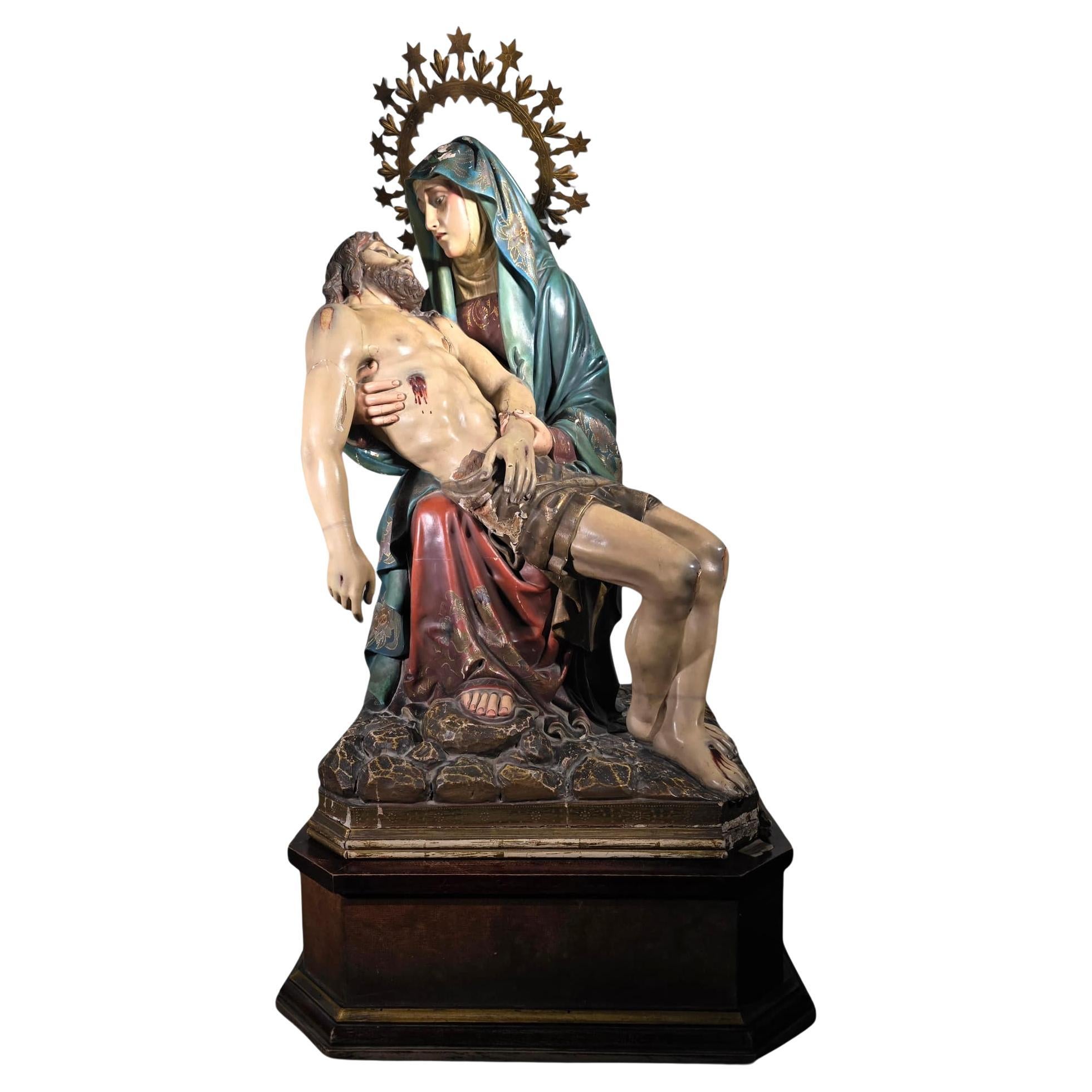
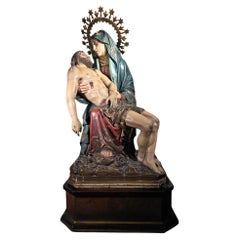
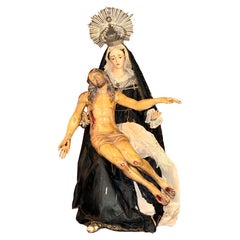
Important 19th Century Sculpture: The Pieta
Located in Madrid, ES
Immerse yourself in the poignant beauty of this significant carved wood and polychrome sculpture depicting the iconic scene of the Pieta. Crafted possibly in Spain during the 19th century, this artwork stands as a striking testament to sacred art and artistic mastery of the era.
The sculpture, executed with exceptional quality, captures the delicacy and devotion of the Pieta scene, where the Virgin Mary cradles the body of Jesus Christ after the crucifixion. Despite some minor losses, as shown in the accompanying photos, these do not significantly diminish the value or beauty of the piece.
Measuring 108x60x55 cm, including the wooden base, this sculpture possesses an imposing presence that will command attention in any space. The expressiveness of the figures and the meticulous attention to detail attest to the sculptor's talent and deep understanding of the religious theme.
Whether as the centerpiece of a sacred art collection or as a standout element in a devotional space, this Pieta sculpture...
Category
Antique Early 19th Century Figurative Sculptures
Materials
Fruitwood
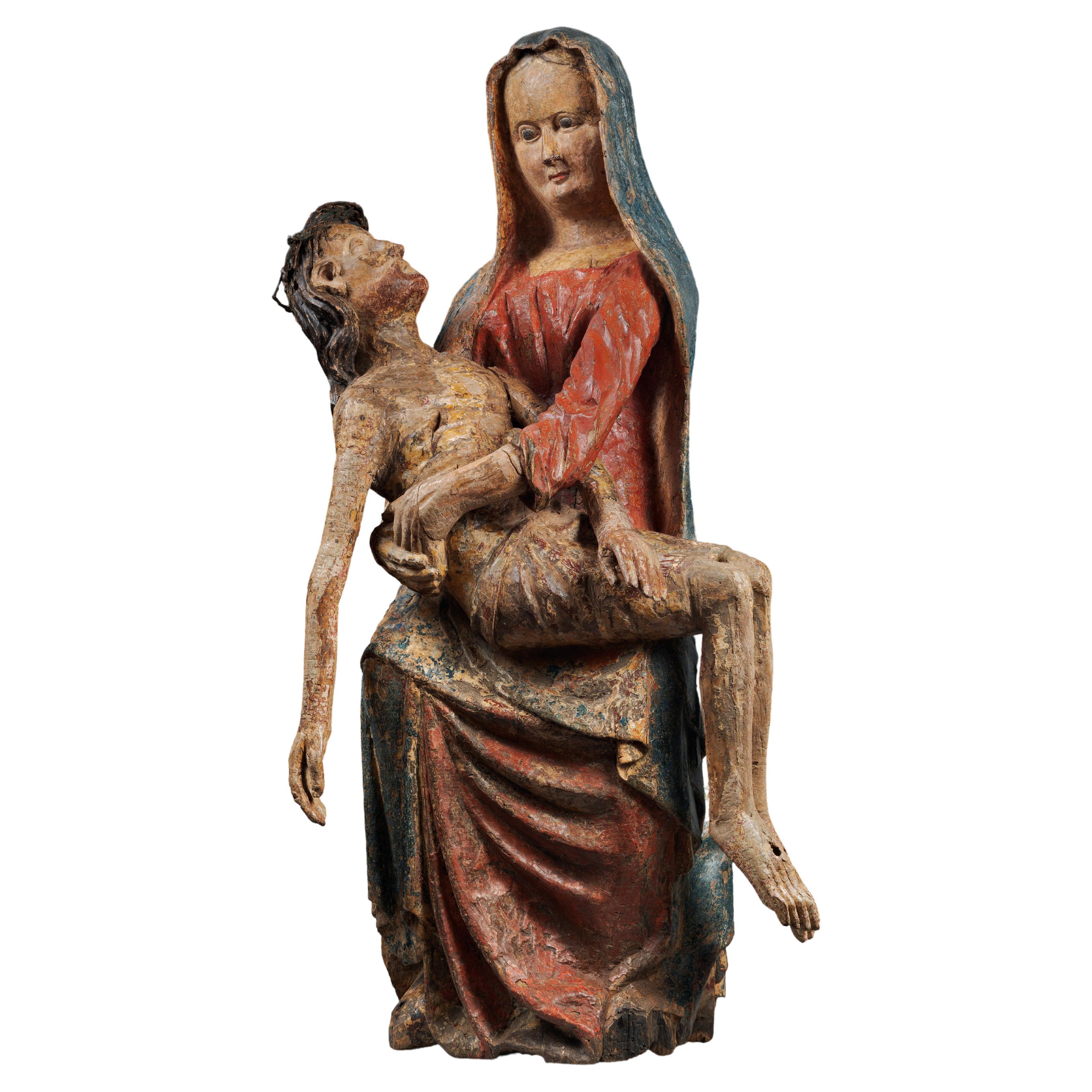
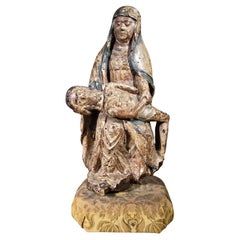
Rare 16th-Century French Polychrome Wooden Pietà Sculpture
Located in Madrid, ES
This rare and extraordinary 16th-century French sculpture depicts the iconic Pietà, showcasing exceptional craftsmanship and emotional depth. Finely carved from wood and adorned with...
Category
Antique 16th Century Figurative Sculptures
Materials
Fruitwood
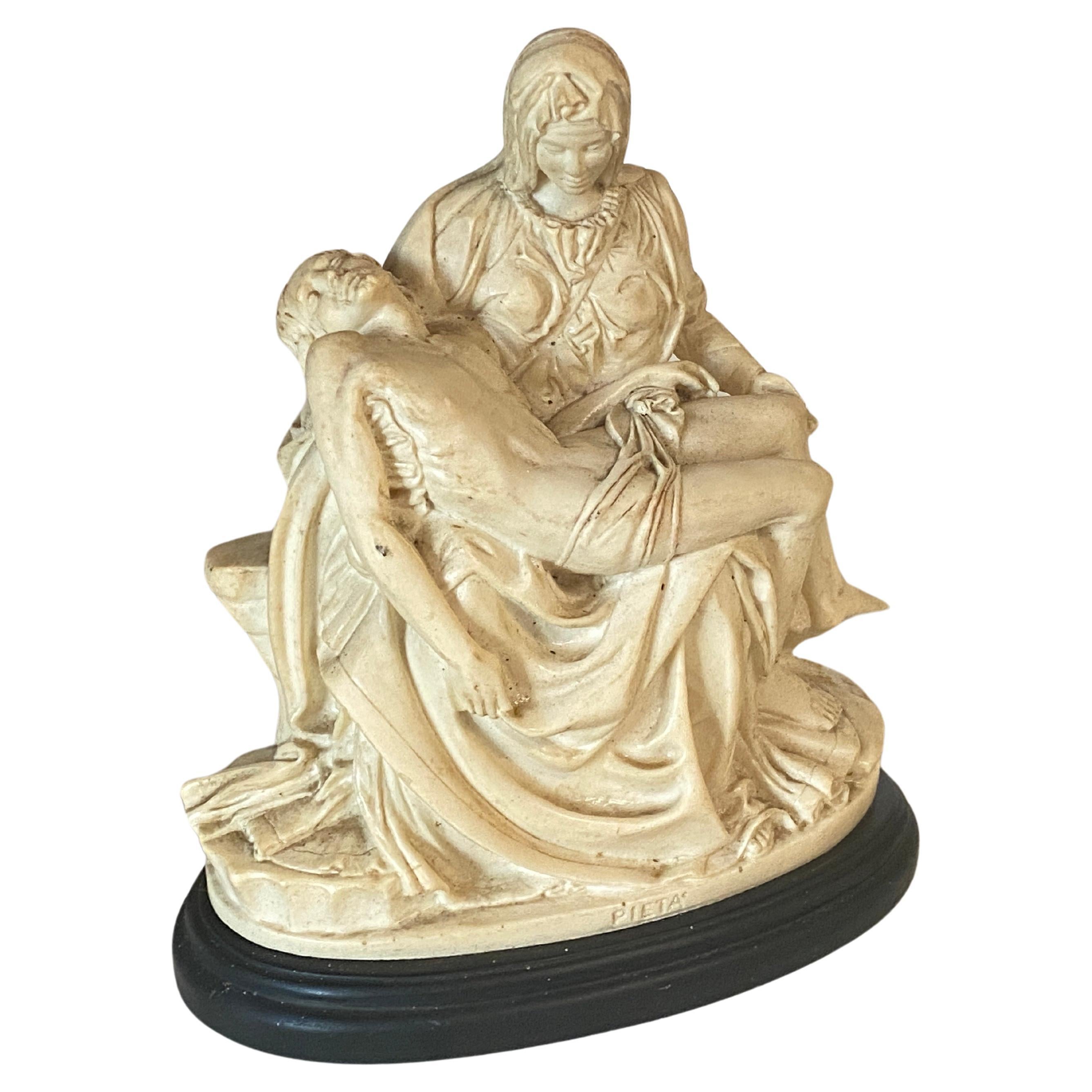
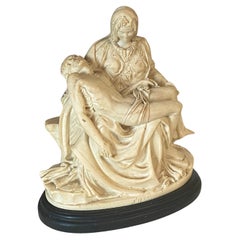
Resin Sculpture Representing La Pieta, White and Black Color France 20th Century
Located in Auribeau sur Siagne, FR
Pieta. Resin sculpture. White and Black Colors.
20eme Century.
Category
20th Century French Figurative Sculptures
Materials
Resin
$259 Sale Price
20% Off
Antique Renaissance Style Wooden Carved Pieta Sculpture with Mary
Christ
Located in Philadelphia, PA
In a Renaissance style.
Possibly Northern European or German.
In the form of the Virgin Mary cradling the lifeless mortal body of Jesus Christ after his removal from the cross. This is known as the Pietà - the sixth of the "Seven Sorrows of Mary" and a common depiction in sculpture.
Carved out of several joined wood blocks.
Simply a wonderful antique Religious sculpture...
Category
Early 20th Century Renaissance Figurative Sculptures
Materials
Wood
Reliquary Set: Recumbent Christ (17th Century) and Our Lady of Sorrows (19th Cen
Located in Madrid, ES
Reliquary Set: Recumbent Christ (17th Century) and Our Lady of Sorrows (19th Century)
A devotional reliquary with a damask lining and glass houses a 17th-century Baroque Christ and a...
Category
Antique 17th Century Spanish Baroque Figurative Sculptures
Materials
Silver
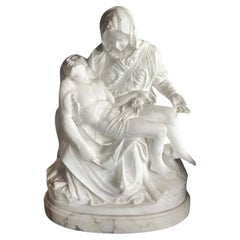
Mid-20th Italian White Marble Sculpture
Madonna della Pietà
after Michelangelo
Located in Los Angeles, CA
A reverent mid-20th century Italian white marble sculpture, finely carved after Michelangelo’s celebrated Madonna della Pietà. The work depicts the Virgin Mary cradling the lifeless ...
Category
Mid-20th Century Italian Sculptures and Carvings
Materials
Marble
More Ways To Browse
Crown Of Thorns
Gothic German
Jesus Crucifixion
15th Century Oak
15th Century Wooden
Jesus With The Crown Of Thorns
Thai Goddess
Vintage Murano Clown
Vintage Soap Art
Wood Hand Mannequin
African Carved Ebony
African Head Sculpture
Antique Court Jester
Antique Garuda
Bacchus Marble
Bronze And Ivory Sculpture
Bronze Hippolyte Moreau
Bronze Seated Woman