1 of 7
Capodimonte, Napoleon Crossing the Alps
$1,500List Price
About the Item
- Creator:Bruno Merli (Maker)
- Dimensions:Height: 12.41 in (31.5 cm)Width: 7.88 in (20 cm)
- Place of Origin:
- Period:
- Date of Manufacture:1960s
- Condition:
- Seller Location:Montreal, CA
- Reference Number:1stDibs: LU106821338520
Authenticity Guarantee
In the unlikely event there’s an issue with an item’s authenticity, contact us within 1 year for a full refund. DetailsMoney-Back Guarantee
If your item is not as described, is damaged in transit, or does not arrive, contact us within 7 days for a full refund. Details24-Hour Cancellation
You have a 24-hour grace period in which to reconsider your purchase, with no questions asked.Vetted Professional Sellers
Our world-class sellers must adhere to strict standards for service and quality, maintaining the integrity of our listings.Price-Match Guarantee
If you find that a seller listed the same item for a lower price elsewhere, we’ll match it.Trusted Global Delivery
Our best-in-class carrier network provides specialized shipping options worldwide, including custom delivery.You May Also Like
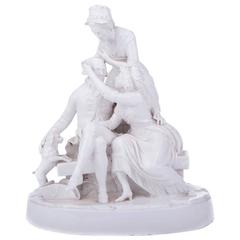
Early 19th Century Capodimonte Figural Group
Located in Dublin 8, IE
Early 19th century Capodimonte lively figural group of two women tending to a gentleman’s hair with playful little dog, circa 1820.
Category
Antique 1820s Irish Porcelain
Materials
Porcelain
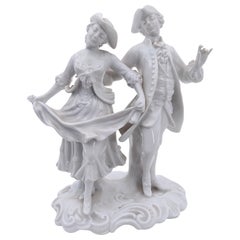
Vintage Capodimonte Porcelain Decorative Item by Ginori, Rococo Style, Italy
By Richard Ginori
Located in Bresso, Lombardy
Made in Italy, 1960s.
These two 18th century figures are made in Capodimonte porcelain.
This statue might show slight traces of use since it's vintage, but it can be considered as in...
Category
Vintage 1960s Italian Mid-Century Modern Figurative Sculptures
Materials
Porcelain
$299
H 6.89 in W 5.91 in D 3.55 in
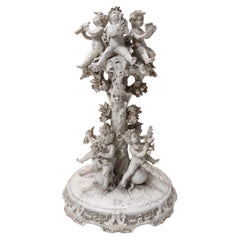
Vintage Capodimonte Ceramic Decorative Item by Mollica, Rococo Style, Italy
By Capodimonte
Located in Bresso, Lombardy
Made in Italy, 1960s.
This group of 7 cherubs are made in Capodimonte lacquered ceramic by Mollica.
This item might show slight traces of use since it's vintage, but it can be consid...
Category
Vintage 1960s Italian Mid-Century Modern Figurative Sculptures
Materials
Ceramic
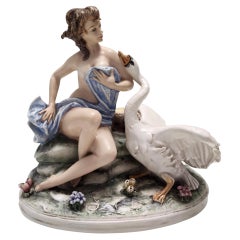
Capodimonte Porcelain Decorative Item by Carlo Mollica, Rococo Style, Italy
By Capodimonte
Located in Bresso, Lombardy
Made in Italy, 1960s.
This scene sculpted by Carlo Mollica recalls the mythological figures of Leda and the Swan (Zeus).
It is made in polychromed porcel...
Category
Vintage 1950s Italian Rococo Revival Figurative Sculptures
Materials
Porcelain
$1,054
H 9.45 in W 9.85 in D 6.7 in
Fine 19th Century Porcelain Capodimonte Group of Cherubs and a Goat
By Capodimonte
Located in Dallas, TX
This bright Capodimonte porcelain group of four putti and a goat symbolizes abundance and the spirit of life. Capodimonte was originally an 18th century Italian porcelain...
Category
Antique Late 19th Century Italian Classical Greek Porcelain
Materials
Porcelain
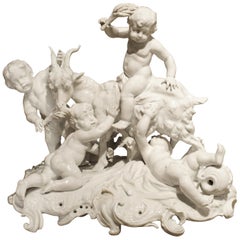
$3,800
H 14 in W 15.5 in D 11.5 in
Art Deco Figurine of
Mata Hari
by Capodimonte / Naples Porcelain Company
By Capodimonte
Located in West Palm Beach, FL
Art Deco Figurine of 'Mata Hari' by Capodimonte / Naples Porcelain Company
Italy, circa 1925
An exceptional work, displaying grace and movement, subtly hand- painted. The seductive turban and gold earring wearing dancer draped in a White and Iron-Red Moon and Star motif garment, on a tasseled pillow.
Hence our Mata Hari, attribution/suggestion. The name Mata Hari, is a Malay expression for the sun. Literally meaning “eye of the day"/ dawn of the day'
This exquisite figure, depicts the The dancer (Mata Hari ?) as the sun-wearing the moon and stars.
Marked with the variation Blue underglaze Crown & N.
In remarkable well cared for condition, some minor wear to the gilt.
The figurine stands...
Category
Early 20th Century Italian Art Deco Figurative Sculptures
Materials
Porcelain
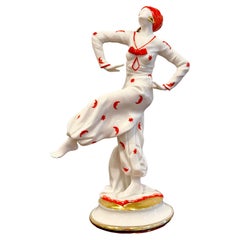
$1,036 Sale Price
20% Off
H 6.5 in W 4.5 in D 3.25 in
Vintage Capodimonte Ceramic and Gold Decorative Item of a Reading Child, Italy
By Capodimonte
Located in Bresso, Lombardy
Made in Italy, 1960s.
This reading child is made in Capodimonte ceramic, which has been lacquered and hand-painted with pure gold.
This item might ...
Category
Vintage 1960s Italian Mid-Century Modern Figurative Sculptures
Materials
Gold
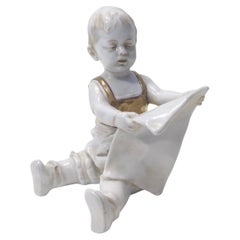
$143
H 4.73 in W 3.94 in D 3.55 in
Large Mythological Meissen Group
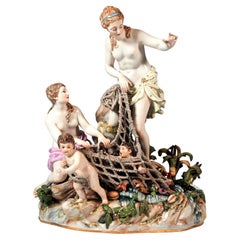
The Catch Of The Triton
, J.J. Kändler, c 1870
By Meissen Porcelain, Johann Joachim Kaendler
Located in Vienna, AT
Excellent Meissen porcelain sculpture:
Very elaborate and lovingly designed group of figures: two young women with artfully pinned-up hair and wrapped in cloths tied around their loi...
Category
Antique Late 19th Century German Baroque Porcelain
Materials
Porcelain
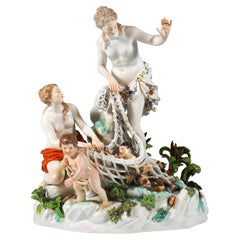
$4,671
H 11.03 in W 9.06 in D 6.7 in
Large Mythological Meissen Group
The Catch Of The Triton
, J.J. Kändler, c 1860
By Meissen Porcelain, Johann Joachim Kaendler
Located in Vienna, AT
Excellent Meissen porcelain sculpture:
Very elaborate and lovingly designed group of figures: two young women with artfully pinned-up hair and wrapped in cloths tied around their loi...
Category
Antique 1860s German Baroque Porcelain
Materials
Porcelain
$4,671
H 11.62 in W 9.45 in D 6.7 in
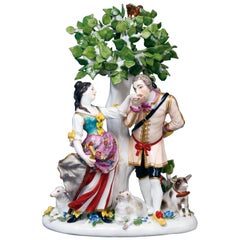
Pastoral Group/Handkuss
The Hand-kiss
By Meissen Porcelain
Located in Lantau, HK
Meissen, hard-paste porcelain, circa 1738-1740.
The Artist
The Meissen manufactory near the city of Dresden was founded by Augustus II (1670-1733), King of Poland and Electoral of Saxony, in 1710. It was the first factory in Europe to succeed in making white hard-paste porcelain. The early years of the Meissen production were focused on creating copies of Chinese porcelain. It was only when Kaendler began to work at Meissen in 1731 that the manufactory would break free from the influence of Asia and produce porcelain of true European character.
The Painting
A sculptor by training, Kaendler took over the direction of the manufactory in 1733. He is considered the key figure in the development of Meissen and the individual behind the transformation of the factory’s porcelain during the 18th century. Kaendler demonstrated his artistic ability by creating a variety of porcelain groups including the Italian Commedia dell’Arte, Pastoral and Crinoline groups, and Cris de Paris, which were met with widespread acclaim and made Meissen famous throughout all of Europe. Soon these porcelain figures would be used extensively alongside vases and other ornaments to decorate interiors.
Provenance
The themes of fête galante, pastoral idylls and masquerade themes, created by Jean-Antoine Watteau (1684-1721), and then developed further by Francois Boucher (1703-1770) and Jean-Honoré Fragonard (1732-1806), depicting amorous scenes with dancers, women and shepherds engaged in frivolous pursuits, spread all over Europe during the first half of the 18th century. This is due to the French engraver Gabriel Huquier (1695-1747), who dedicated himself to images and engravings after Francois Boucher and Juste-Aurele Meissonnier (1695-1750), who fostered the concept of Rococo style, that brought about the new trend in decorative arts.
In 1738, Kaendler introduced one of his figures in pastoral costume with the Handkuss (Hand-kiss) scene under a tree. For the shepherd lovers’ scene, the German sculptor drew his inspiration from Boucher and Watteau. Since the 1730s, the Meissen manufactory has been providing Watteau’s engravings...
Category
Antique 1830s Porcelain
Materials
Porcelain
Still Thinking About These?
All Recently ViewedMore Ways To Browse
Alps Furniture
Vintage Porcelain Horse
Capodimonte Figure
Crossing The Alps
Napoleon Crossing The Alps
Capodimonte Horse
Capodimonte Napoleon
Plaster Hand Sculpture
Italian Classical Sculptures
1600S Antique
Spain Wood Sculpture
Wood 16th Century
Austrian Cold Painted Bronze
Bronze Tree
Austrian Figure
Cold Painted Austrian Bronze
Antique Silver Patina
French Putti