Items Similar to Chiurazzi Bronze Sculpture of the The Neapolitan Fisherman after the Antique

Want more images or videos?
Request additional images or videos from the seller
1 of 16
Chiurazzi Bronze Sculpture of the The Neapolitan Fisherman after the Antique
$8,894.98
£6,685.42
€7,500
CA$12,324.12
A$13,395.83
CHF 7,171.01
MX$161,924.59
NOK 90,368.65
SEK 83,343.36
DKK 57,133.28
About the Item
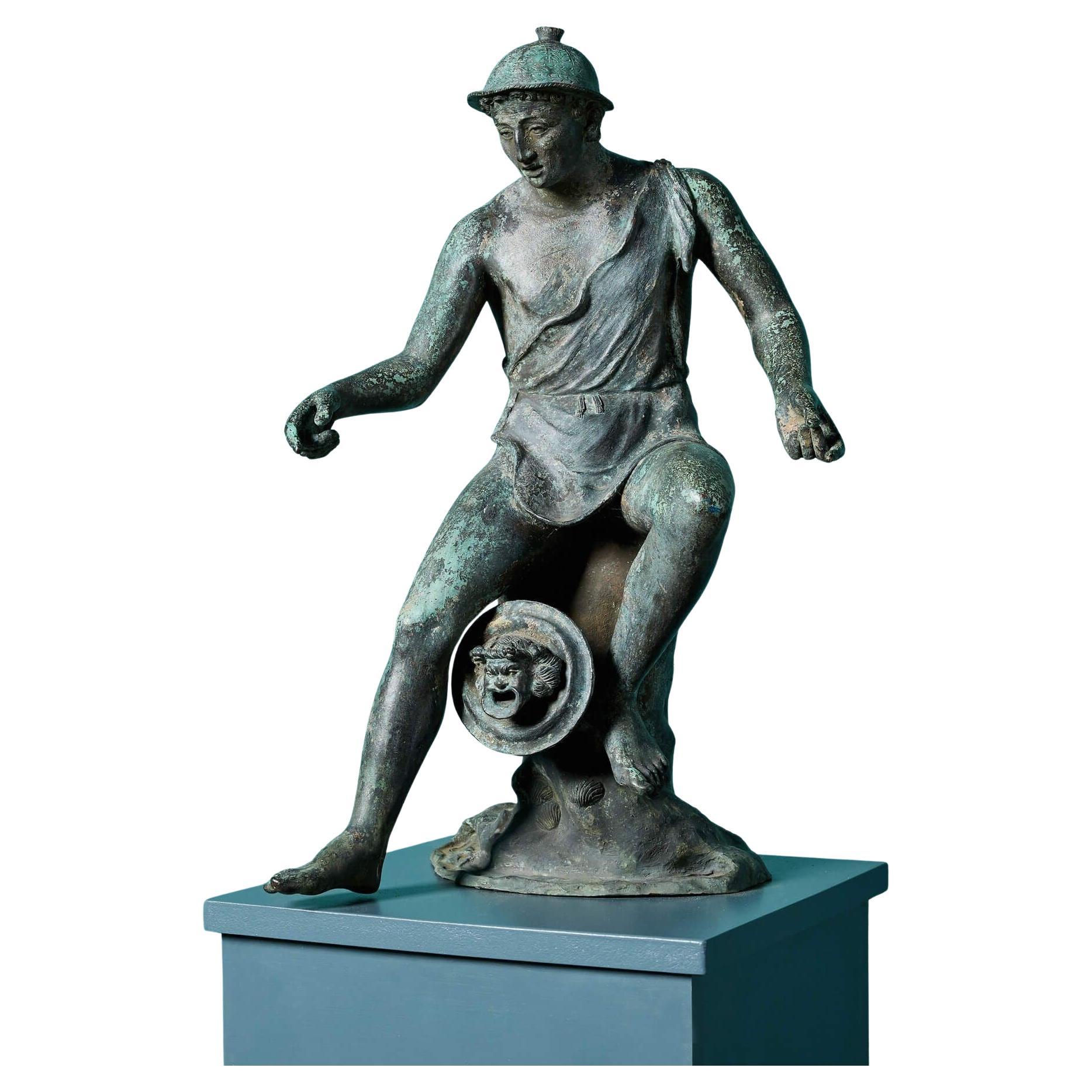
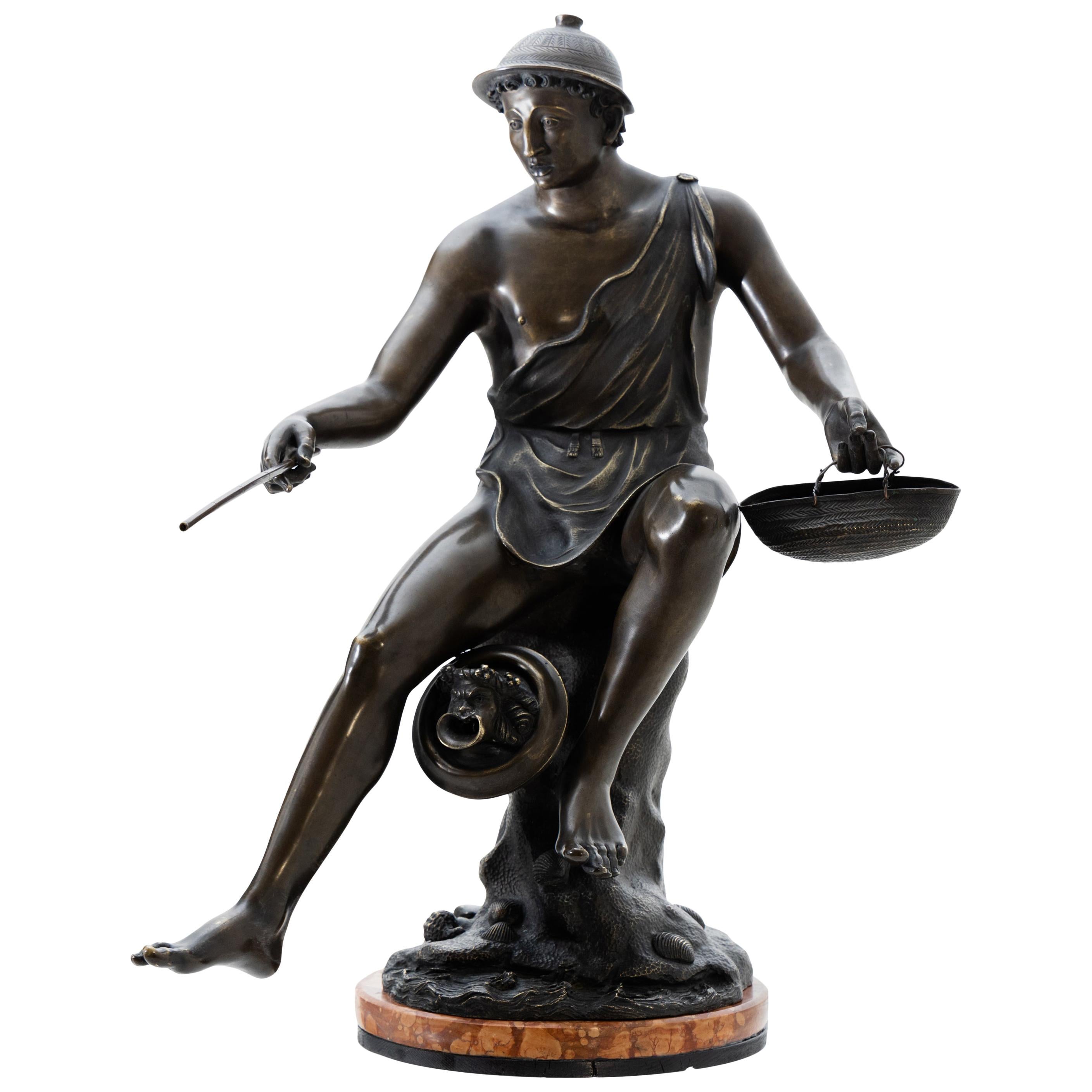
This superbly worked bronze sculpture with a beautiful patina by the Neapolitan foundry Fonderia Chiurazzi is a full-scale (1:1) replica of the original now preserved in the Museo Archeologico Nazionale di Napoli.
The male figure is clad in a short tunic and cap, his head turned slightly to the right, both arms outstretched, his left hand holding a small basket. He is seated on a rocky outcrop adorned with shells, and between his legs runs a small fountain head in the form of a Bacchus mask. Measuring 55 cm in height, the sculpture demonstrates refined workmanship and a rich, natural patina. It is unusual to find the basket with the sculpture.
During the late 19th and early 20th centuries, Chiurazzi produced type of bronzes in various sizes and finishes, but this particular casting is of notably high quality for its type and bears the foundry’s impressed mark Fonderia Chiurazzi.
The original Roman bronze fountain figure, commonly known as The Neapolitan Fisherman, was uncovered in 1823 during archaeological excavations at Pompeii, within the Casa della Fontana Piccola (House of the Little Fountain). This find formed part of a richly decorated mosaic fountain ensemble surrounded by four statuettes, among them a seated angler wearing an exomis (tunic) and holding a fishing rod and basket, an image that perfectly captures a moment of relaxed domestic life in a Roman household.
The original layout of the fountain and its sculptures can be seen in Giuseppe Abbate’s illustration, Mosaic Fountain Sculptures in the House of the Small Fountain, Pompeii, published by the Nicolini brothers in 1854. Abbate’s illustration provides a valuable visual record of how the fountain originally appeared, showing the arrangement of the fisherman, the sister bronze Cupid with Goose, the mosaic basin, and its decorative motifs.
Artist Luigi Bazzani also vividly captured Pompeii’s domestic elegance in his watercolor paintings. One shows another similar fountain scene, depicting how such spaces may have looked during Pompeii’s flourishing years, with richly ornamented walls, bright mosaics, and sculptural fountains glimmering in sunlight. Another watercolor by Bazzani, painted in 1919, directly portrays the Neapolitan Fisherman in situ at Pompeii.
Scholars trace the fisherman’s prototype back to a Hellenistic original of the late 3rd century BCE. Hellenistic sculptural models continued to influence Roman art well into the first centuries CE.
The Fonderia Chiurazzi was established in Naples in 1870 by Gennaro Chiurazzi, a pupil of sculptor Pietro Masulli, who had pioneered the use of the lost-wax casting technique for accurate reproductions of classical bronzes.
After Italian unification (1861), the Naples Archaeological Museum, formerly the Royal Bourbon Museum, began issuing permits to selected workshops to reproduce its vast collections from Pompeii, Herculaneum, and Stabiae. Chiurazzi excelled in this field, combining industrial precision with hand-tooled artistry to produce faithful, museum-quality casts.
By the turn of the 20th century, Chiurazzi bronzes had gained international acclaim, winning prizes at major exhibitions such as the St Louis World’s Fair (1904). They were collected by museums, governments, and private connoisseurs worldwide. The Neapolitan Fisherman became one of the most recognizable and desired models, epitomizing the era’s fascination with rediscovered antiquity.
The Grand Tour and the appeal of classical souvenirs
The Neapolitan Fisherman belongs to the artistic and cultural phenomenon of the Grand Tour, the educational journey through Europe undertaken by young aristocrats and scholars from the 17th to the 19th century. Italy, with its ruins of antiquity, masterpieces of the Renaissance, and picturesque landscapes, was the ultimate destination.
Travelers collected bronze and marble reproductions of ancient statuary as tangible symbols of classical learning and refinement. Foundries such as Chiurazzi’s supplied these discerning travelers with exquisitely crafted reminders of their encounters with ancient Rome and Hellenistic art.
- Creator:Fonderia Chiurazzi (Maker)
- Dimensions:Height: 21.66 in (55 cm)Width: 13.78 in (35 cm)Depth: 13 in (33 cm)
- Style:Grand Tour (Of the Period)
- Materials and Techniques:Bronze,Patinated
- Place of Origin:
- Period:
- Date of Manufacture:Late 19th Century
- Condition:Wear consistent with age and use. It is in untouched condition. Originally, the fisherman, probably had a fishing rod in his left hand but they are almost always lost through time.
- Seller Location:Stockholm, SE
- Reference Number:1stDibs: LU1006847371042
About the Seller
4.9
Recognized Seller
These prestigious sellers are industry leaders and represent the highest echelon for item quality and design.
Established in 1989
1stDibs seller since 2013
108 sales on 1stDibs
Typical response time: <1 hour
- ShippingRetrieving quote...Shipping from: Stockholm, Sweden
- Return Policy
More From This Seller
View AllGrand Tour sculpture of Narcissus, 19th c
Located in Stockholm, SE
This elegant 19th-century Grand Tour bronze sculpture represents Narcissus, the character from Greek mythology known for his beauty and self-admiration. Standing 65 cm high, the figu...
Category
Antique Mid-19th Century Italian Figurative Sculptures
Materials
Bronze

Sculpture of Plaster, signed Gallé and dated -93 (1893)
Located in Stockholm, SE
A plaster sculpture by André Vauthier-Galle (1818–1899). A seated male figure with his hands behind his back. Executed in a very realistic way. The sculpture very much reminds of Auguste Rodins "The Thinker" in its pose.
The sculpture has a great patina.
The sculpture comes from the workshop of the Swedish painter and sculptor Jonas Åkesson...
Category
Antique 1890s French Figurative Sculptures
Materials
Plaster
$3,984 Sale Price
20% Off
"Guerrier des Amériques". Pair of sculptures signed J J Salmson (1823-1902)
By Jean-Jules Salmson
Located in Stockholm, SE
This pair of sculptures, titled "Guerrier des Amériques" by French sculptor J.J. Salmson (1823-1902), depict two American Indian warriors in a striking and detailed manner. Both figu...
Category
Antique Late 19th Century French Figurative Sculptures
Materials
Bronze
$2,514 Sale Price / set
20% Off
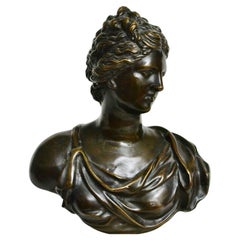
18th century Venus de’ Medici Bronze Bust
Located in Stockholm, SE
An 18th century Venus de’ Medici bronze bust, mounted on a later 19th century marble base. It has a beautiful rich slightly worn dark brown patina. Venus...
Category
Antique 18th Century Italian Classical Roman Busts
Materials
Marble, Bronze
19th Century Gilt Bronze Sculpture of Aurora
Located in Stockholm, SE
A fire-gilt bronze sculpture of Aurora, also known as Eos in Greek mythology, created in France during the Empire period around 1810. She rises lightly onto one foot, poised atop a g...
Category
Antique 1810s French Empire Figurative Sculptures
Materials
Marble, Bronze

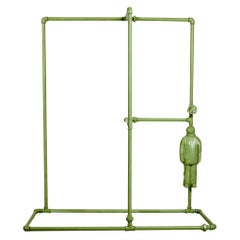
Truls Melin, Sculpture "Sailor"
Located in Stockholm, SE
TRULS MELIN, born in 1958.
Drowning sailors.
Painted metal sculpture
Provenance: Galleri Lars Bohman, Stockholm.
Category
2010s Swedish Abstract Sculptures
Materials
Bronze, Iron
You May Also Like
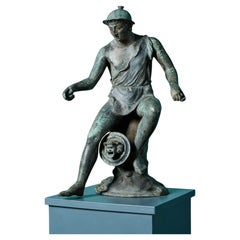
Bronze Sculpture of the Neapolitan Fisherman after the Antique
Located in Wormelow, Herefordshire
A 19th century bronze sculpture of the Neapolitan Fisherman after the antique.
In Grand tour style, the boy almost looks like he is in a stance of motion in this good quality scale,...
Category
Antique Late 19th Century Italian Neoclassical Figurative Sculptures
Materials
Metal, Bronze
Grand Tour Souvenir Bronze of the Neapolitan Fisherman
Located in Palm Springs, CA
A lovely bronze antique sculpture of a fisherman after the antique excavated in Naples in the early 19th century. These Grand Tour Souvenirs were extremely popular in the 19th and ea...
Category
Early 20th Century Italian Figurative Sculptures
Materials
Bronze
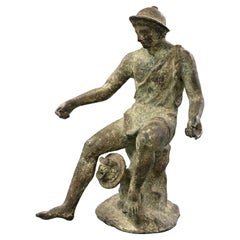
A Bronze Figure of the 1st Century CE Roman ‘Fisherman’, 19th Century
Located in ARMADALE, VIC
A Bronze Figure of the 1st Century CE Roman ‘Fisherman’, 19th Century
Provenance:
Private Australian Collection.
Description:
The male figure cast wearing a tunic and...
Category
Antique 19th Century French Figurative Sculptures
Materials
Bronze
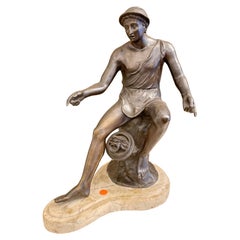
Hermes Bronze, Sig, Sabatino, Italy, 1882
By Sabatino Naoloi
Located in Greding, DE
Bronze of Hermes with petasos on stylized landscape base with shell decoration on round marble plinth. There signed Sabatino, Naples, 1882.
Category
Antique 1880s Italian Neoclassical Revival Figurative Sculptures
Materials
Bronze
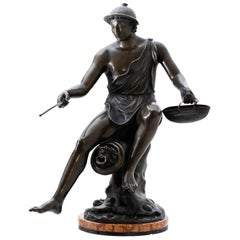
$3,605 Sale Price
20% Off
Bronze Sculpture Motive Fisherman
Located in Buenos Aires, Argentina
Bronze sculpture motive Fisherman
Origin Italy 20th century
circa 1900 partina brown
unsigned- natural wear
lost wax technique.
Art nouveau, modernist art or modernism was an interna...
Category
Antique Early 1900s Italian Art Nouveau Figurative Sculptures
Materials
Bronze
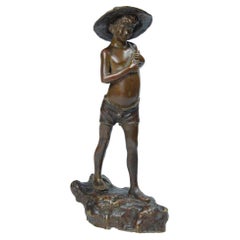
19th Century Grand Tour Bronze Sculpture of Mercurius (Hermes), Marble base
Located in Dresden, DE
Graceful and swift, Mercurius (Hermes in Greek mythology), was the Roman god of Commerce and the Market, protector of Traders. Considered the shrewdest and most cunning of all the go...
Category
Antique 19th Century European Grand Tour Figurative Sculptures
Materials
Bronze