Items Similar to Exceptional Virgin with Child in the Style of Salzburg
s Madonnas
Want more images or videos?
Request additional images or videos from the seller
1 of 5
Exceptional Virgin with Child in the Style of Salzburg
s Madonnas
$48,039.90
£35,596.70
€40,000
CA$65,700.81
A$71,645.65
CHF 37,882.20
MX$861,830.45
NOK 480,730.97
SEK 440,585.46
DKK 304,750.63
About the Item
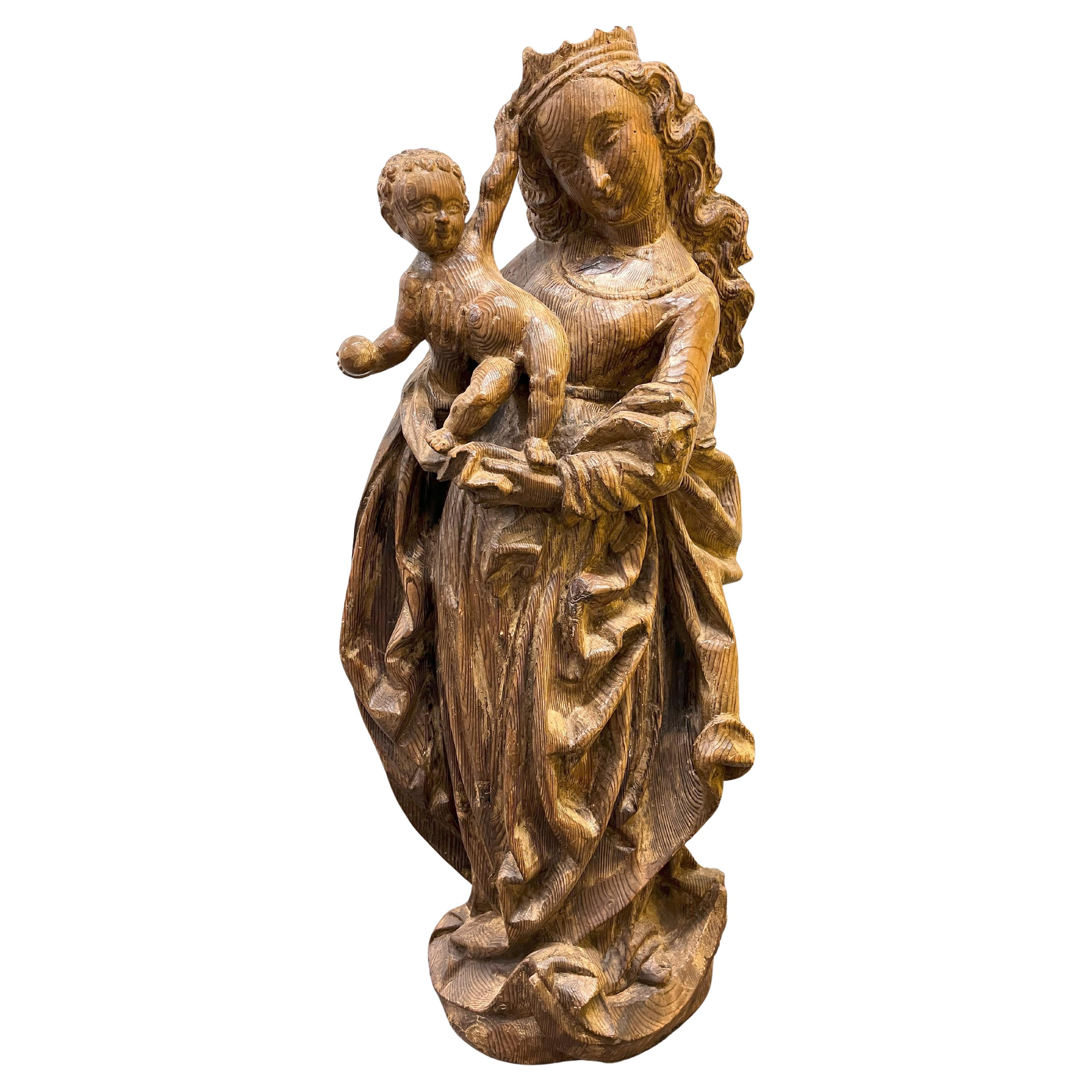
Exceptionnal polychrome wood virgin with child in the style of Salzburg’s Madonnas
Origin : Central Europe
Era : 19th century
Measures: height : 123 cm
Width : 50 cm
Depth : 35 cm
Good condition
Polychrome wood
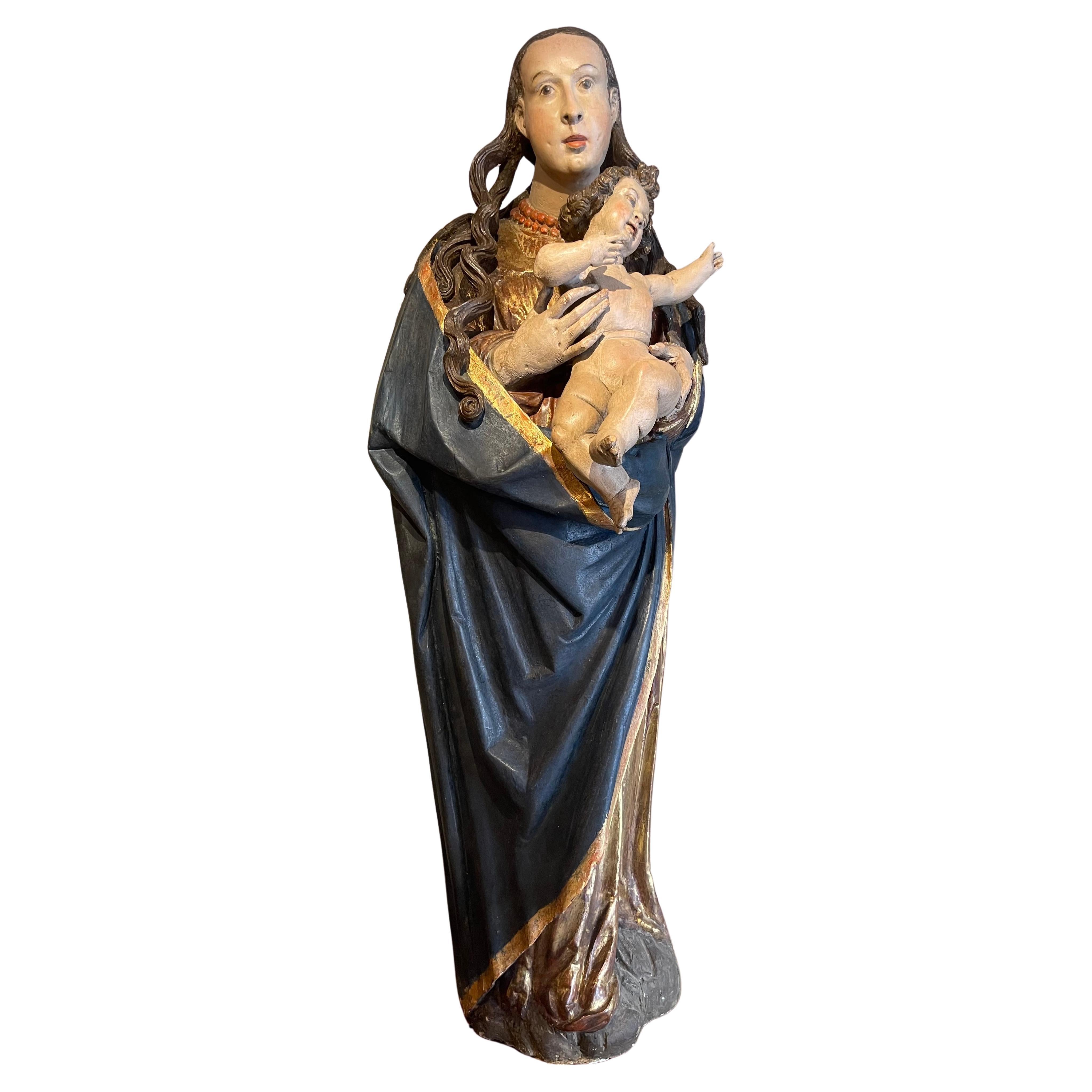
This Virgin and Child presents a gracious and somewhat mannerist attitude emphasized by a rich polychromy.
The Virgin is draped in a thick cloak held by a brooch and displaying the red dress she is wearing beneath. Her position is marked by a strong contrapposto resulting in heavy falls of cloth covering elegantly the mother of God. The wide pleats go from her right shoulder to her left foot and discover her right knee with a strong pli à bec. The right arm holds back a part of the cloak provoking some fine plis tubulaires.
The head of the Virgin is covered by a veil going down on her shoulders and on her back and topped with a crown. The face is framed by strands of hair escaping from the veil.
On her left side the Virgin carries the naked infant Jesus. While her right hand soflty holds the hips of the baby the left hand’s fingers press the soft skin of her son. With his chubby hand Jesus holds His mother’s cloak highlighting the vivid life expressed by sculpture. His playfull attitude and his smiling face and the caring gaze of His mother brings a true softness to the group.
This a tender moment of intimacy between a mother and her son that the sculptor has given us.
This Virgin and Child evokes an ensemble of Virgins statues from Bohemia of which the most famous is the Krumlov Madonna (Kunsthistorisches Museum, Vienna), from an anonymous sculptor. Those madonnas characteristically combines realism and tenderness. Appearing in the late 14th century in Prague and Salzburg the style spreads to the whole central Europe. With a strong lyrism the Virgin always carries the naked or semi naked Infant Jesus on her left leg emerging in swirl of folds and pleats. In each of those Salzburg’s Madonnas the sculptor took a great care to the interaction between the Virgin and her son.
Numerous exemples demonstrates the major effect those Madonnas have had between the late 14th century and early 15th century :
Virgin and Child recalling the Krumlov Virgin and Child, early 15th, Prague, National Gallery
Wroclaw Virgin and Child (Breslau), ca. 1400, Warsow, Naradowe Museum
Virgin and Child, Plzen, Saint Barthelemy Church
Conclusion
Our Virgin and Child is a perfect depiction of those late 14th and early 15 th century Virgins and was probably commissioned during the 19th century.
- Dimensions:Height: 48.43 in (123 cm)Width: 19.69 in (50 cm)Depth: 13.78 in (35 cm)
- Materials and Techniques:
- Period:
- Date of Manufacture:19th Century
- Condition:
- Seller Location:Saint-Ouen, FR
- Reference Number:1stDibs: LU3115329585702
About the Seller
5.0
Vetted Professional Seller
Every seller passes strict standards for authenticity and reliability
Established in 2016
1stDibs seller since 2017
210 sales on 1stDibs
Typical response time: 3 hours
- ShippingRetrieving quote...Shipping from: Saint-Ouen, France
- Return Policy
More From This Seller
View AllImportant 15th Century Polychrome Wood Virgin and Child
Located in Saint-Ouen, FR
Important 15th century polychrome wood virgin and child
Origin: Southern Germany
Period: Late 15th Century, Ca. 1480-1490
Height : 125 cm
Polychrome limewood
Good condition
Provenance : Private collection, Alsace, France.
As soon as 1430, sculpture starts a major and deep stylistic evolution than will unfold over a century, until around 1530. We call it the International Gothic. This production is particularly interested in a quest for realism.
This important Virgin and Child wears a long red dress with a round gilded neckline. A delicate golden belt...
Category
Antique 15th Century and Earlier Figurative Sculptures
Materials
Wood
Virgin and Child in Majesty
Located in Saint-Ouen, FR
Virgin and child in majesty
Origine: castille
Epoque: early 14th century
Measures: Height: 72cm
Length: 30cm
Depth: 25cm
Polychrome and gi...
Category
Antique 15th Century and Earlier Figurative Sculptures
Materials
Wood
$42,034
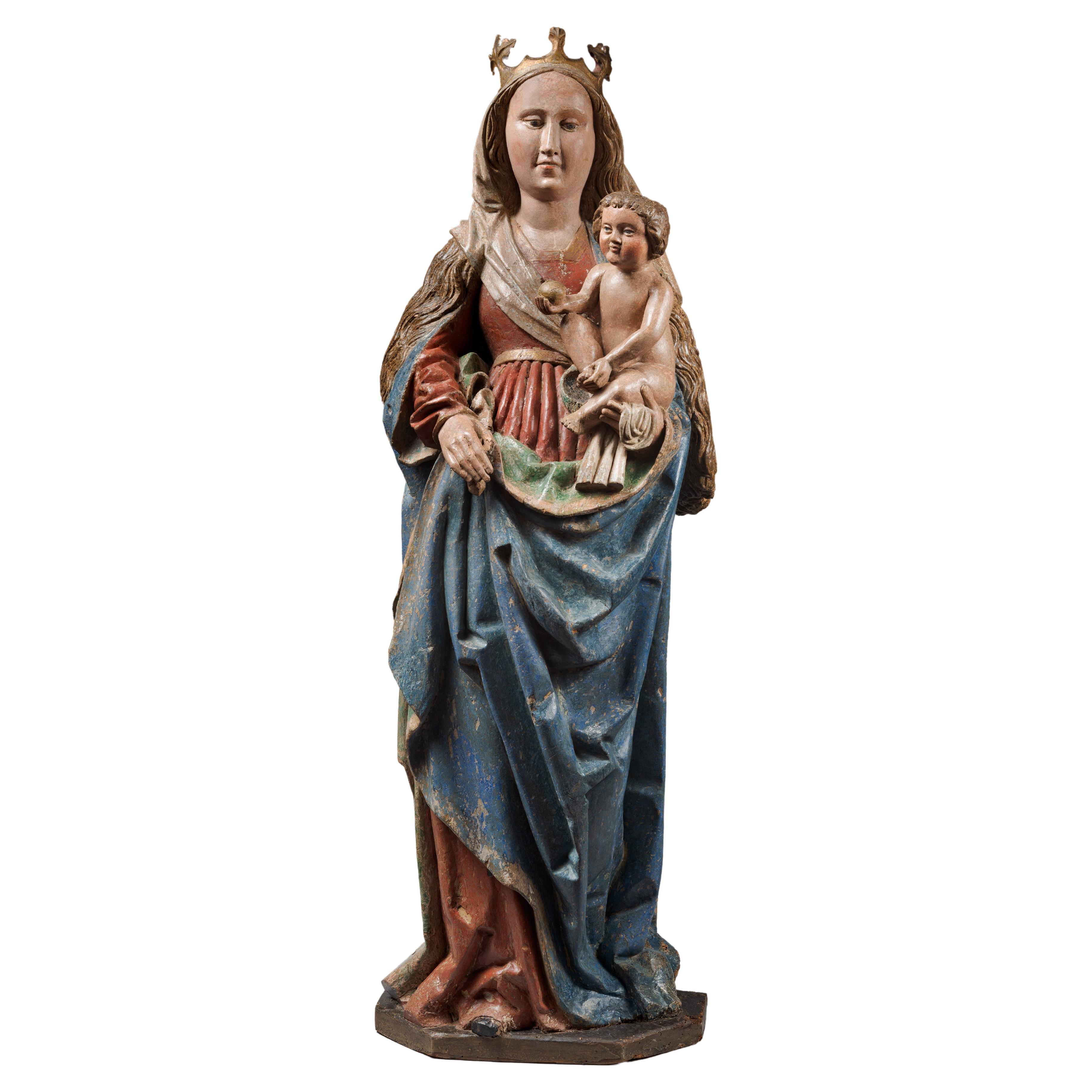
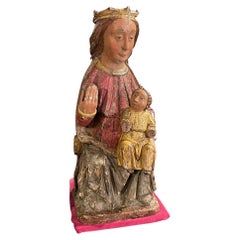
Polychrome carved wood Virgin and Child from the 15th Century
Located in Saint-Ouen, FR
POLYCHROME CARVED WOOD VIRGIN AND CHILD FROM THE 15TH CENTURY
ORIGIN: SOUTH GERMANY, SWABIA, NUREMBERG REGION
PERIOD: 15th CENTURY
Height: 94,6cm
Width : 28 cm
Depth : 18 cm
Lime wood
Original Polychromy
Good state of conservation
From 1430 onwards, sculpture underwent a profound stylistic renewal which continued until 1530, the so-called late Gothic period. In the Germanic countries, original sculptures flourished in an expressive and sensitive vein.
This renewal was inspired by the art of Nicholas of Leiden, who was active in Strasbourg in the 1460's. His style broke with the refined and delicate art of the international Gothic style in force throughout Europe around 1400. The figures became more authentic and realistic. The bodies became denser. Clothes are animated by deep, broken folds, the fabrics are heavy and have a great decorative value. In addition, the polychromy is intended to be illusionistic. The painting makes it possible to restore the texture of the materials, the richness of the textiles and the natural skin tone of the characters.
The dissemination of images through engraving and the great mobility of the artists led to the success of this style, which conquered the Upper Rhine, Swabian, Tyrolean and Franconian regions, contributing to the formation of a common stylistic identity in these regions. The economic boom in the flourishing German cities was conducive to the development of original production. Attracted by this prosperity, numerous workshops were set up in order to meet the orders of religious communities, the Church and the laity, including a clientele of middle-class rockers.
This precious Virgin and Child is depicted standing on a crescent moon, her head encircled by a crown of tall flowers. Her long wavy hair spreads over her shoulders, framing her beautiful oval face. Under fine eyebrows drawn with a brushstroke, her almond-shaped, slightly drooping eyes look at the Child with infinite softness. She is dressed in a long red dress with a rounded neckline, belted under the chest. The heavy fabric of her dress spreads out in broken folds at her feet. On her shoulders she wears a golden cloak. The drapery has deep folds. She holds out her right hand while she holds the Christ Child with her left.
Christ, with his well-defined hair, is naked. His cheeks are highlighted with red, he holds an apple in his left hand and with the other hand makes a sign of blessing towards the faithful.
Virgins with Child on a crescent moon were very popular in the second half of the 15th century, especially as the central subject of altarpieces in southern Germany and Austria. The crescent moon on which Mary is standing is reminiscent of the Woman of the Apocalypse. Often equated with the Virgin Mary.
This episode is taken from the Book of Revelation (12:1-6)
1 Then a great sign appeared in heaven: a woman clothed with the sun, with the moon under her feet and a crown of twelve stars on her head. ; 2 She was pregnant, and she cried out because she was in labor, in pain from giving birth. ; 3 Then another sign appeared in heaven: it was a great fiery red dragon, with seven heads and ten horns, and seven royal crowns on his heads. ; 4 His tail swept down a third of heaven's stars and threw them to the earth. The dragon stood in front of the woman who was about to give birth so that when she gave birth, he might devour her child. ; 5 She gave birth to a son, a male child who is to rule all the nations with an iron rod. Her child was snatched up to God and his throne. ; 6 Then the woman fled into the desert, where God has prepared a place for her. There she will be taken care of for one thousand two hundred sixty days.
Some theologians see in this woman a reference to the Virgin Mary and in the child, Jesus.
This remarkable work is a very fine example of sculpture from Swabian workshops in the last decades of the 15th century. It presents all the characteristic stylistic elements: a highly girdled silhouette, an abundant drapery with angular folds, but also a great physical presence accentuated by the polychromy that restores the anatomical details. This group is made of a wooden log. The deep folds of the drapery highlight the movement of the Virgin holding the child.
Bibliography :
Sophie Guillot de Suduiraut, Dévotion et Séduction, Sculptures souabes des musées de France, vers 1460-1530, Paris musée du Louvre-Éditions somogy, 2015
“Revelation 12 - Common English Bible...
Category
Antique 15th Century and Earlier German Gothic Figurative Sculptures
Materials
Wood
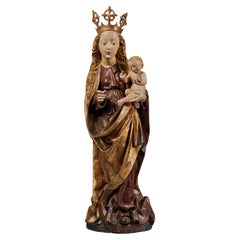
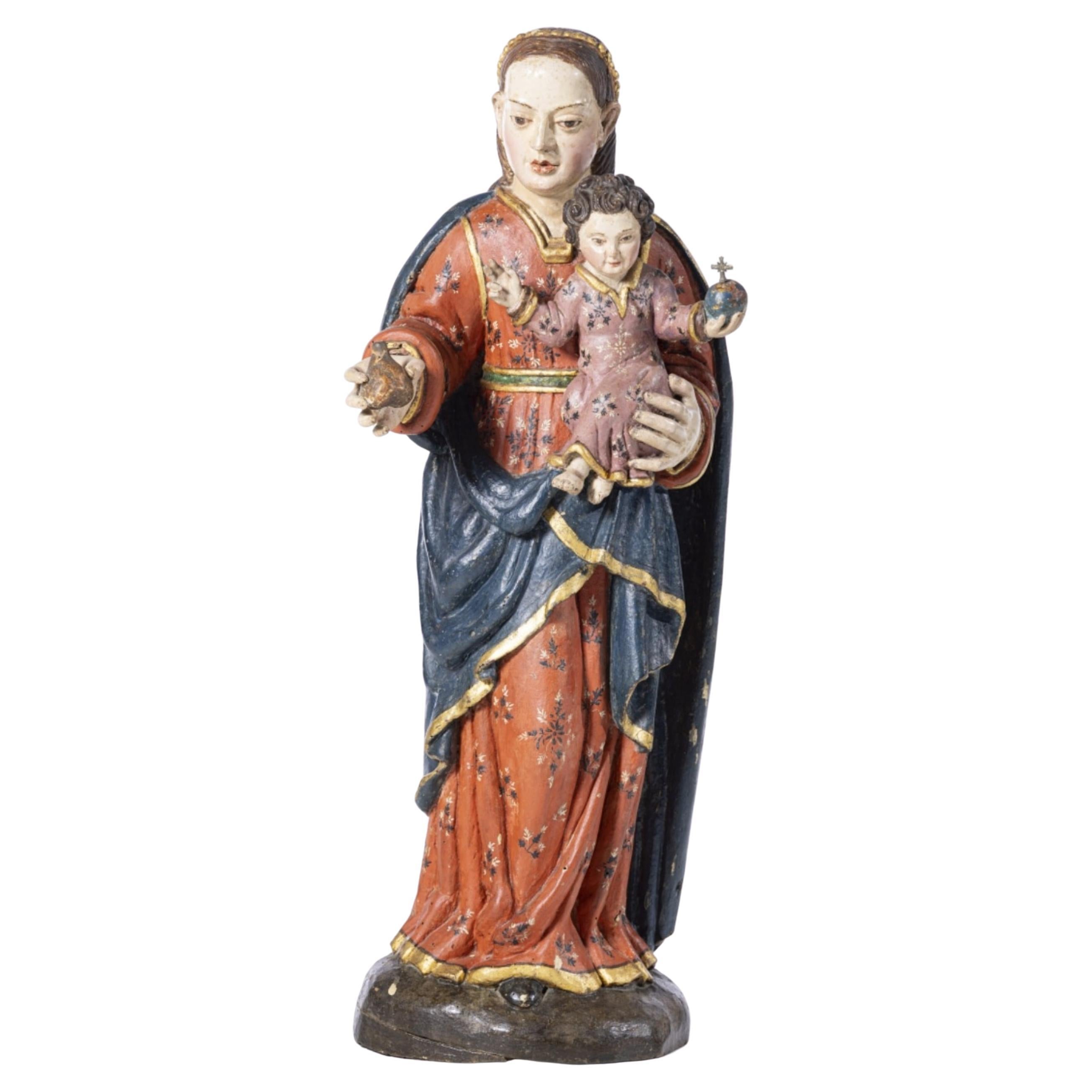
Virgin and Child in Majesty with a Bird
Located in Saint-Ouen, FR
Virgin and child in majesty with a bird
Origin: Southern Germany Or Austria
Period: Late 13tth - Early 14th Century
Height : 87.5 cm
Length : 32 cm
Depth : 19 cm
Lime ...
Category
Antique 15th Century and Earlier Figurative Sculptures
Materials
Wood
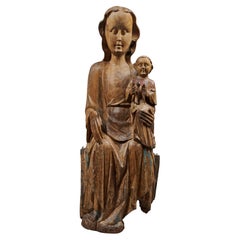
Gothic Virgin and Child from Flanders
Located in Saint-Ouen, FR
Exhibition
Museum Cantini, 1952, The art of the Middle Ages in the Marseille collections, n°101
Provenance
Former collection Louis Bresset (before 1952)
Former collection Profe...
Category
Antique 15th Century and Earlier Dutch Gothic Figurative Sculptures
Materials
Oak
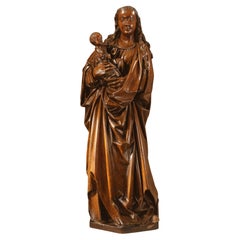
Virgin and Child in Majesty, also known as "Sedes Sapientae"
Located in Saint-Ouen, FR
VIRGIN AND CHILD IN MAJESTY, ALSO KNOWN AS "SEDES SAPIENTIAE"
ORIGIN : SPAIN, CATALOGNE
PERIOD: EARLY 13th CENTURY
Height : 95 cm
Width : 32 cm
Depth : 28 cm
Softwood
No polychromy
In the middle of the 12th century, the Virgin took her place in churches, seated in Majesty, serving as a throne for her son Jesus. She is then called Sedes Sapientiae, meaning the Throne of Wisdom.
At that time, she is not represented for herself and only exists because she has been designated as Theotokos, the mother of God, at the Council of Ephesus in 431, where the divine nature of Christ was proclaimed from his birth.
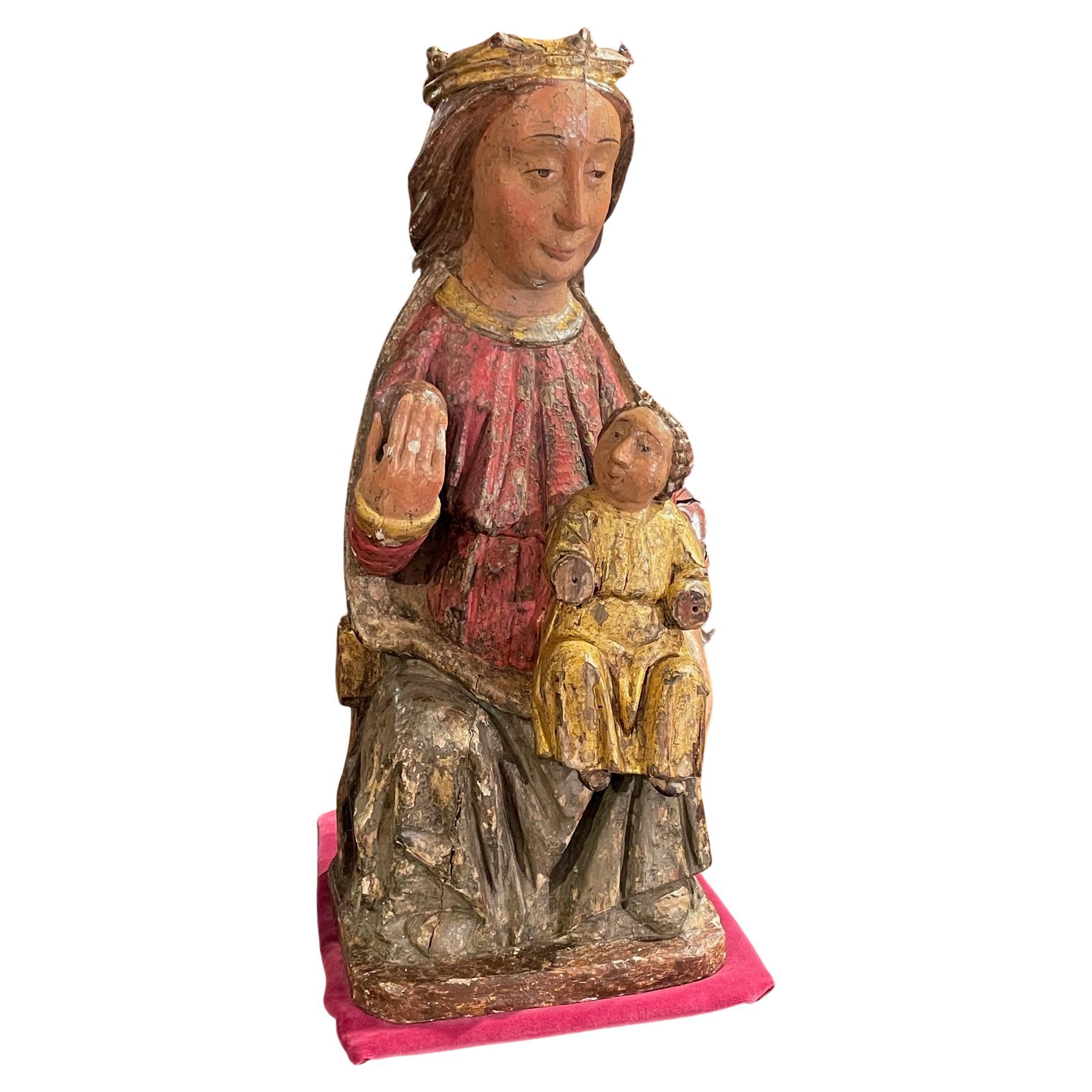
The upright and perfectly hieratic bust of this Virgin and Child in Majesty is seated on a throne-bench. She is dressed in a tunic with a rounded neckline and covered with a fine mantle placed on her narrow shoulders. The supple and natural drapery follows the lines of the body.
Large curls frame her face with delicate and regular features, a long straight nose, almond-shaped eyes, and small lips.
She supports the Infant Jesus with her left hand. Like his mother, he is dressed in a long tunic, and his little feet are visible in the folds. He holds a small sphere in his left hand, while with his right hand, he gestures in blessing. The face of Christ bears a strong resemblance to his mother’s one, and he gives a slight smile.
The position of the Child is no longer as hieratic, nor frontal or central as in the early 12th century, but his face still turns towards the faithful.
The 13th century indeed emerges as a period of transition in the artistic domain. The statuary, while retaining certain characteristics still belonging to the habits of the previous century, also develops new formal solutions.
As a result, Mary maintains a hieratic and frontal position, while her son shifts to place himself well to the left on her knee. Similarly, while the Virgin seems perfectly still, Jesus, on the other hand, appears much more animated, especially in the positioning of his hands. His left hand holds the orb, and judging by the raised right arm directed towards the faithful, one can easily imagine that he was making a gesture of blessing.
The influence of the Sedes Sapientiae from previous centuries still seems particularly prevalent in this work.
These few characteristics allow dating this Spanish Virgin...
Category
Antique 15th Century and Earlier Spanish Gothic Figurative Sculptures
Materials
Softwood
You May Also Like
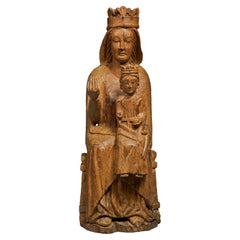
Large Virgin and Child, Tyrol, 16th century
Located in PARIS, FR
Large wooden Madonna and Child, painted and carved in hollow at the back.
The theme of the Virgin and Child is the most represented in all Christian art, whereas the infancy of Jesus...
Category
Antique 16th Century German Renaissance Figurative Sculptures
Materials
Wood, Pine
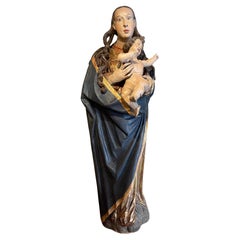
Our Lady with Child Jesus Savior of the World 17th Century
Located in Madrid, ES
Our lady with child Jesus savior of the world 17th century
Portuguese sculpture
in polychrome and gilded wood.
Repaints.
Height: 71 cm
very g...
Category
Antique Early 17th Century Portuguese Renaissance Figurative Sculptures
Materials
Wood
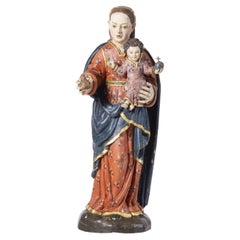
Antique Statue of Virgin Mary and Child , 19th Century
Located in Basildon, GB
A Pine Carving of Virgin and Child signed E. Lechner. Carved in 15th Century style, a high relief with a hollowed back and depicting the crowned Virgin standing on contrapose with lo...
Category
Antique Mid-19th Century European Gothic Religious Items
Materials
Wood, Pine
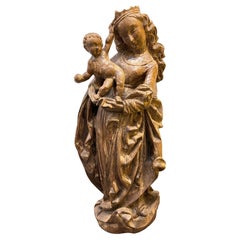
"Virgin with Child Jesus". Spain, End of the 17th-Early 18th Century
Located in Madrid, ES
Spanish Baroque sculpture is one of the most authentic and personal examples of our art, because its conception and its form of expression arose from the people and from the deepest ...
Category
Antique Late 17th Century Spanish Baroque Religious Items
Materials
Wood
Wooden Madonna with Child Baroque Art Italy 17th Century with Export Certificate
Located in Madrid, ES
A Wooden Madonna with child Baroque art, Southern Italy, 17th century.
Measure: H: 71cm
Good condition for the time.
With Export Certificate to USA.
Category
Antique Early 17th Century Italian Baroque Figurative Sculptures
Materials
Wood
19th Century Madonna and Child with Souls in Purgatory Papier-Mache Sculpture
Located in Milan, IT
First half of the 19th century
Madonna and Child with souls in Purgatory
Lacquered and gilded papier-mache with polychrome wooden base
cm 96.5 x 37.5 x 28
"At that time I asked the Lord Jesus: 'For whom do I still have to pray?'. Jesus answered me that the following night he would make me known for whom I had to pray. I saw the Custodian Angel, who ordered me to follow him. At a moment I found myself in a foggy place, invaded by fire and, in it, a huge crowd of suffering souls. These souls pray with great fervour, but without effectiveness for themselves: only we can help them. The flames that burned them, they did not touch me. My Guardian Angel did not abandon me for a moment. And I asked those souls what their greatest torment was. And they unanimously answered me that their greatest torment is the ardent desire of God. I read the Madonna who visited the souls of Purgatory. The souls call Mary 'Star of the Sea'. She brings them refreshment ".
(Diary of Sister Faustina Kowalska p. 11)
A Polish religious, Saint Faustina Kowalska (1905-1938) reinterpreted in the pages of her testimony the ancient role of the Virgin as savior and supporter of the souls of Purgatory. The Second Vatican Ecumenical Council established that, assumed into Heaven, the Mother of God should operate a continuous intercession in favor of those children waiting for Paradise who were in the place, quoted for the first time by Pope Gregory the Great...
Category
Antique Early 19th Century Italian Figurative Sculptures
Materials
Paper
More Ways To Browse
Virgin And Child
Madonna With Child
Virgin Statue
Polychrome Virgin
Antique Erotic Furniture
Banana Tree
Bronze Egyptian Sculpture
Carved Marble Head
Patinated Plaster Sculpture
Small Metal Sculptures
South Africa Art Sculpture
Art Deco Glass Figurine
Balinese Carved
Balinese Wood
Bisque Sculpture
Bronze Faun
Bronze Musician
Male Statue