Items Similar to Late 19th Century Bronze Entitled
La Verité Meconnue
by Aime-Jules Dalou
Want more images or videos?
Request additional images or videos from the seller
1 of 11
Late 19th Century Bronze Entitled
La Verité Meconnue
by Aime-Jules Dalou
$6,195.13
£4,500
€5,272.45
CA$8,543.04
A$9,044.85
CHF 4,894.82
MX$108,102.63
NOK 61,013.28
SEK 55,794.48
DKK 39,378.42
About the Item
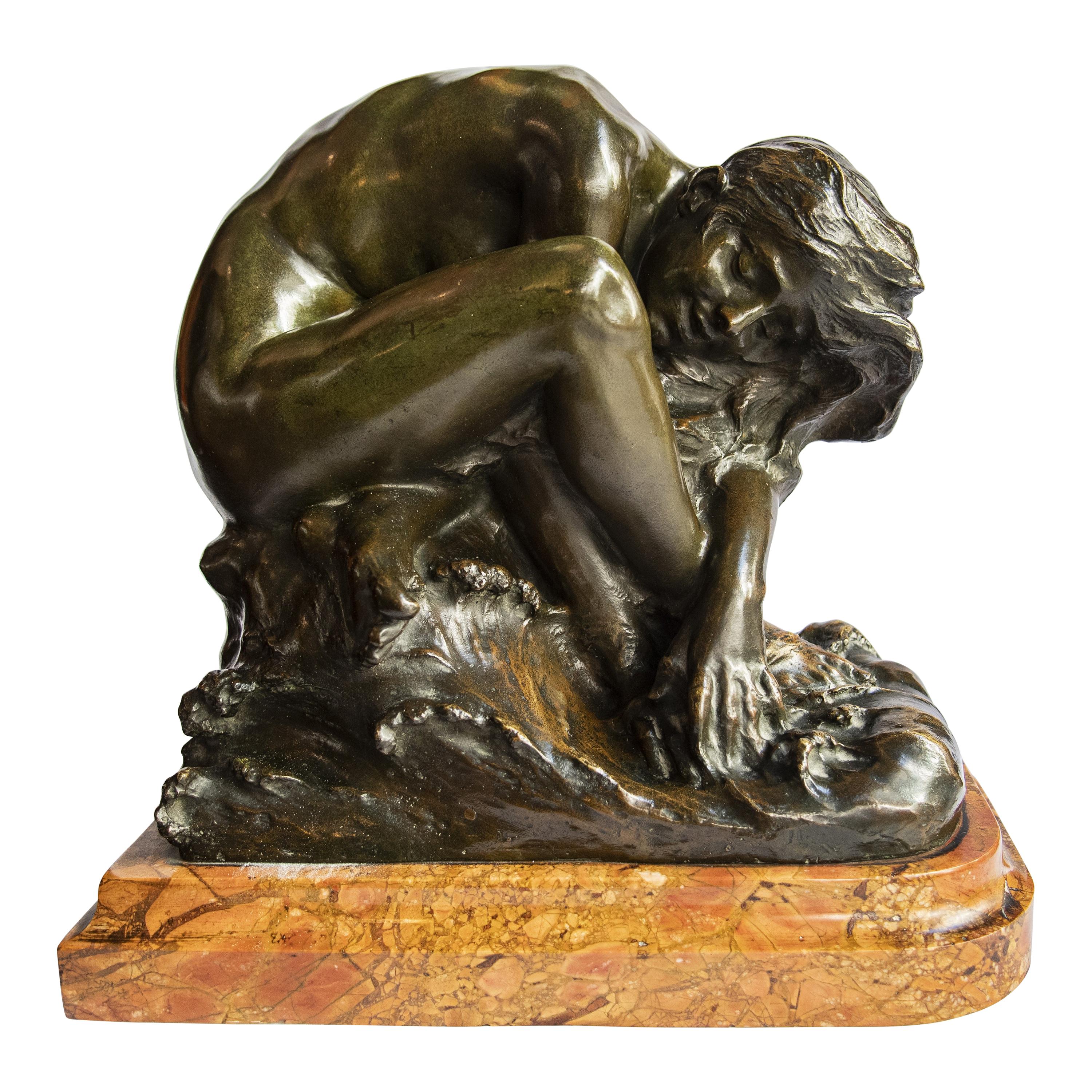
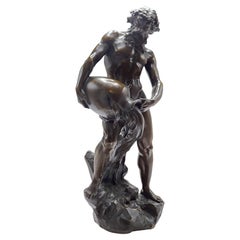
An enigmatic late 19th Century bronze study of a seated female nude leaning on her knees, hiding her face, on integral naturalistic canted rectangular base, signed to one side DALOU above the cracked mirror (facing to the rear), the opposing side marked Susse Fres Edts the rear with Susse Freres pastille flanked by the letters H P and S.
The title of this subject translates as 'The Truth Revealed' and refers to the young woman inconsolable having seen her true reflection in a mirror, which she has dropped and lies broken on the hard floor.
ADDITIONAL INFORMATION
Height: 14 cm
Width: 12 cm
Depth: 8 cm
Condition: Excellent Original Condition
Circa: 1890
Foundry: Susse Frères Paris
Materials: Bronze
SKU: 8790
ABOUT
Aimé-Jules Dalou (31 December 1838 – 15 April 1902) was a French sculptor, recognised as one of the most brilliant virtuosos of nineteenth-century France, admired for his perceptiveness, execution, and unpretentious realism.
He was born in Paris to a working-class family of Huguenot background, he was raised in an atmosphere of secularity and Republican socialism. He was the pupil of Jean-Baptiste Carpeaux, who sponsored him for the Petite École, where he sympathised with Alphonse Legros and Fantin-Latour. In 1854 he attended the École des Beaux-Arts de Paris in the François-Joseph Duret classroom. He combined the vivacity and richness of Carpeaux, for "he was, technically, one of the most distinguished modellers of his time", with the academic insistence on harmonious outlines and scholarly familiarity with the work of Giambologna, Pierre Puget, Peter Paul Rubens and others.
Dalou first exhibited at the Paris Salon in 1861, but he made no secret of his working-class sympathies. His politics obstructed his career under the Second Empire: he was repeatedly refused the Prix de Rome that opened sculptors' careers to future official commissions. He started to work for decorators, and through this work met Auguste Rodin and began their friendship. He made a quiet living providing decorative sculpture for the structures that lined Paris's new boulevards and providing wax models for jewelry. He married Irma Vuillier, a partnership that sustained him throughout his life; they had one daughter, Georgette, who was mentally handicapped and required constant care. Dalou's Daphnis and Chloe shown at the Paris salon of 1869, was purchased by the State.
Having identified himself too publicly with the Paris Commune of 1871, as curator at the Musée du Louvre under Gustave Courbet, he took refuge in England in July 1871, staying at first with his friend the painter and engraver Alphonse Legros. He rapidly made a name through his appointment teaching at the South London Technical Art School and the South Kensington School of Art, also in London. He was convicted in absentia by the French government of participation in the Commune, and given a life sentence.
In his eight-year English exile, Dalou's association with City and Guilds of London Art School, the National Art Training School and the artists of the New Sculpture movement laid the foundation for new developments in the post-classical British school of sculpture. He also recommended his friend and colleague Édouard Lantéri to move from France to England. At the same time Dalou executed a remarkable series of terracotta statuettes and groups, such as A French Peasant Woman and The Reader; a series of Boulogne women, such as A Woman of Boulogne telling her Beads; and a series of informal terracotta portrait busts of friends and acquaintances, rarely signed. He was commissioned to produce the large public fountain called Charity, erected at the back of the Royal Exchange (1878), and for Queen Victoria a monument to two young granddaughters in her private chapel at Windsor (1878).
He returned to France in 1879, after the declaration of amnesty, and produced a number of masterpieces. His great relief of Mirabeau replying to Dreux-Brézé illustrating an encounter of 23 June 1789, which was exhibited in 1883 and later at the Palais Bourbon, and the highly decorative panel Fraternity were followed in 1885 by The Triumph of Silenus. For the city of Paris he executed his most elaborate and splendid achievement, the vast monument, The Triumph of the Republic, erected after twenty years of work in the Place de la Nation, showing a symbolical figure of the Republic, aloft on her car, drawn by lions led by Liberty, attended by Labour and Justice, and followed by Abundance. It is somewhat in the taste of the Louis XIV period, ornate, but with a forward thrust to the ensemble and exquisite in every detail.
Dalou, who was awarded the Grand Prix of the Exposition Universelle (1889), was made a commander of the Legion of Honor. He was one of the founders of the Société Nationale des Beaux-Arts, and was the first president of the sculpture section.
Dalou died in Paris on 15 April 1902, aged 63, and was interred in the Cimetière du Montparnasse in Paris. His auction record, set at Sotheby's on 21 May 2014 is £362,500 for Boulonnaise Allaitant Son Enfant (a young mother from Boulogne feeding her child).
- Creator:Aimé-Jules Dalou (Artist)
- Dimensions:Height: 5.52 in (14 cm)Width: 4.73 in (12 cm)Depth: 3.15 in (8 cm)
- Style:Art Nouveau (Of the Period)
- Materials and Techniques:Bronze,Cast
- Place of Origin:
- Period:
- Date of Manufacture:1890
- Condition:Wear consistent with age and use.
- Seller Location:London, GB
- Reference Number:Seller: 87901stDibs: LU3216331268942

Aimé-Jules Dalou
Aimé-Jules Dalou (1838-1902) was one of only a handful of leading late-nineteenth century French Sculptors, whose reputation was perhaps second only to his contemporaries, Henri Chapu (1833-1891) and Marius Jean Antonin Mercié (1845-1916). Dalou was hugely influential and was a founding member of the Société des Artistes Français and later a founder of the Société Nationale des Beaux-Arts. He was officially rewarded with the highest rank of the Légion d'Honneur two years before his death, with the inauguration of the Triumph of the Republic, in 1899. He started his artistic training in 1852 at the Petite Ecole after being encouraged to do so by Jean-Baptiste Carpeaux, where he studied drawing and modelling. Carpeaux continued to support Dalou throughout his career and influenced his sculpture greatly. Dalou began employment in the field of decorative sculpture working for two companies in Paris, Lefèvre and Favière goldsmiths. During this time he contributed towards the architectural features of Hôtel de la Païva, the then home of the infamous French courtesan Esther Lachmann known as La Païva. Dalou's unique approach lay in his broad range of subject, painterly and sculptural source material, though which he absorbed an impressive spectrum of inspiration. The work of an eighteenth-century sculptor, Louis-François Roubiliac, played a significant role in Dalou's artistic development, whose sculptures he studied whilst in London. Dalou's work includes friezes, maquettes, reliefs, and individual bronze figures. He is known for Baroque-inspired allegorical group compositions, as much as for his depictions of the French rural labouring classes. Dalou encouraged students of art to free themselves from the constraints of established traditions, with his style and teachings thought to have awakened a new generation of young British sculptors whose work was later aligned to the New Sculpture movement.
About the Seller
5.0
Vetted Professional Seller
Every seller passes strict standards for authenticity and reliability
Established in 1936
1stDibs seller since 2017
87 sales on 1stDibs
Typical response time: 1 hour
- ShippingRetrieving quote...Shipping from: London, United Kingdom
- Return Policy
More From This Seller
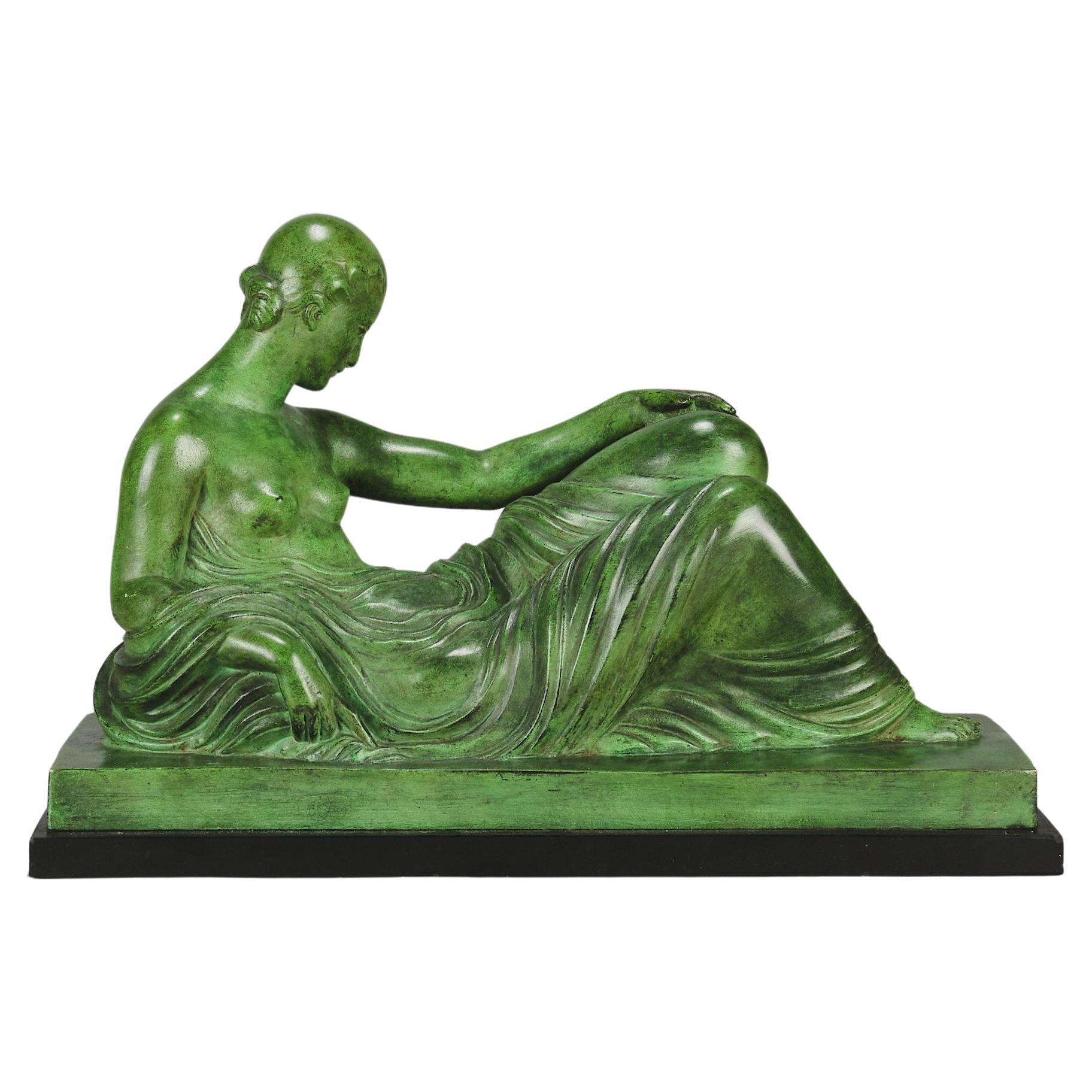
View AllEarly 20th Century Patinated Bronze Entitled "Femme Allongée" by Gaston Béguin
By Gaston Béguin
Located in London, GB
An attractive early 20th century French Art Deco bronze figure of a resting beauty reclining on a daybed with a shawl delicately draped over her. The bronze exhibiting attractive dee...
Category
Early 20th Century French Art Deco Figurative Sculptures
Materials
Marble, Bronze
19th Century Art Nouveau Bronze Sculpture "Fille au Puits" by Auguste Moreau
By Auguste Moreau
Located in London, GB
A very fine late 19th Century Art Nouveau bronze figure of a young girl sat upon a well feeding a small bird, exhibting excellent rich brown variegated patina and very fine hand fini...
Category
Antique Late 19th Century French Art Nouveau Figurative Sculptures
Materials
Bronze
Early 20th Century Art Nouveau Bronze Entitled "La Jeuneuse" by Antonin Carlès
By Antonin Carlès
Located in London, GB
A delightful Art Nouveau early 20th Century gilt bronze figure of a very beautiful young lady holding a flower in her right hand, the surface of the bronze exhibiting fine detail and...
Category
Antique Early 1900s French Art Nouveau Figurative Sculptures
Materials
Bronze

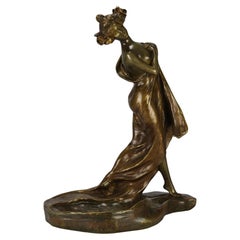
Late 19th Century Art Nouveau Bronze "Nouveau Lady" by Georges Van Der Straeten
By Georges Van der Straeten
Located in London, GB
A delightful Art Nouveau Bronze figure of a young beauty scantily dressed with only a shawl draped across her body in a striking pose. The surface of the bronze with rich golden/brow...
Category
Antique Late 19th Century Belgian Art Nouveau Figurative Sculptures
Materials
Bronze
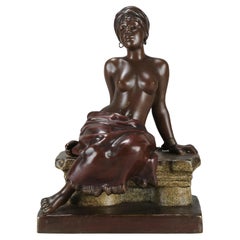
Late 19th Century Art Nouveau Bronze figure "Slave Girl" by Emmanuel Villanis
By Emmanuel Villanis
Located in London, GB
A beautiful patinated Art Nouveau bronze study of a young Art Nouveau beauty sat upon a wall wearing chains with excellent variegated rich brown patina and excellent hand chased surf...
Category
Antique Late 19th Century French Art Nouveau Figurative Sculptures
Materials
Bronze
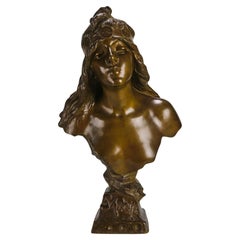
Late 19th Century French Bronze Sculpture "Salome" by Emmanuelle Villanis
By Emmanuel Villanis
Located in London, GB
A beautiful patinated Art Nouveau bronze bust of a young Art Nouveau beauty with excellent variegated rich brown patina and excellent hand chased surface detail, signed E.Villanis & ...
Category
Antique Late 19th Century French Art Nouveau Busts
Materials
Bronze
You May Also Like
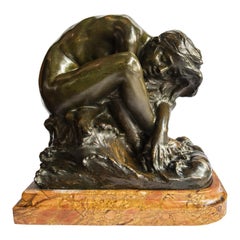
Bronze Sculpture, "Baigneuse", Signed A. Gory, Paris, circa 1920
By Affortunato Gory
Located in CABA, AR
Experience the timeless beauty of Affortunato Gory's "Baigneuse," a captivating bronze sculpture that epitomizes the elegance and grace of the Art Deco era. This exquisite piece dep...
Category
Early 20th Century French Art Deco Figurative Sculptures
Materials
Marble, Bronze
Marcel-André Bouraine, Nude, French Art Deco Bronze Sculpture, circa 1920s
By Marcel-André Bouraine
Located in New York, NY
An Art Deco bronze sculpture of a seated semi-nude woman by Marcel-André Bouraine, French, 1886-1948.
Category
Vintage 1920s French Art Deco Figurative Sculptures
Materials
Bronze
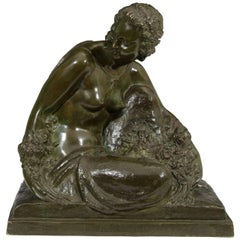
Late 19th Century Bronze Sculpture - Hermes - France
Located in Casteren, Noord-Brabant
Elegant and finely cast bronze sculpture of Hermes, France circa 1890. Hermes, the messenger of the gods in classical mythology, is a symbol of communication, travel, intelligence, a...
Category
Antique 1880s French Classical Roman Figurative Sculptures
Materials
Bronze
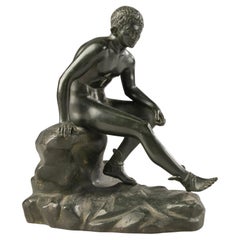
Henri Godet "L
Aurore" Patinated Bronze Sculpture
By Henri Godet
Located in Astoria, NY
Henri Godet (French, 1863-1937) "La Reveil de L'Aurore" [The Awakening of Dawn] Patinated Bronze Sculpture, early 20th century, on a circular base with applied plaque "La Reveil de L...
Category
Early 20th Century French Art Nouveau Figurative Sculptures
Materials
Bronze
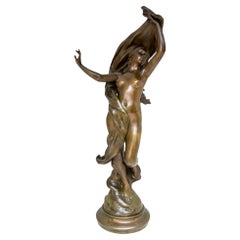
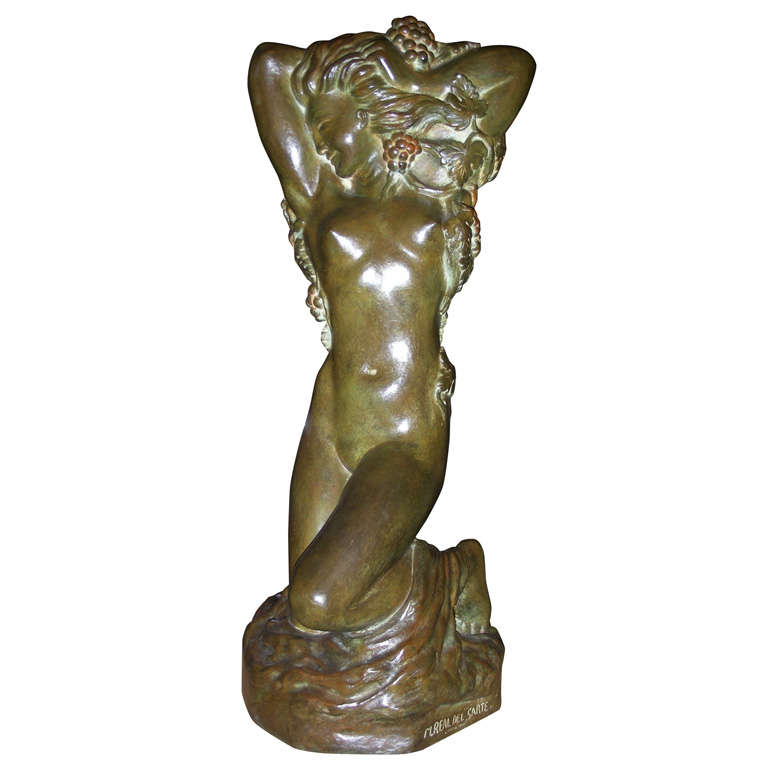
20th C. Bronze Statue of "Ivresse" by Maxime Real del Sarte
By Maxime Real del Sarte
Located in Paris, FR
Patinated bronze statue representing a kneeling nude woman holding grapes, by Maxime Real del Sarte, titled "Ivresse" ("Drunkenness").
Category
20th Century French Sculptures
Materials
Bronze
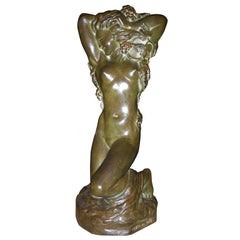
Patinated bronze sculpture "Le Torrent" by Jean-Baptiste Germain
By Jean-Baptiste Germain
Located in Autonomous City Buenos Aires, CABA
Patinated Bronze Sculpture "Le Torrent" by Jean-Baptiste Germain
Patinated bronze sculpture titled "Le Torrent" by French sculptor Jean-Baptiste Germain (1841-1910). The piece depict...
Category
20th Century French Art Nouveau Figurative Sculptures
Materials
Bronze
More Ways To Browse
Peasant Woman
19th Century Empire Floor Mirror
Jean Baptiste Carpeaux
Cracked Mirror
Susse Fres
Aime Jules Dalou
Demetre Chiparus Bronze
Francois Moreau
Hermes God
Marcela Cure
Sculpture Female Signed Bronze Mid Century Modern
Thai Buddha Heads
Tole Sculpture
Art Deco Porcelain Figurine
Bronze Ballerina
Bronze Figural Groups
Clodion Bronze Sculpture
Cupid With Bow