Want more images or videos?
Request additional images or videos from the seller
1 of 13
Sculpture Bust Statue, 16th Century Italian Renaissance Marble Angel
Price:$18,600
$24,000List Price
About the Item
- Dimensions:Height: 40 in (101.6 cm)Width: 13.25 in (33.66 cm)Depth: 13.25 in (33.66 cm)
- Style:Renaissance (Of the Period)
- Materials and Techniques:
- Place of Origin:
- Period:
- Date of Manufacture:Unknown
- Condition:Wear consistent with age and use. Minor losses.
- Seller Location:Montreal, CA
- Reference Number:1stDibs: LU3827119585132
About the Seller
5.0
Vetted Professional Seller
Every seller passes strict standards for authenticity and reliability
Established in 2010
1stDibs seller since 2018
70 sales on 1stDibs
Authenticity Guarantee
In the unlikely event there’s an issue with an item’s authenticity, contact us within 1 year for a full refund. DetailsMoney-Back Guarantee
If your item is not as described, is damaged in transit, or does not arrive, contact us within 7 days for a full refund. Details24-Hour Cancellation
You have a 24-hour grace period in which to reconsider your purchase, with no questions asked.Vetted Professional Sellers
Our world-class sellers must adhere to strict standards for service and quality, maintaining the integrity of our listings.Price-Match Guarantee
If you find that a seller listed the same item for a lower price elsewhere, we’ll match it.Trusted Global Delivery
Our best-in-class carrier network provides specialized shipping options worldwide, including custom delivery.You May Also Like
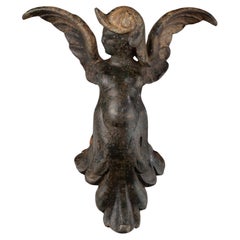
Renaissance Harpy - Italy, 16th century
Located in Bruxelles, BE
Renaissance Harpy
bronze
Italy, 16th century
15 x 12 x 5,5 cm
This expressive bronze figure represents a harpy, a mythological creature with the body of a bird and the head and tor...
Category
Antique 16th Century Italian Renaissance Figurative Sculptures
Materials
Bronze
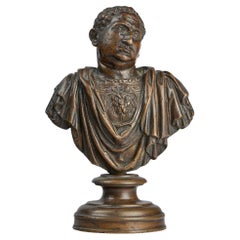
Italian Renaissance 16th Century Bronze Bust of Emperor Vitellius
Located in London, GB
North Italian, 16th century
Bust of the emperor Vitellius
Bronze, on later bronze socle, lead support to reverse
18 cm. / 7 ins (the bust), 23 cm. / 9 ins overall
This small yet attractive all’antica bust of a Roman emperor is inspired by a bust in Venice thought to depict Vitellius (15-69 AD), who ruled Rome for only eight months in 69 AD before he was overthrown by Vespasian.
The Vitellio Grimani, also known as the pseudo-Vitellius, was discovered in Rome in 1505 during excavations on the Quirinale on land owned by the Venetian cardinal Domenico Grimani (1461-1523). On the death of Grimani the Vitellius was sent to Venice and bequeathed to the Republic of Venice, where it was displayed at the Palazzo Ducale from 1525 to 1593. It is now in the Museo arceologico nazionale di Venezia (inv. 20) and regarded as a portrait of an unknown Roman from the first half of the second century AD.
The present small bust, with its rough, waxy surface and imaginative adaptation of the antique model on which it is based, bears all the hallmarks of Renaissance bronze modelling in the north of Italy. Indeed, the vigorous modelling is reminiscent of the works by Andrea Briosco, called Il Riccio (1470-1532), who worked in Padua in the Veneto and specialised in small bronzes based on antique subjects. See, for example, his head of Bacchus (private collection, offered at Sotheby’s London in 2021), which has a similarly waxy treatment of the hair.
The fantastical lion-mask on the breastplate, with its stylised face and unusual braids of hair, is also typical of the imaginative re-working of antique motifs by Renaissance artists. This indicates that the present bust is probably by a follower of Riccio working in Padua or another centre of classicism in the Veneto.
RELATED LITERATURE:
L. Planiscig, 'Andrea Riccio...
Category
Antique 16th Century Italian Renaissance Busts
Materials
Bronze
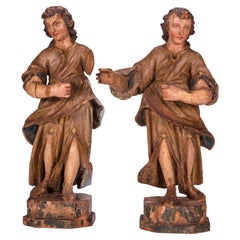
Angelic Carved Wood Sculptures, 16th Century
Located in North Miami, FL
Pair of 16th Century Italian carved polychromed angelic sculptures.
Category
Antique 16th Century Italian Renaissance Figurative Sculptures
Materials
Gold Leaf
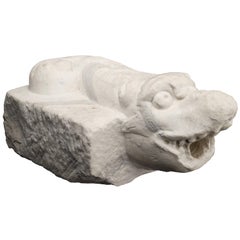
Italian Ancient Marble Sculpture Fountain, Late 16th Century
Located in Milano, IT
Sea monster
Carrara marble mouth fountain
Italy, late 16th century
It measures 13.8 x 31.5 x 18.9 in (35 x 80 x 48 cm)
State of conservation: some small evident gaps and widespread signs of wear due to outdoor exposure. The gray marks crossing it do not come from restoration, but are rather the natural veins of the marble.
This work has some morphological characteristics typically associated with the iconography of the sea monster: an elongated muzzle, sharp teeth, protruding eyes, elongated ears, and a coiled serpent's tail.
An in-depth series of studies on artistic depictions of the sea monster attempted to verify how this symbol evolved in antiquity in the European and Mediterranean contexts and how it gradually changed its image and function over time. The iconography itself is mutable and imaginative and its history is rich with cultural and artistic exchange, as well as the overlapping of ideas. This occurred so much that it is difficult to accurately pinpoint the "types" that satisfactorily represent its various developments.
However, we can try to summarize the main figures, starting from the biblical Leviathan and the marine creature that swallowed Jonah (in the Christian version, this figure was to become a whale or a "big fish", the “ketos mega”, translation of the Hebrew “dag gadol”). Other specimens ranged from the dragons mentioned in the Iliad (which were winged and had legs) to "ketos” (also from Greek mythology), the terrifying being from whose Latinized name (“cetus”) derives the word "cetacean". See J. Boardman, “Very Like a Whale” - Classical Sea Monsters, in Monsters and Demons in the Ancient and Medieval Worlds, in Papers presented in Honor of Edith Porada, Mainz am Rhein 1987, pp. 73-84).
In Italy the monster underwent yet further variations: it can be found in Etruscan art on the front of some sarcophagi representing the companion of souls, while among the Romans we find the “Pistrice” (cited by Plinio in Naturalis Historia PLIN., Nat., II 9, 8 and by Virgilio in Eneide: VERG., Aen., III, 427), which appeared in the shape of a stylized hippocampus or a very large monstrous cetacean and evolved into a hideous being with a dragon's head and long webbed fins.
During the Middle Ages, the sea monster was the object of new transformations: at this time, it is often winged, the head is stretched like a crocodile, the front legs are often very sharp fins - sometimes real paws - until the image merges with dragons, the typical figures of medieval visionary spirituality widely found throughout Europe (on this topic and much more, see: Baltrušaitis, J., Il Medioevo fantastico. Antichità ed esotismi nell’arte gotica, Gli Adelphi 1997).
In Italy during the 15th and 16th centuries, the revival of classicism - representative of the humanistic and Renaissance periods - led to a different reading of these "creatures". Indeed, the sea monster was also to find widespread use as an isolated decorative motif, especially in numerous fountains and sculptures where dolphins or sea monsters were used as a characterizing element linked to water (on this theme see: Chet Van Duzer, Sea Monsters on Medieval and Renaissance Maps, London, The British library, 2013).
From the morphological point of view, the "sea monsters" of this period are mostly depicted as hybrid figures, in which the body of a mythological or real being (a hippocampus, a sea snake, a dolphin), is joined to a head with a rather indistinct appearance. It was usually characterized by large upright ears, an elongated snout, sharp teeth and globular, protruding eyes; a complex and indefinite figure, both from the symbolic point of view and from that of its genesis.
The work we are examining is placed as a cross between the medieval sea serpent and the Renaissance dolphin, with stylistic features which recall the snake as often used in heraldry (such as the "snake" depicted in the coat of arms of the Visconti - the lords and then dukes of Milan between 1277 and 1447 - and which, for some, may be derived from the representations of the “Pistrice” that swallowed Jonah).
In the search for sources, Renaissance cartography and in particular woodcuts should not be neglected. See for example the monsters of Olaus Magnus, from the editions of the “Historia de gentibus septentrionalibus” (“History of the peoples of the north”) and the natural histories of Conrad Gesner, Ulisse...
Category
Antique 16th Century Italian Renaissance Animal Sculptures
Materials
Carrara Marble
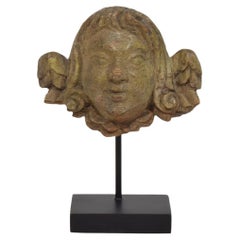
French 16th/ 17th Century Weathered Oak Renaissance Angel Fragment
Located in Buisson, FR
Beautiful weathered oak winged angel head Renaissance ornament.
France, 16/ 17th century. Weathered
Measurements include the wooden pedestal.
Category
Antique 16th Century French Renaissance Figurative Sculptures
Materials
Oak
$266 Sale Price
47% Off
H 5.32 in W 3.94 in D 1.58 in
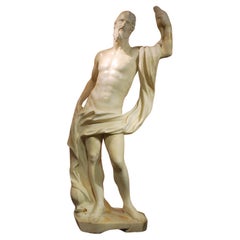
A 16th century carved marble sculpture of poseidon
Located in London, GB
This fine and imposing sculpture is an excellent example of 16th century Italian craftsmanship. The figure is stood on a raised, shaped rectangular base with a carved "dolphin" at th...
Category
Antique 16th Century Italian Renaissance Figurative Sculptures
Materials
Marble
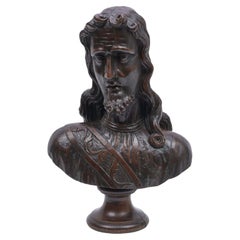
A Monumental 16th Century Renaissance Carved Oak Bust of Jesus Christ
Located in Queens, NY
Magnificent and Monumental 16th Century Renaissance Carved Oak Bust of Christ, Flemish Netherlandish, C. 1550
A powerful and deeply expressive Renaissance carved oak bust of Jesus C...
Category
Antique 16th Century Dutch Renaissance Busts
Materials
Oak
$34,700
H 24 in W 17.5 in D 9.5 in
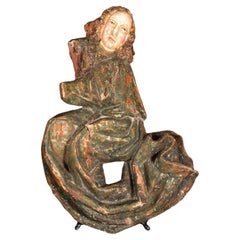
Angel, Carved and Polychrome Wood, 16th Century
Located in Madrid, ES
Angel. Carved and polychrome wood. Century XVI.
Polychrome wood carving showing an angel, with the face facing the viewer and the body in pr...
Category
Antique 16th Century Spanish Renaissance Figurative Sculptures
Materials
Wood
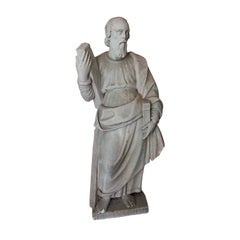
16th Century Marble Statue of a Robed Figure
Located in Los Angeles, CA
Fine, hand-carved, Carrara marble, robed figure from central Italy modeled in the Classical, contrapposto pose. The inscription fragment on the base reads "..under the auspices of...".
Category
Antique 16th Century Italian Statues
Materials
Marble
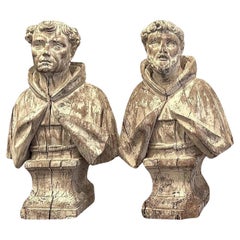
Pair of 16th Century Italian Wooden Busts
Located in Los Angeles, CA
A pair of hand carved and parcel painted carved busts.
Category
Antique 16th Century Busts
Materials
Wood, Paint
More From This Seller
View AllMarble Bust of a Young Man, Carrara Marble
Located in Montreal, Quebec
Marble Bust of a Young Man, Carrara Marble.
Category
Antique 19th Century French Neoclassical Busts
Materials
Carrara Marble
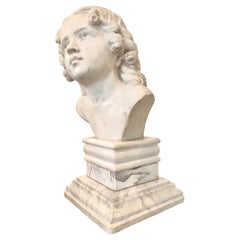
French Marble Bust of Louis XIV, the Sun King
Located in Montreal, Quebec
Louis XIV, known as Louis the Great or Le Roi Soleil (Sun King) was a monarch who reigned as king of France from 1643 until his death in 1715. His reign of 72...
Category
20th Century French Neoclassical Busts
Materials
Marble

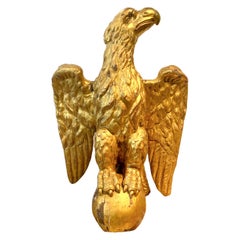
French Giltwood Eagle Sculpture
Located in Montreal, Quebec
Rare French, 19th century, Empire. Large size carved wood and gesso gilt eagle, with its full body, swept back wings, pronounced talons, perched on a ball. Important size.
Conditi...
Category
Antique Late 19th Century French Empire Animal Sculptures
Materials
Gesso, Wood
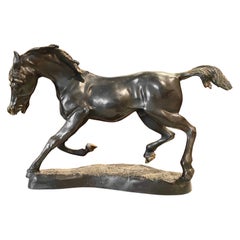
French Large Bronze Horse Sculpture on Bronze Base
Located in Montreal, Quebec
A majestic trotting horse cast in bronze. The wind blows through its mane and tail to create the striking impression that the horse is in movement. This sculpture is mounted on a rou...
Category
Mid-20th Century French French Provincial Animal Sculptures
Materials
Bronze
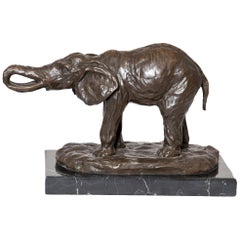
Bronze Elephant on Marble Base, Signed by Milo
Located in Montreal, Quebec
Bronze elephant mounted on grey marble base. Signed "Milo".
Size including base 8.75" H x 14.5" L x 6.25" D.
Size of elephant only 8" H x 13" L x 5.5" D.
Category
20th Century French Animal Sculptures
Materials
Marble, Bronze
$1,800 Sale Price
25% Off
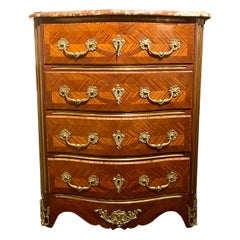
Regence Parquetry French Commode, Marble Top, 19th Century
Located in Montreal, Quebec
French Regence style commode or chest of drawers, marble-top, 19th century. Diamond-shape parquetry veneer, four front drawers. Carved edges, red Languedoc marble top. Gilt bronze ha...
Category
Antique 19th Century French Regency Commodes and Chests of Drawers
Materials
Marble
Still Thinking About These?
All Recently ViewedMore Ways To Browse
Marble Angel Statue
Igorot Tribesmen
John Tuska
Lladro Figures
Ludwig Eisenberger
Meissen Figures Dancers
Meissen The Kiss
Paul Philippe On Sale
Plaster Nose Sculpture
Roberto Nischli
Royales De Champagne
Staffordshire Red Riding Hood
Thomas B Maracle
Vintage Lladro Clown
Wallendorf Figurine
Weeping Buddha
16th Dynasty Buddha
Albert Wein